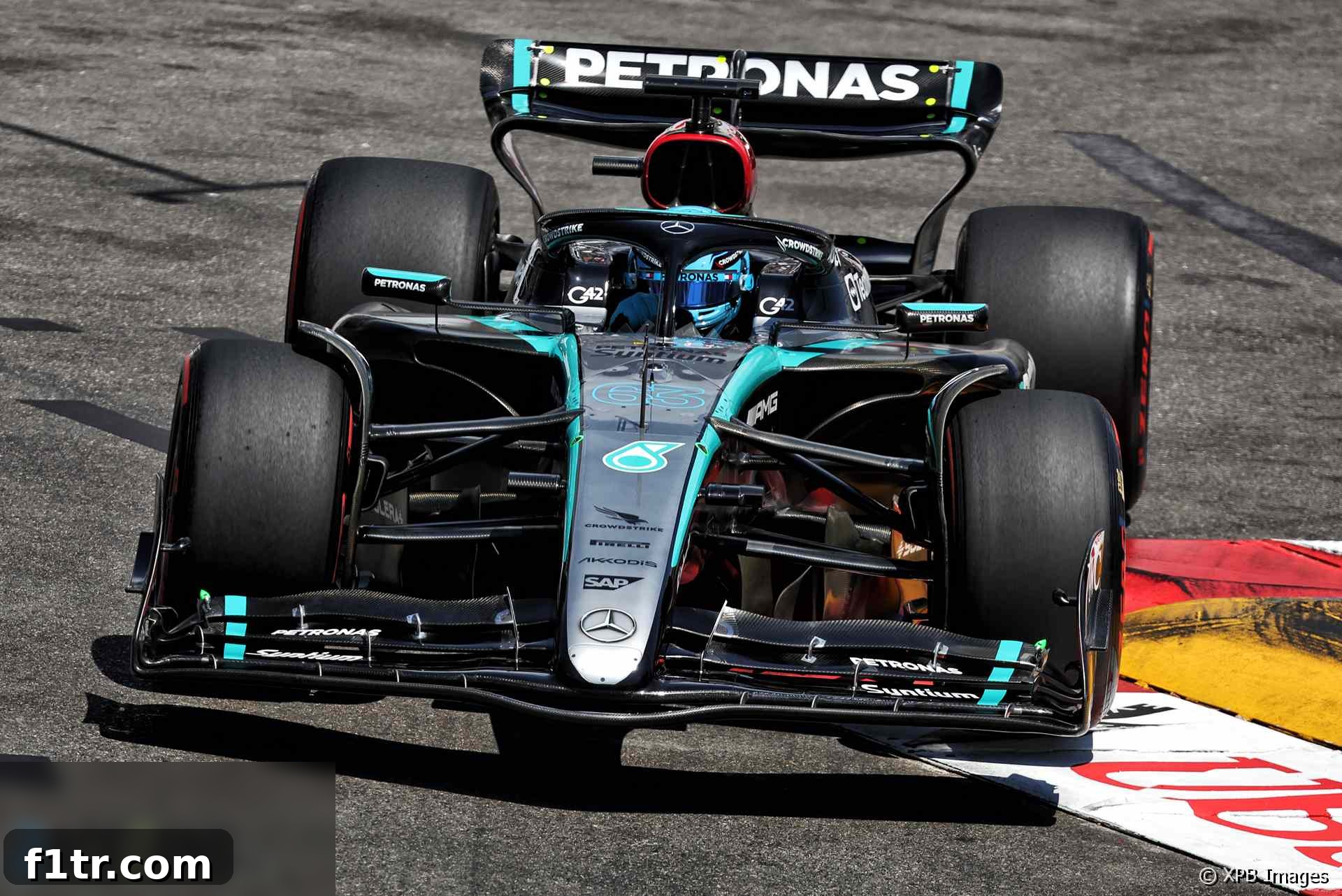
Mercedes’ Strategic Call: Hamilton’s Selfless Move with Monaco Front Wing Upgrade
In a rare and telling glimpse into the intricate dynamics of Formula 1 team strategy, Lewis Hamilton made a striking suggestion at the recent Monaco Grand Prix. According to the Mercedes-AMG Petronas F1 Team, the seven-time world champion proposed that his teammate, George Russell, should be the one to debut their sole new front wing design during the challenging weekend. This decision, a departure from Mercedes’ usual practice of providing identical upgrades to both drivers, underscores a strategic shift within the team as they relentlessly pursue performance improvements.
Advert | Become a Supporter & go ad-free
The unique deployment of the upgraded front wing saw only Russell run the latest specification in Monaco, leaving Hamilton with the older version. The discrepancy did not go unnoticed, with Hamilton himself drawing attention to the difference post-qualifying, even musing that he didn’t expect to out-qualify Russell again for the remainder of the season given the performance differential. This candid admission from a driver of Hamilton’s stature highlights the perceived impact of even a single component upgrade in the hyper-competitive world of Formula 1.
A Unified Front: The Drivers Agree to Accelerated Upgrades
Andrew Shovlin, Mercedes’ head of trackside engineering, shed further light on the strategic decision, revealing that both Hamilton and Russell had previously endorsed the team’s initiative to introduce upgrades as soon as they became available, rather than waiting until enough parts were manufactured for both cars. This proactive approach reflects Mercedes’ urgency to understand and improve their car’s performance amidst a challenging period in their F1 dominance.
“We’re looking to have race quantities of that wing in Montreal,” Shovlin explained in a video released by the team, referring to the upcoming Canadian Grand Prix. He elaborated on the manufacturing process: “Normally, you’d say race quantities is at least three because you’ve got one for each car and then you’ve got a spare available should anything happen. We don’t make three in one go, we make the first, then the second, then the third.”
The immediate implication of this production timeline was that only one new front wing could be ready for Monaco. “An upshot of that was that we had one that we could bring to Monaco, have it ready for Friday to do the weekend,” Shovlin confirmed. The groundwork for such a decision had already been laid: “Now, a while ago, the drivers had said, why do we always wait until we’ve got a full set? Why not just let one of us run it?” This critical dialogue between the team and its drivers illustrates a shared commitment to accelerating the learning curve, even if it meant a temporary disparity in equipment between the two cars.
“So we agreed with them that, given the situation with the team in terms of performance, we need to improve and we need to learn, and it’s actually quite good to have different specs on the car in order to do that,” Shovlin continued. “So we did agree with the drivers that where we are now, we will be happy to bring one to the track and they were both happy with that.” This mutual agreement speaks volumes about the level of trust and shared purpose within the Mercedes camp, especially when faced with the difficult task of closing the gap to their rivals.
Hamilton’s Selfless Proposal: A Strategic Decision
In a surprising twist, Shovlin revealed that it was Lewis Hamilton himself who initiated the suggestion for George Russell to receive the new front wing for the Monaco event. This act, coming from a driver whose career is defined by fierce competitiveness, highlights a pragmatic and team-oriented mindset. The team has also outlined a clear plan for future single upgrades: the privilege will be rotated between its drivers in subsequent races.
Advert | Become a RaceFans supporter andgo ad-free
“Lewis said, if we’re going to start doing this where we haven’t got enough parts, let George run it in Monaco,” Shovlin recounted. “There will be races in the future where we have a single update, and of course, we just alternate, from here on in. But Lewis actually made that decision quite simple for us.” This gesture from Hamilton not only simplifies the team’s allocation dilemma but also fosters an environment of fairness and shared responsibility, crucial elements for maintaining team cohesion in the high-pressure world of Formula 1.
The Monaco Test and Future Evaluation
While the low-speed, tight confines of the Monaco circuit are notoriously challenging for evaluating significant car changes, Mercedes remains encouraged by the initial data and driver feedback regarding the new front wing’s performance. The Principality’s unique layout offers limited opportunities for high-speed aerodynamic assessment, making it a less than ideal testing ground for major aero upgrades.
“There’s a reason teams don’t normally bring update kits to Monaco, which is the very low-speed nature of the circuit, the fact it’s so busy with short straights, it’s very hard to actually evaluate anything,” Shovlin admitted. Despite these inherent difficulties, the team managed to gather valuable intelligence. “All the data we have seen, though, says that it was delivering performance, it was bringing a benefit.” This early positive indication, even from a challenging track, instills confidence within the Mercedes technical team.
Crucially, George Russell’s direct feedback corroborated the data. “In terms of how the car was feeling, George was happy with that and he could feel that it was a step in the right direction,” Shovlin added. This subjective driver experience, particularly from a young, highly sensitive driver like Russell, is paramount for validating objective data. The feeling of “a step in the right direction” suggests improved balance, greater stability, or enhanced grip, all critical attributes for performance. “So we’re definitely happy with what we’ve seen to date.”
The true acid test for the new front wing, however, will come at more traditional racing venues. “But we will learn more in Montreal and then particularly when you get to a track like Barcelona with a wider corner speed range, you can really start to learn about it there,” Shovlin emphasized. Montreal’s Circuit Gilles Villeneuve, with its long straights and heavy braking zones, will offer opportunities to assess the wing’s efficiency and impact on braking stability. Barcelona’s Circuit de Catalunya, a well-known F1 testing ground with a diverse mix of low, medium, and high-speed corners, will provide the comprehensive data Mercedes needs to fully understand the upgrade’s aerodynamic characteristics across a wide operating window. This progressive evaluation strategy is key to optimizing the car’s performance throughout the season.
The Impact on Team and Championship Aspirations
This episode in Monaco extends beyond a mere technical upgrade; it’s a testament to Mercedes’ evolving team culture and strategic fortitude. In a sport often characterized by intense internal rivalries, Hamilton’s willingness to prioritize team learning and performance over individual advantage speaks volumes. Such an act can bolster team morale, foster greater collaboration, and reinforce a shared vision for success. It also subtly reshapes the narrative around the Hamilton-Russell partnership, portraying them not just as competitors, but as unified forces working towards a common goal.
The strategic decision to deploy single upgrades, rotating between drivers, is a calculated risk that reflects Mercedes’ urgency. It acknowledges the need for rapid development cycles and the immediate acquisition of performance data to stay competitive. While it may temporarily create an imbalance, the long-term benefit of faster learning could be significant for their championship aspirations. As the season progresses, the performance gains from such iterative developments will be critical in Mercedes’ bid to reclaim their position at the pinnacle of Formula 1.
Advert | Become a RaceFans supporter andgo ad-free
2024 Monaco Grand Prix: Further Reading
For more insights and developments from the high-stakes 2024 Monaco Grand Prix, explore the related articles below:
- Formula 1 will fix red flag rule loophole which ruined Monaco GP – Domenicali
- Magnussen ‘could have backed off but didn’t’ in Monaco crash, says team boss
- Ocon defends his driving after ‘hurtful abuse’ over Monaco GP crash with Gasly
- How the midfield’s hottest team mate rivalry boiled over
- “He’s really dangerous”: Unheard driver radio from F1’s slow show in Monaco
Browse all 2024 Monaco Grand Prix articles