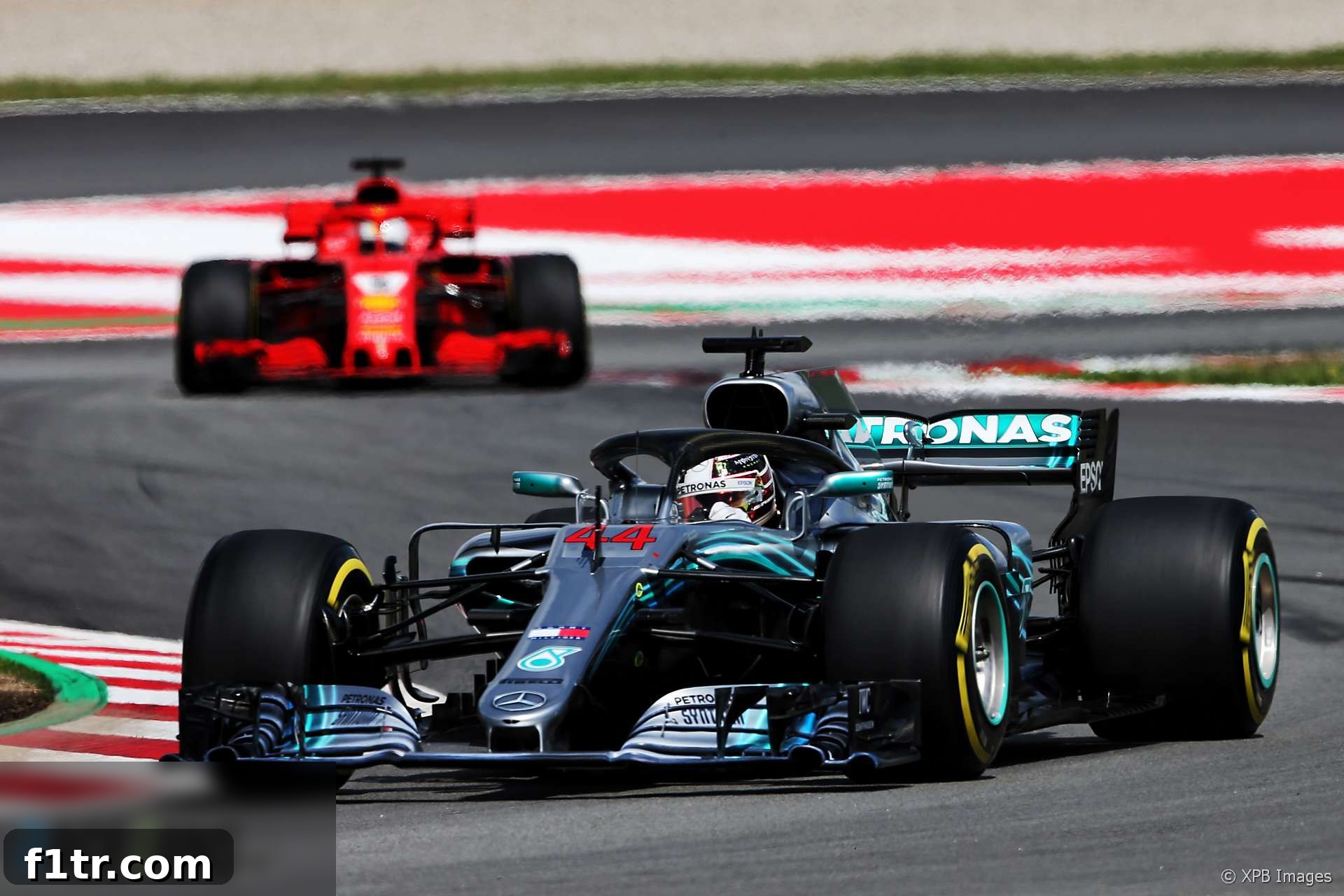
Lewis Hamilton’s Spanish Grand Prix Masterclass: A Turnaround Story
Lewis Hamilton, the celebrated Mercedes driver, expressed profound “amazement” at the exceptional competitiveness of his W09 challenger during the Spanish Grand Prix. This sentiment marked a significant shift from his earlier struggles, where the delicate balance of his car had been a persistent concern since the season’s inaugural race in Australia.
From Struggle to Dominance: Hamilton’s Season-Long Balance Battle
The early part of the 2018 Formula 1 season presented an unexpected challenge for the reigning champion. While he started strong in Melbourne, feeling “really comfortable” with the car’s balance, the subsequent races saw a worrying decline in his confidence. This wasn’t merely a psychological hurdle; it was a tangible issue with the car’s handling characteristics, particularly its rear stability. Hamilton revealed, “Since then I just didn’t have the confidence to attack, to lean on the car, to have the rear particularly where I wanted it.” This lack of predictability at the rear axle meant he couldn’t push the car to its absolute limit, a fundamental requirement for extracting peak performance from a modern F1 machine. A “nervous, snappy car” was how he described the W09 in previous qualifying sessions, making high-speed corners a precarious dance on the edge of grip rather than a controlled, aggressive manoeuvre.
Such a struggle for a driver of Hamilton’s calibre is indicative of the razor-thin margins in Formula 1. The slightest imbalance can dramatically impact a driver’s ability to extract lap time, especially when pushing for pole position or fending off rivals in a race. The car’s tendency to snap or lose traction unexpectedly would force Hamilton to adopt a more cautious approach, costing him precious tenths of a second. This underlying issue had undoubtedly contributed to the intensely competitive nature of the early 2018 season, where Ferrari and Sebastian Vettel often appeared to hold a slight edge.
The Spanish GP Breakthrough: Unlocking the Mercedes W09
Qualifying Challenges and Race Day Revelation
Even heading into the Spanish Grand Prix weekend, the lingering issues with the W09’s balance were evident. Hamilton admitted, “For whatever reason I still didn’t have that [on Saturday]. It was a very nervous, snappy car throughout qualifying.” Despite these difficulties, he managed to put in a strong performance to secure pole position, a testament to his sheer talent and ability to drive around the car’s limitations. However, the true transformation occurred between Saturday’s qualifying and Sunday’s race. It was a subtle, yet profound, change that unlocked the car’s hidden potential.
The key to this dramatic improvement, according to Hamilton, lay in “the right wing setting, for example, for the race.” This seemingly minor adjustment had a monumental impact. “The car was a little bit nicer to drive. It was a little bit more of a normal balance,” he explained. This “normal balance” allowed Hamilton to trust the car implicitly, enabling him to attack corners with renewed vigour and precision. The sensation of a stable and predictable car is invaluable to a driver, allowing them to focus entirely on optimising their lines and tyre management rather than constantly battling the machine. He observed, “I could see that in my time I was much more comfortable,” a critical factor for maintaining blistering pace over an entire race distance.
The Art of Tyre Management and Pace Advantage
Beyond the enhanced car balance, what truly distinguished Hamilton’s performance in Spain was his unparalleled ability to manage his Pirelli tyres. This allowed him to maintain a formidable pace throughout each stint, consistently outpacing his competitors. He candidly expressed his surprise at the disparity: “I was a bit amazed to see the pace difference that I had to others, plus I was able to look after my tyres a lot more than it appeared the guys behind me [could].” This was a crucial advantage, particularly in the notoriously demanding conditions of the Circuit de Barcelona-Catalunya, where tyre degradation is a significant factor.
While his rivals, particularly those running close behind him, found themselves battling rapid wear, especially on the front-left tyre—a common issue at Barcelona due to its long, sweeping right-hand corners—Hamilton’s tyres remained in excellent condition. He noted, “They were running out of tyres, the front-left tyre, and I was able to look after mine.” This superior tyre preservation meant he could push harder for longer, extending his stints and giving his team strategic flexibility. This skill isn’t merely about driving slowly; it’s about a nuanced understanding of the tyres, precise throttle and steering inputs, and an optimal car setup that minimises abrasive forces on the rubber. It allowed him to maintain a high average speed without compromising the structural integrity or performance of his tyres, a critical factor in securing and extending his lead.
Relentless Pursuit: Pushing the Limits on Track
Hamilton’s commanding performance was also a masterclass in strategic execution and relentless determination. Despite his incredible tyre preservation, the team opted for an early pit stop in his first stint. This decision was a tactical move designed to “cover off any threat from Sebastian Vettel’s Ferrari,” preventing an undercut attempt from his main championship rival. Even though Hamilton felt he “could’ve still got another four laps in that first stint,” the team’s priority was to neutralise Vettel’s strategic options and solidify their track position.
Once on fresh tyres for his second stint, the message from the pit wall was clear and empowering: he “didn’t need to conserve his tyres.” This was a license for Hamilton to unleash the full potential of his now perfectly balanced Mercedes W09. He embraced this directive with his characteristic intensity, describing his mindset: “I was feeling comfortable and I [wanted] to push this car to the limit. I wanted to see how far I can push it, how far I can push myself, how consistent I can be, can I beat that time, can I improve?” This statement perfectly encapsulates the mindset of a true champion – not just winning, but constantly striving for perfection, measuring himself against his own benchmarks. He maintained this extraordinary level of focus and aggression throughout the entire race, only relenting in the very final moments of the event. “That was my mindset the whole race. It wasn’t until turn 12 of the last lap that I backed off,” he revealed, underscoring his unwavering commitment to extracting every ounce of performance until the checkered flag.
The 2018 F1 Season Context and Championship Implications
The Spanish Grand Prix victory was more than just another race win for Lewis Hamilton; it was a pivotal moment in the 2018 Formula 1 season. Coming after a period of relative struggle with the car’s balance, this dominant performance signalled a significant turnaround for Mercedes. It demonstrated their ability to analyse and rectify technical issues, providing Hamilton with the machinery he needed to showcase his supreme talent. This win allowed Hamilton to consolidate his lead in the Drivers’ Championship, establishing a crucial psychological advantage over Sebastian Vettel and Ferrari, who had shown immense promise in the early races.
The lessons learned from optimizing the W09’s setup in Barcelona proved invaluable for the remainder of the season, enabling Mercedes to refine their approach to car balance and tyre management. This race underscored the critical interplay between driver feedback, engineering prowess, and strategic acumen in Formula 1. It was a vivid illustration of how a champion driver, when given a car that responds to their touch, can elevate their performance to an almost untouchable level. Hamilton’s “amazement” at his car’s competitiveness was not just a remark; it was the recognition of a breakthrough, a moment when the pieces clicked into place, setting the stage for what would become another legendary championship charge.
2018 F1 season Related Articles
- F1 feared “death knell” for Drive to Survive after Ferrari and Mercedes snub
- McLaren staff told us we were “totally crazy” to take Honda engines in 2018 – Tost
- ‘It doesn’t matter if we start last’: How Red Bull’s junior team aided Honda’s leap forward
- Honda’s jet division helped F1 engineers solve power unit problem
- McLaren Racing losses rise after Honda split
Browse all 2018 F1 season articles