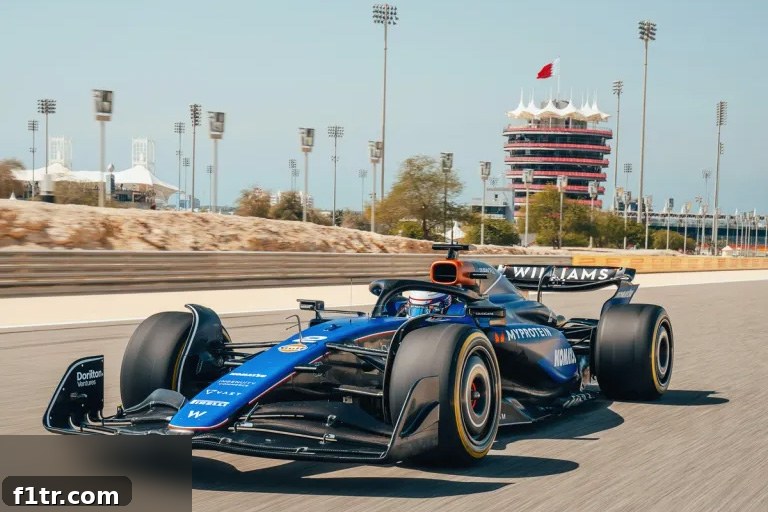
Williams Racing, one of Formula 1’s most iconic and storied teams, officially became the final contender to unveil its new challenger for the highly anticipated 2024 season. The wraps came off the FW46, marking a pivotal moment as the team aims to build on its promising performance from the previous year. This launch signals the full roster of the new-generation Formula 1 cars for 2024, setting the stage for what promises to be an exhilarating season of competitive racing.
Advert | Become a Supporter & go ad-free
The FW46 made its initial track appearance at the renowned Bahrain International Circuit, just ahead of the crucial official pre-season testing. While the car itself made its debut in Bahrain, Williams had previously teased fans with a revised livery for the upcoming season, presented two weeks prior in a high-profile event in New York. This earlier reveal showcased the team’s refreshed aesthetic on a modified version of their 2023 car, building anticipation for the full unveiling of the FW46. The choice of New York for the livery launch underscored Williams’ growing global appeal and strategic efforts to engage a wider audience, reflecting the modern F1 era’s focus on brand visibility and fan interaction.
The 2023 season marked a significant turnaround for Williams Racing, as they secured a respectable seventh position in the constructors’ championship. This achievement was not merely a numerical improvement; it represented their best result since 2017, a testament to the dedicated hard work, strategic changes, and technical developments implemented by the team under the leadership of Team Principal James Vowles. The climb up the standings from the depths of previous seasons instilled a renewed sense of optimism and belief within the Grove-based outfit, signaling a potential return to competitiveness for the once-dominant British team. Drivers Alexander Albon and Logan Sargeant played crucial roles in this resurgence, consistently extracting performance from a car that showed flashes of genuine pace.
One of the most encouraging aspects of Williams’ 2023 campaign was the tangible impact of mid-season upgrades. James Urwin, Alexander Albon’s insightful race engineer, highlighted these improvements as a strong indicator of the FW46’s inherent potential. “The update we had in the middle of last year largely did what [the designers] said it was going to do, and the Silverstone update,” Urwin explained in a video published by the team. This meticulous development process, where real-world performance validated simulator data and design intentions, instilled confidence. “If that’s anything to go by, then this one should be pretty close to what we think it is in here. So if that is the case then it’s exciting.” This sentiment reflects the critical link between successful iterative development and the foundation it lays for future car designs. The ability to predict and then achieve performance gains through updates provides invaluable data and builds trust in the team’s aerodynamic and engineering philosophies for the FW46.
Urwin further elaborated on a crucial design objective for the FW46: providing the drivers with a car possessing a broader range of strengths. The 2023 car, while strong in certain conditions (particularly low-downforce tracks), often struggled with consistency across various circuit types and changing track conditions. “Hopefully if it’s not these extreme ends of the spectrum where we had to pitch it each week, it should be a bit more consistent track to track and in sprint races and that sort of thing, should help in that respect and so on,” Urwin noted. This pursuit of versatility is paramount in modern Formula 1, where the calendar features a diverse array of circuits, from high-speed layouts like Monza to tight street circuits and technical tracks demanding maximum downforce. A car that performs reliably across this spectrum allows drivers to maintain a competitive edge without requiring drastic setup compromises each race weekend. Furthermore, with the increasing prevalence of Sprint races, where limited practice time places a premium on a car that is inherently balanced and predictable, consistency becomes a major asset. This design philosophy aims to reduce the team’s reliance on finding a narrow operating window for the car, enabling both Alexander Albon and Logan Sargeant to extract maximum performance more frequently.
Echoing these sentiments, Gaetan Jego, another key race engineer within the Williams team, emphasized the focus on improved drivability. “I think the key bit is that the car is more drive-able, more together,” Jego added. This concept of “drive-ability” is multifaceted in Formula 1; it refers to a car that responds predictably to driver inputs, provides clear feedback, and allows the driver to push closer to the limit with confidence. He continued, “All the issues we had last year that were sometimes very limiting are much smaller so you are able to drive the car and to do consistent laps more easily, which is quite important.” Last year’s car sometimes presented handling quirks or balance issues that, at times, severely limited its ultimate performance ceiling and made it challenging for drivers to maintain a consistent rhythm over a race distance. Addressing these limitations means drivers can focus more on race craft, tire management, and strategy rather than wrestling with an unpredictable machine. The ability to produce consistent lap times is fundamental to strong race performance, allowing for effective tire preservation, optimized strategy execution, and the ability to challenge rivals more effectively. A car that is “more together” implies a harmonious interaction between its various aerodynamic, mechanical, and suspension components, leading to a more stable and confidence-inspiring platform for the drivers.
The FW46’s initial shakedown at the Bahrain International Circuit a day prior to official pre-season testing was a critical milestone. These initial runs, often referred to as filming days, are strictly limited in mileage but serve an invaluable purpose: to ensure all fundamental systems are functioning correctly, to conduct basic safety checks, and to gather preliminary data. It’s the first real-world verification of countless hours of design, simulation, and manufacturing. Following this brief shakedown, the intense three-day pre-season testing session commenced, where all ten Formula 1 teams converged on the Bahrain track. This period is arguably one of the most vital phases of the season, as teams push their new cars to their limits, collecting vast amounts of data on reliability, performance, and driver feedback. It’s a delicate balance between pushing for outright pace, understanding tire degradation, and confirming aerodynamic concepts. For Williams, these three days are crucial to validate the engineering team’s confidence in the FW46’s design, fine-tune initial setups, and allow Alexander Albon and Logan Sargeant to acclimate to their new machinery ahead of the Bahrain Grand Prix, which swiftly follows testing. Every lap, every data point, and every piece of feedback gathered during these sessions will directly influence the FW46’s development trajectory throughout the early part of the 2024 season.
Advert | Become a RaceFans supporter andgo ad-free
Pictures: Williams FW46
Video: Williams reveal FW46
The FW46 rolls out in Bahrain 🤩🇧🇭 pic.twitter.com/VTxA0ytMWT
— Williams Racing (@WilliamsRacing) February 20, 2024
Advert | Become a RaceFans supporter andgo ad-free
Formula 1
- “Overtaking is overtaking”: Domenicali denies F1’s yo-yo racing is “artificial”
- The crashes F1 is trying to prevent may be rare – but the danger is obvious
- F1 returning to India soon after 2027 sounds like wishful thinking
- Verstappen loathes F1’s new generation of cars – but what do his rivals reckon?
- The ‘throwback weekend’ is back in fashion. But it’s a flawed concept – especially for F1
Browse all Formula 1 articles