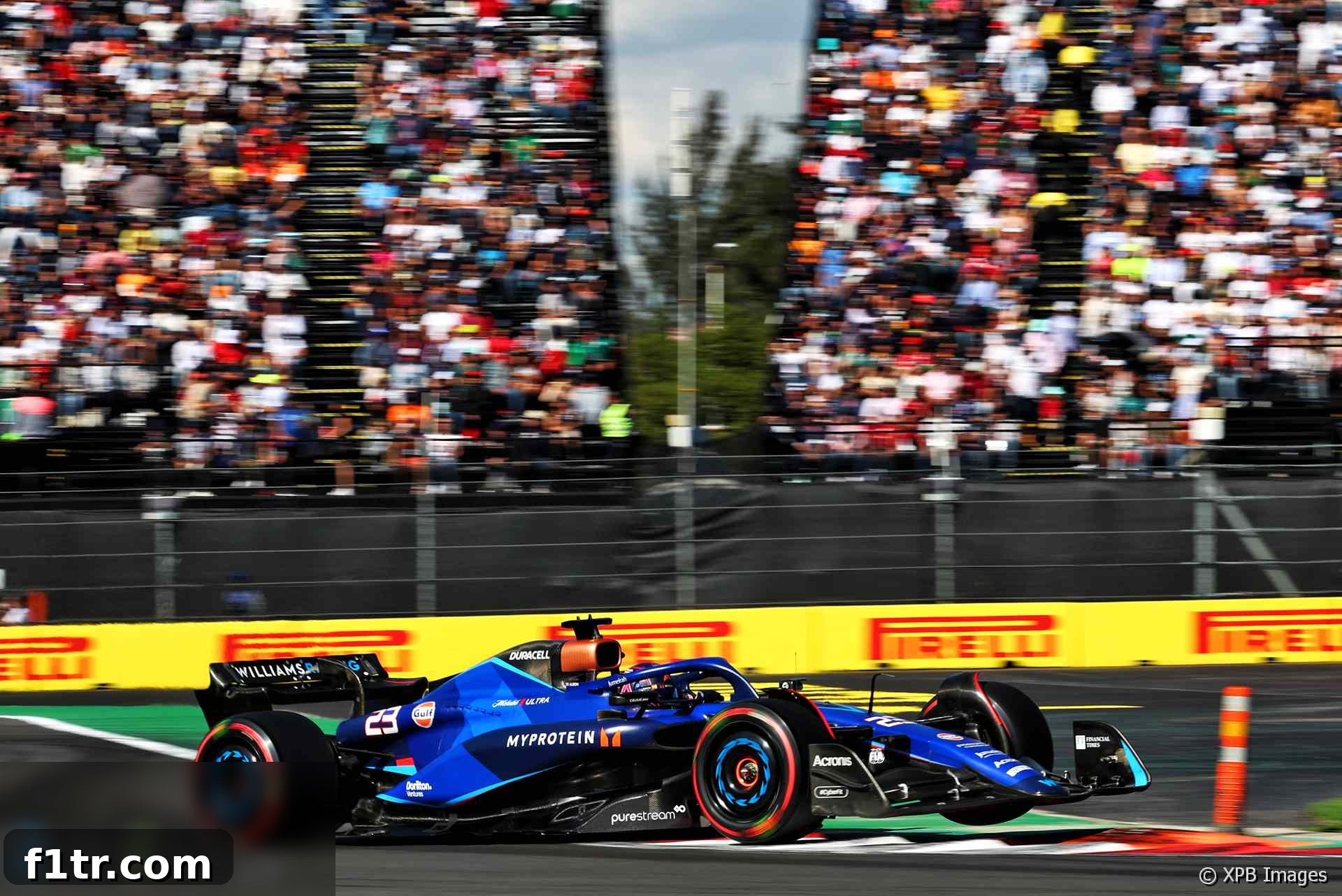
Alexander Albon has called for a meticulous review of how Williams’ Formula 1 car reacts to evolving track conditions, following a perplexing reversal of fortunes during the Mexican Grand Prix weekend. The Thai-British driver’s impressive pace in practice sessions often evaporated come qualifying, highlighting a persistent inconsistency that the team is determined to unravel.
Advert | Become a Supporter & go ad-free
Albon’s Mexican Grand Prix Mystery: From P2 to P14 in a Flash
The Autódromo Hermanos Rodríguez circuit in Mexico City proved to be a track of highs and lows for Alexander Albon and the Williams Racing team. Hopes soared after Albon secured an impressive second place in both Friday’s opening practice session (FP1) and Saturday’s final practice (FP3). These results painted a promising picture, suggesting that the FW45 possessed genuine one-lap pace and strong fundamental balance. Yet, the elation quickly faded as the critical qualifying session approached, with Albon only managing to qualify 14th after falling to the same position in Friday’s second practice (FP2).
The Unpredictable Swings: A Recurring Pattern for Williams
This dramatic swing in performance wasn’t an isolated incident, but rather a perplexing pattern that has plagued Williams throughout the Mexican Grand Prix weekend. Albon noted a striking similarity between the Friday sessions, where his car felt strong in FP1 but lost significant pace by FP2. The pattern eerily repeated itself from FP3 to qualifying, leaving the team and driver scratching their heads. The challenge for Williams lies in understanding the precise factors causing this fluctuation and developing strategies to maintain their competitive edge across varying track states.
Pace Loss, Not Track Limits, the Real Frustration
Albon’s qualifying session was further complicated by a track limits infringement that saw his fastest Q2 lap time deleted. While such incidents are always frustrating for a driver pushing the limits, Albon was quick to point out that this was a secondary concern. His primary frustration stemmed from a profound “lack of pace” that afflicted the car during the crucial qualifying segment. He lamented, “I was four or five tenths slower than I did in FP3. We lost a lot of grip out there, I need to review it.” This significant drop in performance, rather than a single yellow flag or track limit penalty, was the true impediment to a higher grid position for the Williams ace.
Unpacking the Grip Conundrum: A Rear-End Battle
The core of the problem, according to Albon, was a dramatic and sudden loss of rear grip. “The other drivers struggled but for me it was from turn one a lack of rear grip and then as you lack the rear grip, it escalates because you just start sliding more and then the tyre becomes out of control,” he explained. This breakdown in rear stability makes the car incredibly difficult to handle, forcing the driver into a defensive rather than aggressive driving style, which is detrimental to lap time in qualifying.
Echoes of the Past: A Familiar Mexican Challenge
The predicament felt eerily familiar to Albon, recalling similar struggles at the previous year’s Mexican Grand Prix. In 2022, Williams also showed flashes of strong practice pace only to qualify far down the order, often on the back row. This recurring theme suggests a fundamental characteristic of the FW45, or perhaps the team’s setup philosophy, that struggles to adapt as track conditions evolve. Albon noted that this year’s qualifying session felt less like a typical sprint for pole and more like a race simulation due to the extreme tyre management required: “My laps were actually more like race laps. I had to do so much tyre management through my quali laps just to keep the rears alive for sector three.” This necessity to preserve the tyres rather than extract maximum performance is a clear indicator of underlying issues that need immediate attention.
Advert | Become a RaceFans supporter andgo ad-free
The Mystery of Changing Conditions: More Than Just Temperature
What makes Williams’ situation particularly puzzling is Albon’s observation regarding ambient temperatures. Despite the significant grip loss between morning and afternoon sessions, he highlighted that “the ambient temperature is very similar morning to afternoon, but the grip loss is quite significant.” This suggests that the issue isn’t simply a matter of rising air temperature, which often affects tyre performance. Instead, it points to other factors such as track evolution, rubbering-in from other cars, changes in track surface temperature, or even subtle shifts in wind direction that might be disproportionately affecting the aerodynamic balance or mechanical grip of the Williams car.
Understanding these nuanced changes is crucial for Williams. The ability to predict and compensate for how the track surface changes over a race weekend is a hallmark of top F1 teams. If Williams can unlock the secret to this inconsistency, it could unlock a significant performance boost, allowing them to capitalize on their inherent car pace more reliably. The data gathered from Albon’s feedback will be invaluable in dissecting the problem and formulating a robust solution.
The Elusive Q3: A Glimmer of Hope That Faded
Despite the persistent problems, Albon maintained a degree of optimism, believing that Williams was on the cusp of a very strong qualifying performance had he been able to reach Q3. He felt the car was starting to come alive as the session progressed: “I actually think it was coming to us. By Q2 run two, I was in a much better place and I thought ‘finally, Q3 here we go’ but it never came.” This tantalizing glimpse of potential underscores the frustration. It indicates that the raw pace might be there, but the team’s current understanding of the car’s behavior in dynamic conditions prevents them from consistently harnessing it when it matters most.
The Road Ahead for Williams: Consistency is Key
For Williams, a team that has shown remarkable progress throughout the 2023 season, these inconsistencies are a critical area for improvement. Their ambition to climb further up the Constructors’ Championship standings relies not just on flashes of brilliance but on sustained, reliable performance across all sessions and varying conditions. The Mexican Grand Prix highlighted a specific vulnerability, and addressing it will be paramount as they look towards the remaining races and, more importantly, the development of their 2024 challenger.
The detailed post-mortem will likely involve analyzing vast amounts of telemetry data, correlating it with Albon’s invaluable driver feedback, and potentially experimenting with different setup philosophies to broaden the car’s operating window. Mastering how their car interacts with different track surfaces and atmospheric conditions will be crucial for Alexander Albon and Logan Sargeant to consistently extract the maximum performance from the FW45 and its successor. The team’s engineering department faces a significant task, but one that is essential for their long-term competitive aspirations in Formula 1.
Advert | Become a RaceFans supporter andgo ad-free
2023 Mexican Grand Prix Related Articles
- ‘I’m so s*** in qualifying’: Norris berates himself despite pole-winning lap
- Ferrari reaping the benefits of having F1’s most closely-matched team mates
- Norris had “no chance” to beat Verstappen in Mexico even without Q1 exit
- Transcript: How Ricciardo’s race went awry soon after he was told to “bring it home”
- Mercedes see “very encouraging signs” from Austin floor update
Browse all 2023 Mexican Grand Prix articles