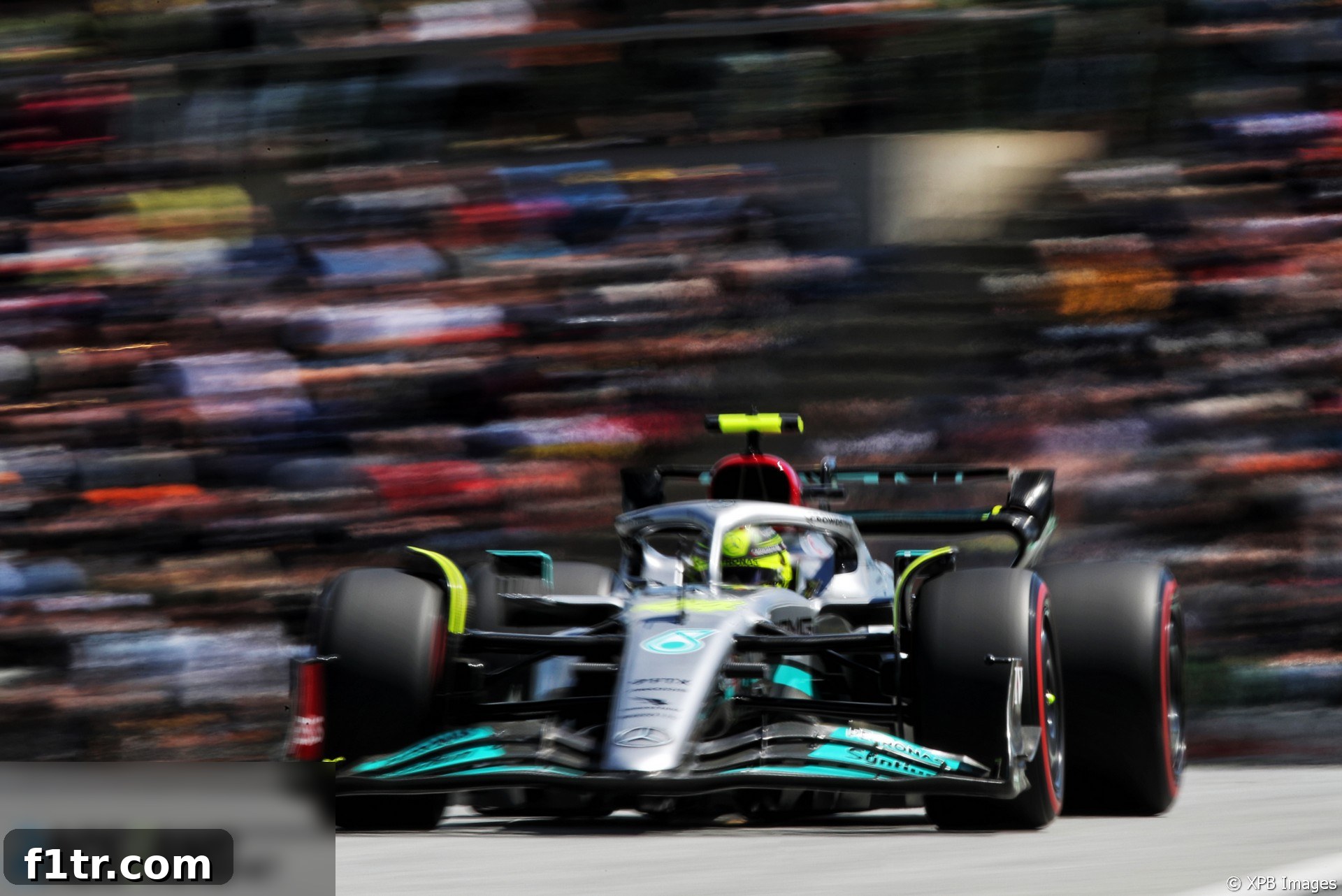
Lewis Hamilton endured a frustrating end to what had promised to be a breakthrough qualifying session for the Mercedes-AMG Petronas Formula 1 Team at the 2022 Austrian Grand Prix. The seven-time world champion expressed immense disappointment in himself after crashing out during the crucial Q3 segment, bringing a sudden halt to Mercedes’ strongest showing of the season thus far.
Lewis Hamilton’s Austrian GP Qualifying Crash: Disappointment Amidst Mercedes’ Resurgence
The picturesque Red Bull Ring in Spielberg, Austria, played host to a qualifying session filled with high-octane drama and unexpected twists during the 2022 Formula 1 Austrian Grand Prix. For Lewis Hamilton, it was a profound emotional rollercoaster, culminating in a significant impact with the circuit’s barriers at Turn 7 during the decisive Q3 segment. This incident not only shattered his aspirations for a strong starting position but also left him “incredibly disappointed” with his own execution, despite the palpable and much-welcomed improvement in the Mercedes W13’s pace. The session, which had initially offered a beacon of hope for the struggling Mercedes team, quickly turned into a moment of frustration for their star driver.
A Promising Start Derailed: Mercedes’ Unforeseen Speed
Throughout the preliminary stages of qualifying, Hamilton had showcased a level of raw speed and confidence in his car that had been conspicuously absent for much of the challenging 2022 season. The Mercedes team, which had been battling persistent porpoising, inconsistent balance, and an overall lack of competitive pace across numerous races, finally appeared to have unlocked a significant portion of the W13’s latent potential. Both Hamilton and his talented teammate, George Russell, consistently placed themselves among the leading contenders, trading blows with the formidable Red Bulls and Ferraris. This sudden surge in performance, hinting that the reigning constructors’ champions were finally turning a crucial corner in their development, made Hamilton’s subsequent crash all the more poignant and impactful.
“I’m incredibly disappointed in myself, ultimately,” Hamilton conveyed to the official F1 channel after the qualifying session, his usually composed demeanor marked by visible frustration and regret. “I had a big hit with the barrier. I’m so sorry to the team; everyone worked so hard to put this car together, and I never like to bring it back damaged.” The heavy impact necessitated extensive repairs to his W13, imposing an unwelcome and time-consuming burden on the dedicated garage crew. The prospect of starting Saturday’s sprint race from a lowly 10th on the grid, a position far below his capabilities and Mercedes’ rediscovered pace, was undoubtedly a bitter pill for the seven-time champion to swallow, adding immense pressure for a strong recovery drive.
The Perilous Edge: Pushing Limits and Losing Control
The inherent nature of Formula 1 qualifying demands that drivers extract every conceivable millisecond of performance from their sophisticated machinery. This often entails pushing the car to the absolute limits of grip, control, and adhesion. Hamilton, in his relentless pursuit of the fastest possible lap time and a potential front-row start, found himself momentarily on the wrong side of that razor-thin margin at the challenging Turn 7. “We were fighting for top three, I think,” he explained, still processing the bewildering sudden loss of control. “I don’t have an answer to it; I just lost the back end in Turn 7, and that was that.” Such high-speed incidents, even for a driver of Hamilton’s unparalleled experience and caliber, starkly underscore the immense challenges of piloting a modern F1 car at the absolute ragged edge, especially when the car’s dynamic behavior is still being fully understood following recent developmental upgrades.
Adding to Mercedes’ woes on that dramatic Friday, shortly after Hamilton’s incident, his teammate George Russell also experienced a significant excursion off the track, albeit a less destructive one, which nonetheless impacted his final qualifying position. Russell, demonstrating remarkable resilience, managed to secure an impressive fifth place, a commendable effort given the tumultuous circumstances. However, these back-to-back incidents for a team that had historically shown remarkable reliability and precision control hinted at a new dynamic: perhaps the hard-won increase in pace came hand-in-hand with an elevated risk factor, or the drivers were simply pushing harder than ever before to fully capitalize on the newfound performance gains. It painted a picture of a team grappling with a much faster, yet perhaps more temperamental, car.
Toto Wolff’s Balanced Perspective: A Silver Lining in the Storm
In the immediate aftermath of the double incident, Mercedes Team Principal Toto Wolff adopted a characteristically pragmatic yet profoundly supportive stance. While openly acknowledging the disappointment that naturally accompanied such qualifying errors, he emphatically urged his drivers not to unduly dwell on their mistakes. Instead, Wolff strategically chose to redirect focus towards the significant and undeniable positives that had been unearthed during the session – specifically, the W13’s dramatically improved speed. “They shouldn’t beat themselves up because of this situation of crashing out,” Wolff stated, delivering a clear and reassuring message of unwavering support to both Hamilton and Russell.
Wolff’s perspective was deeply rooted in the team’s arduous and often frustrating journey throughout the 2022 season. “We’ve given them a car that wasn’t on par for 10 races in a row,” he candidly remarked to Sky Sports, emphasizing the protracted struggles. “Now we’re starting to come to terms, and we’re able to drive in front, and then it can happen that you just lose the car.” This candid admission underscored the profound psychological burden that had been placed on both the drivers and the highly skilled engineers, who had tirelessly grappled with a car that consistently underperformed against expectations. The undeniable fact that the W13 was finally demonstrating pace comparable to the front-running Red Bull and Ferrari machines, even if it occasionally led to driver errors, was a far more encouraging sign than enduring yet another weekend of simply struggling for midfield positions. It represented a crucial turning point in their understanding and development.
His concluding thought on the matter eloquently encapsulated the team’s renewed sense of optimism and ambitious direction: “I’d rather have a fast car and a qualifying like this than not having the pace to be in the top four.” This philosophy speaks volumes about Mercedes’ core ambition and their uncompromising pursuit of excellence. For a team accustomed to an era of unparalleled dominance, battling for consistent podiums and outright race victories is the only acceptable standard. The crashes, while undeniably costly in terms of potential grid positions, lost points, and extensive repair bills, were almost perceived as a necessary, albeit painful, consequence of truly pushing the boundaries to rediscover that elusive front-running performance that defines their DNA.
Implications for the Austrian Grand Prix Sprint Race and Beyond
With Lewis Hamilton starting from a challenging 10th position and George Russell from a more promising 5th for Saturday’s sprint race, Mercedes faces a complex yet potentially rewarding scenario. The sprint race format, strategically introduced to inject an extra layer of excitement and unpredictability into select Grand Prix weekends, offers limited opportunities for intricate strategic maneuvers but presents a valuable chance for drivers to significantly gain positions ahead of the main Grand Prix on Sunday. Hamilton, globally renowned for his exceptional race craft, strategic acumen, and unparalleled ability to carve through the field, will undoubtedly be looking to maximize his recovery drive and climb as many places as possible.
“I’m encouraged, of course, to see our performance,” Hamilton thoughtfully commented, reflecting on the underlying speed and potential of his car despite his personal setback. “We weren’t expecting to be as close as that today, so that’s a huge positive. But I’m really quite far back. I don’t know what’s possible from there, but we have a sprint race as well, so I hope that tomorrow I can make up for some lost time.” His carefully guarded optimism suggests a deep understanding of the inherent difficulty of overtaking on the relatively short and fast Red Bull Ring circuit, which is known for its limited passing zones. However, he also clearly recognizes the immense potential for securing crucial points and, more importantly, a significantly improved starting position for Sunday’s main event.
The sprint race will serve as a crucial test of Mercedes’ newfound pace, their tire degradation management capabilities, and overall race readiness. If the W13 maintains its competitive edge and demonstrates strong performance over a longer stint, both Hamilton and Russell could significantly improve their grid positions for the full Grand Prix. Russell, starting from P5, enjoys a more straightforward path to potentially challenge for a top-three finish in the sprint, which would represent a substantial morale and points boost for the entire team. Furthermore, the invaluable data meticulously gathered during the sprint race will be critical for fine-tuning race strategies, comprehensively understanding the car’s behavior under sustained race conditions, and making informed decisions regarding tire choices and optimal setup for the demanding Grand Prix on Sunday.
Looking Ahead: A Glimmer of Hope for Mercedes’ 2022 Season
While the immediate disappointment and frustration of qualifying were undeniably palpable, the overarching and underlying message emerging from the Austrian Grand Prix weekend thus far is overwhelmingly positive for the Mercedes team. The undeniable demonstration of genuine, front-running pace, even if it was punctuated by unfortunate driver errors, provides the team with a much-needed morale boost and concrete, empirical evidence that their relentless developmental efforts are finally yielding tangible results. After an exceptionally challenging start to the 2022 season, where they consistently found themselves trailing the dominant Red Bull and Ferrari teams, suddenly finding themselves in contention for top-three spots represents a significant and highly encouraging stride forward.
The focus for Mercedes now sharply shifts to effective damage limitation and maximizing the accumulation of championship points in both the sprint race and the main Grand Prix. For Lewis Hamilton, renowned globally for his extraordinary resilience, unwavering determination, and uncanny ability to bounce back triumphantly from setbacks, the remainder of the weekend presents a profound opportunity for a defiant and memorable recovery drive. For the team as a cohesive unit, it’s a critical chance to consolidate their hard-won performance gains and continue their upward trajectory in what remains a long, incredibly demanding, and fiercely competitive Formula 1 season. Despite its dramatic and challenging qualifying session, the 2022 Austrian Grand Prix might just ultimately be remembered as the pivotal turning point for Mercedes’ campaign, marking the moment they rediscovered their competitive fire and true potential.
Related Articles: 2022 Austrian Grand Prix
- FIA affirms three sprint races on 2023 Formula 1 calendar
- “Oh, so unlucky!” How Alonso’s cursed Austrian Grand Prix unfolded on his radio
- Ferrari believe their performance deficit to Red Bull is now “negligible”
- Another fan’s experience of harassment last weekend – and why F1 must act
- AlphaTauri “desperately” need upgrades after “disaster” weekend, urges Gasly
Browse all 2022 Austrian Grand Prix articles