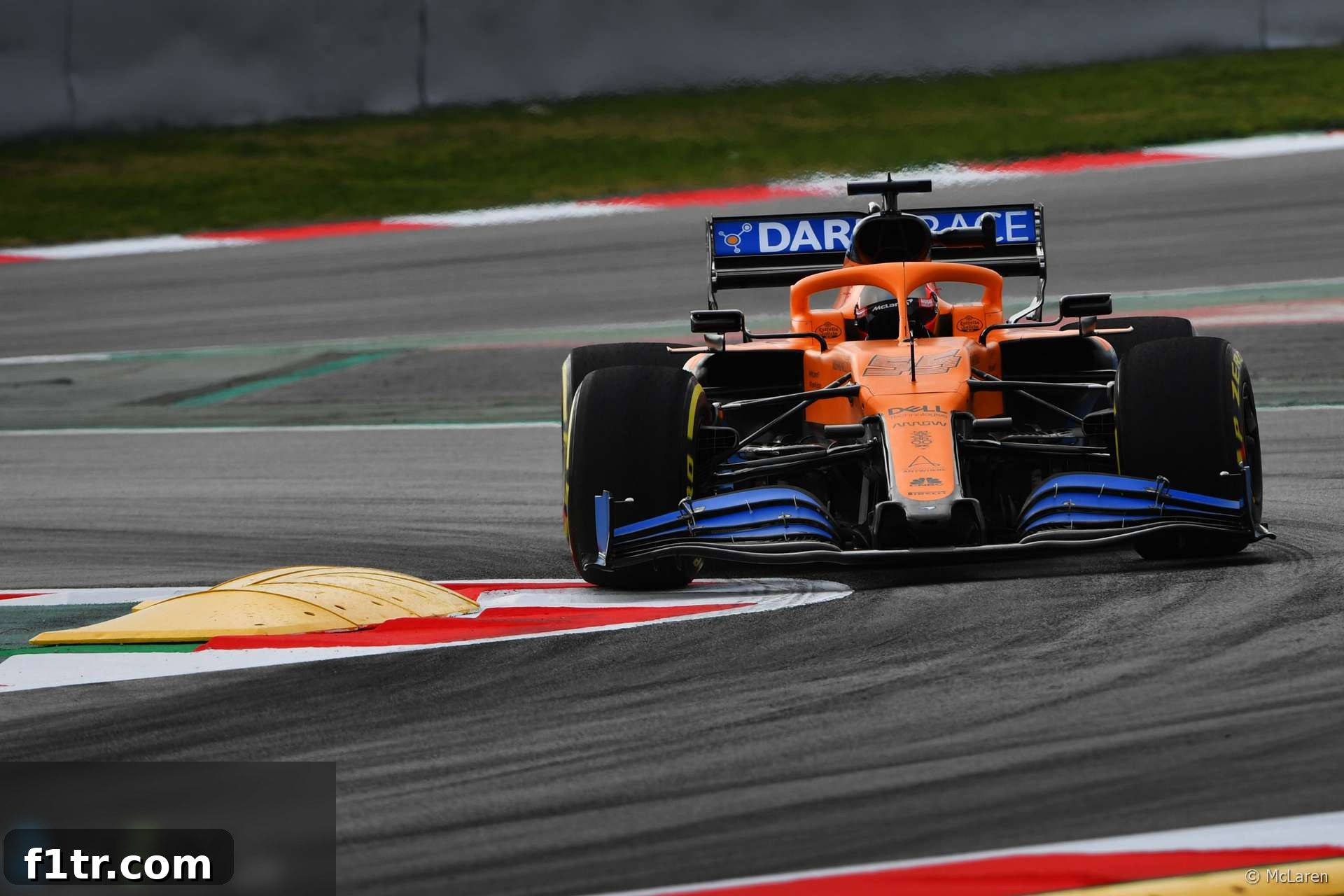
The highly anticipated McLaren MCL35, the team’s contender for the 2020 F1 season, officially hit the track for the first time today. This momentous occasion marks the culmination of months of meticulous design, engineering, and manufacturing efforts from the Woking-based outfit, signaling the true beginning of their 2020 campaign. The initial shakedown was performed during a designated filming day, a crucial precursor to the rigorous pre-season testing schedule.
At the helm of the new challenger were Carlos Sainz Jnr and Lando Norris, McLaren’s dynamic young driver pairing, who took turns putting the MCL35 through its paces. The action unfolded at the iconic Circuit de Catalunya, near Barcelona, a venue renowned for hosting the Spanish Grand Prix and serving as a traditional testing ground for Formula 1 teams. These initial laps, while limited in scope, provided invaluable preliminary data and allowed the team to conduct crucial system checks, ensuring the car’s fundamental components functioned as intended.
The MCL35 represents a significant step forward for McLaren as they sought to build on the impressive momentum generated during the 2019 season. That year saw the team secure a commendable fourth place in the Constructors’ Championship, their best result in years, signaling a genuine return to competitiveness. The new car, therefore, carries the weight of high expectations, with fans and pundits alike keen to see if McLaren can continue their upward trajectory and challenge the established front-runners.
The MCL35: A New Chapter for McLaren
The unveiling and subsequent track debut of the MCL35 were events steeped in optimism for the McLaren team. Following a period of significant restructuring and a renewed technical direction, the team had shown promising signs of recovery. The MCL35 was designed with a philosophy of aggressive development, aiming to optimize aerodynamic efficiency, mechanical grip, and overall performance. Engineers focused on refining areas identified as strengths from its predecessor, the MCL34, while addressing any weaknesses. This iterative design process is vital in the fast-paced world of Formula 1, where marginal gains can translate into significant competitive advantages.
Visually, the MCL35 retained the striking papaya and blue livery that has become synonymous with McLaren’s recent resurgence, a nod to the team’s rich heritage while firmly looking towards the future. Beyond aesthetics, every curve and surface of the car is meticulously crafted for performance, a testament to the thousands of hours spent in computational fluid dynamics (CFD) simulations and wind tunnel testing. The initial shakedown offers the first real-world validation of these designs, albeit under controlled conditions.
Filming Day: A Crucial First Step
A filming day, like the one McLaren undertook at the Circuit de Catalunya, is a standard practice for Formula 1 teams before official testing. While it allows for a limited amount of running – typically restricted to 100 kilometers and often on demonstration-spec Pirelli tires rather than full race compounds – its importance cannot be understated. Its primary purpose is to generate promotional content, such as high-definition videos and photographs, for marketing campaigns, sponsor activations, and fan engagement. These assets are vital for teams to showcase their new car and build excitement ahead of the season.
However, beyond the PR aspect, filming days also serve a critical technical function. They provide an invaluable opportunity for the team to perform initial system checks, ensuring all components communicate correctly and function as designed. This includes verifying telemetry systems, checking brake and steering functionality, and conducting basic engine fire-up procedures under real-world track conditions. It’s a chance to iron out any immediate, minor issues before the intense scrutiny of official pre-season testing begins, allowing the team to hit the ground running when more extensive data collection becomes possible.
The Driving Force: Sainz and Norris
The pairing of Carlos Sainz Jnr and Lando Norris has proven to be a refreshing and highly effective combination for McLaren. Sainz, the more experienced of the two at the time, had demonstrated exceptional consistency and leadership in 2019, securing a memorable podium finish and regularly delivering strong points hauls. His technical feedback and understanding of car development were instrumental in McLaren’s progress.
Lando Norris, still relatively new to Formula 1, impressed immensely with his raw speed, qualifying prowess, and engaging personality. His youthful exuberance combined with undeniable talent made him a fan favorite and a fierce competitor. Together, they formed a cohesive unit, fostering a positive team environment that was palpable throughout the paddock. For the 2020 season, both drivers were eager to build on their individual successes and collectively push McLaren further up the grid. Their initial impressions and feedback from these first laps in the MCL35 would be critical for the engineering team.
Circuit de Catalunya: The Proving Ground
The choice of the Circuit de Catalunya for this initial shakedown, and indeed for all pre-season testing, is no coincidence. The circuit is celebrated for its diverse layout, featuring a mix of high-speed straights, challenging corner sequences, and various braking zones. This variety makes it an excellent all-round testbed, allowing teams to evaluate a car’s performance across different scenarios. Its consistent weather conditions, generally mild during February, also make it a reliable location for collecting data without significant disruptions.
The circuit’s layout provides unique challenges for car setup, from aerodynamic efficiency on the long start-finish straight to mechanical grip through its tight chicanes and sweeping corners. Engineers can gather crucial information on tire degradation, brake performance, engine mapping, and chassis balance. The familiarity teams have with Barcelona also makes it easier to establish benchmarks and compare performance year-on-year, providing valuable context for their new car’s development.
Anticipation for Pre-Season Testing
With the initial filming day complete, all eyes now turn to the official three-day pre-season test, which commenced shortly after at the same Circuit de Catalunya. This comprehensive test period is where the real work begins. Teams will engage in extensive data collection, running a variety of aerodynamic tests, long-run simulations, and qualifying-style hot laps. Drivers will spend significant time refining their understanding of the car, experimenting with different setups, and providing detailed feedback to their engineers.
Reliability will be a key focus, as teams aim to complete as many laps as possible to identify and resolve any mechanical or electrical issues before the season-opening Australian Grand Prix. The data gathered during these tests is instrumental in guiding the car’s development path throughout the entire season, influencing upgrades and strategic decisions. For McLaren, this period was crucial to validate the progress they believed they had made with the MCL35 and to gauge their competitive standing against their rivals.
McLaren was not alone in undertaking these crucial initial runs. Other notable teams, including Williams, Haas, and Renault, also rolled out their new machines for the first time on track around the same period. This synchronized activity across the grid underscored the frenetic pace of development in Formula 1 and the shared objective of maximizing track time ahead of what promised to be an exhilarating 2020 F1 season. Each team aimed to gain an early advantage, setting the stage for an intriguing championship battle.
Pictures: 2020 McLaren F1 car
Advert | Become a RaceFans supporter andgo ad-free
Related Articles from the 2020 F1 Season
- Grosjean to make F1 test return tomorrow for first time since Bahrain horror crash
- Pictures: Wrecked chassis from Grosjean’s Bahrain fireball crash to go on display
- Bottas vs Rosberg: Hamilton’s Mercedes team mates compared after 78 races each
- F1 revenues fell by $877 million in Covid-struck 2020 season
- Hamilton and Mercedes finally announce new deal for 2021 season
Browse all 2020 F1 season articles