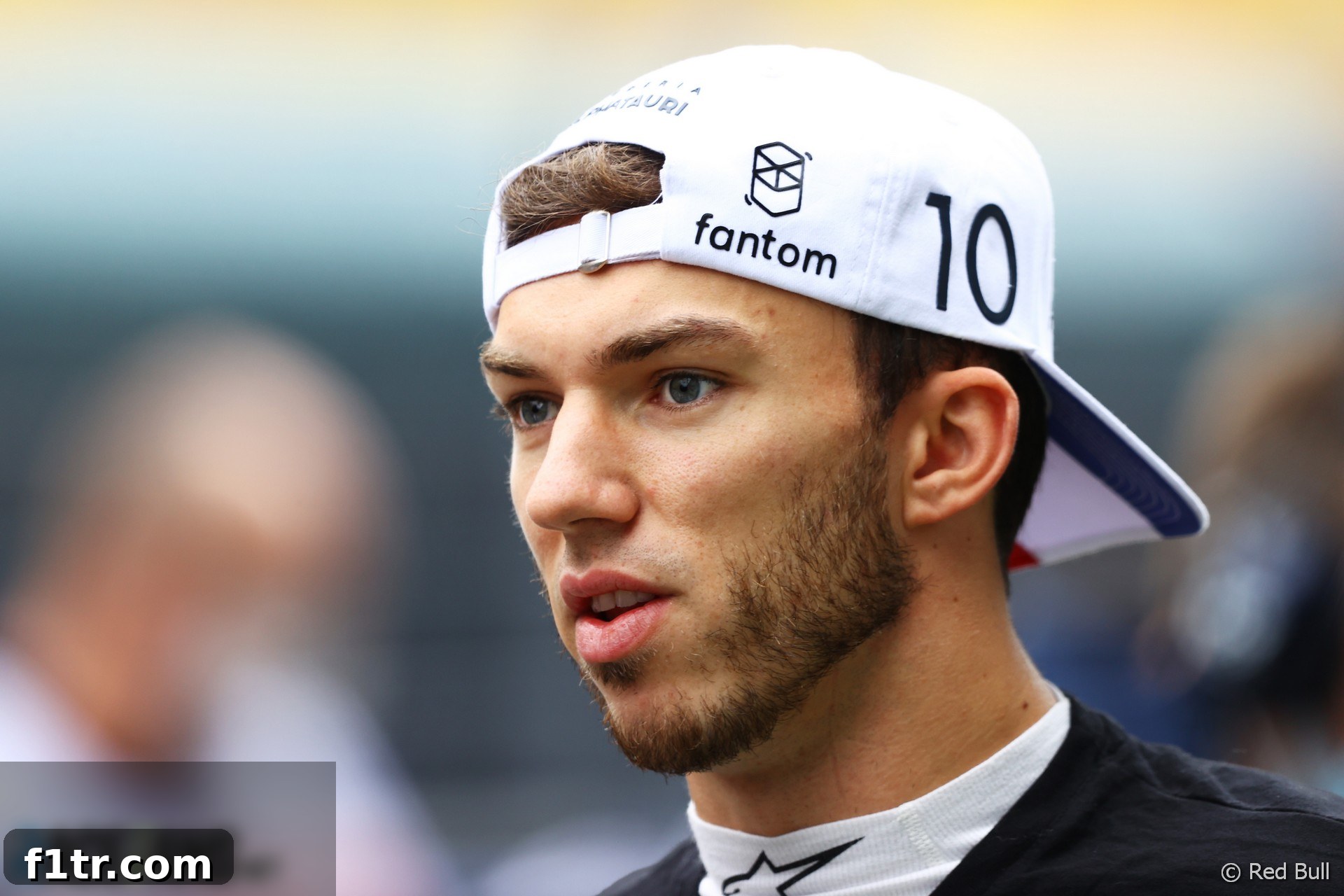
A visibly frustrated Pierre Gasly expressed profound disappointment after the Russian Grand Prix, acknowledging that AlphaTauri had earned their second consecutive point-less finish. The weekend in Sochi proved to be a harsh reality check for the team, highlighting critical strategic missteps that ultimately undermined strong underlying car performance and left significant championship points on the table.
The challenges for Gasly began well before race day. During Saturday’s qualifying session, his hopes of securing a strong grid position for Q3 were dashed under frustrating circumstances. Gasly found himself impeded by George Russell earlier in the session, a delay that cost him crucial time. Adding to his woes, the AlphaTauri team then made the strategic call against pitting him for a fresh set of tyres in the closing stages of Q2. This decision proved costly, as he narrowly missed out on a coveted spot in the top 10. The impact of this oversight was palpable, with Gasly seen pounding his Halo and steering wheel in a clear display of anger and exasperation – a powerful indicator of the lost opportunity and the immediate repercussions of the team’s tactical choices.
The qualifying setback was unfortunately a precursor to further strategic blunders on race day. The Russian Grand Prix descended into chaos in its dramatic final laps as rain began to fall heavily across the Sochi Autodrom. While many of Gasly’s direct competitors quickly reacted by pitting for intermediate tyres, AlphaTauri initially chose to keep Gasly out on worn slick tyres. This critical delay proved to be a disastrous call. Drivers who pitted promptly, such as Valtteri Bottas and Kimi Raikkonen, immediately gained a massive advantage, scything through the field and ultimately scoring valuable championship points. Gasly, struggling for grip on the wrong compound, was left vulnerable, even experiencing a collision with Lance Stroll before eventually finishing a distant 13th, far outside the points-paying positions.
Reflecting on the painful race strategy, Gasly’s frustration was evident. He meticulously recounted the series of events that led to their downfall: “We did all the first stint in front of Bottas, second stint we come right behind Bottas and then the rain comes, they boxed him and then we stayed out and basically they finished P5 and then we finished out of the points.” His summary starkly contrasted their outcome with that of their rivals, underscoring the severity of the misjudgment. He elaborated on the crucial role of tyre choice: “We were not on track with the right tyres, but apparently we didn’t expect more rain and there was more rain, so it was unfortunate and we’ll revise how to improve our weather forecast.” This candid assessment highlighted a critical weakness in the team’s race management and an urgent need to refine their meteorological predictions and reactive decision-making.
The entire weekend left Gasly questioning the team’s operational efficiency. Speaking on Sunday evening, he openly voiced his concerns: “It’s questionable how we do things, because I know we have a very small group of people in the team and unfortunately this weekend we got it wrong yesterday and again today.” This statement, while acknowledging the team’s lean structure, pointed directly to a pattern of errors that extended beyond a single incident. The repeated strategic miscalculations in both qualifying and the race indicated a deeper issue in capitalizing on their potential. Gasly felt strongly that AlphaTauri had squandered genuine opportunities, allowing competitors to walk away with significant gains.
“We left big points on the table,” Gasly lamented, emphasizing the tangible cost of their errors. He provided clear examples of rivals who benefited from superior strategy: “There was Bottas and Kimi [Raikkonen] right in front of us that boxed and everybody boxed and we stayed two or three more laps out and they finished fifth and eighth and we finished 13th. So it’s clearly something that we didn’t maximise.” The stark comparison served as a poignant reminder of what could have been. Bottas’s remarkable recovery to fifth place and Raikkonen’s solid eighth after timely tyre changes demonstrated the power of correct strategic execution under pressure, a power AlphaTauri failed to wield.
This string of errors was particularly galling for Gasly because he firmly believed in the competitive potential of their AT02 car. “It’s a shame because honestly, the car was once more competitive and we can’t allow ourselves to make such mistakes if we want to fight for fifth in the championship,” he asserted. His statement underlined a recurring theme throughout the season: AlphaTauri often displayed strong pace, only to be let down by strategic misjudgments or operational mishaps. The car consistently showed flashes of brilliance, capable of challenging the midfield front-runners, but the team’s inability to execute flawless weekends consistently was hindering their progress.
Prior to the previous round at Monza, AlphaTauri had been a beacon of consistency, holding the unique distinction of being the only team to have scored points in every race of the year. This impressive streak, however, was broken, and the subsequent performance in Russia only compounded their recent struggles. Gasly was adamant that the team possessed the raw speed to secure strong results at both tracks. He pointed to their qualifying performance at Monza, where he secured a sixth-place start, and their promising practice pace in Sochi: “In Monza we qualified sixth. Again in practice we were third and sixth on Friday, we had very strong pace on inters. When I see the last lap, we’re a full second faster than everybody on inters so the pace was again there.” These examples highlighted a frustrating dichotomy: the car’s inherent speed was undeniable, yet it wasn’t translating into consistent race day success.
Gasly’s critique wasn’t merely aimed at individual decisions but at a broader pattern: “But we made too many mistakes and this weekend we didn’t deserve to score points. I think we just do too many mistakes.” This sentiment captured the collective responsibility and the urgent need for a comprehensive review of their processes. For a team with aspirations of challenging for fifth in the constructors’ championship, such errors are simply unsustainable. Every lost point has amplified significance in the tightly contested midfield battle, and AlphaTauri risked falling behind if they couldn’t rectify these recurring issues.
The French driver concluded his reflections with a call to action for the entire team. “For all of us we need to just work more and understand how to capitalise on such opportunities. It’s a tough one to take because there was clearly better to do, but hopefully it can be good for the rest of the year.” This stoic outlook, despite the profound disappointment, conveyed a glimmer of hope that these painful lessons from Sochi would serve as a catalyst for improvement. The aim is to transform these setbacks into valuable learning experiences, ensuring that AlphaTauri can truly unlock its full potential and convert strong car performance into consistent championship points for the remainder of the Formula 1 season.
2021 Russian Grand Prix Insights and Analysis
- Norris says he missed few chances to win in 110-race wait for first F1 victory
- Sochi disappointment will make Norris and McLaren stronger, says Seidl
- F1 race start times could be brought forward to avoid Spa-style wash-outs
- New technology in Ferrari’s power unit update vital for 2022 – Binotto
- Mercedes have left too many points on the table, admits Wolff
Browse all 2021 Russian Grand Prix articles and race analysis