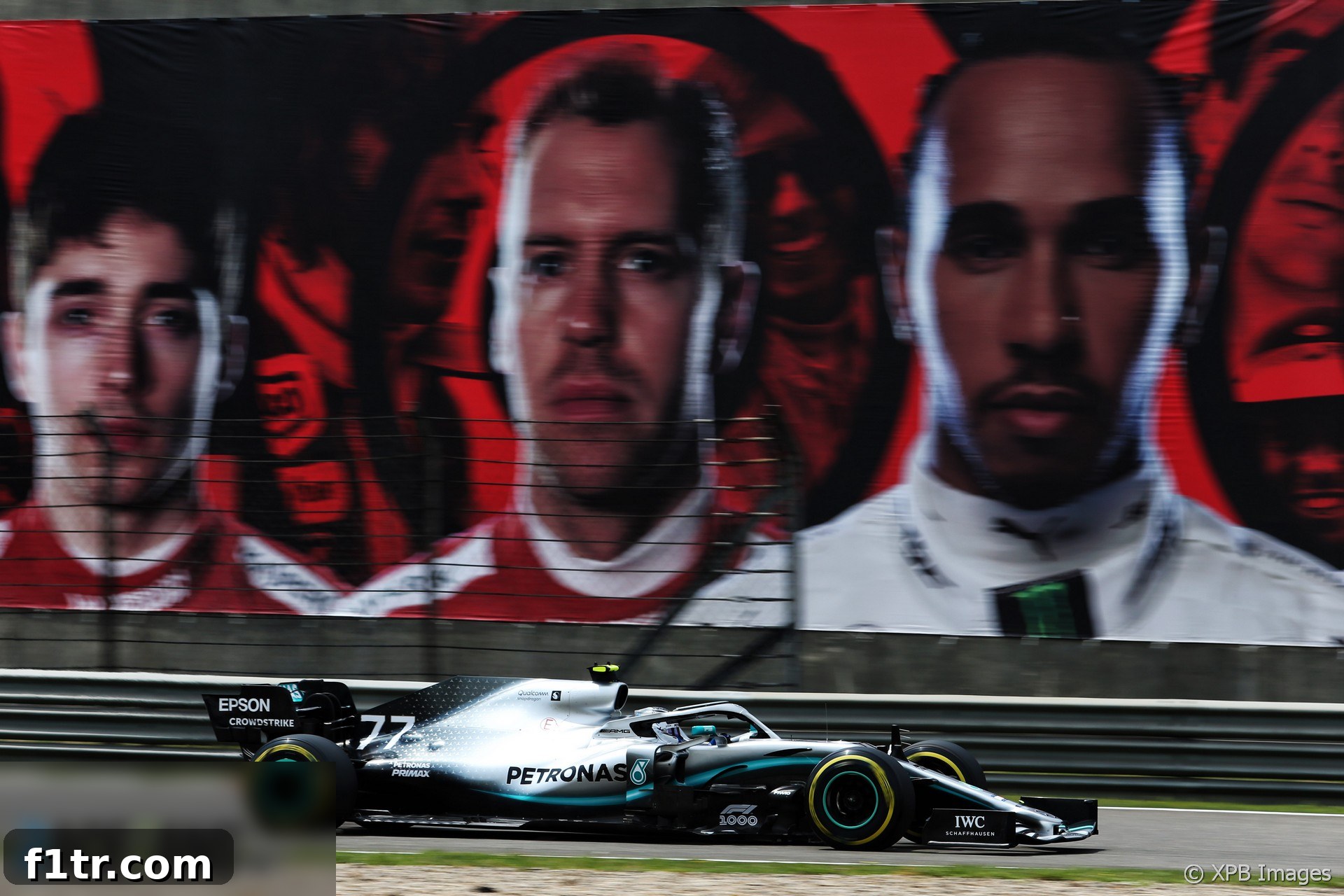
The final practice session for the 2019 Chinese Grand Prix culminated with Mercedes driver Valtteri Bottas asserting his dominance, setting the fastest lap before the session was prematurely halted by a dramatic crash involving Toro Rosso’s Alexander Albon. This crucial Saturday morning session, preceding the qualifying rounds, offered teams and drivers a last opportunity to fine-tune their setups and evaluate tire performance on the challenging Shanghai International Circuit.
Bottas’s impressive pace underscored Mercedes’ strong form heading into the weekend. However, the session’s conclusion was overshadowed by Albon’s significant incident at the final corner, which brought out the red flag and ensured no further improvements could be made by the trailing pack. The incident served as a stark reminder of the circuit’s demanding nature and the fine margins at play in Formula 1.
Bottas Seizes Control After Strategic Tire Switch
For much of the 60-minute session, it was Sebastian Vettel who commanded the top of the timing sheets in his Ferrari. The four-time world champion demonstrated strong initial pace, utilizing the softer compound tires for his early runs. His early performance hinted at Ferrari’s potential, especially after a mixed Friday of practice where Mercedes had shown a slight edge.
However, Vettel’s final attempt to improve his time was marred by an error at Turn Nine, a critical section of the circuit. This minor but costly mistake prevented him from further cementing his position at the top and ultimately opened the door for his Finnish rival. Ferrari’s strategic choices and Vettel’s execution would come under scrutiny, particularly as the team aimed to challenge Mercedes’ early season momentum.
Valtteri Bottas, meanwhile, executed a near-perfect sequence of laps. Initially, he had been running approximately half a second adrift of Vettel’s benchmark while on the medium compound tires. The Mercedes team, renowned for their meticulous strategy, then switched Bottas to the softer, faster Pirelli tires. This move proved decisive. On his subsequent flying lap, Bottas found an astonishing almost a second of pace, delivering a clean and clinical performance that propelled him to the fastest time. He ended the session nearly four-tenths of a second ahead of Vettel, a significant margin in the tightly contested world of Formula 1.
The performance of their respective teammates further highlighted the close battle between the two constructors. Charles Leclerc, in the sister Ferrari, managed to slot in just two-hundredths of a second behind Vettel, confirming Ferrari’s strong overall package despite Vettel’s late error. Lewis Hamilton, Bottas’s teammate at Mercedes, finished P4, indicating that both Mercedes drivers were firmly in contention for pole position.
Alexander Albon’s Costly Crash Brings Session to Early Close
The drama of the session reached its peak when Toro Rosso driver Alexander Albon suffered a heavy crash at the very final corner. Albon, who had been enjoying a commendable run and showing promising pace for the junior Red Bull team, lost control of his STR14 at the exit of the corner during his last flying lap. The car made severe contact with the barrier, resulting in significant damage to its left-hand side.
The immediate concern was for Albon’s safety, but thankfully, he was able to extricate himself from the heavily damaged vehicle without any apparent serious injuries. The incident, however, necessitated the deployment of the red flag, effectively ending the session a few minutes prematurely. This meant that several drivers, including both Red Bull drivers who had scheduled their final, fastest runs for the very end of the session, were unable to complete their planned laps or improve their times.
The crash will undoubtedly pose a significant challenge for the Toro Rosso mechanics, who faced a race against time to repair Albon’s car for the crucial qualifying session. Such incidents often force teams into extensive rebuilds, sometimes even requiring a new chassis, which can severely compromise a driver’s weekend. Albon’s strong performance prior to the crash, which saw him running in ninth place, underscored the frustration for both the driver and the team.
Red Bull’s Compromised Session and Midfield Scramble
The untimely red flag had a particularly detrimental impact on the Red Bull Racing team. Both Max Verstappen and Pierre Gasly had delayed their initial runs, waiting until halfway through the session to begin their qualifying simulations. Consequently, Albon’s crash occurred precisely when they were making their final, crucial attempts to set competitive lap times. Verstappen, in particular, was limited to just five laps throughout the session, which significantly hampered his ability to find a rhythm and optimize his car’s setup.
As a result, Verstappen slipped down the order, finishing seventh, behind the likes of Nico Hulkenberg in the Renault and Kimi Raikkonen in the Alfa Romeo. This indicated that Red Bull might have had more pace to unlock had they not been interrupted. Gasly, in the other Red Bull, also struggled to make an impression, finishing P15, further highlighting the team’s missed opportunity in FP3.
The midfield battle, as expected, remained incredibly tight. Albon, despite his crash, managed to hold onto ninth position, just a tenth ahead of his Toro Rosso teammate Daniil Kvyat, and within a tenth of Carlos Sainz Jnr’s McLaren. This tight grouping suggested that qualifying would be a fiercely contested affair for positions within the top ten. Lando Norris, in the other McLaren MCL34, just missed out on the top ten, further illustrating the compact nature of the midfield.
Renault showed flashes of pace with Nico Hulkenberg securing a strong fifth position, indicating the team’s potential to challenge for ‘best of the rest’ honors. Kimi Raikkonen continued to extract impressive performance from his Alfa Romeo, placing sixth, reinforcing his consistent form. The likes of Sergio Perez and Lance Stroll in the Racing Points also showed reasonable pace, ensuring that the fight for Q3 spots would be intense.
Haas and Williams Continue to Endure Struggles
At the back of the grid, the Haas pair of Romain Grosjean and Kevin Magnussen continued to face significant challenges. Despite their promising start to the season, they found themselves struggling for pace, ending the session only ahead of the two Williams drivers. This indicated ongoing difficulties for the American team in finding optimal performance from their VF-19 car, particularly in managing tire temperatures and overall balance.
The Williams team, as has been the case for much of the 2019 season, occupied the very bottom of the timing sheets. However, there was a glimmer of positivity: George Russell once again proved to be the quicker of the two FW42 drivers. More notably, Russell managed to close the gap to the midfield considerably more than in previous sessions, suggesting that the team might be making incremental progress, even if they remain a significant distance from the pack.
Final Practice Results and Outlook for Qualifying
The final practice session underscored the competitive nature of the 2019 Formula 1 season. While Mercedes and Ferrari appear to be locked in a battle at the front, the midfield remains incredibly dense, with mere tenths of a second separating multiple teams. The results from FP3 provide a crucial snapshot of performance and inform the final strategy calls for the upcoming qualifying session.
Valtteri Bottas’s commanding performance puts him in an excellent position for qualifying, but Sebastian Vettel and Charles Leclerc will be eager to respond. The true pace of Red Bull, particularly Max Verstappen, remains somewhat an unknown due to the red flag, making qualifying an even more anticipated event. The challenges faced by teams like Toro Rosso due to damage, and the ongoing struggles of Haas and Williams, also highlight the diverse narratives playing out across the grid.
With qualifying just hours away, teams will be poring over the data collected from FP3, making final adjustments to setups, and preparing for what promises to be a thrilling battle for grid positions at the 2019 Chinese Grand Prix.
| Pos. | No. | Driver | Car | Best lap | Gap | Laps |
|---|---|---|---|---|---|---|
| 1 | 77 | Valtteri Bottas | Mercedes | 1’32.830 | 11 | |
| 2 | 5 | Sebastian Vettel | Ferrari | 1’33.222 | 0.392 | 12 |
| 3 | 16 | Charles Leclerc | Ferrari | 1’33.248 | 0.418 | 10 |
| 4 | 44 | Lewis Hamilton | Mercedes | 1’33.689 | 0.859 | 10 |
| 5 | 27 | Nico Hulkenberg | Renault | 1’33.974 | 1.144 | 11 |
| 6 | 7 | Kimi Raikkonen | Alfa Romeo-Ferrari | 1’34.246 | 1.416 | 14 |
| 7 | 33 | Max Verstappen | Red Bull-Honda | 1’34.447 | 1.617 | 5 |
| 8 | 55 | Carlos Sainz Jnr | McLaren-Renault | 1’34.510 | 1.680 | 9 |
| 9 | 23 | Alexander Albon | Toro Rosso-Honda | 1’34.600 | 1.770 | 11 |
| 10 | 26 | Daniil Kvyat | Toro Rosso-Honda | 1’34.783 | 1.953 | 10 |
| 11 | 4 | Lando Norris | McLaren-Renault | 1’34.938 | 2.108 | 11 |
| 12 | 11 | Sergio Perez | Racing Point-Mercedes | 1’35.078 | 2.248 | 9 |
| 13 | 3 | Daniel Ricciardo | Renault | 1’35.142 | 2.312 | 11 |
| 14 | 18 | Lance Stroll | Racing Point-Mercedes | 1’35.223 | 2.393 | 10 |
| 15 | 10 | Pierre Gasly | Red Bull-Honda | 1’35.326 | 2.496 | 8 |
| 16 | 99 | Antonio Giovinazzi | Alfa Romeo-Ferrari | 1’35.726 | 2.896 | 12 |
| 17 | 8 | Romain Grosjean | Haas-Ferrari | 1’35.771 | 2.941 | 14 |
| 18 | 20 | Kevin Magnussen | Haas-Ferrari | 1’35.998 | 3.168 | 15 |
| 19 | 63 | George Russell | Williams-Mercedes | 1’36.124 | 3.294 | 10 |
| 20 | 88 | Robert Kubica | Williams-Mercedes | 1’36.176 | 3.346 | 11 |
Third practice visual gaps
Valtteri Bottas – 1’32.830
+0.392 Sebastian Vettel – 1’33.222
+0.418 Charles Leclerc – 1’33.248
+0.859 Lewis Hamilton – 1’33.689
+1.144 Nico Hulkenberg – 1’33.974
+1.416 Kimi Raikkonen – 1’34.246
+1.617 Max Verstappen – 1’34.447
+1.680 Carlos Sainz Jnr – 1’34.510
+1.770 Alexander Albon – 1’34.600
+1.953 Daniil Kvyat – 1’34.783
+2.108 Lando Norris – 1’34.938
+2.248 Sergio Perez – 1’35.078
+2.312 Daniel Ricciardo – 1’35.142
+2.393 Lance Stroll – 1’35.223
+2.496 Pierre Gasly – 1’35.326
+2.896 Antonio Giovinazzi – 1’35.726
+2.941 Romain Grosjean – 1’35.771
+3.168 Kevin Magnussen – 1’35.998
+3.294 George Russell – 1’36.124
+3.346 Robert Kubica – 1’36.176
Drivers more than ten seconds off the pace omitted from this visualization.
| Pos | Driver | Car | FP1 | FP2 | FP3 | Fri/Sat diff | Total laps |
|---|---|---|---|---|---|---|---|
| 1 | Valtteri Bottas | Mercedes | 1’34.653 | 1’33.330 | 1’32.830 | -0.5 | 71 |
| 2 | Sebastian Vettel | Ferrari | 1’33.911 | 1’33.357 | 1’33.222 | -0.135 | 64 |
| 3 | Charles Leclerc | Ferrari | 1’34.167 | 1’34.158 | 1’33.248 | -0.91 | 44 |
| 4 | Max Verstappen | Red Bull-Honda | 1’34.334 | 1’33.551 | 1’34.447 | +0.896 | 54 |
| 5 | Lewis Hamilton | Mercedes | 1’34.118 | 1’34.037 | 1’33.689 | -0.348 | 63 |
| 6 | Nico Hulkenberg | Renault | 1’35.591 | 1’34.096 | 1’33.974 | -0.122 | 64 |
| 7 | Carlos Sainz Jnr | McLaren-Renault | 1’35.756 | 1’34.141 | 1’34.510 | +0.369 | 69 |
| 8 | Kimi Raikkonen | Alfa Romeo-Ferrari | 1’35.729 | 1’34.551 | 1’34.246 | -0.305 | 70 |
| 9 | Lando Norris | McLaren-Renault | 1’35.631 | 1’34.296 | 1’34.938 | +0.642 | 73 |
| 10 | Daniel Ricciardo | Renault | 1’35.239 | 1’34.336 | 1’35.142 | +0.806 | 66 |
| 11 | Pierre Gasly | Red Bull-Honda | 1’35.428 | 1’34.455 | 1’35.326 | +0.871 | 63 |
| 12 | Alexander Albon | Toro Rosso-Honda | 1’35.695 | 1’34.634 | 1’34.600 | -0.034 | 74 |
| 13 | Daniil Kvyat | Toro Rosso-Honda | 1’35.447 | 1’34.694 | 1’34.783 | +0.089 | 54 |
| 14 | Lance Stroll | Racing Point-Mercedes | 1’35.466 | 1’34.779 | 1’35.223 | +0.444 | 72 |
| 15 | Sergio Perez | Racing Point-Mercedes | 1’35.820 | 1’34.784 | 1’35.078 | +0.294 | 68 |
| 16 | Kevin Magnussen | Haas-Ferrari | 1’35.517 | 1’34.788 | 1’35.998 | +1.21 | 74 |
| 17 | Romain Grosjean | Haas-Ferrari | 1’35.507 | 1’35.704 | 1’35.771 | +0.264 | 70 |
| 18 | Antonio Giovinazzi | Alfa Romeo-Ferrari | 1’35.914 | 1’35.726 | -0.188 | 54 | |
| 19 | Robert Kubica | Williams-Mercedes | 1’36.847 | 1’36.121 | 1’36.176 | +0.055 | 76 |
| 20 | George Russell | Williams-Mercedes | 1’37.619 | 1’36.229 | 1’36.124 | -0.105 | 74 |
2019 Chinese Grand Prix Coverage
- Top ten pictures from the 2019 Chinese Grand Prix
- 2019 Chinese Grand Prix Star Performers
- Hamilton cruises to sixth China win as Ferrari tactics backfire
- Third consecutive one-two gives Mercedes chance to break record
- Paddock Diary: Chinese Grand Prix day four
Browse all 2019 Chinese Grand Prix articles