Imola Grand Prix Strategy Unpacked: Ferrari’s Bold Challenge to Red Bull
The 2022 Emilia-Romagna Grand Prix delivered a captivating blend of speed, skill, and high-stakes strategic gambles. A race initially hampered by rain conditions, it presented a deceptively straightforward strategy outlook for most competitors. However, the relentless pursuit of victory at the pinnacle of motorsport often dictates audacious moves. It was Ferrari, under immense pressure and chasing a critical P2, that ultimately ignited the strategic fireworks in the closing stages, attempting to disrupt Red Bull’s dominant rhythm and elevate Charles Leclerc into contention for a higher podium finish.
The Wet Start and a Pivotal Tire Call
The race began under challenging intermediate tire conditions, a familiar sight at a rain-affected Imola circuit. The initial laps saw drivers carefully navigating the slick track, assessing grip levels, and preserving their wet-weather rubber. As the track gradually began to dry, the crucial decision of when to switch to slick tires emerged as the first significant strategic fork in the road. This year’s lower tire blanket temperature limits added another layer of complexity, making the transition to dry tires a particularly risky venture. Teams had to balance the potential gain of an early switch against the risk of cold slicks on a still-damp track, which could lead to significant time loss or even a spin.
Advert | Become a Supporter & go ad-free
It was Daniel Ricciardo, driving for McLaren, who demonstrated the courage and foresight to initiate this critical transition. Gambling on an early switch to slicks, Ricciardo ventured into the unknown, effectively becoming the strategic barometer for the entire field. McLaren’s timing proved impeccable; as Ricciardo’s slick tires rapidly came alive and demonstrated superior pace, the rest of the grid wasted no time in emulating his move. A flurry of pit stops ensued, and within a few laps, virtually every car had swapped their intermediates for medium compound dry tires, resetting the race and transforming it from a cautious wet-weather affair into a full-throttle sprint.
Following this collective switch, the prevailing expectation was that teams would run their medium tires to the end. The compound offered sufficient durability and performance to complete the remaining laps without another stop, making a one-stop strategy the default and seemingly optimal choice. This stable scenario set the stage for a strategic chess match where track position and tire management would be paramount, until Ferrari’s audacious move broke the mold.
Ferrari’s Aggressive Gambit: Pressuring Red Bull
With Max Verstappen and Sergio Perez leading comfortably, and Charles Leclerc trailing the Red Bull pair, Ferrari believed they spotted a window of opportunity to disrupt the established order. With just 14 laps remaining, the Scuderia made a bold call, bringing Leclerc into the pits for a fresh set of soft compound tires. This move was designed to give Leclerc a significant pace advantage in the closing stages, hoping to enable him to aggressively attack Sergio Perez for second place and potentially put pressure on Verstappen.
Red Bull’s Perspective: A Reactive Pit Stop?
From Red Bull’s vantage point, Ferrari’s decision to pit Leclerc was not purely tactical but rather a necessity driven by tire degradation. Christian Horner, Red Bull’s team principal, articulated this view, suggesting that Ferrari’s front tires were beginning to show signs of distress. “I think that their front tyre was starting to get into a bit of trouble for them, so I think they needed to pit,” Horner stated. He also speculated that Ferrari might have been influenced by traffic, seeing an opportunity to clear rivals while Perez was potentially held up. However, Horner emphasized that Red Bull was prepared. “But it didn’t play out like that. So we were able to respond with Checo and then cover with Max [Verstappen] and maintain track position on better tyres with both drivers.” Red Bull’s swift and effective response, double-stacking their cars for soft tires shortly after Ferrari, effectively neutralized the threat and underscored their strategic agility.
Ferrari’s Counter-Narrative: A Deliberate Tactical Play
Mattia Binotto, Ferrari’s team principal, offered a contrasting explanation, firmly asserting that the pit stop was a purely tactical maneuver, not a forced reaction to tire wear. “We were not running out of front tyres,” Binotto clarified. He explained that while Leclerc’s pace on the mediums was comparable or slightly better than Perez’s, an overtaking opportunity seemed unlikely with the existing tires. The aim was to create that opportunity. “Because we believed that there was no opportunity for us to attack and overtake Perez with those tyres any more we did the pit stops to hope at least that they would have stopped as well. Which was the case, so they were both on new tyres resetting the race 15 laps to go and on soft tyres.” This move was a clear statement of intent: Ferrari was willing to take a calculated risk to improve their position, even if it meant sacrificing track position for outright pace.
Indeed, for a brief period, Ferrari’s tactic seemed to be paying off. Leclerc, on his fresh soft tires, rapidly closed the gap to Perez, demonstrating blistering pace that put immense pressure on the Red Bull driver. He was within striking distance, seemingly lining up an attack. Binotto affirmed this, stating, “It worked pretty well because Charles was very close to Sergio, he tried to attack before he made the mistake.” This momentary success highlighted the potential of the strategy, showcasing the fine margins and high rewards of aggressive race management.
However, the pursuit of glory at such high speeds comes with inherent risks. In his relentless quest to overtake Perez, Leclerc pushed the limits, making a critical error that saw him spin into a barrier. Though he managed to recover and limp back to the pits for repairs, the incident effectively dashed his hopes for a podium finish, costing him valuable points and nullifying the strategic advantage Ferrari had created. While the fastest lap bonus point was a secondary consideration, Binotto emphasized, “For us, I think at that stage it was more important to attack and to [get] ahead of Sergio. We thought it would have been an opportunity and a possibility and went for it.” This underscored Ferrari’s aggressive mindset, prioritizing a higher race finish over ancillary rewards.
Unconventional Strategies Beyond the Front Runners
While the strategic battle at the front between Ferrari and Red Bull captivated audiences, other teams also explored alternative approaches. Apart from the Red Bull drivers who also took on extra soft tires to mirror Ferrari’s move, Daniel Ricciardo once again found himself in a unique strategic position. Following his initial successful gamble on slicks, McLaren opted for another unconventional choice later in the race, fitting him with hard compound tires. The hope was that this move might yield an unexpected advantage if conditions changed or if other cars faced issues, but ultimately, this particular roll of the dice did not pay off for the Australian driver. The majority of the field, having successfully navigated the intermediate-to-medium transition, stuck to the conventional single-stop strategy, highlighting the confidence in the medium compound’s durability and performance in the drying conditions.
Deeper Insights from Imola: Race Data Analysis
Advert | Become a RaceFans supporter andgo ad-free
Understanding the intricate dynamics of a Formula 1 race requires a deep dive into the underlying data. The Emilia-Romagna Grand Prix was no exception, offering a wealth of information that illuminates strategic decisions, driver performances, and the overall flow of the race. Below are detailed charts and tables presenting various aspects of the event, from lap-by-lap positions to individual fastest laps and comprehensive tire strategies.
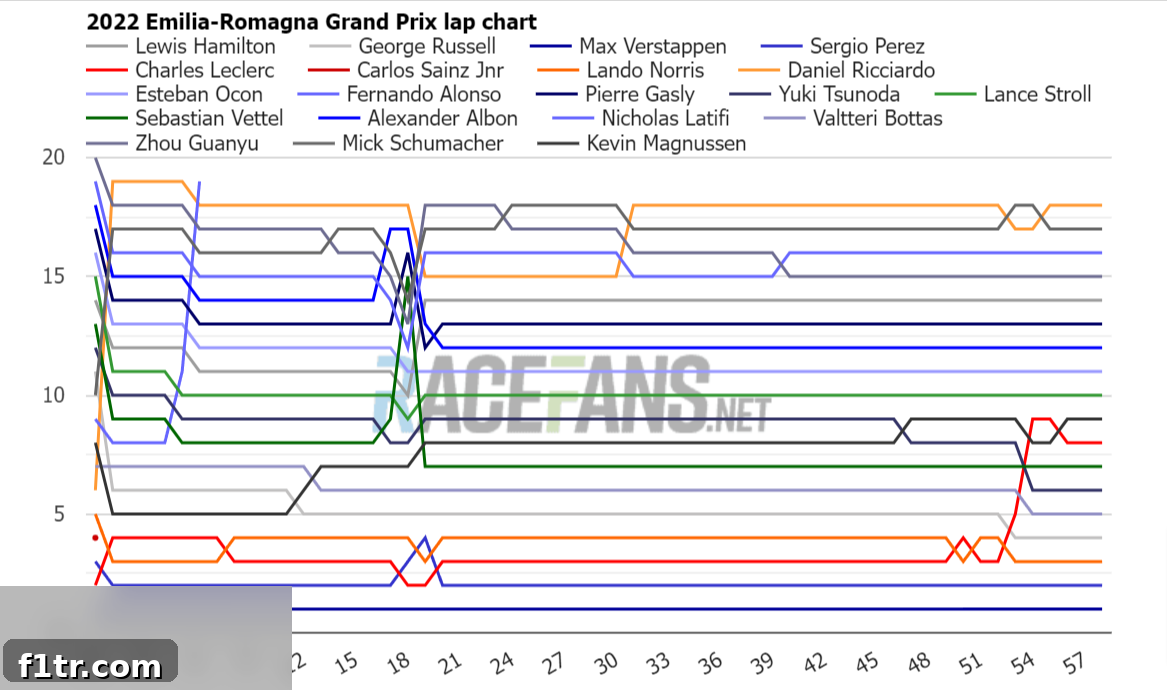
2022 Emilia-Romagna Grand Prix Lap Chart
The lap chart visually represents the position of each driver on every lap of the race. Interactive versions typically allow users to click names to highlight specific drivers and track their progress or regressions throughout the Grand Prix. This tool is invaluable for understanding track position battles and strategic shifts as they unfold.
2022 Emilia-Romagna Grand Prix Race Chart
The race chart illustrates the gaps between each driver relative to the leader’s average lap time. It provides a clear picture of how the field spreads out, who is gaining, and who is losing ground. Very large gaps are often omitted for clarity, allowing for a focused view on the competitive clusters. This chart highlights the ebb and flow of pace and strategic advantages.
Position Change
This table summarizes the changes in driver positions from their starting grid slot, including their performance on the chaotic opening lap and their overall progress or decline by the race’s end. It offers a quick snapshot of who gained and lost the most ground.
| Driver | Start position | Lap one position change | Race position change |
|---|---|---|---|
| Lewis Hamilton | 14 | 2 | 0 |
| George Russell | 11 | 5 | 7 |
| Max Verstappen | 1 | 0 | 0 |
| Sergio Perez | 3 | 1 | 1 |
| Charles Leclerc | 2 | -2 | -4 |
| Carlos Sainz Jnr | 4 | ||
| Lando Norris | 5 | 2 | 2 |
| Daniel Ricciardo | 6 | -13 | -12 |
| Esteban Ocon | 16 | 3 | 5 |
| Fernando Alonso | 9 | 1 | |
| Pierre Gasly | 17 | 3 | 4 |
| Yuki Tsunoda | 12 | 2 | 5 |
| Lance Stroll | 15 | 4 | 5 |
| Sebastian Vettel | 13 | 4 | 5 |
| Alexander Albon | 18 | 3 | 6 |
| Nicholas Latifi | 19 | 3 | 3 |
| Valtteri Bottas | 7 | 0 | 2 |
| Zhou Guanyu | 20 | 2 | 5 |
| Mick Schumacher | 10 | -7 | -7 |
| Kevin Magnussen | 8 | 3 | -1 |
2022 Emilia-Romagna Grand Prix Lap Times
This section displays all recorded lap times for the drivers, excluding exceptionally slow laps that might skew the data (e.g., pit stop laps or significant incidents). Analyzing individual lap times helps in understanding each driver’s consistent pace, their performance on different tire compounds, and how they managed their tires throughout their stints.
2022 Emilia-Romagna Grand Prix Fastest Laps
The fastest lap table highlights the quickest single lap achieved by each driver during the race. This metric is crucial not only for the additional point awarded to the driver who sets the fastest lap (provided they finish in the top 10) but also for indicating ultimate car performance and a driver’s ability to extract maximum speed when needed.
| Rank | Driver | Car | Fastest lap | Gap | On lap |
|---|---|---|---|---|---|
| 1 | Max Verstappen | Red Bull | 1’18.446 | 55 | |
| 2 | Charles Leclerc | Ferrari | 1’18.574 | 0.128 | 63 |
| 3 | Sergio Perez | Red Bull | 1’18.949 | 0.503 | 52 |
| 4 | Mick Schumacher | Haas-Ferrari | 1’18.999 | 0.553 | 55 |
| 5 | Yuki Tsunoda | AlphaTauri-Red Bull | 1’20.544 | 2.098 | 61 |
| 6 | Valtteri Bottas | Alfa Romeo-Ferrari | 1’20.758 | 2.312 | 43 |
| 7 | Lando Norris | McLaren-Mercedes | 1’20.903 | 2.457 | 61 |
| 8 | George Russell | Mercedes | 1’20.962 | 2.516 | 57 |
| 9 | Sebastian Vettel | Aston Martin-Mercedes | 1’21.211 | 2.765 | 47 |
| 10 | Kevin Magnussen | Haas-Ferrari | 1’21.238 | 2.792 | 61 |
| 11 | Zhou Guanyu | Alfa Romeo-Ferrari | 1’21.286 | 2.840 | 61 |
| 12 | Nicholas Latifi | Williams-Mercedes | 1’21.338 | 2.892 | 62 |
| 13 | Lewis Hamilton | Mercedes | 1’21.419 | 2.973 | 50 |
| 14 | Daniel Ricciardo | McLaren-Mercedes | 1’21.577 | 3.131 | 61 |
| 15 | Pierre Gasly | AlphaTauri-Red Bull | 1’21.713 | 3.267 | 34 |
| 16 | Lance Stroll | Aston Martin-Mercedes | 1’21.750 | 3.304 | 46 |
| 17 | Alexander Albon | Williams-Mercedes | 1’21.757 | 3.311 | 61 |
| 18 | Esteban Ocon | Alpine-Renault | 1’21.887 | 3.441 | 37 |
| 19 | Fernando Alonso | Alpine-Renault | 1’39.685 | 21.239 | 5 |
| 20 | Carlos Sainz Jnr | Ferrari |
Advert | Become a RaceFans supporter andgo ad-free
2022 Emilia-Romagna Grand Prix Tyre Strategies
This table provides a comprehensive overview of each driver’s tire strategy throughout the race, detailing the compound used and the number of laps completed on each stint. It showcases the diverse approaches teams took, from the standard two-stop (or one-stop on slicks) to more aggressive multi-stop gambles.
| Stint 1 | Stint 2 | Stint 3 | Stint 4 | |
|---|---|---|---|---|
| Max Verstappen | Intermediate (19) | C3 (32) | C4 (12) | |
| Sergio Perez | Intermediate (18) | C3 (32) | C4 (13) | |
| Lando Norris | Intermediate (19) | C3 (44) | ||
| George Russell | Intermediate (18) | C3 (45) | ||
| Valtteri Bottas | Intermediate (18) | C3 (45) | ||
| Charles Leclerc | Intermediate (19) | C3 (30) | C4 (4) | C4 (10) |
| Yuki Tsunoda | Intermediate (18) | C3 (45) | ||
| Sebastian Vettel | Intermediate (17) | C3 (46) | ||
| Kevin Magnussen | Intermediate (18) | C3 (45) | ||
| Lance Stroll | Intermediate (18) | C3 (44) | ||
| Esteban Ocon | Intermediate (18) | C3 (44) | ||
| Alexander Albon | Intermediate (17) | C3 (45) | ||
| Pierre Gasly | Intermediate (17) | C3 (45) | ||
| Lewis Hamilton | Intermediate (18) | C3 (44) | ||
| Zhou Guanyu | Intermediate (18) | C3 (44) | ||
| Nicholas Latifi | Intermediate (18) | C3 (44) | ||
| Mick Schumacher | Intermediate (18) | C3 (34) | C4 (10) | |
| Daniel Ricciardo | Intermediate (2) | C3 (14) | C2 (14) | |
| Fernando Alonso | Intermediate (6) | |||
| Carlos Sainz Jnr | Intermediate (1) |
2022 Emilia-Romagna Grand Prix Pit Stop Times
The pit stop times table details the duration of each driver’s pit stops. In Formula 1, fractions of a second can make a huge difference, and this data highlights the efficiency of pit crews, the speed of tire changes, and any potential delays that impacted a driver’s race.
| Driver | Team | Pit stop time | Gap | On lap | |
| 1 | Sergio Perez | Red Bull | 29.627 | 50 | |
| 2 | Max Verstappen | Red Bull | 29.942 | 0.315 | 51 |
| 3 | Max Verstappen | Red Bull | 30.001 | 0.374 | 19 |
| 4 | Charles Leclerc | Ferrari | 30.042 | 0.415 | 49 |
| 5 | Lando Norris | McLaren | 30.070 | 0.443 | 19 |
| 6 | Daniel Ricciardo | McLaren | 30.155 | 0.528 | 30 |
| 7 | Sergio Perez | Red Bull | 30.366 | 0.739 | 18 |
| 8 | Yuki Tsunoda | AlphaTauri | 30.372 | 0.745 | 18 |
| 9 | Pierre Gasly | AlphaTauri | 30.405 | 0.778 | 17 |
| 10 | Daniel Ricciardo | McLaren | 30.422 | 0.795 | 16 |
| 11 | Sebastian Vettel | Aston Martin | 30.484 | 0.857 | 17 |
| 12 | Alexander Albon | Williams | 30.793 | 1.166 | 17 |
| 13 | Mick Schumacher | Haas | 30.984 | 1.357 | 52 |
| 14 | George Russell | Mercedes | 31.079 | 1.452 | 18 |
| 15 | Nicholas Latifi | Williams | 31.125 | 1.498 | 18 |
| 16 | Mick Schumacher | Haas | 31.320 | 1.693 | 18 |
| 17 | Esteban Ocon | Alpine | 31.409 | 1.782 | 18 |
| 18 | Charles Leclerc | Ferrari | 31.794 | 2.167 | 19 |
| 19 | Zhou Guanyu | Alfa Romeo | 32.203 | 2.576 | 18 |
| 20 | Daniel Ricciardo | McLaren | 32.362 | 2.735 | 2 |
| 21 | Lance Stroll | Aston Martin | 32.667 | 3.040 | 18 |
| 22 | Lewis Hamilton | Mercedes | 32.740 | 3.113 | 18 |
| 23 | Kevin Magnussen | Haas | 33.765 | 4.138 | 18 |
| 24 | Charles Leclerc | Ferrari | 36.560 | 6.933 | 53 |
| 25 | Valtteri Bottas | Alfa Romeo | 40.957 | 11.330 | 18 |
Conclusion: Lessons Learned from Imola
The 2022 Emilia-Romagna Grand Prix was a microcosm of Formula 1’s strategic intensity, illustrating the high stakes involved in every decision. Ferrari’s brave attempt to pressure Red Bull, while ultimately ending in disappointment for Leclerc, underscored the team’s commitment to challenging for every possible advantage. It was a calculated risk that, for a moment, genuinely threatened the dominant Red Bull pairing. Red Bull’s swift and intelligent counter-strategy, however, showcased their formidable strength, not just in raw pace but also in their ability to react decisively and maintain control under pressure.
The race also highlighted the critical role of adaptability in unpredictable conditions, from Daniel Ricciardo’s initial slick tire gamble setting the trend for the entire field, to the nuanced interpretations of tire wear and strategic intent from team principals. Imola served as a potent reminder that in Formula 1, victory is not solely about the fastest car or driver, but a complex interplay of engineering, driving talent, and strategic acumen, where a single misstep or a brilliant call can dramatically alter the outcome. It’s these strategic battles that add layers of excitement and unpredictability, cementing Formula 1’s status as a premier global motorsport spectacle.
Go ad-free for just £1 per month>> Find out more and sign up
Become a RaceFans Supporter
RaceFans is run thanks in part to the generous support of its readers. By contributing £1 per month or £12 per year (or the same in whichever currency you use) you can help cover the costs of creating, hosting and developing RaceFans today and in the future.
Become an RaceFans Supporter today and browse the site ad-free. Sign up or find out more via the links below:
- Become a RaceFans Supporter
- RaceFans Supporter FAQ
2022 Emilia-Romagna Grand Prix
- Aston Martin’s first points reward “immense” effort by factory after Melbourne crashes
- Verstappen becomes 14th driver in F1 history to score more than one ‘grand slam’
- Transcript: “I need more power” – Hamilton and Russell’s contrasting fortunes at Imola
- Ferrari backs increase to six sprint races as F1 Commission meets in London
- Ocon blames pit equipment after penalty for near-miss with Hamilton in pits
Browse all 2022 Emilia-Romagna Grand Prix articles