F1 Midfield Battle: Alfa Romeo’s Struggle to Contain George Russell’s Williams Threat
The Formula 1 midfield consistently delivers some of the most enthralling battles on the track, where fractions of a second and every championship point can drastically alter a team’s fortunes. In this cutthroat environment, Alfa Romeo Racing ORLEN finds itself in a peculiar and challenging position. Despite making undeniable strides in qualifying performance, the team is struggling to consistently convert this potential into race day results, often finding their path blocked by an unexpected, yet formidable, opponent: George Russell of Williams Racing. This dynamic creates a captivating subplot within the 2021 F1 season, as Alfa Romeo grapples with the task of overcoming a driver whose talent frequently surpasses his car’s inherent capabilities.
Throughout the 2021 campaign, Alfa Romeo has shown encouraging signs of progress with their C41 challenger. The team has consistently demonstrated an ability to extract more pace on Saturdays, leading to improved grid positions compared to previous seasons. However, this enhanced qualifying performance has not consistently translated into championship points, a critical metric for any F1 team. The frustration within the team is palpable, particularly when confronted by the exceptional individual performances of George Russell, whose consistent ability to push his Williams FW43B into the upper echelons of the midfield qualifying battle often places him directly in Alfa Romeo’s path.
The George Russell Effect: A Williams Driver Defying Expectations
George Russell’s contributions to Williams Racing during the 2021 Formula 1 season have been nothing short of extraordinary. His performances have repeatedly exceeded what one might expect from a car generally perceived to be a backmarker. A prime example of this came at the Austrian Grand Prix, where Russell delivered a masterclass in qualifying, expertly guiding his Williams into Q3 for the first time that year. This remarkable effort culminated in an impressive eighth-place starting position on the grid.
This achievement is particularly significant when viewed against Alfa Romeo’s best qualifying result for 2021, which saw one of their drivers start tenth. Russell’s ability to consistently outshine his machinery is further highlighted by his average qualifying position of 13.5 for the season. This places him notably ahead of experienced campaigners like Alfa Romeo’s Kimi Raikkonen and even some drivers in ostensibly faster cars, such as AlphaTauri’s Yuki Tsunoda. He also holds a slight edge over Antonio Giovinazzi, Alfa Romeo’s other driver. Russell’s recurring capacity to elevate the Williams’ performance on a single lap makes him a formidable and often frustrating opponent for teams with greater resources, who find themselves consistently challenged by his raw speed and precision.
Austrian Grand Prix: A Microcosm of Alfa Romeo’s Struggle
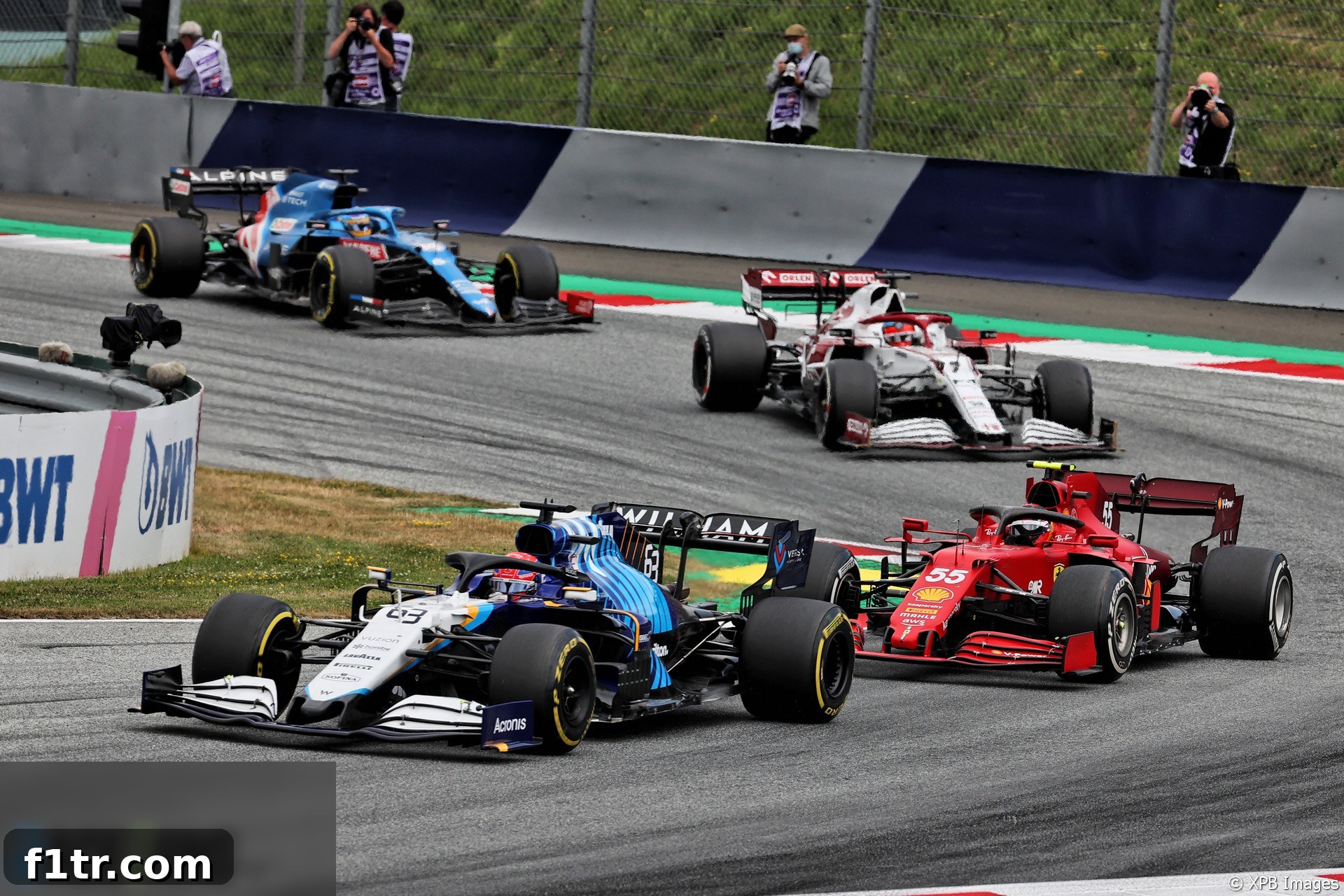
The Austrian Grand Prix served as a stark illustration of Alfa Romeo’s ongoing challenge to convert their qualifying promise into concrete race results, especially when battling George Russell. Despite respectable grid positions, the race presented numerous hurdles for the Swiss-Italian outfit. Antonio Giovinazzi’s race was compromised from the outset with an unscheduled first-lap pit stop, a setback that severely disrupted his strategy and relegated him to the back of the field. Kimi Raikkonen, demonstrating flashes of his characteristic racecraft, managed to climb as high as sixth place at one point during the early stages of the race.
However, Raikkonen’s progress was ultimately stifled by his inability to pass Russell. For a considerable portion of his crucial first stint, the veteran Finn found himself locked behind the Williams, despite what Alfa Romeo believed to be a superior car in race trim. This demonstrated the immense difficulty in overtaking Russell, even when holding a theoretical pace advantage. The team’s frustrations were compounded by a last-lap collision for Raikkonen, further dimming their hopes for points. Consequently, both Alfa Romeo drivers finished behind George Russell in Austria, a result that powerfully underscored the disparity between their qualifying potential and their actual race-day performance when pitted against a driver of Russell’s calibre.
Technical Insights: Straight-Line Speed vs. Overall Race Pace
Xevi Pujolar, Alfa Romeo’s head of trackside engineering, provided valuable commentary on the inherent characteristics of the Williams car that make it such a formidable opponent. He specifically highlighted its impressive straight-line speed, stating, “It’s quick on the straights. I can confirm that. Difficult to follow and to pass on the straights.” This characteristic suggests that Williams might be running a lower downforce setup, prioritizing drag reduction to maximize speed on straights, a strategy that can be particularly effective at circuits like the Red Bull Ring with its numerous long acceleration zones. This inherent advantage makes the Williams incredibly difficult to pass once it gains momentum, even for cars that might be quicker through corners.
Despite this, Pujolar expressed confidence in Alfa Romeo’s overall package, asserting, “but I think we have got a better race car.” This statement implies that while the Williams might hold an advantage in terms of sheer top speed, the Alfa Romeo C41 likely possesses superior attributes in other critical areas such as cornering performance, stability under braking, or more efficient tire management over a full race stint. However, realizing the benefit of a “better race car” hinges on the ability to effectively utilize those strengths on track. If a car cannot overtake, even a theoretically faster race pace becomes irrelevant. This strategic conundrum – how to leverage superior overall performance against a competitor with a clear straight-line advantage – remains a central challenge for Alfa Romeo in the tightly contested F1 midfield.
Advert | Become a RaceFans supporter and go ad-free
The Intense Midfield Scramble: Beyond Just Russell
While George Russell’s individual brilliance undoubtedly poses a significant challenge, Alfa Romeo’s ambitions are also intertwined with a broader and fiercely competitive array of midfield rivals. Pujolar underscored the tight nature of this segment of the grid, remarking, “Not only Russell, but we can fight here with Alpine, with Aston Martin, and even one of the AlphaTauris. So everything is very tight.” This candid assessment highlights the intense nature of the Constructors’ Championship battle, where points are hard-won and the pecking order can fluctuate dramatically from one event to the next. Established teams like Alpine, featuring talents such as Esteban Ocon and Fernando Alonso, and Aston Martin, with Sebastian Vettel and Lance Stroll, are formidable opponents frequently vying for the final points-scoring positions.
The consistent threat from AlphaTauri, particularly through Pierre Gasly’s impressive and often unexpected performances, further emphasizes the razor-thin margins. For Alfa Romeo, the ability to consistently engage in direct battles with these highly competitive teams signifies genuine progress when compared to their standing in recent seasons. Yet, the persistent frustration of not consistently converting their improved potential into tangible championship points remains. The difference between success and disappointment in this part of the grid is incredibly fine, demanding flawless execution in every aspect of the race weekend, from strategic calls to pit stop efficiency and on-track racecraft. Upcoming races, including iconic venues, will continue to test the endurance and adaptability of these teams, requiring maximum effort from both car and driver in this high-stakes Formula 1 season.
Leadership Perspectives: Confidence, Expectation, and the Path Forward
Jost Capito’s Endorsement of George Russell
The leadership at Williams Racing naturally holds George Russell in the highest regard, especially given his consistent ability to outperform the car’s perceived limitations. Team Principal Jost Capito, a veteran in motorsport who has previously worked with top talents including Kimi Raikkonen, expressed immense satisfaction with Russell’s contributions. Capito articulated the team’s high expectations for Russell, particularly following his standout performances in the previous year, confirming, “The expectations were high [for Russell] especially after last year. And I think he fully delivers according to the expectations.” This powerful endorsement underscores not only Russell’s exceptional current form but also the significant potential he embodies for the future of Formula 1. His consistent knack for extracting the absolute maximum from the Williams car, often bringing it into direct contention for points, unequivocally validates the team’s profound faith in his capabilities and solidifies his reputation as one of the sport’s most promising young talents.
Xevi Pujolar’s Call to Action for Alfa Romeo
On the Alfa Romeo side, Xevi Pujolar’s comments reveal a pragmatic yet determined assessment of the challenge presented by Russell and a clear resolve to overcome it. While openly acknowledging Russell’s exceptional qualifying prowess — stating that “Russell is quite especially doing a very good job in qualifying” — Pujolar’s subsequent message to his team is unambiguous: “we just need to work harder and match it or do better.” This isn’t merely a call for continued car development; it’s a broader mandate to optimize every facet of their race weekend operations. This includes refining car setup, developing more effective race strategies, and ensuring that both drivers, Antonio Giovinazzi and Kimi Raikkonen, can consistently maximize the car’s potential on both qualifying Saturdays and race Sundays. The pressure on Alfa Romeo is intensifying, as they strive to translate their improved qualifying pace into consistent, points-scoring race finishes, a goal that becomes increasingly difficult when a driver of Russell’s caliber acts as a persistent and formidable barrier.
Strategic Implications and Future Prospects for Alfa Romeo
For Alfa Romeo, navigating the challenge posed by George Russell and the broader F1 midfield necessitates a comprehensive and multi-faceted strategic approach. Their focus must extend beyond simply raw pace to encompass robust race strategies, flawlessly executed pit stops, and exceptional tire management throughout a Grand Prix. If their “better race car” truly holds a tangible advantage in race trim, then finding innovative ways to leverage this without getting trapped behind cars with superior straight-line speed becomes paramount. This could involve exploring daring undercut or overcut strategies, or perhaps a more aggressive approach to car setup that explicitly prioritizes overtaking potential over achieving an absolute qualifying lap time.
Looking ahead, the remaining races of the 2021 season are critically important for Alfa Romeo’s championship aspirations. Consistently outperforming direct rivals such as Williams, Aston Martin, and Alpine in both qualifying and converting those advantageous grid positions into valuable championship points will be the defining measure of their season’s success. While George Russell continues to capture headlines with his stellar performances, his future beyond Williams remains a constant topic of speculation, a factor that could potentially reshape the midfield landscape in the coming years. For the present, however, he remains a significant and formidable obstacle. Alfa Romeo’s journey through this fiercely contested midfield serves as a compelling testament to the unpredictable and thrilling nature of Formula 1, where driver talent, technical innovation, and strategic acumen all converge to determine ultimate success.
Related Articles: 2021 Austrian Grand Prix
Explore more in-depth analyses and perspectives from the 2021 Austrian Grand Prix and the ongoing F1 season:
- Vasseur on Alfa’s “huge step forward” and why he’s vexed by technical directives
- How Ricciardo “got some enjoyment back” after “really low” first race in Austria
- F1’s penalty points are not “harsh” and won’t be reviewed this year – Masi
- Austrian double showed Sainz found his feet faster than 2021’s other big-name moves
- 2021 Austrian Grand Prix Star Performers
Browse all 2021 Austrian Grand Prix articles