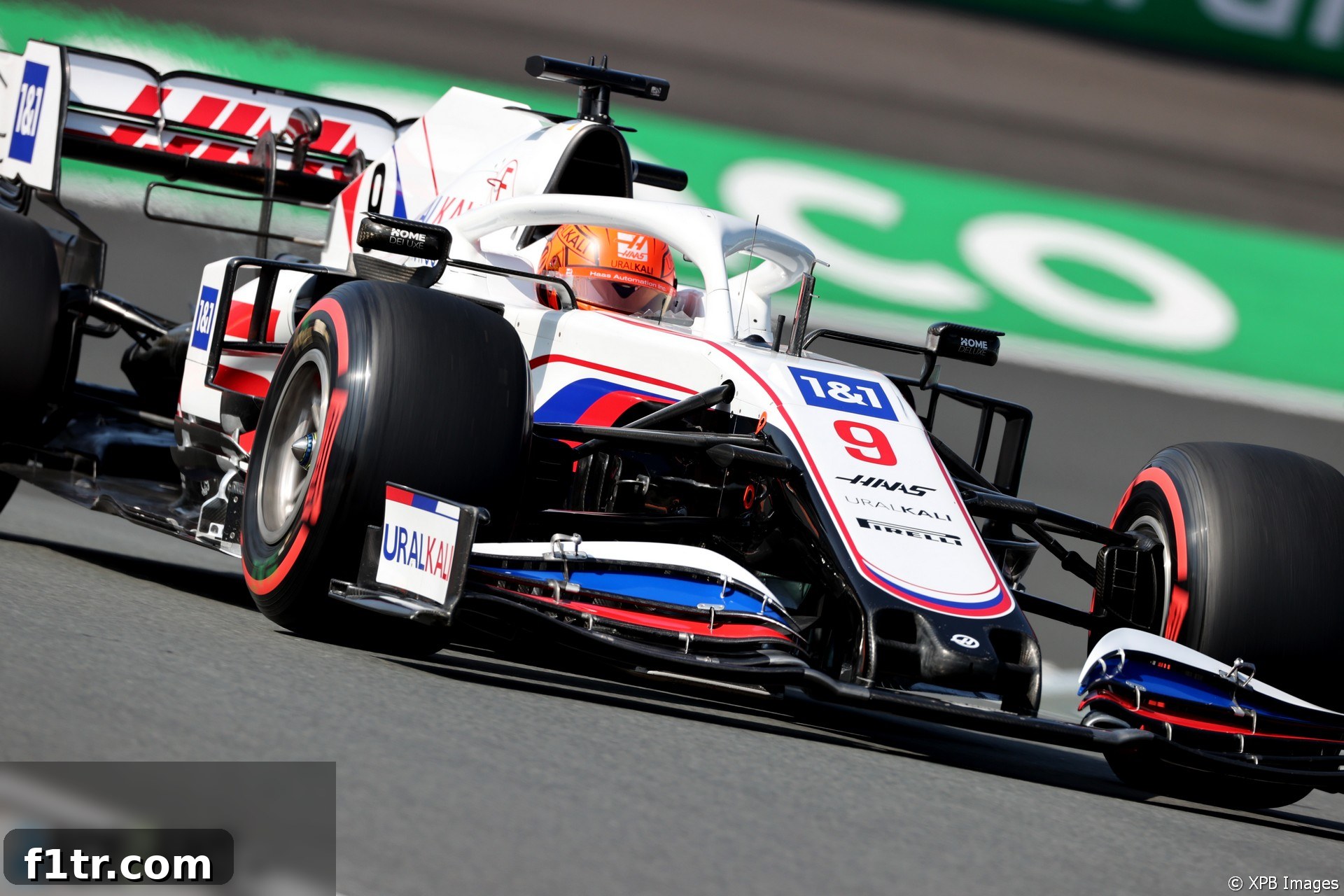
Nikita Mazepin declared his firm stance against what he perceived as a disregard for an agreed-upon internal team arrangement by his teammate, Mick Schumacher, during a critical qualifying session. The incident, which unfolded during the Q1 segment of the 2021 Dutch Grand Prix, brought the simmering tensions between the two Haas drivers to a head, sparking a heated radio exchange and subsequent discussions.
Clash on the Out-Lap: Mazepin’s Frustration
The controversy ignited when Schumacher overtook Mazepin as both drivers exited the pits, embarking on their crucial final runs in Q1. Mazepin, visibly and audibly frustrated, voiced his complaints vociferously over the team radio. He later articulated his belief that, based on prior team discussions and an established system, he had the prerogative to lead the two Haas cars out onto the track for the qualifying attempt.
Reflecting on the contentious moment, Mazepin stated, “We had a discussion in the team about what happened. And I think after that discussion there is one clear thing that’s left: the system that I was told in Imola is not the case any more. I’m not sure when it changed and how it changed.” His comments underscored a profound sense of confusion and betrayal regarding what he understood to be a clear protocol within the team for managing track position on out-laps.
Mazepin emphasized the urgent need for clarity and consistency, particularly given the competitive nature of Formula 1. “So we need to find a system that works because I’m not going to give in, he doesn’t want to give in. So we need to find a ruling procedure, which both of us have to apply to, not when each of us wants. We need to find a procedure that each driver has to apply to all the time with a must.” His firm declaration highlighted his determination not to yield in future similar scenarios, necessitating a clear directive from the Haas F1 team management to prevent further clashes.
Acknowledging the team’s developmental stage, Mazepin added, “We are a young team, as everybody says. So I think we will get better, improve, understand and become stronger from it.” This statement, while hopeful, also implicitly pointed to the organizational challenges a new or struggling team faces, where such internal conflicts can often arise and escalate.
Schumacher’s Rationale: Tyre Warm-Up and Team Approval
In stark contrast to Mazepin’s perception of a breach of agreement, Mick Schumacher’s perspective painted a different picture, supported by his team radio communications. The transcript revealed that Schumacher explicitly sought and received permission from his race engineer, Gary Gannon, to overtake Mazepin.
“My radio communication was clear that I was allowed to overtake him as long as it was before turn three,” explained Schumacher, confirming that he acted within the clear guidelines provided by his engineer. “And I did so.” This indicates a potential disconnect or miscommunication between different parts of the Haas F1 team, or differing interpretations of existing “team orders” regarding out-lap etiquette.
Schumacher further elaborated on the strategic necessity behind his move. His primary motivation was to generate sufficient temperature in his tyres, which had cooled considerably while waiting in the pit lane. “I’ve been [running] behind him for the whole part of the weekend and it’s been quite clear already since FP3 that I needed for some reason a faster out-lap compared to him to warm up my tyres,” he revealed. He added that this issue was particularly pronounced in earlier runs, where he experienced “nearly no grip” in turn 13 due to cold tyres.
The young German driver clarified his request: “I needed a faster lap and Nikita didn’t, so that’s why I asked. I requested and I did get the okay.” He firmly denied any malicious intent towards his teammate. “I didn’t try to impede him or make his life difficult,” Schumacher insisted, “I was just trying to make my life a bit easier by having the opportunity to go faster. I also overtook Lando [Norris] around the lap to try and get even more heat in.” This highlights the critical importance of tyre preparation in modern Formula 1 and how drivers often adapt their out-lap strategies to achieve optimal performance.
The Hazardous Aftermath: Vettel’s Intervention and Stewards’ Scrutiny
The initial dispute between the Haas drivers escalated into a more dangerous situation on track. Following Schumacher’s overtake, Mazepin attempted to reclaim his position, resulting in both cars momentarily running side-by-side. This maneuvering occurred precisely as Sebastian Vettel, driving his Aston Martin, approached them at high speed, attempting to begin his own flying lap. The veteran German driver was significantly hampered by the Haas pair, forcing him to take evasive action.
The stewards swiftly noted the incident, initiating an investigation into the Haas drivers for potentially impeding another competitor. While both Mazepin and Schumacher ultimately avoided a penalty, the event underscored the inherent dangers of on-track squabbles during critical qualifying sessions, especially when faster cars are trying to manage their own runs.
Mazepin later offered a degree of leniency towards Schumacher regarding the Vettel incident. “To be fair to Mick, I was very upset because I was overtaken when I wasn’t supposed to be overtaken, and then he backed me up into Vettel. But in all fairness to him, he didn’t know that Vettel was coming. It goes a little bit towards the direction that he didn’t back me up on purpose.” This acknowledges the limited visibility and real-time information drivers often have regarding approaching competitors, relying heavily on team radio guidance.
However, Mazepin also emphasized his own awareness of Vettel’s approach: “But I, on the other hand, knew that he was coming and I needed to get out of the way. So I moved to the inside but with Mick braking and making a gap to Latifi, there was nowhere to go.” He painted a vivid picture of the chaotic circumstances: “You’re always going to end up in some sort of trouble when seven cars are travelling at 30kph and a fast car is arriving at 300. But it’s been a very stressful 20 minutes of my life.” This segment highlights the safety implications and the immense pressure drivers face, particularly in congested traffic during qualifying.
An Enduring Rivalry: Mazepin’s Philosophy and Team Dynamics
This incident at Zandvoort was by no means the first confrontation between the two Haas F1 teammates. Throughout the 2021 season, Nikita Mazepin and Mick Schumacher had been involved in several near-misses and even a notable tangle at Silverstone, suggesting a pattern of intense internal competition that occasionally borders on friction. The ongoing rivalry has cast a spotlight on the team’s ability to manage its rookie drivers effectively, especially when they are competing at the very back of the grid.
When questioned by RaceFans about the possibility of improving his relationship with Schumacher, Mazepin articulated a clear personal philosophy and commitment to following team directives. “I’m Russian, and the way that I believe we are is that we’re very direct and I know my place in the team,” he asserted. “I’ve got a team boss and I’m more than happy to follow the rules because I think it’s very important to be a team, and one day the rules will play towards you, one day the rules will play against you but at least it’s consistent and you know where you stand.” This emphasizes his preference for clear, unambiguous rules and a hierarchical structure within the team.
Mazepin also expressed his disdain for what he perceives as opportunistic or disrespectful behavior on track, especially when drivers are fighting for less significant positions. “What I don’t like with people is when they are cheeky, fighting for P19. I think it just shows their true nature and I don’t tolerate that and I will just remain being myself, regardless of the outcome and I will listen to my team boss, which is Günther [Steiner] and do as I’m told, until the last day of my Formula 1 career, which hopefully is very far away.” His strong words highlight his direct approach and his unwavering loyalty to the team principal, Günther Steiner, suggesting that he expects the same level of adherence to rules from his teammate.
Mazepin Team Radio Excerpt from Q3
| Haines: | Line feedback from Ed. At turn three turn in later at turn three to stay higher. |
| Mazepin: | I thought Mick is not allowed to overtake me? That’s not fine. You said he’s not allowed to overtake. |
| Haines: | Copy let’s just keep the gap to him, let’s just keep the gap we need the end of the lap. Bottas behind is in sync. |
| Haines: | Queueing cars at the end of the lap, we still have plenty of time. |
| Haines: | Mazepin passes Norris and draws alongside Schumacher after turn 12. The first pushing car is Vettel, currently six seconds back. Vettel now five behind on a push. |
| Haines: | Mazepin dives down the inside of Schumacher at turn 13 but doesn’t pass. Remember mode push. And watch for Vettel two behind. Watch for Vettel coming past. And then in sync. |
| Mazepin: | Unclear. |
| Haines: | Okay watch for Perez first pushing car now, four seconds back. |
| Mazepin: | Is there a chance to go again or is that it? |
| Haines: | No, that’s it. Perez one-and-a-half seconds back. I think he’s backed out., |
| Mazepin: | Yeah man what the fuck, you said to me we are the first car |
| Komatsu: | I’ll talk to you afterwards, Nikita. |
Implications for the Haas F1 Team and Driver Management
The unfolding drama between Nikita Mazepin and Mick Schumacher during the Dutch Grand Prix qualifying session is emblematic of the challenges faced by the Haas F1 team. As a smaller outfit operating with limited resources and fielding two rookie drivers, the internal dynamic between teammates becomes even more critical. While healthy competition is expected and encouraged, recurrent clashes and perceived breaches of internal protocols can lead to a toxic atmosphere, potentially hindering the team’s overall performance and development. For a team like Haas, which often finds itself battling at the rear of the grid, cohesion and clarity are paramount to maximizing any available opportunities.
The incident also underscores the intricate complexities of F1 team orders and driver management. Balancing individual driver ambitions with team objectives, especially concerning track positioning, tyre warm-up strategies, and maintaining clear air for flying laps, requires meticulous planning and unambiguous communication. The differing accounts from Mazepin and Schumacher, despite both being under the same team umbrella, suggest a breakdown in either the establishment or communication of these vital rules.
Going forward, the onus will be on Günther Steiner and the Haas F1 management to implement a robust and transparent system that both drivers understand and are compelled to adhere to. Without a clear and consistently enforced procedure, such incidents are likely to recur, potentially jeopardizing the team’s standing and the development of its young drivers. The episode at Zandvoort serves as a stark reminder that even in the lowest echelons of the F1 grid, the stakes remain incredibly high, and driver rivalries can have significant consequences.
2021 Dutch Grand Prix
- “So many people love him”: Raikkonen’s rivals pay tribute to retiring champion
- Alonso studied junior series, not IndyCar, for Zandvoort banking clues
- 2021 Dutch Grand Prix Star Performers
- Paddock Diary: Dutch Grand Prix part two
- Verstappen makes the Netherlands 12th country to produce a home F1 winner
Browse all 2021 Dutch Grand Prix articles