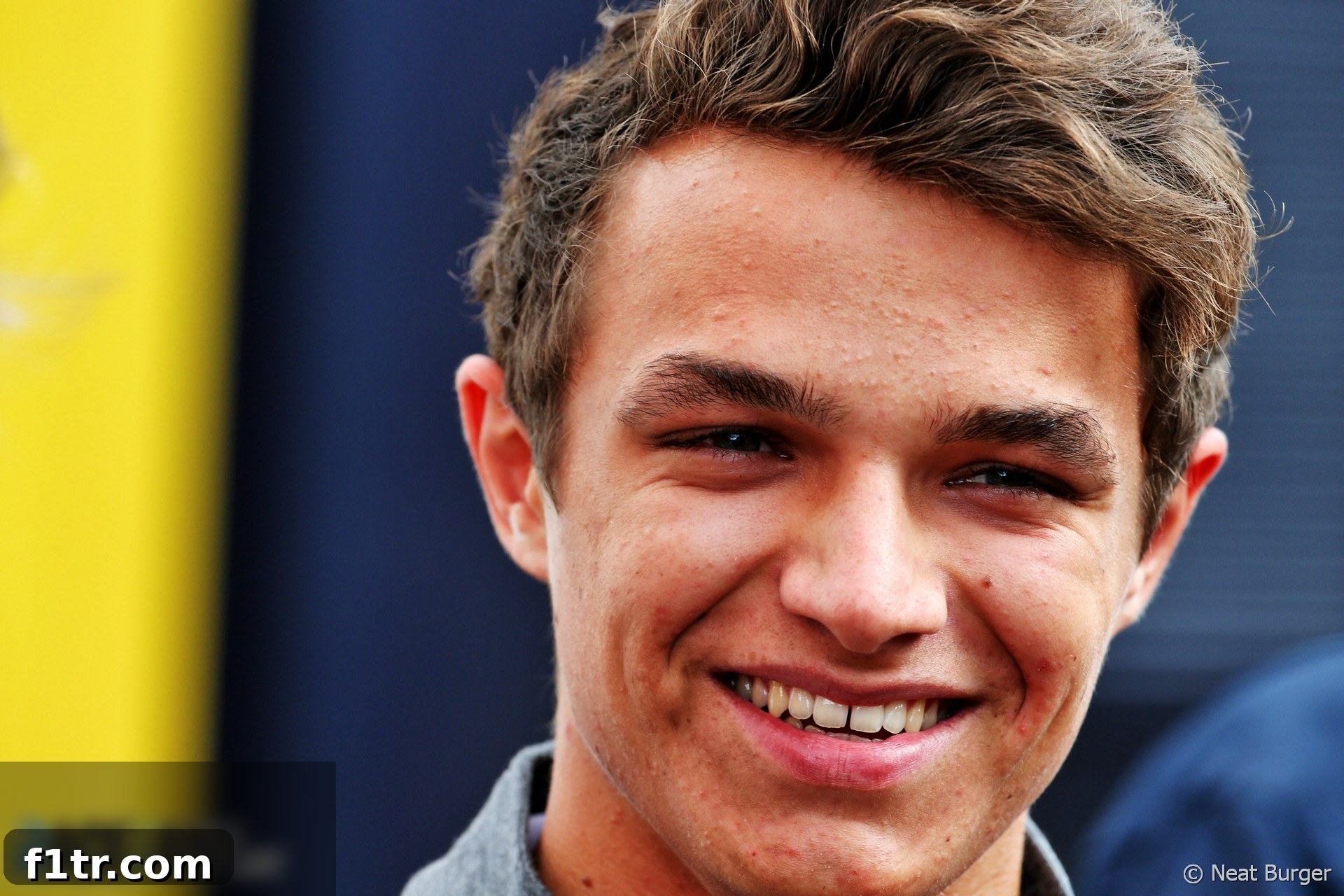
In the high-octane world of Formula 1, where every word is often meticulously crafted, Lando Norris stands out. His approach to racing, particularly during his debut season, has consistently been marked by a refreshing straightforwardness and a surprisingly frank self-assessment. This candidness offers a unique glimpse into the mindset of a young talent navigating the intense pressures of elite motorsport. His first full season with McLaren in Formula 1 was, by many metrics, a remarkable achievement for a rookie. Yet, Norris, a former F3 champion and F2 runner-up, openly admitted to significant apprehension leading up to his debut. He confessed to questioning his own capabilities, specifically pondering, “if I was going to be good enough” when placed alongside his more experienced team mate, Carlos Sainz Jnr.
The transition from junior categories to Formula 1 is notoriously challenging, and Norris articulated the immense pressure he felt. “I didn’t know if I was going to be quick enough going up against a driver who’s done four years in Formula 1, in McLaren – just in Formula 1 against so many good drivers,” Norris reflected. This sentiment underscores the daunting task faced by any rookie: proving their mettle against a grid full of world-class drivers and, crucially, against an established teammate. The self-doubt was palpable. “I didn’t know if I was going to be able to do a good enough job every time,” he added, highlighting the relentless consistency demanded at the pinnacle of motorsport.
Such initial uncertainty is not uncommon, even for drivers of Norris’s evident talent. However, his ability to swiftly overcome this apprehension became a hallmark of his rookie campaign. The early races of the 2019 season provided the perfect antidote to his self-doubt. By reaching Q3 on his debut at the Australian Grand Prix and then securing an impressive sixth place at the chequered flag in Bahrain, Norris immediately signaled his raw pace and potential. These performances were instrumental in building his confidence. “So I just didn’t believe in myself much. But already even after Australia and then Bahrain and I already gained a lot of confidence from that,” he explained, emphasizing how quickly positive results can reshape a driver’s mental landscape.
Norris’s immediate impact was not just a pleasant surprise; it was a clear demonstration of his inherent speed. Many observers expected a period of adaptation, but Norris bypassed it with ease. Indeed, the fact that he didn’t manage to better that sixth-place finish by the end of the season was perhaps the biggest surprise, often attributed to a string of unfortunate events rather than a lack of pace or skill. This solid foundation set the stage for a season where he would continuously learn, adapt, and push the boundaries of what was expected from a Formula 1 newcomer.
Qualifying: A Testament to Raw Pace
The lower the lines in the chart above, the better the driver performed in qualifying relative to their teammate.
One area where Lando Norris consistently shone throughout his junior career was qualifying. His ability to extract maximum performance from a car over a single flying lap was undeniable. Curiously, this strength seemed to falter slightly during his stint in Formula 2, where he appeared to lose a fraction of his distinctive edge. Yet, upon his promotion to Formula 1, Norris spectacularly rediscovered his knack for delivering exceptional qualifying laps, a crucial asset in a sport where grid position can heavily influence race outcomes. His performance in qualifying was frequently a highlight, underlining his pure, unadulterated speed from the moment he stepped into the McLaren MCL34.
In a direct comparison with his more seasoned teammate, Carlos Sainz Jnr, Norris demonstrated remarkable parity. Over the course of the 2019 season, the two drivers tied 10-10 in their qualifying head-to-head, a truly impressive feat for a rookie. This equal standing against a respected and competitive teammate speaks volumes about Norris’s natural speed and rapid adaptation to Formula 1 machinery. For many, this achievement would be cause for considerable celebration, but Norris, ever the pragmatist, offered only a modest amount of satisfaction.
“It’s a nice thing,” he conceded, acknowledging the positive aspect of his qualifying performance. However, his focus remained firmly on the bigger picture and the ultimate goal. “But at the end of the day, he’s beat me in the championship in the drivers and that’s what matters a lot more than just out-qualifying a guy.” This quote perfectly encapsulates Norris’s self-critical yet ambitious nature. While he could be happy with his qualifying efforts, he understood that points are scored on Sundays, and that was where he needed to elevate his game. His assessment was clear and unwavering: “So qualifying I can be happy with. In the races I need to take a step forward going into next year.” This forward-looking perspective, even in the face of strong individual performances, defines his approach to continuous improvement.
His qualifying prowess was undoubtedly a foundation of his debut season. It allowed him to start many races from a strong grid position, giving him a fighting chance for points. The ability to consistently deliver a quick lap in the crucible of Saturday’s qualifying sessions demonstrated not just raw speed, but also the mental fortitude to perform under immense pressure. This consistent demonstration of pace was a vital component of McLaren’s overall improved performance in 2019, showcasing their car’s potential and Norris’s capability to unlock it.
Race Performance: Navigating Challenges and Learning Curves
The transition from a strong qualifying performance to a successful race finish is where many rookies face their steepest learning curve, and Lando Norris was no exception. While his teammate Carlos Sainz often demonstrated a remarkable ability to hold or improve his position during the races, Norris’s pattern wasn’t quite as consistently favourable. This disparity was not solely down to a lack of race craft; it was also, in part, a consequence of various misfortunes and reliability issues that plagued his season.
Among the most notable setbacks was the power unit problem he encountered on the penultimate lap of the Belgian Grand Prix at Spa-Francorchamps. This cruel twist of fate cost him a potential season-best finish of fifth place, a result that would have significantly boosted his points tally and confidence. Such incidents are particularly frustrating for a rookie, as they disrupt momentum and obscure the true picture of their on-track performance. The Spa incident was a stark reminder of how quickly circumstances beyond a driver’s control can impact their race results.
Beyond mechanical woes, race craft encompasses a complex array of skills, including tyre management, strategic decision-making, effective overtaking, and defensive driving. For a driver new to Formula 1, mastering these elements against seasoned competitors requires significant experience. Sainz, with his four years in the sport, naturally held an advantage in these nuanced aspects of race day. Norris’s focus for improvement clearly lay in transforming his undeniable qualifying speed into consistent race results, by becoming more adept at managing the ebb and flow of a Grand Prix.
Share of Points: Contributing to McLaren’s Resurgence
The chart above visually represents the distribution of points between teammates throughout the season. While Carlos Sainz finished ahead of Norris in the drivers’ championship, securing a strong sixth place overall, Norris’s contribution to McLaren’s impressive fourth-place finish in the Constructors’ Championship was substantial. Every point scored by Norris was crucial for the team’s resurgence. His strong performances, especially in qualifying, laid the groundwork for point-scoring opportunities, even if some of these were thwarted by external factors.
Understanding the share of points is key to evaluating a rookie’s impact. While Sainz’s experience helped him consistently convert opportunities, Norris demonstrated that he possessed the raw talent and speed to compete at this level. The gap in points underscored the need for Norris to refine his race strategy, improve his tyre management, and simply gain more mileage and experience in the demanding environment of a Formula 1 Grand Prix. It was a learning year, and the points he did secure were hard-fought and valuable contributions to the team.
Race Results Versus Other Drivers: Benchmarking Performance
This chart provides a broader perspective on Norris’s performance relative to the wider grid. In his rookie year, Norris not only competed against his teammate but also measured himself against other drivers across the field. McLaren, as a team, made significant strides in 2019, moving up the pecking order in the midfield. Norris played a pivotal role in this progression, often finding himself battling established names and even outperforming them on occasion. His ability to hold his own in competitive packs and extract performance from the McLaren demonstrated his burgeoning talent.
Evaluating a rookie against the full spectrum of drivers is essential for identifying potential. Norris’s consistent presence in the points-scoring positions, despite the challenges, showed that he was not just making up the numbers. He was actively contributing to McLaren’s improved standing and proving himself as a capable Formula 1 driver, solidifying his place on the grid for future seasons. His competitive spirit and willingness to push were evident in many of his race performances, marking him as a driver with a bright future.
Speaking after the final race of the 2019 season, a period often reserved for reflection and planning, Norris candidly discussed areas where he needed to evolve. He pinpointed the need to become more “proactive” at the wheel during races, a crucial aspect of independent decision-making in Formula 1. This wasn’t just a casual observation; it was a clear goal he intended to rigorously work on during the off-season, demonstrating his dedication to holistic improvement beyond raw speed.
The young Briton noted positive strides even towards the end of his debut year. “I already did it better this race and I’m very happy with how I did this race,” he stated, referring to the season finale. This progressive learning curve saw him less reliant on constant guidance from his race engineers. “I didn’t always rely on the engineers telling me something. I was already making my own changes,” he explained. This shift from reactive driving to proactive decision-making is a significant marker of a driver’s maturity and increasing comfort within the complex environment of F1 racing, where real-time choices can make or break a Grand Prix.
He further elaborated on the specific skills that come with time and experience: “It’s just experience of knowing when to push, when not to push, when to save tyres. Charging the battery, using the battery in the right areas – it’s just a bit of experience.” These are not trivial details; they are fundamental elements of modern Formula 1 race management. Mastering tyre degradation, optimizing energy recovery and deployment (ERS), and understanding when to attack or conserve are highly intricate skills that can only be honed through countless laps and race scenarios. Norris openly acknowledged this, highlighting the nuanced aspects of race craft that often separate the good from the great.
Despite his self-critical nature, Norris was resolute in his determination to return stronger. “I don’t like blaming it on experience, but I think a little bit of experience and I’ll come back next year – I want to be confident saying that I’ll come back next year and be better with this,” he affirmed. This statement not only shows his humility but also his unwavering belief in his potential for growth. His commitment to comprehensive analysis was also evident: “I would have reviewed this race, reviewed probably every race of the season by next year and throughout the winter, and come back a stronger guy.” This methodical approach to self-improvement underscores a champion’s mentality, setting him up for a more consistent and impactful sophomore season.
Race: Reasons for Retirements
| Race | Retirement Reason |
|---|---|
| Spain | Accident (Collision with Lance Stroll) |
| Canada | Brakes (Mechanical failure) |
| Germany | Power unit (Engine related issue) |
| Mexico | Withdrew (Strategic withdrawal after pit stop issues) |
The table above details the four retirements Lando Norris experienced during his 2019 rookie season, each presenting its own set of challenges and lessons. The Spanish Grand Prix saw an unfortunate collision with Lance Stroll, an incident that, while not entirely Norris’s fault, served as a harsh reminder of the tight margins and unpredictable nature of wheel-to-wheel racing in Formula 1. Such race incidents are often part of a rookie’s learning curve, teaching them how to avoid or manage similar situations in the future.
In Canada, a mechanical failure related to the brakes forced him out of the race, a frustrating end to what could have been a promising outing. Reliability issues are a common hurdle for drivers, particularly in a complex machine like a Formula 1 car, and these retirements highlight the impact of factors beyond a driver’s direct control. Germany brought another retirement due to a power unit issue, further underscoring the technical demands and potential vulnerabilities of modern F1 engines. Each mechanical DNF represented lost points and valuable race experience.
Finally, in Mexico, Norris was listed as ‘Withdrew’, following strategic decisions after issues encountered during a pit stop. This type of retirement, while not a dramatic crash or mechanical failure, still removes a driver from contention and can be a source of tactical reflection for both the driver and the team. Collectively, these retirements impacted Norris’s overall points tally and championship standing, but they also provided invaluable learning opportunities, forcing him to adapt to adversity and remain resilient throughout a challenging debut season. These experiences undoubtedly contributed to the stronger, more proactive driver he aimed to become in subsequent years.
2019 F1 Season: Context and Key Moments
The 2019 Formula 1 season was a significant year for McLaren, marking a notable step forward in their journey back to competitiveness, with Lando Norris playing a key role in this revival. His rookie season provided numerous talking points and contributed to the wider narrative of the sport. Below are some related articles that delve deeper into various aspects of the 2019 season, offering further context and insights into the landscape in which Norris made his impressive debut.
- Crying in the Melbourne car park at 2019 grand prix was my career low – Ocon
- McLaren Racing reports reduced £71 million loss in 2019
- Kvyat: Hockenheim podium last year was “my biggest achievement” so far
- How the FIA’s new encrypted fuel flow meter targets Ferrari’s new suspected ‘aliasing’ trick
- “He smashed my office door”: 23 must-see moments from ‘Drive to Survive’ season two
Browse all 2019 F1 season articles