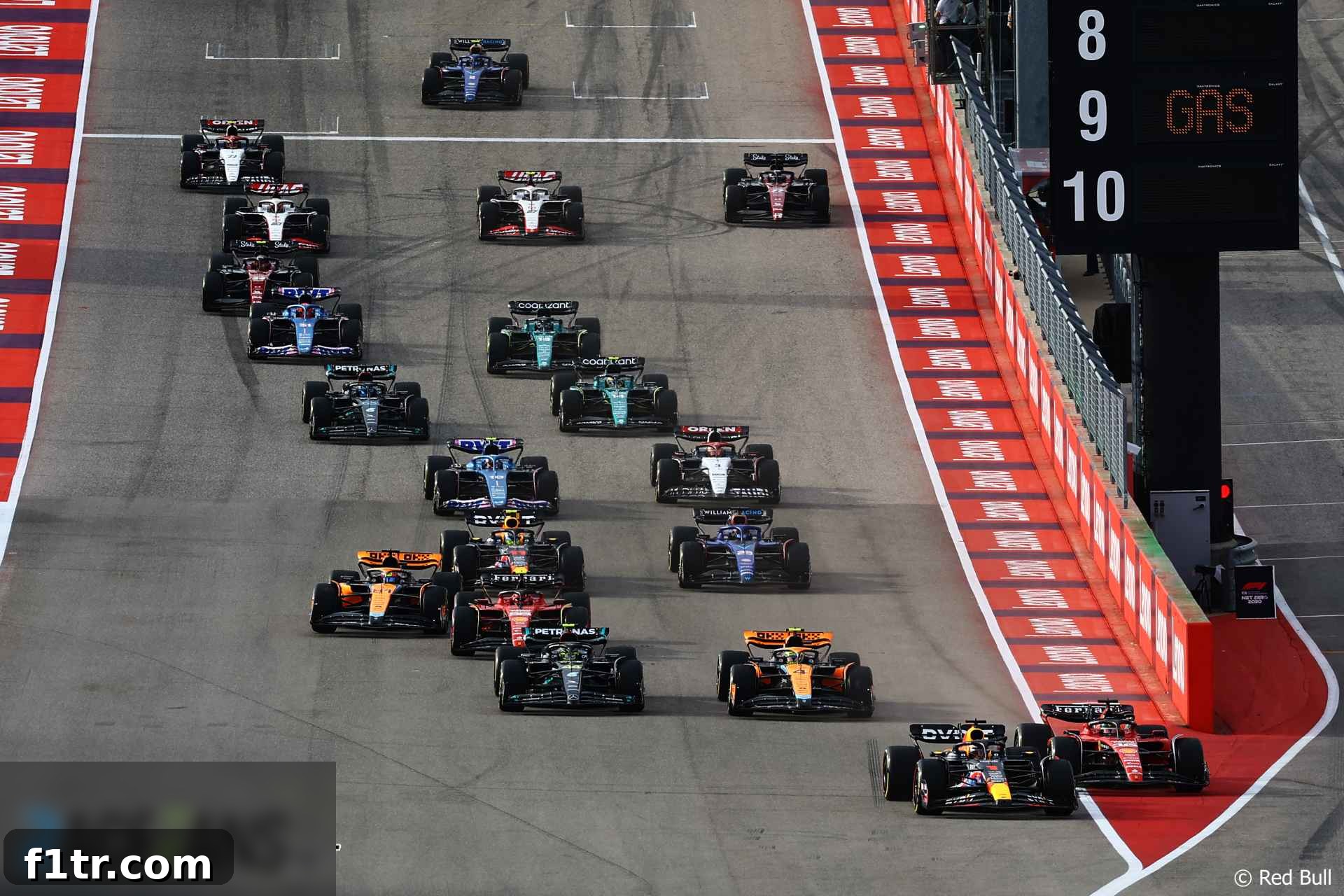
The roar of engines and the tension of the opening lap in Formula 1 sprint races often deliver some of the most exhilarating moments in motorsport. At the United States Grand Prix, the sprint race at Circuit of the Americas provided just such a spectacle, with a particularly intense battle unfolding at Turn 1 between pole-sitter Max Verstappen and front-row starter Charles Leclerc. Following the race, Leclerc offered a surprisingly candid assessment of Verstappen’s aggressive defending, stating unequivocally that he “would have done the exactly the same” if he were in the Dutchman’s position.
The incident in question occurred moments after the lights went out for the sprint race. Leclerc, starting his Ferrari alongside Verstappen’s Red Bull on the front row, launched an immediate challenge for the lead. As the pair hurtled towards the tight left-hander of Turn 1, Leclerc attempted to seize the inside line. However, Verstappen, known for his uncompromising racecraft, moved decisively to cover the apex, forcing Leclerc to take a wider trajectory and nearly pushing him off the track limits. This robust defensive maneuver by Verstappen allowed him to retain his crucial lead, albeit at the cost of Leclerc’s immediate momentum. The Ferrari driver’s slight check-up opened the door for Lewis Hamilton, who, driving his Mercedes, capitalized on the situation to sweep past Leclerc on the exit of the first corner.
Hamilton subsequently maintained his advantage over Leclerc for the remainder of the sprint race, securing a strong second-place finish behind the dominant Verstappen. Leclerc ultimately crossed the line in third, collecting valuable points but undoubtedly reflecting on what might have been. The immediate post-race commentary from Leclerc, however, shed light on a fascinating aspect of Formula 1 racing: the unwritten code of aggressive but fair competition. Despite losing out in the initial skirmish, Leclerc harbored no resentment towards his rival.
Reflecting on the opening lap and the lost opportunity, Leclerc explained, “There was an opportunity, there was a gap and I tried. But obviously then it was tight and I lost the position to Lewis.” He conceded that his competitors, specifically Mercedes and Red Bull, had demonstrated superior pace on the day. “They were a bit stronger today in race pace. We expected them stronger and they were, so we need to work to try and understand what we can do better to be a step ahead tomorrow,” he acknowledged, highlighting Ferrari’s ongoing battle to match the top teams in pure race trim.
Leclerc’s acceptance of Verstappen’s tactics speaks volumes about his racing philosophy. For many drivers, such a move, pushing a competitor close to (or over) the track edge, might be grounds for complaint or an investigation. Yet, Leclerc saw it as an inherent part of the fierce competition at the pinnacle of motorsport. “To be honest, I would have done exactly the same if I was in his position,” he admitted without hesitation. This statement underscores a shared understanding among elite drivers regarding the fine line between aggressive racing and unsporting conduct. It’s a testament to the respect and mutual understanding that often exists even amidst the most intense rivalries.
“It’s on the limit, but as I’ve always said in the past, that’s the way I like to fight. So this today didn’t play in my way, but that’s fine. It’s part of racing and I’m happy with it,” Leclerc affirmed. His words resonate with the spirit of Formula 1, where drivers are expected to push boundaries, exploit every advantage, and engage in thrilling wheel-to-wheel combat. This “on the limit” approach is precisely what captivates fans and defines many of the sport’s most memorable moments. While the outcome wasn’t ideal for Leclerc, his pragmatic acceptance demonstrated a maturity and a deeper understanding of the cutthroat nature of F1. It wasn’t about seeking blame, but rather about acknowledging the raw, unadulterated essence of racing.
Looking ahead to Sunday’s main Grand Prix, where Leclerc was poised to start from a commanding pole position, the focus within the Ferrari garage shifted towards optimizing strategy. A key element in this strategic planning stemmed from the performance data gathered during the sprint race, particularly from his team mate, Carlos Sainz Jnr. Sainz had completed the sprint race on soft tyres, a choice that, while perhaps not optimal for his personal result, provided invaluable intelligence for the longer, more demanding Grand Prix.
“At the end, we have quite a lot of data to analyse having the two cars on two different strategies,” Leclerc explained, highlighting the foresight of Ferrari’s approach. This two-pronged attack allowed the Scuderia to assess the degradation and performance characteristics of different tyre compounds over a race distance, albeit a shorter one. The soft tyre’s behavior, in particular, would be crucial for determining potential pit stop windows, the viability of different stint lengths, and whether a one-stop or two-stop strategy would be more effective on the COTA circuit.
For Ferrari, understanding the nuances of tyre performance is paramount, especially when facing formidable rivals like Red Bull and Mercedes, both of whom have demonstrated exceptional tyre management capabilities throughout the season. “I think this will be a bit of a help for us because we know how the soft tyre is behaving for tomorrow so I hope we can take advantage of that and hopefully we can win tomorrow,” Leclerc stated, expressing cautious optimism. The insights gained from Sainz’s soft tyre run would allow the strategists to model various scenarios, anticipate rival moves, and adapt their plans in real-time during the Grand Prix. This tactical chess match is often as vital as raw pace, and Ferrari aimed to leverage every piece of data to maximize Leclerc’s pole position advantage.
The United States Grand Prix is renowned for its thrilling races and the strategic complexities presented by the Circuit of the Americas. Tyre degradation, particularly on the softer compounds, can be significant, making accurate predictions and flexible strategies essential. With Leclerc starting from the front, the goal would be to convert pole position into victory, a feat that would require flawless execution, aggressive driving when necessary, and impeccable strategic calls from the pit wall. The lessons from the sprint race, particularly regarding the competitive pace of Mercedes and Red Bull and the detailed tyre data, would be instrumental in forging Ferrari’s path to success.
Ultimately, Leclerc’s composed reaction to the sprint race incident and his focus on the strategic battle ahead showcased a driver who is not only a formidable competitor but also a shrewd analyst of the sport. His willingness to acknowledge the legality and the intrinsic nature of Verstappen’s aggressive defending, despite being on the losing end, speaks to a deep respect for the art of F1 racing. As the grid prepared for the main event, all eyes would be on Leclerc and Ferrari, eager to see if their strategic prowess, combined with the Monegasque’s talent, could translate sprint race lessons into Grand Prix glory, capitalizing on every opportunity that unfolds on the challenging Texas track.
2023 United States Grand Prix
- US GP was Mercedes’ best race of 2023 despite disqualification – Wolff
- Singapore and Austin retirements cost me top 10 championship place – Ocon
- United States Grand Prix result unchanged as FIA rejects Haas’ call for review
- Sargeant admits he’s ‘struggled to use all the downforce at times’ in F1
- Mercedes’ Brazilian GP set-up was “conservative” after US GP disqualification
Browse all 2023 United States Grand Prix articles