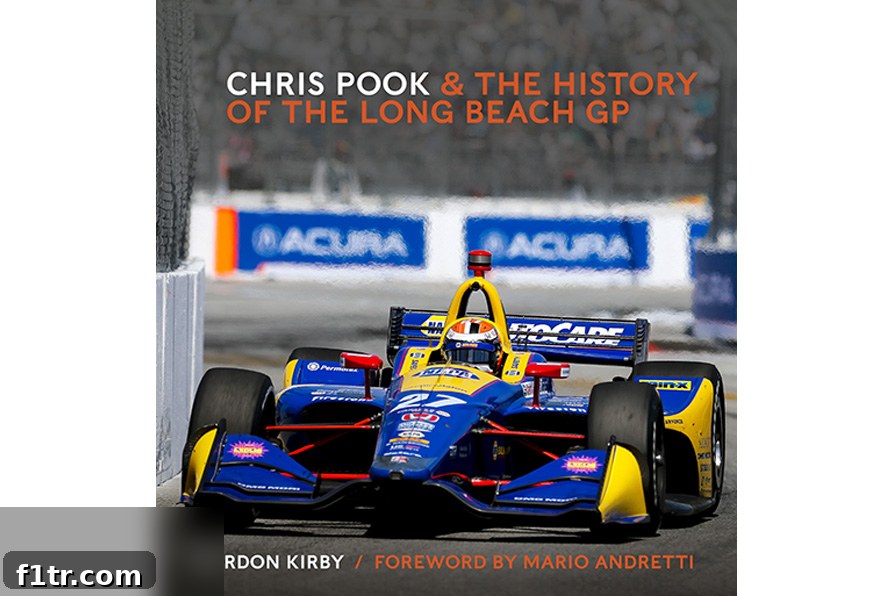
The moment I learned Gordon Kirby’s meticulously crafted book, “Chris Pook and The History of the Long Beach Grand Prix,” awaited my eager hands at the Race Fans HQ, my anticipation soared. Such was my haste, even the legendary Usain Bolt might have envied my sprint. For any ardent follower of American motorsport, Gordon Kirby’s name is synonymous with authoritative and captivating historical accounts. His reputation as one of the premier chroniclers of US racing is well-earned, and the prospect of delving into a coffee table book dedicated to the iconic Long Beach street circuit was, quite frankly, irresistible. This isn’t just another motorsport book; it’s a deep dive into the making of a legend, a testament to vision and perseverance.
Advert | Become a Supporter & go ad-free
The Long Beach Grand Prix, a name that resonates deeply within the annals of racing, has cemented its place as a groundbreaking event. Chris Pook’s audacious vision for this Californian street venue didn’t just create a race; it arguably laid down the very blueprint for modern-era street circuits globally. Its inception in 1975 marked the beginning of an extraordinary, almost uninterrupted 45-year run, a streak regrettably broken only by the unforeseen challenges of the Covid-19 pandemic, which forced the cancellation of this year’s much-anticipated event. Over these decades, the historic Long Beach street circuit has been a vibrant stage for various top-tier racing categories, initially hosting the thunderous Formula 5000 and then the glamorous Formula 1. However, since 1984, the Long Beach Grand Prix has become inextricably linked with IndyCar racing, embracing its numerous iterations and solidifying its status as IndyCar’s most revered non-oval event.
Chris Pook: The Visionary Architect of Long Beach
At the heart of the Long Beach Grand Prix’s enduring success and remarkable evolution stands Chris Pook. More than just a promoter, Pook was the quintessential driving force, a man who lived by his wits and an unyielding entrepreneurial spirit to transform a bold idea into a concrete reality. His journey was fraught with challenges, from securing initial funding and navigating complex urban logistics to constantly adapting to the changing landscape of international motorsport. One of the most significant transitions he masterfully managed was the seismic shift from Formula 1 to IndyCar. This pivotal moment in the circuit’s history is chronicled within the book, shedding light on what many, including the author, consider to be one of Bernie Ecclestone’s greatest missed opportunities in cementing F1’s foothold in America. Pook’s leadership ensured not only the survival but the flourishing of the Long Beach Grand Prix, demonstrating a remarkable capacity for innovation and strategic foresight that continues to inspire event organizers worldwide.
Kirby’s narrative, as one would rightly expect from a book titled “Chris Pook and The History of the Long Beach Grand Prix,” offers an intimate, highly personalized account of these events, seen very much through the eyes and experiences of the legendary promoter himself. This unique narrative choice imbues the book with a deeply personal feel, allowing readers to gain unprecedented insights into the myriad decisions, negotiations, and sheer determination that shaped the Grand Prix. It also creates ample space for fascinating digressions and explorations of related stories that enrich the overall tapestry of the Long Beach saga. For instance, the book vividly recounts the distress call from Bernie Ecclestone, seeking Pook’s invaluable expertise to help salvage F1’s struggling Phoenix Grand Prix, illustrating Pook’s broader influence within the sport. Furthermore, readers are treated to detailed accounts of other key moments from the event’s illustrious life – the harrowing accident of Clay Regazzoni, the unparalleled run of success by Al Unser Jnr, and the entertaining Toyota celebrity races that added a unique flavor to the race weekends. Each anecdote and historical note contributes significantly to the book’s remarkable richness, making it an absorbing journey through motorsport history.
A Deeper Dive: Strengths and Areas for Enhancement
While the storytelling and historical insights are undoubtedly stellar, certain aspects of the book, particularly for a publication designed as a coffee table edition, left me yearning for a little more. Perhaps my expectations have been elevated by the lavishness of other recent releases in the motorsport genre, but the selection and presentation of images in this volume felt somewhat restrained. For a book that promises to chronicle such a visually dynamic and historically rich event as the Long Beach Grand Prix, one hopes for a more expansive and breathtaking library of photographs – perhaps more candid shots, iconic moments captured from unique angles, or a deeper dive into the behind-the-scenes preparations that make a street race come alive. The existing images, while certainly informative, sometimes lacked the visual punch and historical depth that could fully do justice to the vibrant history of the event and its legendary figures.
Similarly, as I thoroughly perused the results pages, I found myself hankering after a greater level of detail for each race. Beyond merely identifying the victor, a comprehensive historical account of such a pivotal circuit could significantly benefit from including more granular data – information such as pole position qualifiers, fastest lap records, critical retirements, notable overtakes, and even a broader spectrum of the finishing order. This additional detail would transform the results section from a simple listing of winners into a valuable resource for historians, statisticians, and truly dedicated fans keen to immerse themselves in the minutiae of each thrilling Long Beach Grand Prix event. While the core narrative shines brightly, these supplementary elements, often expected in comprehensive historical volumes, could have elevated the book to an even higher plane of excellence.
Despite these minor quibbles, what truly cannot be faulted in “Chris Pook and The History of the Long Beach Grand Prix” is the exceptional quality of the writing and the compelling nature of the story itself. Gordon Kirby, with his unparalleled journalistic acumen, brings Chris Pook’s incredible career and the dramatic evolution of the Long Beach Grand Prix to life with remarkable skill and fluidity. Pook’s journey, from a bold visionary to a seasoned motorsport icon, is portrayed with an engaging clarity that captures the essence of his tireless efforts and unwavering dedication. The prose is clean, direct, and effectively conveys the excitement and challenges inherent in bringing world-class racing to the streets of Long Beach.
Value Proposition: Price Point vs. Content
The primary area where the book’s ‘coffee table’ format and its associated pricing present a discernible weakness. Priced at $80 (£65), it enters a competitive segment of motorsport literature where readers rightfully expect a premium experience commensurate with the cost. To truly justify this price tag, the book would ideally need either a far more luscious, exhaustive, and visually stunning library of photographs, or alternatively, it could be re-cast as a more keenly-priced paperback edition. When evaluating it against other recent publications vying for your hard-earned money at this price point, it becomes challenging to award full marks. Many competing titles offer a more complete package, particularly in terms of visual presentation and supplementary data. Nevertheless, it is crucial to reiterate that despite these considerations regarding value and presentation, “Chris Pook and The History of the Long Beach Grand Prix” remains a thoroughly absorbing and profoundly important read for anyone interested in the fascinating world of motorsport history, street circuit development, or the indomitable spirit of Chris Pook himself.
Advert | Become a RaceFans supporter andgo ad-free
RaceFans Rating: A Compelling Read for Motorsport Aficionados
Delve into more insights with our extensive collection of RaceFans book reviews, offering expert critiques on the best in motorsport literature.
Chris Pook and the History of the Long Beach Grand Prix: Book Details
Author: Gordon Kirby
Publisher: Racemaker Press
Published: 2020
Pages: 320
Price: $80 (£65)
More Motorsport Book Reviews and Related Content
- Next new F1 game to arrive in 2027, EA to offer 2026 season as paid DLC
- “F1 Insider: Notes from the Pit Lane” – Ted Kravitz’s new F1 book reviewed
- “Rennsport”: The RaceFans review
- “Grid to Glory: 75 Milestone F1 Moments” – Alex Jacques’ new book reviewed
- “Formula 3000: Where Legends Earned Their Stripes” reviewed
Browse all RaceFans Reviews