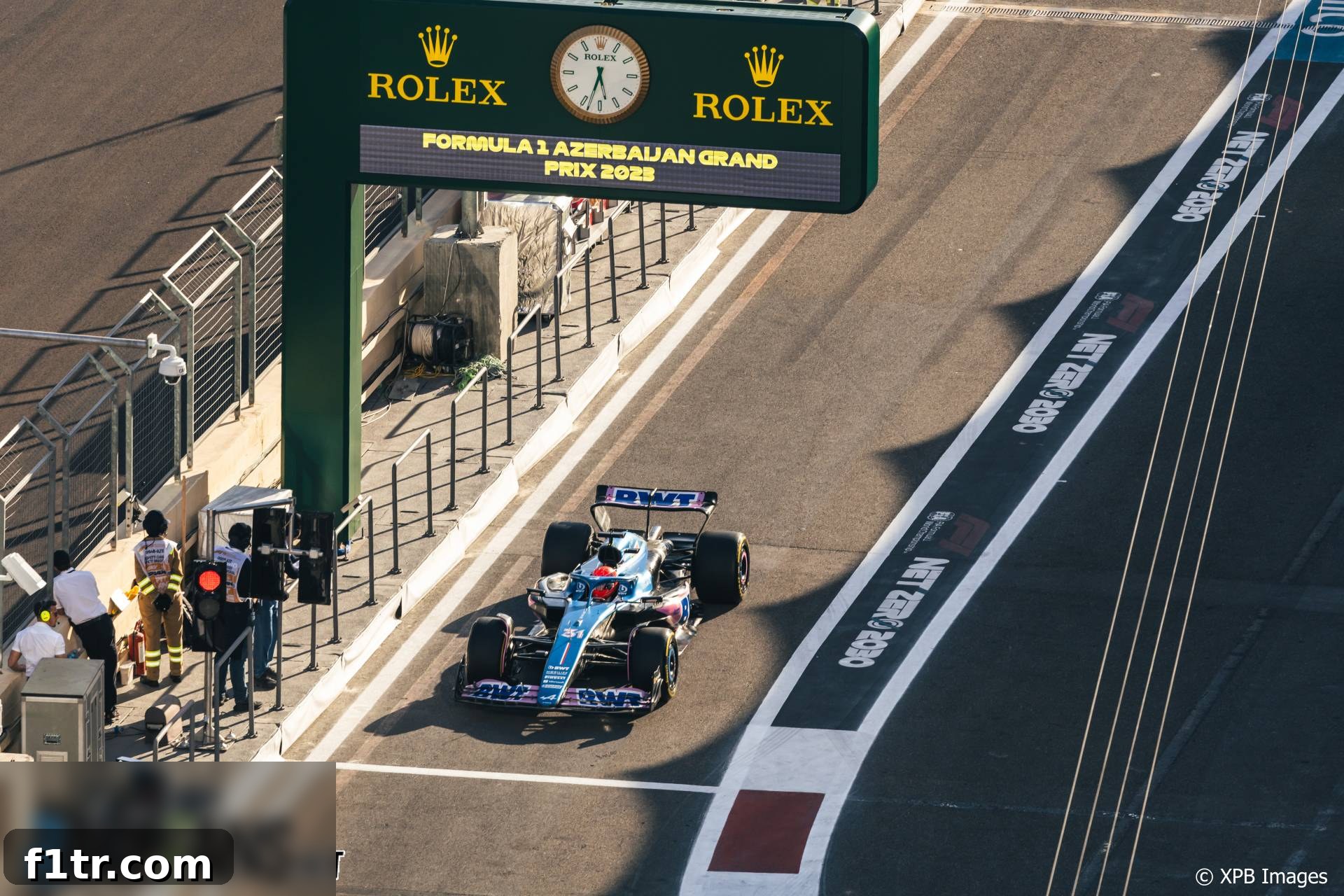
Alpine’s pursuit of Formula 1 success saw them introduce a significant new floor upgrade at the challenging Azerbaijan Grand Prix, a development their sporting director Alan Permane confirmed “overperformed” expectations. Despite this technical triumph, the team found themselves unable to convert the tangible performance gains into valuable championship points, enduring a weekend marred by unforeseen issues and strategic missteps at the iconic Baku City Circuit.
Advert | Become a Supporter & go ad-free
The Azerbaijan Grand Prix was a critical juncture for many teams, offering a unique blend of high-speed straights and tight, technical sections. For Alpine, it represented an opportunity to demonstrate their development progress and climb higher in the fiercely competitive midfield standings. However, the Baku weekend proved to be an exercise in frustration, as neither of their drivers, Pierre Gasly nor Esteban Ocon, managed to finish in the points for the second consecutive event, adding pressure to a season that has so far delivered mixed results for the Enstone-based squad.
The team’s woes commenced early, during the sole practice session on Friday. What should have been a crucial hour for setup validation and understanding the new floor’s characteristics quickly turned into a crisis. Pierre Gasly’s car suffered a dramatic incident, catching fire on track, which not only curtailed his own running but also triggered alarm bells within the team. Out of an abundance of caution, Alpine was compelled to pull Esteban Ocon’s car into the garage for thorough checks, fearing a similar issue could affect his vehicle. This preventative measure, while prudent for safety, severely limited their already constrained practice time, a setback that would ripple through the entire weekend’s proceedings.
Despite the significant reduction in track time and data collection during FP1, Esteban Ocon displayed commendable skill, managing to qualify 12th for the main grand prix and 13th for the sprint race. His performance under pressure highlighted the underlying potential of the A523 chassis, especially with the promising new floor. However, the team then faced a critical dilemma. Concerns over the wear rate of the plank – a mandatory legality device on the underside of the car – prompted Alpine to make a difficult decision. Opting to implement suspension set-up changes to Ocon’s car under parc ferme conditions, a regulation designed to prevent major alterations between qualifying and the race, meant that Ocon would be forced to start both the sprint and the grand prix from the pit lane. This tactical choice, made to ensure the car’s legality, effectively negated his qualifying efforts and handed him an uphill battle from the outset of both competitive sessions.
Alpine’s Sporting Director, Alan Permane, shed light on the team’s predicament, confirming that the new floor update had indeed delivered the anticipated gains in downforce, exceeding initial projections. “It worked as performed,” Permane stated, adding, “In fact, it overperformed a little bit. That’s a positive to take away from this weekend.” However, this performance came with an unexpected caveat: the aggressive nature of the new aerodynamic package, combined with the limited setup time, led to significant concerns regarding the wear of the car’s plank. The plank, a crucial component beneath the car, is meticulously measured after sessions to ensure it hasn’t worn beyond legal limits. Excessive wear can lead to immediate disqualification, a penalty no team wants to risk. Permane admitted, “We were very concerned with Esteban’s plank wear, honestly, because we’d only had such a short period of time. At the end of the full qualifying session it was looking tough.”
The decision to alter Ocon’s car setup and incur a pit lane start penalty was, as Permane described, a “very difficult decision.” The team faced a stark choice: risk disqualification after the race or sacrifice track position for legality. “We were very worried about the car being illegal at the end of the race, or even before the end of the race,” Permane explained. He directly attributed this difficult situation to the curtailed running in FP1, stating, “And that is a direct consequence of what happened in FP1.” This highlights the cascading impact of the early technical issues and the critical importance of a smooth practice session, especially when introducing new, high-performance components. The lost data from FP1 meant Alpine could not fully optimize Ocon’s setup to manage the new floor’s plank wear characteristics effectively, forcing a conservative, penalty-inducing solution.
Advert | Become a RaceFans supporter andgo ad-free
Despite the operational setbacks, Permane drew considerable encouragement from the sheer effectiveness of their latest floor upgrade. This success underscores Alpine’s robust development pipeline and their growing confidence in their simulation and design processes. “It looks very much like we’re going to continue that trend of just being able to put things on the car without really having to test them too much, which is such a huge benefit, and something that we grew in confidence with last year,” he remarked. This capability to translate simulated performance into real-world gains without extensive on-track validation is a testament to modern F1 engineering and a significant competitive advantage. For Alpine, it suggests a reliable trajectory for future performance improvements. Permane further teased upcoming enhancements, stating, “As more and more things come through, and we’ve got something in Miami [the next race], we’ve got something else in Imola. I’m not too sure where we are beyond that, but there’s definitely another tenth [of a second in performance] coming, then another tenth. So there’s good stuff coming in the pipeline, and having that confidence that it will work first time is great.” This forward-looking optimism, based on tangible gains, offers a glimmer of hope for a more competitive future for the French team.
Permane robustly defended the team’s decision to introduce such an ambitious upgrade at a street circuit like Baku, where practice time is inherently limited, and the risk of damage is high. What might appear “brave” to outsiders, he deemed “completely normal” for Alpine. “I don’t think it was ‘brave’, I think it was completely normal,” he asserted, explaining, “We’re very confident that our upgrades work. We saw that all last year.” This confidence stems from their meticulous research and development, allowing them to rely on simulation data and track correlations. He noted that even with minimal running, the team quickly validated the upgrade’s integrity. “We can see within a few laps, although we only did do a few laps in FP1, but also everything looked normal. We also saw after the qualifying session the upgrades were fine, there was no risk to them.” This highlights a mature development philosophy where reliability and predicted performance are consistently met.
Advert | Become a RaceFans supporter andgo ad-free
The operational effort behind producing these new components was also lauded by Permane. He praised the “incredible job from the factory to produce three of a completely new specification floor from one race to the other.” This logistical and manufacturing feat underscores the relentless pace of development in Formula 1. The commitment to rapid iteration is crucial for teams aiming to close the gap to front-runners. Looking ahead, Permane confirmed, “We’ll have another one in Miami, so we’ll be fully up to speed on spares,” ensuring that future races will not be hampered by a lack of available parts for their newly upgraded package.
Permane also provided a definitive explanation for the cause of Pierre Gasly’s alarming car fire on Friday, confirming it was due to a hydraulic leak. While the exact root cause of the leak remained somewhat elusive, Permane expressed strong confidence that such an incident would not recur. He detailed the immediate actions taken by the team: “We replaced all the hoses” and meticulously examined the corresponding parts on Ocon’s car. This proactive approach underscores the paramount importance of safety in motorsport. Permane’s assertion, “I’m very sure that that is a one-off and won’t happen again,” aimed to reassure about the team’s engineering integrity and preventative measures.
Reflecting on the totality of the weekend’s challenges, Permane acknowledged that Alpine had not performed to their own exacting standards. “You make your own luck with things like that,” he admitted, continuing, “We didn’t honestly do a good enough job. We had a hose fail on one car and gave us a huge fire. And we had a problem with the build of the gearbox on the other car.” These candid remarks illustrate the complex and fragile nature of Formula 1 machinery, where a minor component failure can have catastrophic consequences for a team’s performance. The cumulative effect of these issues meant both drivers had severely limited track time: “I think Pierre did one or two timed laps in FP1, Esteban did two, or maybe three. And from there you go into qualifying.” Despite these significant handicaps, Permane singled out Ocon’s qualifying effort for praise: “[Pierre] had an accident, which is unfortunate, but I think Esteban did a really incredible job in qualifying to qualify 12th with the car he had.”
Alpine’s 2023 campaign has been a struggle for consistency, with just eight points amassed over the first four rounds. Their difficulties in Baku only exacerbated this trend. Only one car managed to finish the opening race in Bahrain, while neither car saw the chequered flag in Melbourne. Their best result thus far has been an eighth-place finish. The sheer effectiveness of the new floor upgrade had initially convinced Alpine that they possessed the potential to significantly bolster their points tally in Baku. However, the Friday setbacks proved too great to overcome. Permane lamented that the team ended up “nowhere” on pace during the races and “really struggled” to perform, directly linking this underperformance to the critical loss of preparation time early in the weekend. The inability to fully capitalize on a genuinely strong upgrade due to operational failures was a bitter pill to swallow for the team.
Advert | Become a RaceFans supporter andgo ad-free
Permane delivered a stern assessment of the team’s overall weekend performance, emphasizing the need for faultless execution in Formula 1. “It really shows you have to be on your game. We cannot allow ourselves to have a Friday like we had, especially on a weekend like this,” he explained. He underscored the profound impact of lost practice time, a crucial commodity for optimizing car setup and understanding tyre behaviour. “You can just about get away with this on a normal weekend, but even then you’re still losing valuable preparation time. You’re still one session behind all the time. Every time you run the car, you find something, you improve it. So we can’t do that,” Permane stressed, highlighting the incremental gains derived from every minute of track time.
Despite the challenges, Permane dismissed the notion that the revised sprint race weekend format, introduced in Azerbaijan, had significantly exacerbated Alpine’s problems. He maintained that the fundamental requirement for a smooth weekend remained unchanged, regardless of the format. “I don’t think it being a new format sprint weekend is any different to last year’s sprint weekend,” he said. The core message was clear: preparedness and incident-free running are always paramount. “You need to start off well prepared and just have a smooth weekend,” he affirmed. The team’s failure to achieve this basic prerequisite led to a rapid deterioration of their prospects: “We had that with neither car in FP1, and it snowballed out of control from there.” While the new format might present unique strategic considerations, Alpine’s issues were self-inflicted, stemming from fundamental reliability and operational missteps rather than the format itself. The silver lining remains the potent new floor, offering a clear path to future performance if the team can eliminate these costly errors.
Bringing the F1 news from the source
RaceFans strives to bring its readers news directly from the key players in Formula 1. We are able to do this thanks in part to the generous backing of our RaceFans Supporters.
By contributing £1 per month or £12 per year (or the equivalent in other currencies) you can help cover the costs involved in producing original journalism: Travelling, writing, creating, hosting, contacting and developing.
We have been proudly supported by our readers for over 10 years. If you enjoy our independent coverage, please consider becoming a RaceFans Supporter today. As a bonus, all our Supporters can also browse the site ad-free. Sign up or find out more via the links below:
- Become a RaceFans Supporter
- RaceFans Supporter FAQ
Advert | Become a RaceFans supporter andgo ad-free
2023 F1 season
- FIA president cleared of alleged interference in two 2023 races
- First week viewing figures for new Drive to Survive season fall again
- Max who? Drive to Survive season six prefers its favourite faces
- RaceFans’ complete 2023 season review
- The F1 drivers who pulled off the 10 biggest charges through the field in 2023
Browse all 2023 F1 season articles