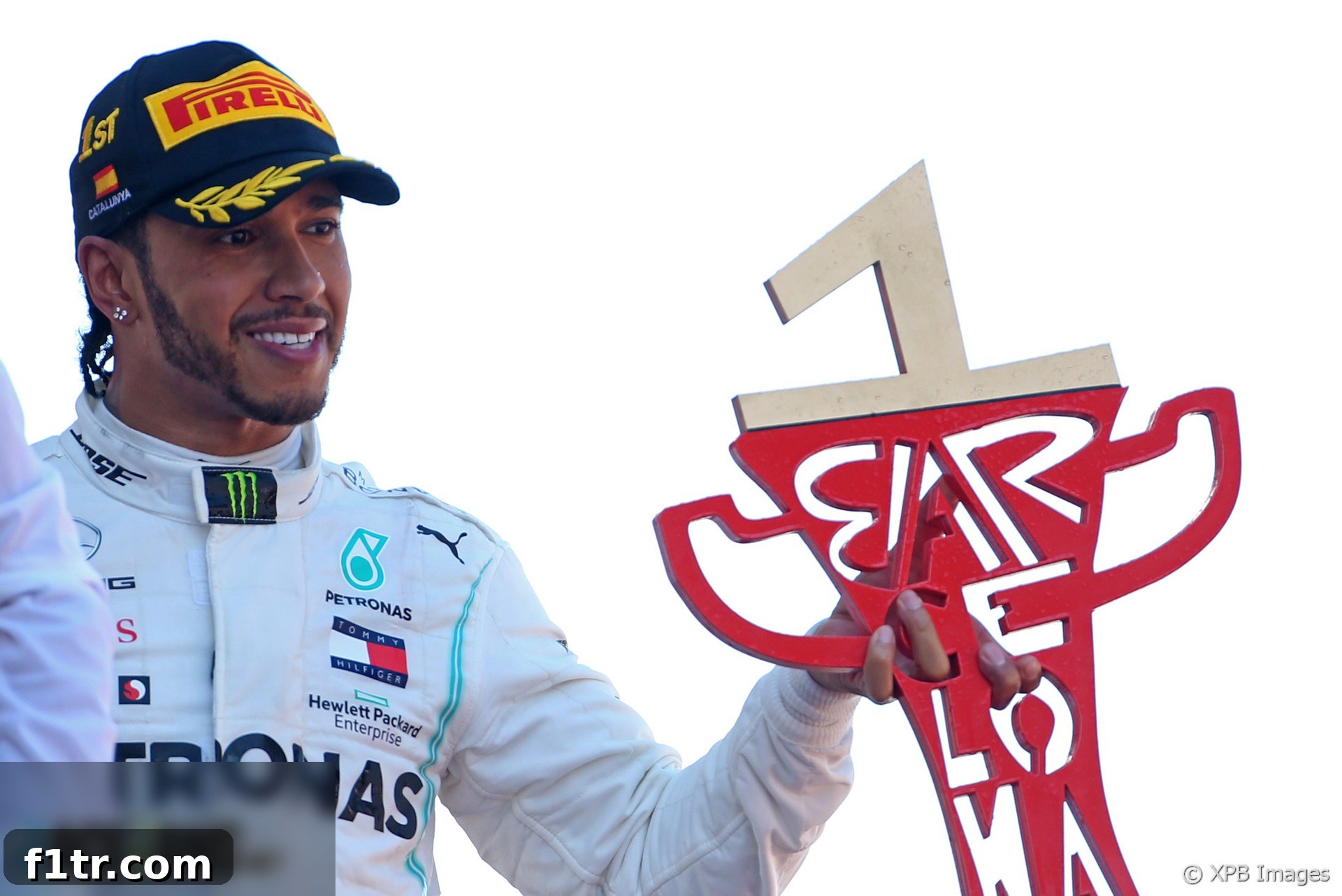
Lewis Hamilton Overcomes Qualifying Setback to Dominate Spanish Grand Prix
In a masterful display of racing prowess, Lewis Hamilton silenced any doubts about his form by clinching a commanding victory at the 2019 Spanish Grand Prix. The five-time world champion bounced back from what he described as a “nightmare” Saturday qualifying session, demonstrating exceptional race pace to secure his third win of the season and extend his lead in the Drivers’ Championship. Following the triumph, Hamilton vowed to redouble his efforts in perfecting his single-lap performance, a challenge he openly embraced.
Conquering the Qualifying Conundrum: A Saturday of Struggles
The build-up to the Spanish Grand Prix had seen an unfamiliar narrative unfold for Hamilton. For the second consecutive race weekend, the Mercedes driver found himself outqualified by his formidable teammate, Valtteri Bottas, who secured pole position. This trend, though minor in the grand scheme of a championship, hinted at a slight imbalance in Hamilton’s ability to extract the absolute maximum from his car over a single qualifying lap. The pressure in Formula 1 is immense, with margins often measured in milliseconds, and the difference between pole and second place can set the tone for the entire weekend. Hamilton acknowledged these struggles, admitting, “Yesterday was a bit of a nightmare.” This candid reflection underscored the relentless pursuit of perfection that defines elite athletes in motorsports. Despite his vast experience and numerous accolades, Hamilton consistently seeks areas for improvement, a trait that has been instrumental in his sustained success.
Qualifying demands a unique blend of aggressive driving, precise car control, and meticulous tire management to unleash the car’s full potential for one flying lap. The car’s setup, the driver’s confidence, and the track conditions must all align perfectly. For Hamilton, these elements hadn’t quite converged during the crucial moments of Saturday in Barcelona. His subsequent comments revealed a deep analytical approach, suggesting that while his race craft remained unparalleled, there was a specific nuance in single-lap performance he aimed to uncover and master. This self-analysis is a hallmark of a champion, never settling, always striving for that extra edge.
Race Day Resurgence: A Masterclass in Pace and Precision
However, the narrative shifted dramatically on Sunday. From the moment the lights went out, Hamilton showcased a different level of performance. He delivered a stunning start, immediately challenging Bottas for the lead and asserting his dominance. His race pace proved to be formidable, allowing him to control the race from the front and comfortably pull away from the chasing pack. The victory was a testament to his exceptional ability to adapt and perform under pressure, especially when it mattered most. Hamilton elaborated on his transformation, stating, “But race pace has generally been quite good for me. I’ve been really happy and comfortable generally in the races.”
This comfort translated into a flawless drive, characterized by consistent lap times and strategic tire management. Before heading to the grid, Hamilton and his engineering team made critical adjustments to the car’s balance, modifications that proved instrumental in his race performance. “When we went out to do the laps to the grid I wasn’t very happy with the balance still so I had to make some changes, had to alter my driving style a little bit but it worked well in the race scenario,” he explained. This adaptability, the capacity to fine-tune both the machine and one’s technique in real-time, is what separates the good from the great. It speaks volumes about his profound understanding of his Mercedes W10 and his intuitive feel for the limits of the car and the track. The synergy between driver and team in optimizing the car for race conditions was perfectly executed, leading to a performance that solidified his position at the pinnacle of the sport.
The Unwavering Quest for Single-Lap Perfection
Despite a convincing victory, Hamilton’s competitive spirit drove him to focus on the areas he still felt he could improve. His post-race reflections were not just about celebrating the win, but about dissecting the challenges of Saturday. “I’m going to look into detail why it doesn’t work on a single lap and that may take some time,” he affirmed. This dedication to continuous improvement is a defining characteristic of Hamilton’s career. He isn’t content with being merely good; he strives for absolute perfection.
The intricacies of single-lap performance in Formula 1 are complex, often revolving around the delicate balance of tire warm-up, optimal car setup for maximum grip, and the driver’s ability to execute a perfect lap with minimal room for error. Hamilton, usually renowned for his exceptional tire management, pondered, “Normally with tyres I’m pretty good. I think that’s the weak area but it’s not that I can’t do it, I’ve just got to discover it and that’s what I’ll put some effort towards.” This targeted approach to his perceived weakness demonstrates an acute self-awareness and a willingness to invest time and effort into mastering every facet of his craft. For a driver who has already achieved so much, this persistent drive to understand and overcome perceived limitations is truly remarkable and serves as an inspiration to aspiring athletes across all disciplines.
Mercedes’ Unprecedented Dominance and the Call for Competition
The Spanish Grand Prix marked a significant milestone for Mercedes, as they secured their fifth consecutive one-two finish of the season. This unprecedented start to the 2019 F1 season further cemented their position at the top of both the Constructors’ and Drivers’ Championships, pulling significantly ahead of rivals like Ferrari. While enjoying his team’s success, Hamilton expressed a genuine desire for more intense competition from other teams, particularly from Ferrari.
“I prefer when they are in the mix with us,” he stated, reflecting on the excitement that close battles bring to the sport. He fondly recalled races where competitors were on the front row, creating thrilling intertwined grids. “I love that. Especially when we’re kind of intertwined where there’s a Mercedes and a Ferrari for example.” Hamilton emphasized that from both a driver’s and a team’s perspective, competing against another top-tier outfit elevates the challenge and the overall experience. The intensity of direct competition, battling wheel-to-wheel with rival teams, adds another layer of excitement and strategic depth that internal team battles, while challenging, cannot fully replicate.
The Dynamics of Internal Versus External Rivalry
Hamilton further elaborated on the distinction between competing with an external rival and engaging in an internal team battle. While acknowledging the immense challenge of an internal contest, such as that with Valtteri Bottas, he suggested that the thrill for both drivers and spectators is magnified when multiple teams are vying for victory. “When it becomes more internal it’s less exciting I would say, but it’s still massively challenging for the driver,” he clarified. This insight highlights the different pressures involved; an internal battle focuses on maximizing personal performance against a teammate in identical machinery, while an external battle introduces variables of different car philosophies, engineering strengths, and strategic plays from rival garages.
Despite Mercedes’ comfortable lead, Hamilton stressed that success is never guaranteed. The team and drivers still have to push the limits every single race weekend. “We still have to deliver, it’s not a case of just rocking up and going out we still have to work very hard to extract everything from the car just as every other driver is extracting everything from their car,” he asserted. This commitment underlines the relentless nature of Formula 1, where complacency can quickly lead to a loss of momentum. The pursuit of marginal gains, the constant analysis of data, and the tireless work in the factory and on track are all essential, regardless of the championship standings. Hamilton’s words serve as a reminder that even at the pinnacle of dominance, the effort to maintain that position is unwavering, fueled by an insatiable hunger for excellence.
Looking Ahead: The Road to the 2019 Championship
Lewis Hamilton’s victory at the Spanish Grand Prix not only cemented his championship lead but also showcased his incredible resilience and adaptability. His candid self-assessment and commitment to improving his single-lap pace demonstrate a champion’s mindset focused on continuous growth. As the 2019 F1 season progressed, Mercedes continued its formidable run, but the aspiration for closer competition from teams like Ferrari remained a key talking point. Hamilton’s desire for more rivals in the mix spoke to a broader love for the sport and the spectacle of intense, multi-team battles. The season promised more twists and turns, but Hamilton’s performance in Spain served as a powerful statement of intent, signaling his determination to leave no stone unturned in his quest for another world title, proving that even a “nightmare” Saturday can be transformed into a triumphant Sunday through sheer will and skill.
Explore More from the 2019 F1 Season
- Crying in the Melbourne car park at 2019 grand prix was my career low – Ocon
- McLaren Racing reports reduced £71 million loss in 2019
- Kvyat: Hockenheim podium last year was “my biggest achievement” so far
- How the FIA’s new encrypted fuel flow meter targets Ferrari’s suspected ‘aliasing’ trick
- “He smashed my office door”: 23 must-see moments from ‘Drive to Survive’ season two
Browse all 2019 F1 season articles