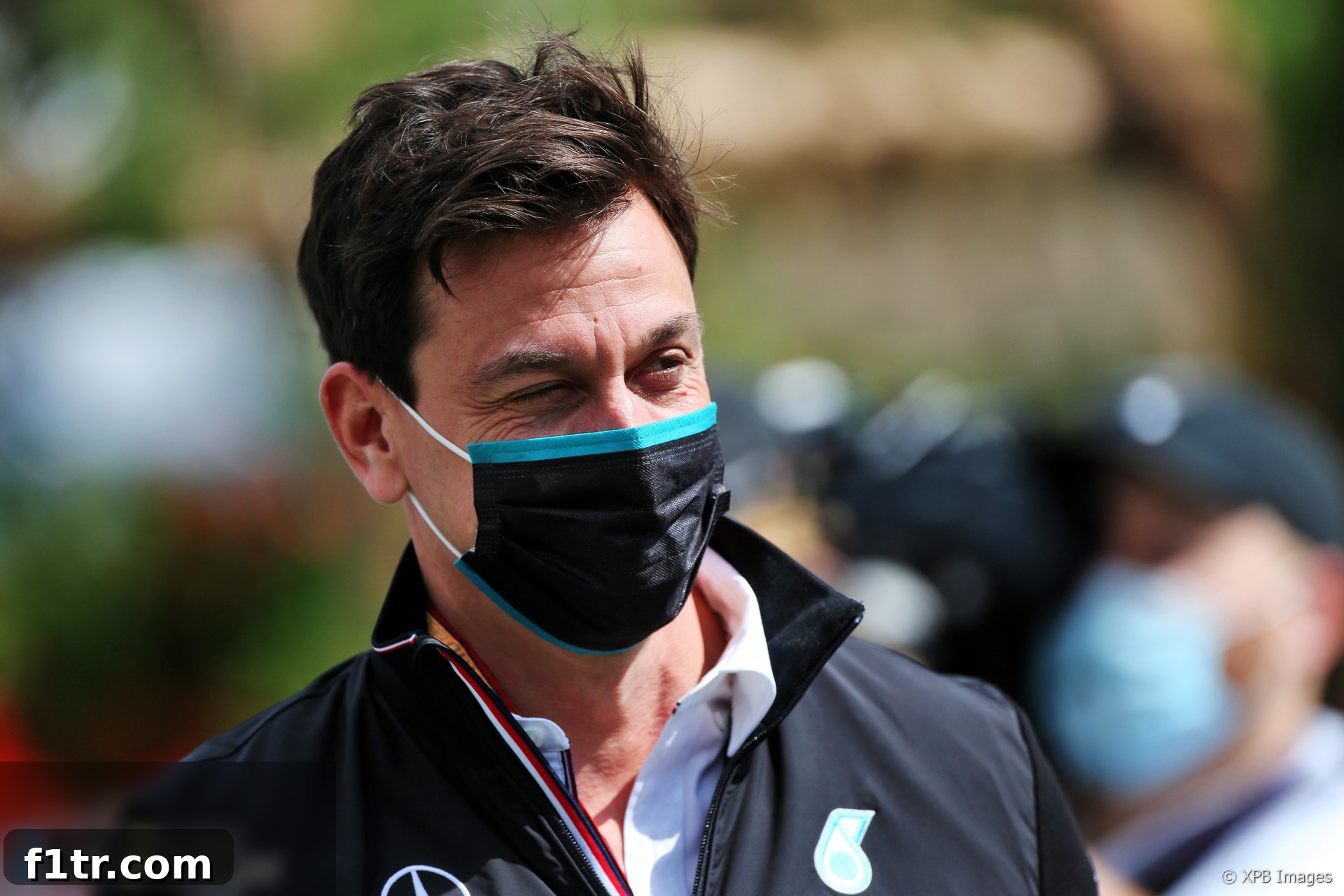
In the latest comprehensive F1 news round-up, Mercedes team principal Toto Wolff has sharply criticized several rival teams for publicly discussing their readiness to sign the crucial new Concorde Agreement, which dictates participation in Formula 1 from next year onwards. Wolff’s comments underscore the underlying tensions and strategic maneuvering currently at play as teams negotiate the future commercial and governance landscape of the sport.
Toto Wolff on Concorde Agreement Negotiations: A Call for Discretion
The Concorde Agreement is a pivotal, confidential contract between the FIA, Formula 1’s commercial rights holder (Liberty Media), and the competing teams. It outlines the terms of competition, the distribution of prize money, and the sport’s governance framework for the coming years. As the deadline for signing the 2021 agreement approaches, the stakes are incredibly high for all ten teams involved. When pressed on the ongoing obstacles to Mercedes finalizing their commitment, Wolff did not mince words, directing his criticism towards specific unnamed competitors.
Advert | Become a Supporter & go ad-free
Advertisement Space
“I don’t know why some of the other teams made those ridiculous commentary that they’re ready to sign and there seems to be some competitors that are not. They make themselves a laughing stock with those comments in the public,” Wolff stated, visibly frustrated by the public discourse.
He continued, emphasizing the sanctity of private negotiations: “Negotiations should be taking place behind closed doors without a running commentary from competitors. And in that respect, we’re talking to Liberty, we are keen on staying in Formula 1, there are some clauses which bother us a little bit, but nothing that can’t be sorted.”
Wolff’s stance highlights Mercedes’ preference for a discreet negotiation process, away from the media spotlight, to ensure that sensitive discussions about the sport’s financial structure and competitive regulations are handled with appropriate confidentiality. Mercedes, a dominant force in recent F1 history, holds significant leverage in these discussions, and their concerns, though unspecified, likely revolve around ensuring a fair competitive playing field and equitable revenue distribution that recognizes their continued investment and success in the sport. The implication is clear: public posturing by some teams might be perceived as an attempt to pressure others or to influence public opinion, tactics that Wolff evidently disapproves of during such critical, high-stakes talks.
- Will all 10 F1 teams sign on the line and race on into 2021?
Quotes: Dieter Rencken
Advert | Become a RaceFans supporter andgo ad-free
Advertisement Space
Social Media Pulse: Driver Performance and Fan Engagement
Social media continues to be a vibrant hub for Formula 1 discussions, offering fans and pundits a direct platform to share immediate reactions, analyses, and opinions. This round-up captures a notable post discussing driver performance, a constant topic of debate among the F1 community:
Otmar Szafnauer saying Stroll got closer to @SChecoPerez in terms of one-lap pace over the course of last year. Looking at the data (and disregarding the obvious outlier of Suzuka) I have to say, I don’t see it: https://t.co/jskXrRHrCk #F1 #HungarianGP
— Keith Collantine (@keithcollantine) July 18, 2020
This tweet from respected F1 journalist Keith Collantine highlights a common point of contention: the objective assessment of driver performance. It directly challenges Racing Point team principal Otmar Szafnauer’s assertion that Lance Stroll significantly closed the gap to his highly-rated teammate Sergio Perez in single-lap pace. Such discussions, backed by data analysis, provide invaluable insight for fans and contribute to the rich tapestry of F1 commentary. Social media platforms like Twitter are indispensable for real-time engagement during race weekends, allowing fans to follow intricate details, debate team strategies, and share the passion for the sport.
- Find more official F1 accounts to follow in the F1 Twitter Directory
Further Motor Racing Insights: News from F1, F2, and IndyCar
Beyond the top headlines, the world of motor racing offers a constant stream of developments. Here’s a curated selection of recent links providing further context and updates from across the racing spectrum:
Advert | Become a Supporter & go ad-free
Advertisement Space
Qualifying Strategy: Honda’s Proactive PU Change for Gasly
Honda Racing F1 revealed a critical decision regarding Pierre Gasly’s power unit (PU) ahead of the Hungarian Grand Prix. Despite no immediate failure, their engineers detected an anomaly in the data, prompting a preventative PU change. This strategic move, without incurring a grid penalty due to the component being within allowance, highlights the meticulous analysis and proactive approach required in modern F1. It prioritizes reliability and performance for the race, avoiding potential in-race issues that could severely impact Gasly’s chances, especially at a circuit like the Hungaroring where overtaking is notoriously difficult.
F2 Discipline: Nissany Receives Grid Drop After Teammate Collision
In Formula 2, Roy Nissany faced a five-place grid penalty for the sprint race in Budapest. This sanction came after a post-feature race investigation into a collision with his teammate, Marino Sato. Incidents between teammates are always sensitive, and this penalty underscores the FIA’s commitment to maintaining fair play and safe racing, even within the confines of a team. Such penalties can significantly alter a driver’s weekend trajectory and highlight the intense competitive pressures within the F1 feeder series.
Ferrari’s Hungarian GP Qualifying: Glimmers of Improvement
Ferrari’s team principal Mattia Binotto expressed cautious optimism after what he termed “A better Saturday” at the Hungarian Grand Prix. His comments specifically noted, “It’s interesting to note the difference down the few straight sections on this track, between some cars and the rest of the pack.” This observation from Binotto hints at ongoing struggles with engine performance or aerodynamic efficiency on straights, a known area of concern for the Scuderia. While a “better” Saturday offers some relief, Ferrari’s journey to reclaim their top-tier form remains a challenging uphill battle, with every small gain closely scrutinized.
IndyCar Thriller: Pagenaud’s Unbelievable Last-to-First Victory at Iowa
IndyCar delivered a stunning spectacle as Simon Pagenaud achieved a remarkable last-to-first victory at Iowa. Pagenaud recounted his disbelief: “All of a sudden, they said, ‘You are the leader’. I thought: ‘They’ve got it wrong. There is no way I’m the leader. I know I’m fast, but I didn’t think I had passed everybody.” This incredible comeback highlights the unpredictable nature and strategic depth of IndyCar racing, where daring gambles, pit stop strategy, and sheer driving prowess can combine to create truly memorable moments. Pagenaud’s win stands as a testament to perseverance and opportunistic driving.
Haas’s Hungarian GP Qualifying: A Struggle Against Traffic and Timing
The Haas F1 Team’s qualifying recap from the Hungarian Grand Prix painted a picture of frustration, particularly for their drivers. One driver’s quote encapsulates the challenge: “Going onto the last set I was quite convinced we had a chance to get into Q2, the car felt good. I guess we missed our timing and I had to press the neutral button before the last corner to let the queue go. My tires were then dead cold by turn one and that was qualifying over.” This illustrates the razor-thin margins in F1 qualifying, where a small misjudgment in timing or encountering traffic can completely derail a lap, especially for teams battling in the competitive midfield and back of the grid.
Unwavering Dedication: F1 Fans Find Unique Ways to Watch at Hungaroring
Despite restrictions preventing spectators from entering the Hungaroring circuit, dedicated Formula 1 fans demonstrated their unwavering passion by finding creative ways to witness the Hungarian Grand Prix. A fan quoted by Reuters declared, “I have followed (Finnish driver) Kimi Raikkonen ever since he began to race and became a huge fan. I have seen every race here in every year, and I won’t stop just because the ring is closed.” This heartwarming story is a powerful reminder of the deep connection between F1 and its global fanbase, showcasing their ingenuity and commitment even when traditional access is denied. It underlines the enduring appeal of the sport, transcending logistical hurdles.
We always endeavour to credit original sources. If you have a tip for a link to feature in the next RaceFans round-up please send it in via the contact form.
Advert | Become a RaceFans supporter andgo ad-free
Advertisement Space
Comment of the Day: Analyzing Toto Wolff’s Strategic Communication
Today’s featured comment delves into the shrewd communication tactics employed by Mercedes team principal Toto Wolff, particularly concerning his recent remarks about Racing Point. @Force-Maikel provides an insightful analysis:
“He’s not complimenting Racing Point here. Wolff is a master of communication. Mercedes dominance is good for the team as they can win races easily, but it makes the rest of the field look like idiots and is generally perceived by the outside world, media and fans as a negative for the sport (i.e. championship fight looks hopeless already bar which Mercedes driver wins it, but honestly we already know in our hearts).”
“So he does what he always does, talk up the competition. In this case his main rivals are nowhere. Ferrari has suffered a major setback on the engine front and their car concept doesn’t seem to be going nowhere either. Red Bull have built an unstable car that has looked skittish ever since it launched. It will probably take them half a season to correct it like last year, and by that point the ship will have sailed.”
“So now he does the only thing that he can and make Racing Point seem more dangerous than they really are, and that’s exactly what he wants. Don’t make it look like this isn’t going to be a walk in the park for Mercedes. Of course it will be. That car is perfect. It seems to work at every track well enough to be at least eight tenths clear of everyone else.”
@Force-MaikelThis astute commentary dissects Wolff’s nuanced approach. Mercedes’ unparalleled success, while beneficial for the team, can ironically diminish fan excitement by creating a perception of predictable outcomes. To counteract this, Wolff often engages in strategic communication designed to inflate the competitive threat posed by other teams, even when Mercedes holds a significant advantage. By highlighting Racing Point’s performance – particularly given their car’s striking resemblance to last year’s championship-winning Mercedes – Wolff subtly aims to deflect criticism about Mercedes’ dominance and maintain a narrative of a competitive championship. The comment rightly points out the struggles of traditional rivals like Ferrari, grappling with engine issues and car concept challenges, and Red Bull, dealing with an inherently unstable chassis. In this landscape, elevating Racing Point, often dubbed the ‘pink Mercedes,’ serves as a clever tactic to inject perceived rivalry and keep the sport’s narrative engaging, even if, as @Force-Maikel suggests, Mercedes’ car remains overwhelmingly superior.
Happy Birthday!
A big happy birthday shout-out goes to our fellow RaceFans community members: Cube, Phil G, Tom Haxley, Robk23, and Toiago! We hope you all have a fantastic day celebrating.
If you’d like to receive a birthday shout-out in our future round-ups, please let us know your birth date by reaching out to us via the contact form or by adding your details to our dedicated list here.
On This Day in F1 History: Fittipaldi’s British Grand Prix Triumph
- Exactly 45 years ago today, the legendary Brazilian driver Emerson Fittipaldi clinched a momentous victory at the British Grand Prix. Fittipaldi, a two-time Formula 1 World Champion (1972, 1974), was a formidable force in the 1970s. His win at the British Grand Prix that year, behind the wheel of a McLaren M23-Ford Cosworth, further cemented his status as one of the sport’s all-time greats. This particular race would have been a thrilling spectacle, adding another significant chapter to the rich history of both the British Grand Prix and Fittipaldi’s illustrious career. Reflecting on such historical moments reminds us of the champions and defining races that have shaped Formula 1 into the global phenomenon it is today.
This comprehensive round-up aimed to provide an in-depth look at the current dynamics within Formula 1, from the high-stakes Concorde Agreement negotiations and team strategies at race weekends to the passionate engagement of fans and a nostalgic look back at F1 history. As the season progresses, these narratives will undoubtedly evolve, continuing to deliver the thrilling, unpredictable, and always dramatic spectacle that is Formula 1.