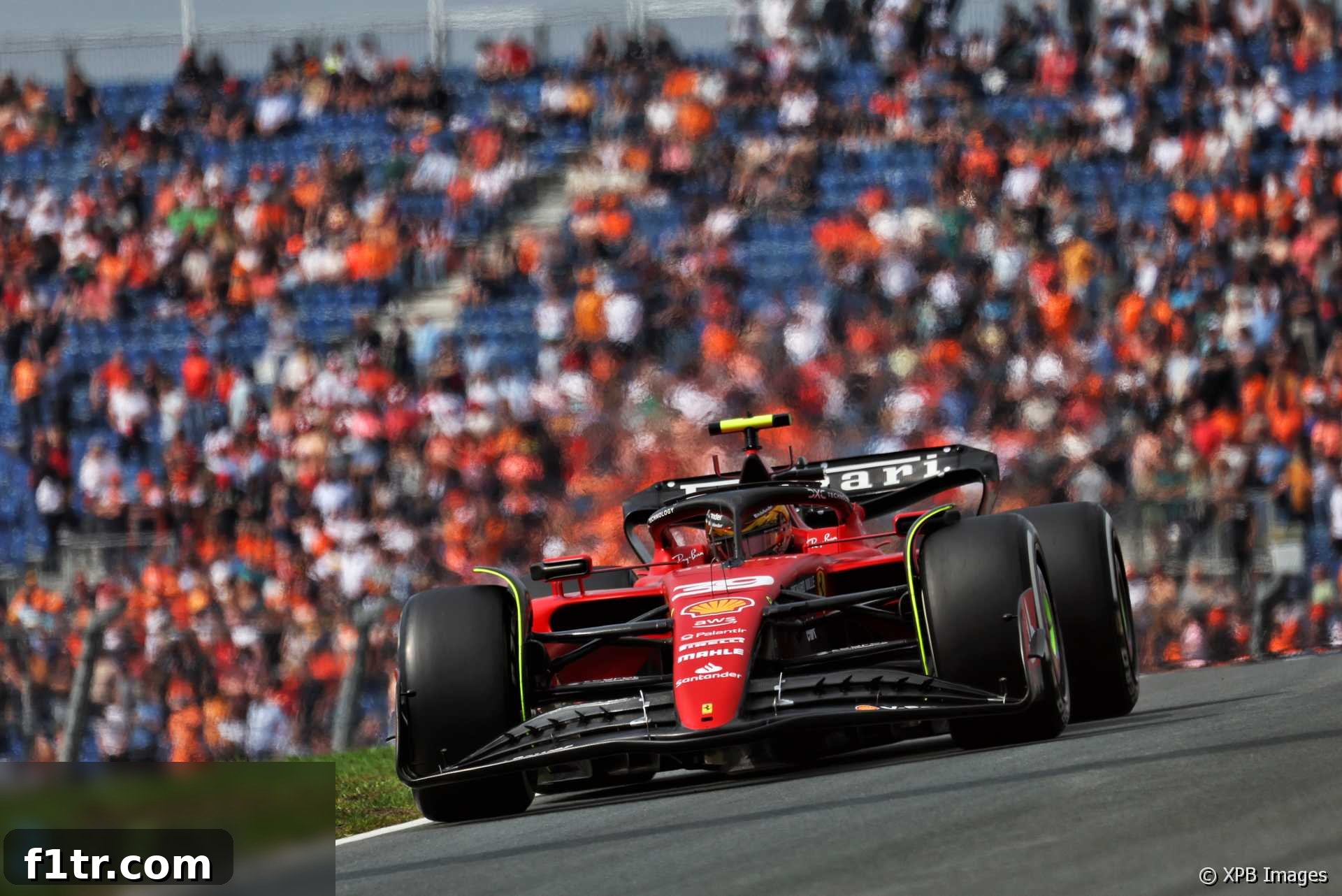
Ferrari’s Performance Puzzle: Sainz’s Concerns vs. Cardile’s Clarity on SF-23 Limitations
The highly competitive landscape of Formula 1 consistently brings forth intriguing dynamics, not least within the sport’s most storied team, Ferrari. A recent divergence of opinion between star driver Carlos Sainz Jnr and the Scuderia’s head of chassis development, Enrico Cardile, has ignited discussions about the team’s understanding of their challenging SF-23 car. While Sainz has openly suggested a lack of complete comprehension regarding the vehicle’s inherent limitations, Cardile firmly asserts that the team possesses a crystal-clear insight into their current performance nuances and areas for improvement.
The Core Disagreement: Driver’s Frustration Meets Engineering Certainty
Ferrari’s 2023 season has been characterized by a notable inconsistency in form, often showcasing flashes of brilliance only to be followed by perplexing struggles. This fluctuating performance, particularly in their ongoing battle to challenge Red Bull at the front of the grid, has naturally led to introspection within the Maranello outfit. Carlos Sainz Jnr, a driver known for his meticulous feedback and analytical approach, recently articulated his frustration, positing that Ferrari’s varied results throughout the season were attributable to “something intrinsic that we don’t fully understand.” This sentiment reflects a common challenge in Formula 1: translating complex car behavior into actionable development insights, especially when the car’s characteristics vary significantly from track to track.
However, Enrico Cardile, the respected head of Ferrari’s chassis area, offers a starkly different perspective. For Cardile and his engineering team, the root causes of the SF-23’s performance swings are not shrouded in mystery but are, in fact, entirely understood. “For us, it is crystal clear what we did wrong with the car,” Cardile insisted, leaving no room for ambiguity regarding the engineering department’s grasp of the situation. He continued, “What the weaknesses are is clear – it’s not a matter of our understanding what we should do.” This direct contradiction highlights a fascinating internal dialogue, where the driver’s experience of inconsistency on track meets the engineers’ data-driven certainty in the factory.
Unpacking Ferrari’s Inconsistent Season: A Tale of Varied Venues
The Ferrari SF-23 has indeed demonstrated a peculiar sensitivity to different circuit layouts and conditions, which contributes significantly to the perception of inconsistency. As Cardile himself acknowledged, “this car is consistent during the rest of weekend in terms of behaviour, but sometimes this behaviour changes from track to track.” He cited specific examples, pointing out, “In Hungary, we had a difficult time. In Belgium, the performance was back.” This anecdotal evidence underscores the challenge for drivers, who must adapt their style and expectations weekly, and for engineers, who strive to build a car with a broader operating window.
The Hungarian Grand Prix, with its tight and twisty layout, exposed the SF-23’s limitations, particularly its handling characteristics through slow and medium-speed corners. In contrast, the high-speed demands of Spa-Francorchamps for the Belgian Grand Prix saw Ferrari’s fortunes improve, with the car exhibiting greater stability and pace. These swings, from struggling to contend for podiums to fighting for top-five positions, are precisely what fueled Sainz’s remarks. However, Cardile’s assertion suggests that even these track-specific variations are cataloged and understood within Ferrari’s extensive data sets, serving as crucial input for ongoing development rather than indicators of an inscrutable machine.
Aerodynamic Weaknesses: The Root Cause Identified and Targeted
Central to Cardile’s argument is the belief that Ferrari has accurately pinpointed the primary source of their car’s limitations: its aerodynamic characteristics. “We think that our main weakness is on the aero characteristics of the car,” he explained, providing a clear focus for their development efforts. This revelation is critical, as aerodynamics form the bedrock of modern Formula 1 car performance, influencing everything from downforce and drag to tire degradation and overall balance.
Cardile, an accomplished aerospace engineer who transitioned from Ferrari’s sports car division to its F1 team in 2016, elaborated on the timeline and intensity of their focus. “So all the focus since [testing] when it’s been pretty clear that we were not at the level that we expected to be, the weakness for the front was coming from there. So all the focus, all the efforts has been since [testing] on improving the aero characteristics of the car.” This statement highlights a proactive and continuous development cycle, starting from early season testing, where the initial assessment of the SF-23 revealed its aerodynamic shortcomings. The team’s commitment to relentlessly refining these aspects speaks volumes about their methodical approach to overcoming performance deficits.
Data-Driven Development: Ferrari’s Analytical Approach and Progress
Contrary to the perception of struggling to decipher their car’s behavior, Cardile emphasized that Ferrari benefits from a robust and consistent data feedback loop. This system effectively bridges the gap between driver perception, advanced simulation tools, and real-world track data. “We have been lucky, because the comments of the drivers has been always aligned between the sim and track and aligned with the data we gather from the car,” Cardile noted. This critical alignment ensures that the team is working with reliable information, allowing them to accurately diagnose issues and evaluate the effectiveness of their solutions. “So we can see what we are complaining with,” he added, indicating that the challenges are not elusive but quantifiable.
Despite this clear understanding and diligent effort, Cardile acknowledged the undeniable reality of Formula 1: the relentless pace of competition. “We are a bit progressed through the development of this car, improving some characteristic of the car. But the pace we are developing the car is obviously not satisfactory because we are still far from the blue guys there.” The “blue guys” is an unmistakable reference to Red Bull Racing, the dominant force in the 2023 season. This candid admission underscores the immense challenge Ferrari faces, even with a clear understanding of their car. While progress has been made, the rate of improvement has not yet been sufficient to close the significant gap to the championship leaders, intensifying the pressure on Ferrari’s development trajectory.
Looking Ahead: The Path to Future Success and Strategic Development
For Enrico Cardile, the path forward is clear, albeit demanding. It transcends simply identifying problems; it’s about executing solutions effectively to achieve specific performance targets. “Now for the future it’s a matter of delivering a good product where we cope with the targets we have. We know what we have to do, it’s a matter of doing, it’s a matter of finding the right contents of the car, the right architecture of the car to achieve the target.” This strategic outlook confirms that Ferrari’s focus extends beyond incremental upgrades to the current SF-23. It encompasses a fundamental review of the car’s architecture and component integration, likely with an eye towards the 2024 challenger and beyond.
The long-term vision involves a comprehensive approach to design and engineering, ensuring that future iterations of the Ferrari F1 car possess a wider operating window and less sensitivity to track characteristics. The work conducted during sessions like FP1 at the recent Zandvoort Grand Prix, where Cardile mentioned dedicating the session to “a specific test to better tune our tools to better operate the car this year and to have data to improve the behaviour of the car next year,” exemplifies this dual focus. It’s about optimizing current performance while rigorously gathering data to inform and refine the next generation of Ferrari machinery, striving for a more consistently competitive package.
Beyond the Headlines: The Complexity of F1 Development
The contrasting perspectives of a driver and an engineering lead within a top Formula 1 team offer a fascinating glimpse into the immense complexity of modern motorsport. Carlos Sainz Jnr’s lived experience behind the wheel, feeling the subtle shifts and limitations, provides invaluable subjective feedback. Enrico Cardile’s data-driven, analytical approach, grounded in engineering principles, provides the objective, quantifiable understanding necessary for targeted development. Both perspectives are crucial for success, and their alignment, as Cardile noted, is a significant advantage for Ferrari.
Ultimately, the discussion around Ferrari’s SF-23 highlights the continuous pursuit of perfection in Formula 1. Every component, every line of code, and every aerodynamic surface is meticulously scrutinized in the quest for performance. While the road ahead remains challenging, Ferrari’s commitment to understanding and overcoming their car’s inherent weaknesses demonstrates their unwavering ambition to return to consistent championship-contending form. The ongoing development battle, both on track and in the factory, is a testament to the relentless innovation and dedication that defines Formula 1 at its highest level.
Related F1 Insights and 2023 Dutch Grand Prix Articles
- Azerbaijan GP defeat was key to record-equalling run of wins – Verstappen
- “Too early to say” if podium signals return to form for Aston Martin – Alonso
- Verstappen makes history with unbeaten hat-track in first home races
- Perez is ‘doing his job and will be our driver in 2024’, Horner insists
- Ferrari had the “sixth or seventh fastest car” at Zandvoort – Sainz
Browse all 2023 Dutch Grand Prix articles