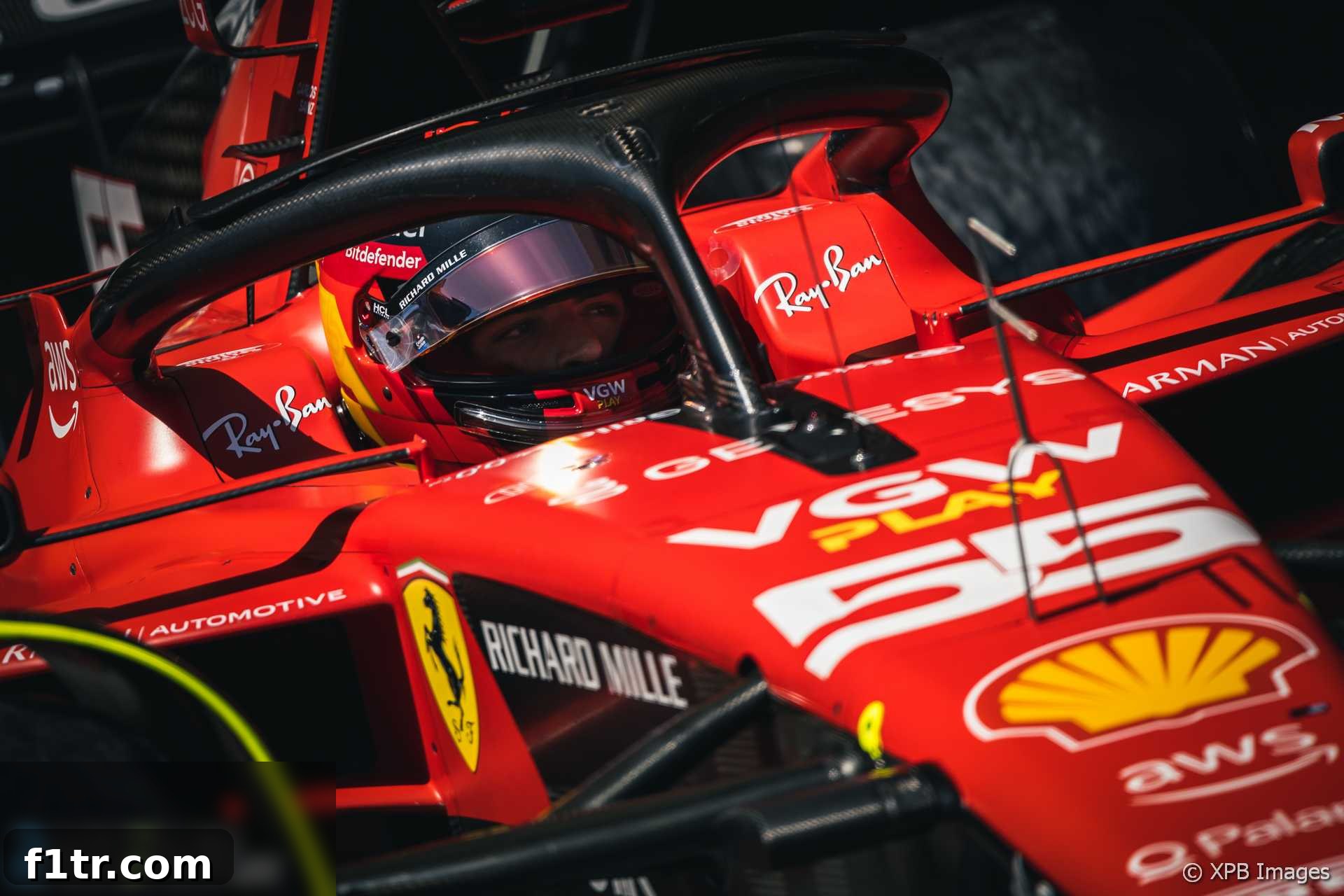
Carlos Sainz Grapples with Car Handling and Confidence at Azerbaijan Grand Prix Sprint
Carlos Sainz Jnr openly admitted to experiencing significant difficulties with his car’s handling and a notable lack of confidence after securing a fifth-place finish in the Azerbaijan Grand Prix sprint race. This result, while contributing valuable points to Ferrari’s tally, starkly underscored a challenging start to the weekend for the Spanish driver, particularly when contrasted with his teammate’s stellar performance.
His Ferrari team mate Charles Leclerc showcased the F1-75’s outright pace by clinching pole position for both the sprint race and the main Grand Prix – a remarkable achievement that highlighted the car’s raw speed potential. However, the performance gap between the two Ferrari drivers was strikingly evident throughout the weekend’s qualifying sessions. Sainz consistently lagged over half a second behind Leclerc in both instances, a substantial deficit in Formula 1 terms. This significant time difference pointed to underlying issues for Sainz, setting the stage for a weekend focused more on minimizing losses than on contending for top honors.
The Unforgiving Nature of Baku and the Sprint Format’s Impact
“I have an explanation why, I clearly don’t feel comfortable and confident,” Sainz stated candidly after the sprint race. “If I would then I would just be lacking three tenths, half a second per lap. But I clearly don’t have the confidence.” This straightforward admission highlights the critical role of driver confidence, especially on a demanding street circuit like Baku. The Azerbaijan Grand Prix, known for its unique blend of ultra-fast, long straights and incredibly tight, technical sections nestled between historic city walls, punishes any lack of faith in the car’s capabilities. Drivers must push to the absolute limit, often brushing the unforgiving barriers, and any uncertainty about the car’s behavior can translate directly into lost lap time and increased risk of error.
The introduction of the new sprint format for the 2023 season, which drastically reduces practice time to a single hour on Friday, severely compounded Sainz’s predicament. This condensed schedule leaves minimal opportunity for teams and drivers to fine-tune complex car setups or for drivers to adapt to challenging track conditions. “I’m going to need more time after this weekend to really go deeper in the data, because now with this format you just simply don’t have time. You’re going into a quali, into a race into another quali, and it’s impossible to take conclusions or to change anything that would help me for sure get a bit more comfortable,” Sainz explained.
This revised format essentially throws teams into competitive sessions almost immediately after just one short practice session, demanding instant, peak performance. For a driver grappling with specific car characteristics that don’t align with their natural driving style or the track’s unique demands, the severe reduction in free practice sessions is a significant handicap. Normally, drivers would utilize Friday practice to meticulously experiment with different setups, assess tire compounds, and refine their driving lines, slowly building confidence and gaining a comprehensive understanding of the car’s limits. In Baku, with the sprint format, that crucial developmental luxury was non-existent, forcing Sainz into a reactive rather than proactive approach to his car’s issues.
Carlos Sainz Adopts a “Damage Limitation” Strategy
“So I’m a bit stuck. But as I said, it gets to a point where you just need to accept it. It’s one weekend in my life that I’m feeling this strange situation and at this point is more damage limitation,” Sainz reflected. This philosophy of “damage limitation” is a well-established strategy in Formula 1 when a driver or team encounters unforeseen and unresolvable challenges. It means acknowledging that winning or even a podium finish might be out of reach, and instead strategically focusing on maximizing the points haul by driving conservatively, minimizing risks, and ensuring the car finishes the race in the best possible position. For a competitor as fiercely ambitious as Sainz, admitting to a damage limitation mindset so early in a race weekend clearly underscores the severity of his struggles and the depth of the challenge.
The core of his problem lay in the inability to make substantial, impactful changes to the car’s setup within the constrained schedule. “When you can change nothing in the car and you cannot really experiment to get yourself comfortable you are in for a difficult weekend like I am at now,” he added. This statement illuminates a fundamental truth of modern F1: while drivers are immensely talented athletes, the car’s setup and its synergy with the driver’s preferences are paramount to performance. Without the freedom to adjust, experiment, and refine the car, a driver can feel disconnected and unable to extract the maximum performance, even from a competitive machine like the Ferrari SF-23.
Sainz further elaborated on his persistent attempts to adapt his driving style to the car’s inherent and unwelcome balance. “I’ve done some steps with my driving and changing a few things to try to adapt myself to the balance that I have on the track. But it’s proving to be a very challenging weekend.” This speaks volumes about the immense skill and adaptability of F1 drivers, who are constantly making micro-adjustments to compensate for their car’s unique characteristics. However, there comes a critical point where sheer driver input alone cannot overcome a fundamental lack of harmony between the car, the specific demands of the track, and the driver’s crucial sense of confidence.
“At this point, knowing what the pace is this weekend, it’s more a damage limitation weekend for me than anything else. I’m really struggling out there with confidence, always feeling really on the limit of the rear axle and it’s not a nice feeling to have around Baku.” The specific mention of struggling with the rear axle is particularly insightful and telling. On a treacherous street circuit like Baku, rear-end stability is absolutely crucial for maintaining confidence through high-speed corner entries and for achieving optimal traction out of the slower, tight corners. A car that feels loose, unpredictable, or perpetually on the edge at the rear makes it incredibly difficult for a driver to commit and push hard, leading to a detrimental vicious cycle where a lack of confidence prevents the driver from truly finding and exploiting the car’s limit, thereby further exacerbating the feeling of discomfort and ultimately, slower lap times.
Divergent Fortunes: Sainz vs. Leclerc at Ferrari
The stark contrast in performance between Carlos Sainz Jnr and Charles Leclerc at the Azerbaijan Grand Prix sprint weekend presented a fascinating, albeit concerning, subplot for the Ferrari team. Leclerc, appearing to be at one with the challenging Baku City Circuit, delivered a masterclass in qualifying, securing two pole positions back-to-back. This remarkable feat unequivocally demonstrated the inherent speed of the Ferrari SF-23, proving that, under the right conditions and with a setup that perfectly suits a driver, the car could indeed be a formidable force capable of topping the time sheets.
However, the consistent half-second gap between the two teammates in qualifying is, in Formula 1 terms, a significant chasm. It is not merely a fractional difference but a substantial performance deficit that immediately raises critical questions about car setup optimization, individual driver adaptation, or potentially a complex combination of both factors. While Leclerc evidently exploited the car’s strengths and adeptly adapted his driving style to extract maximum performance, Sainz found himself locked in a battle, wrestling with an uncomfortable and unpredictable balance, particularly concerning the crucial rear end of the car. This highlights just how critically important a car’s specific handling characteristics can be and how they might inherently suit one driver’s natural style and preferences more effectively than another’s.
The Ferrari SF-23 has demonstrated flashes of brilliant speed throughout the initial stages of the season, often topping the speed charts in qualifying sessions. However, it has also displayed a concerning inconsistency in both race pace and overall stability, particularly when tires degrade or track conditions change. Leclerc, with his notoriously aggressive and somewhat intuitive driving style, sometimes manages to tame these challenging characteristics, especially over a single qualifying lap where he can extract explosive speed. Sainz, conversely, is widely known for his more measured, precise, and analytical approach, typically thriving on a car that offers stable, predictable, and consistent handling. When that fundamental stability is compromised, as it conspicuously appeared to be in Baku, his ability to extract peak performance suffers proportionally. The Ferrari team will undoubtedly be analyzing the telemetry data from both cars extensively and meticulously to fully understand these divergent performances and, crucially, to provide Sainz with a more conducive and confidence-inspiring platform in future races.
Looking Ahead: Implications for the Season and Ferrari’s Strategy
Sainz’s challenging weekend in Baku serves as a potent and stark reminder of the inherent complexities of Formula 1, where minimal practice time, a uniquely demanding street circuit, and the intricate nuances of car setup can profoundly impact a driver’s performance and confidence. For Ferrari, ensuring both their drivers are consistently comfortable and competitive is an absolute imperative for their aspirations in the Constructors’ Championship. While Leclerc’s double pole positions were undoubtedly a significant morale boost for the Scuderia, Sainz’s struggles meant the team ultimately couldn’t maximize its potential points haul from the new sprint format weekend, ceding valuable ground to rivals.
Post-Baku, the focus for Sainz and the dedicated Ferrari engineers will undoubtedly shift to an in-depth data analysis and extensive simulator work. With the invaluable benefit of hindsight and detailed telemetry, they will meticulously aim to identify the specific setup parameters or car characteristics that contributed most to his pronounced lack of confidence, particularly regarding the crucial rear axle stability. This iterative process of rigorous data review, advanced simulation, and subsequent on-track application is absolutely crucial for resolving such complex issues and, more importantly, for preventing them from reoccurring in the future, especially as the season progresses to diverse tracks.
For Carlos Sainz himself, a driver widely celebrated for his consistency, meticulous approach, and exceptional ability to adapt, this particular weekend was an anomaly he will be immensely keen to move past quickly. His well-earned reputation as a “smooth operator” and a remarkably reliable points scorer makes his candid admission of discomfort particularly noteworthy and uncharacteristic. Historically, Sainz has often delivered strong, consistent performances, frequently extracting maximum potential and sometimes even outperforming his teammates in various conditions. This makes his struggles in Baku a point of significant concern for him personally and for Ferrari, who critically need both their talented drivers performing at their absolute peak to challenge formidable rivals like Red Bull and the surprisingly competitive Aston Martin team.
Crucially, the experience gained, even from a challenging and frustrating weekend like Baku, is immensely invaluable for a Formula 1 team. Ferrari will undoubtedly utilize these hard-won insights to refine the SF-23’s ongoing development direction, aiming for a broader and more forgiving operating window that can accommodate both drivers’ preferences more effectively across various track types. As the intensely competitive Formula 1 season progresses, the ability to quickly understand, diagnose, and rectify such performance discrepancies will be paramount for any team vying for championship glory. Sainz’s transparent and detailed feedback provides a clear roadmap for the team to meticulously address these pressing issues, with the fervent hope that future race weekends will see him confidently back to his competitive best, fully at one with his machine.
Related Articles from the 2023 Azerbaijan Grand Prix
- Aston Martin radio messages reveal how “older brother” Alonso helps Stroll
- How slashing practice to a single hour in Baku tripped up F1 teams
- Bottas: “Rapid improvement needed” at Alfa Romeo
- Red Bull could become first team to score 1,000 points in a season
- Aston Martin hoping DRS fix works in Miami after Stroll manages fault in race
Browse all 2023 Azerbaijan Grand Prix articles