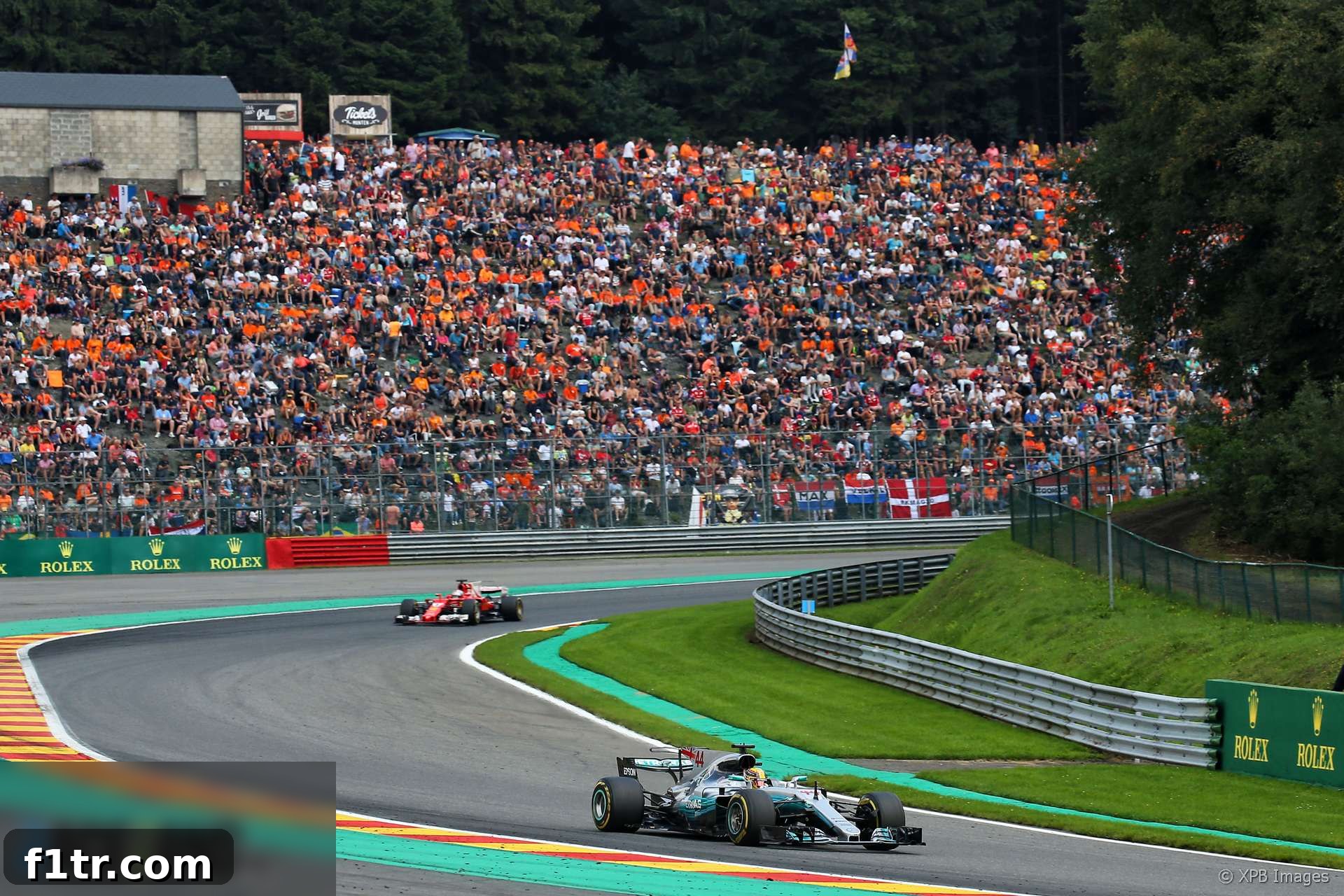
The legendary Spa-Francorchamps circuit in Belgium, renowned for its challenging layout and breathtaking speeds, is once again at the forefront of Formula 1 discussions, with seven-time world champion Lewis Hamilton offering a tantalizing prediction. Hamilton suggests that the formidable Pouhon corner, also known as Double Gauche, could be taken flat-out by some Formula 1 cars this year, a testament to the relentless evolution of engineering and driver capability in the sport.
Pouhon, comprising turns 10 and 11, is a high-speed double-left-hander that demands immense bravery and precision from drivers. Its potential conquest, without lifting off the accelerator, signifies another milestone in F1’s ongoing pursuit of raw speed and aerodynamic efficiency. This follows a trend seen in recent years where iconic corners like Eau Rouge, Raidillon, and Blanchimont, once formidable tests of nerve and machinery, have become full-throttle sections thanks to ever-increasing levels of downforce.
The Evolution of Speed: Flat-Out Corners in Modern F1
The ability to tackle these monumental corners flat-out underscores a profound shift in Formula 1 car design and performance. In previous eras, drivers would often have to lift significantly, or even brake, to navigate the apexes of corners like Eau Rouge and Blanchimont. Today, advancements in aerodynamics, tire technology, and chassis rigidity have transformed these sections into blistering showcases of engineering prowess. Modern F1 cars generate astonishing levels of downforce, effectively glueing them to the track even at extreme speeds. This aerodynamic grip allows drivers to carry incredible momentum through bends, pushing the limits of what was once thought possible.
The sensation of traversing such corners at full throttle is difficult to convey. For a driver like Hamilton, it represents the ultimate connection between man and machine, a dance on the edge of adhesion where every input is critical. The G-forces experienced are immense, challenging the physical and mental fortitude of even the fittest athletes. This constant evolution not only captivates fans but also pushes manufacturers to innovate continuously, striving for marginal gains that can translate into lap time advantages.
Pouhon: The Next Frontier for F1 Prowess
Hamilton’s remarks about Pouhon being a potential flat-out corner highlight its unique challenge and allure. “It’s still a great track to drive,” said Hamilton, expressing his excitement. “And it’s exciting to think Pouhon might be flat-out this year, which is awesome.” He further elaborated on the indescribable feeling, “I wish… your imagination of what it might be like going there, times that by a thousand and it probably won’t still be there.” This sentiment perfectly encapsulates the profound difference between merely imagining high-speed cornering and actually experiencing it from the cockpit of a Formula 1 car.
Pouhon is characterized by its downhill entry and uphill exit, making it a complex sequence that rewards commitment. Taking it flat-out would require immaculate car balance, perfect tire temperature, and absolute faith from the driver in their machine’s aerodynamic capabilities. It’s a corner where the car’s stability under high lateral load is tested to its absolute maximum. The implications for qualifying laps and race overtakes are significant, as maintaining speed through such a section can grant a crucial advantage on the subsequent straights.
Spa-Francorchamps: A Legendary Driver’s Circuit
Circuit de Spa-Francorchamps is not merely a track; it’s a living legend in motorsport. Stretching over seven kilometers through the Ardennes forest, it is one of the longest and most revered circuits on the F1 calendar. Its iconic features include the steep climb through Eau Rouge and Raidillon, the long Kemmel Straight leading into Les Combes, the challenging turns of Bruxelles and Pouhon, and the flat-out sweeps of Stavelot and Blanchimont before the Bus Stop chicane. The circuit’s natural undulations, unpredictable weather, and mix of high-speed straights and demanding corners make it a true test of a car’s overall package and a driver’s skill.
The circuit’s elevation changes are dramatic, contributing to its unique character. Drivers experience significant compressions and releases as they navigate its contours, adding another layer of complexity to setup and driving style. It is a track that separates the truly exceptional drivers from the rest, often yielding unforgettable racing moments and unexpected results. For many, Spa represents the purest form of Formula 1 racing, demanding courage, precision, and endurance.
Mercedes’ History at Spa: Dominance Amidst Challenges
Despite Mercedes’ recent success at Spa-Francorchamps, including three consecutive victories with two for Hamilton, the Briton doesn’t necessarily view it as one of the team’s absolute strongest tracks. “I don’t remember it being a favourite track for us in terms of performance,” Hamilton remarked. “I don’t see it as an outlier. It’s not been a bad track for us, but I don’t see it more as an outlier than some of the other great ones like Silverstone, for example.”
This nuanced perspective highlights the complex nature of optimizing a Formula 1 car for a circuit like Spa. While Mercedes has clearly found a winning formula in recent years, the balance between generating sufficient downforce for the high-speed corners and achieving maximum straight-line speed for the long Kemmel Straight and run down to Blanchimont is always a delicate act. Teams must make strategic choices about wing levels and car setup, knowing that an advantage in one sector might compromise performance in another. Mercedes’ ability to secure victories here, even without considering it an outright favorite, speaks volumes about their engineering depth and Hamilton’s capacity to extract every ounce of performance from his car.
The Ferrari Challenge: A Battle of Power and Aerodynamics
Adding another layer of intrigue to the Spa Grand Prix is the fierce competition from rivals, particularly Ferrari. Hamilton acknowledges the significant strides made by the Italian team: “It’s not a bad one for us. But you saw last year how close it was between us and Ferrari. This year they seem to have, at least towards the break, after Austria, quite a big step in power. This is a power circuit.”
Spa-Francorchamps, with its extensive full-throttle sections, heavily rewards superior engine performance. Ferrari’s reported “big step in power” could therefore be a significant factor in their competitiveness. The power unit, encompassing the internal combustion engine, turbocharger, and energy recovery systems (ERS), plays a crucial role in determining top speed and acceleration out of corners. Mercedes and Ferrari have been locked in an intense development battle, particularly regarding their power units, and Spa serves as a critical battleground for this technological arms race. The ability to deploy electrical energy efficiently and maintain optimal engine modes throughout the lap can be the difference between victory and defeat.
Despite Ferrari’s potential advantage in raw power, Hamilton remains cautiously optimistic about Mercedes’ overall package. “I don’t know how we will compare with them power-wise this weekend but I think car performance-wise we should be quite close.” This suggests that while Ferrari might hold an edge on the straights, Mercedes might compensate with superior aerodynamic efficiency in the corners or better tire management. The intricate interplay between engine performance, chassis dynamics, and driver skill will ultimately dictate the outcome, making the race at Spa an eagerly anticipated spectacle.
The Thrill of Speed and the Engineering Marvel
The prospect of seeing F1 cars taking Pouhon flat-out is more than just a statistic; it’s a testament to the continuous evolution and daring spirit of Formula 1. It signifies how human ingenuity, combined with cutting-edge technology, can push the boundaries of what is mechanically and physically achievable. For fans, it promises a display of breathtaking speed and unparalleled driver commitment on one of the sport’s most hallowed grounds.
The Spa-Francorchamps Grand Prix is always a highlight of the Formula 1 calendar, and with Hamilton’s insights into the potential for even greater speeds, the anticipation builds for a thrilling weekend of racing. The strategic decisions regarding car setup, the relentless battle between power units, and the sheer bravery of the drivers as they navigate this legendary circuit will once again captivate audiences worldwide. It will be a true showcase of speed, skill, and the relentless pursuit of perfection that defines Formula 1.
Related Articles
- F1 feared “death knell” for Drive to Survive after Ferrari and Mercedes snub
- McLaren staff told us we were “totally crazy” to take Honda engines in 2018 – Tost
- ‘It doesn’t matter if we start last’: How Red Bull’s junior team aided Honda’s leap forward
- Honda’s jet division helped F1 engineers solve power unit problem
- McLaren Racing losses rise after Honda split
Browse all 2018 F1 season articles