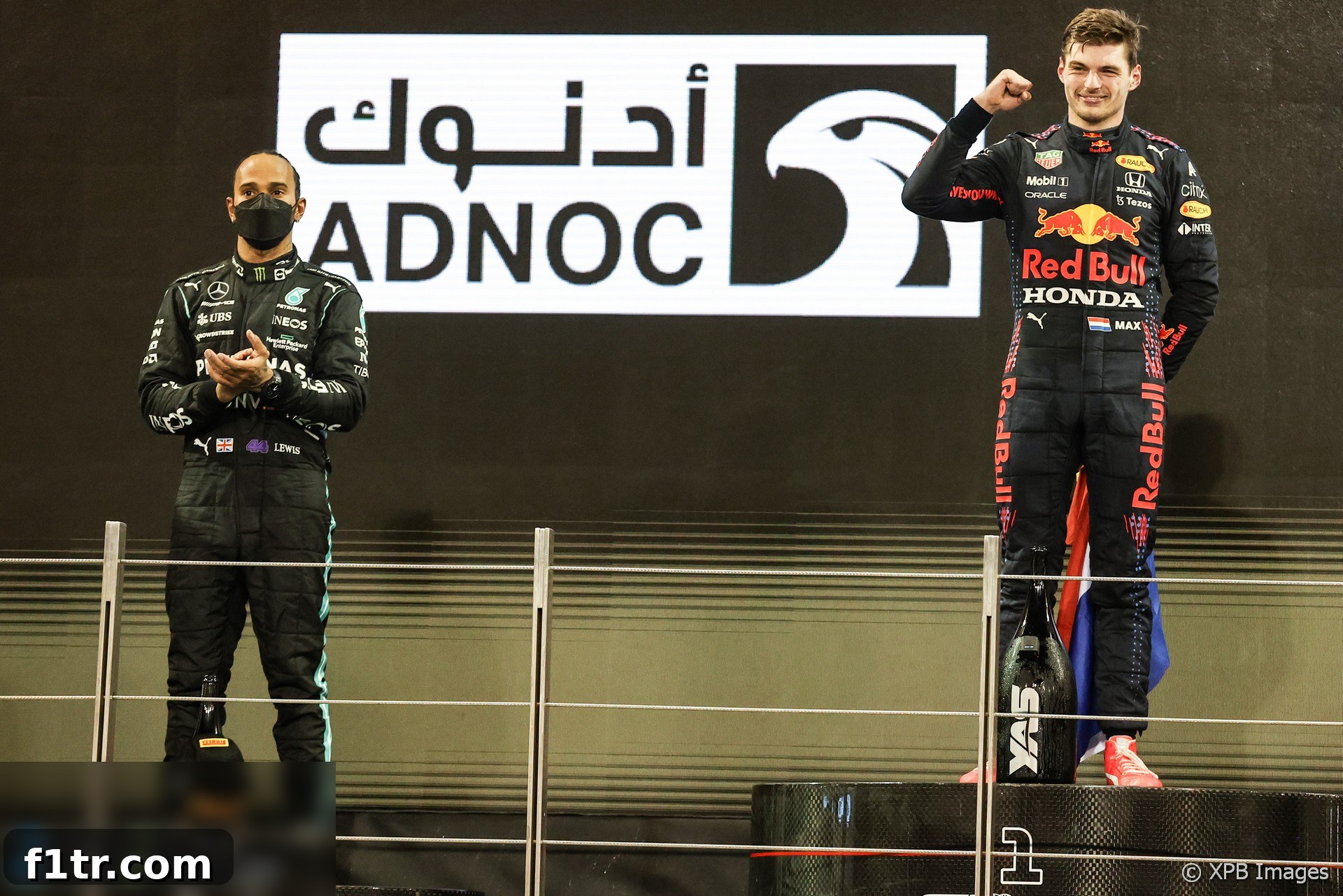
The 2021 Formula 1 Abu Dhabi Grand Prix remains etched in motorsport history as arguably the most shocking, controversial, and ultimately consequential race the sport has ever witnessed. One year ago, at the Yas Marina Circuit, the climax of an epic season delivered a finish that reverberated far beyond the track, triggering a cascade of changes that have reshaped the very foundations of Formula 1.
In a mere 12 minutes, a seemingly guaranteed eighth world championship for Lewis Hamilton dramatically slipped away. A late Safety Car deployment, followed by a last-lap restart executed under contentious circumstances that contravened established rules, allowed Max Verstappen to seize the title in a stunning upset. The outcome left Hamilton and his Mercedes team reeling, their hopes dashed in the most unforeseen manner.
Mercedes immediately launched a formal protest against the race results on multiple grounds. Their primary argument centered on the FIA’s F1 Race Director, Michael Masi, and his alleged failure to adhere correctly to the Safety Car procedure. Specifically, they contended that Masi did not allow all lapped cars to unlap themselves as required and restarted the race prematurely. Despite Mercedes’ strong case, the race stewards dismissed their protests. Four days later, after intense deliberation, Mercedes confirmed their decision not to appeal, thereby solidifying Verstappen’s maiden championship.
While the immediate threat to Verstappen’s title was averted, the controversy did not simply disappear. Months later, following a comprehensive and detailed scrutiny of the events, the FIA acknowledged that Masi had indeed made a critical error in his application of the regulations. This admission ultimately led to Masi’s departure from his role and from the governing body entirely. The fallout from those seismic final laps in Abu Dhabi instigated profound transformations across Formula 1. Here, we delve into the myriad ways in which F1 has evolved as a direct consequence of that unforgettable day.
New FIA Leadership Prioritizes Transparency and Governance
The 2021 Abu Dhabi Grand Prix marked not only the culmination of a thrilling championship and the end of a car generation but also the conclusion of Jean Todt’s tenure as FIA president. After 12 years and three terms at the helm of Formula 1’s governing body, Todt reached the end of his leadership mandate. Just five days after the dramatic chequered flag in Abu Dhabi, Mohammed Ben Sulayem was announced as the new president, having defeated Todt’s long-time right-hand man, Graham Stoker, in the elections.
Among Todt’s final directives was the order for a comprehensive review into the controversial final laps of the Abu Dhabi Grand Prix. This critical task fell to Ben Sulayem and his new team to see through to completion, with Peter Bayer, the FIA’s Secretary General of Sport, leading the inquiry. The findings of this highly anticipated report were eventually published in March. The investigation concluded that Michael Masi had failed to follow the Safety Car procedure correctly due to “human error” but also stated that he had acted in “good faith” at the time. Crucially, despite acknowledging that its own rules had not been correctly followed, the FIA maintained that altering the final results of the race or the championship was not a possibility.
Under Ben Sulayem’s presidency throughout 2022, increasing transparency has become a cornerstone of the FIA’s new operational philosophy. Beyond publicly sharing the full Abu Dhabi report, the governing body also released a detailed report into the opening laps of the Japanese Grand Prix at Suzuka. This report provided an in-depth analysis of the dangerous near-miss between drivers and a recovery crane deployed on track, leading to swift procedural changes. Drivers widely welcomed this shift towards openness and have expressed a strong desire to maintain ongoing dialogue with the FIA on future safety matters, indicating a renewed sense of trust and cooperation within the F1 paddock.
Significant Shake-up in Race Control Operations
Even before the FIA’s formal report was published, Michael Masi’s departure as F1 Race Director was announced at the end of his third season in the demanding role. His eventual exit from the governing body altogether underscored the seriousness of the Abu Dhabi fallout. To fill the void, the FIA implemented an unprecedented and experimental change for the 2022 season: appointing two race directors to share duties across the 22-race calendar. Niels Wittich, formerly a DTM race director, and Eduardo Freitas, a veteran World Endurance Championship and Le Mans 24 Hours race director, were tasked with rotating the position.
Wittich commenced the season, overseeing the first five Grands Prix, before Freitas took over for the Spanish Grand Prix and the iconic Monaco event. However, Freitas’s handling of the delayed start to the Monaco Grand Prix, caused by a sudden rain shower just before the formation lap, drew considerable criticism from some drivers and team principals. Tensions resurfaced as drivers began to voice growing concerns about a perceived lack of consistency in the application of certain rules by the dual race director system.
Following a particularly contentious drivers’ meeting with Wittich at the Red Bull Ring, George Russell, a director of the Grand Prix Drivers’ Association, publicly called for the FIA to reconsider and return to a single race director, alongside more consistent stewarding panels between races. The debate intensified after another major controversy at Suzuka, involving a recovery crane being released onto a wet track while drivers were still circulating, which outraged many competitors. In response, the FIA announced that Wittich would assume the role of sole race director for the remainder of the championship, indicating a strategic shift back towards a centralized command. There has been no subsequent indication that the rotation system will be reinstated for the 2023 F1 season, suggesting a return to a more stable structure.
A more subtle but nonetheless significant change stemming from last year’s events is the discontinuation of direct media access to the race director. Throughout the 2021 season, Masi regularly took questions from accredited media at the circuit after every Grand Prix, offering valuable insights into the reasoning behind various decisions. These regular sessions ceased before Abu Dhabi, specifically after the Jeddah race, where Verstappen received multiple penalties following repeated clashes with Hamilton in a highly ill-tempered event. That round, much like Yas Marina a week later and indeed many races throughout 2022, generated no shortage of critical questions, but the FIA has since chosen not to offer media the same direct opportunity to question Masi’s successors, opting for a more controlled communication approach.
Sweeping Regulatory Changes to Prevent Future Controversies
The furore ignited by the Abu Dhabi race predictably led to a comprehensive raft of regulation changes and critical clarifications, all designed with the explicit aim of preventing any such contentious situation from ever occurring again in Formula 1. These amendments touched upon various facets of race management and interpretation.
In direct response to Masi’s controversial decision to selectively allow only the lapped cars positioned between Hamilton and Verstappen to unlap themselves – a clear violation of the rules – the FIA introduced an automated system. This new protocol now determines precisely which cars are permitted to unlap themselves behind the Safety Car, entirely removing the subjective discretion previously held by the race director. This shift aims to ensure a fair and consistent application of the unlapping procedure for all competitors.
Furthermore, the wording of Article 55.13 of the sporting regulations, the specific rule governing the unlapping process, underwent crucial modification. The original text stated, “any cars that have been lapped by the leader will be required to pass the cars on the lead lap and the Safety Car.” The revised text now explicitly refers to “all cars,” removing any potential ambiguity that Masi might have interpreted or exploited. While race control had never previously executed an instruction quite like the one given in Abu Dhabi, the amended wording leaves no room for such interpretation in the future.
The Safety Car procedure received further refinement early in the 2022 season. Following F1’s return to Jeddah, drivers were explicitly instructed that they must maintain a single-file formation prior to any restart. This rule directly addresses the incident at the final Abu Dhabi restart where Verstappen drew alongside, and briefly nosed ahead of, Hamilton, prompting yet another unsuccessful protest from Mercedes. From this year’s Australian Grand Prix onwards, drivers are unequivocally prohibited from overlapping their car with the car ahead during rolling restarts, ensuring greater order and fairness.
In a concerted effort to enhance drivers’ understanding and consistency in the application of racing rules, the FIA also produced a series of comprehensive guidelines. These guidelines were designed to advise drivers on how stewards would be directed to assess various incidents, particularly collisions. Race director Niels Wittich shared these detailed clarifications with drivers early in the season. However, despite this initiative, these guidelines do not appear to have entirely eradicated complaints of inconsistency from competitors, suggesting that achieving absolute uniformity in dynamic racing scenarios remains a persistent challenge.
Track limits rules have also seen significant simplification under the new race director regime. Departing from Masi’s previous approach of attempting to apply bespoke and often complex rules for each individual circuit and corner, drivers are now universally informed that the white lines define the absolute track limits. Consequently, any laps where all four wheels of the car are deemed to be outside these white lines will be automatically deleted. This standardized approach aims to bring greater clarity and reduce contentious track limits debates.
Additionally, the FIA has directed teams that race control will no longer explicitly ask them to give up positions gained or retained by exceeding track limits or by forcing other drivers off the track. Instead, teams are now instructed to use their own discretion to determine whether to ask their drivers to cede positions if they believe rules have been broken. While this shifts responsibility, teams can – and regularly do – consult race control for clarification and guidance before making such decisions.
Another significant consequence of the Abu Dhabi controversy was the FIA’s establishment of an off-site ‘remote operations centre’ situated in Geneva. This state-of-the-art facility is designed to provide third-party assistance and critical data analysis to the race director and stewards when investigating incidents during a Grand Prix. While its role has largely operated in the background, the FIA explicitly outlined in its Suzuka report that the centre played a substantial part in its investigations, demonstrating its integral role in modern race management.
Finally, and perhaps one of the most immediate and impactful changes: team principals are no longer permitted to speak directly with the race director during a Grand Prix. All communication between the teams and race control must now be channeled exclusively through the team’s nominated sporting director. This procedural shift aims to reduce direct pressure on the race director and ensure more formal, structured, and less emotional interactions during critical race moments.
Transformations in Broadcast Coverage of Formula 1
A major alteration to the live broadcast coverage of Formula 1 in 2022 was a direct result of the Abu Dhabi controversy. Radio messages exchanged between teams and race control are no longer publicly broadcast in any form during Grands Prix coverage. Throughout the tumultuous 2021 championship battle between Verstappen and Hamilton, snippets of radio communication involving team principals Toto Wolff and Christian Horner, and Michael Masi, became a regular and often dramatic soundtrack to the on-track action.
As the controversy surrounding the race’s final lap erupted, Toto Wolff’s impassioned protest, “No, Michael, no – that is so not right,” was instantly immortalized within F1 fan culture and became an iconic phrase. Similarly, after the race, Masi’s defensive refrain, “It’s called a motor race, we went car racing,” achieved equally infamous status. These exchanges provided unfiltered, raw moments that captured the high stakes and intense pressure of the championship fight.
While Red Bull sporting director Jonathan Wheatley and his Mercedes counterpart Ron Meadows previously found their direct conversations with race control broadcast to millions on the world feed, their correspondence is now strictly private once again. As fascinating a glimpse behind the curtain as these radio snippets provided, the consensus is that it can only be for the ultimate good of the sport that these sensitive and occasionally heated discussions remain exclusively between the two involved parties. This change aims to reduce external pressure on officials and allow decisions to be made without the immediate scrutiny and potential bias of a global audience.
Verstappen Retains His Crown Amidst Mercedes’ Struggles
Having battled blow-for-blow over the grueling 22-race season in 2021, both Max Verstappen and Lewis Hamilton would have been exceptionally worthy winners of the championship. As Formula 1 headed into the 2022 season, introducing vastly new technical regulations, the prospect of the two titans resuming their epic duel, with Hamilton aiming to settle the score, was a truly tantalizing one for fans and pundits alike.
However, this highly anticipated reprise of their rivalry was not to be. Mercedes arrived with a fundamentally new car, the W13, which was severely hampered by excessive aerodynamic porpoising – a phenomenon where the car bounces violently at high speeds. This inherent flaw fundamentally compromised their performance from the outset. Meanwhile, Verstappen and Red Bull, despite facing some early reliability problems, found themselves engaged in a spirited battle against a resurgent Ferrari team during the initial phase of the season.
Over the course of 2022, Red Bull meticulously developed their RB18 into an all-conquering machine. This formidable package, combined with Verstappen’s extraordinary talent, allowed him to achieve an unprecedented tally of 15 race wins, securing his second consecutive world title with four races remaining in the season. Just one race later, Red Bull sealed the Constructors’ Championship, marking their first team title since 2013, solidifying their dominance in the new regulatory era.
For Mercedes, 2022 represented a significant downgrade in performance compared to their previously unassailable position. The team struggled immensely to keep pace with Red Bull and Ferrari during the early stages of the season, necessitating an arduous development effort to bridge the deficit. While Mercedes eventually managed to close the gap to their rivals by the latter half of the season, their overall performance was starkly contrasted with Red Bull’s. Red Bull amassed an astonishing 17 race victories throughout the season, whereas Mercedes managed only a single win all year – a memorable triumph at the penultimate round in Brazil. The team, once Constructors’ Champions, consequently fell to third place in the standings by the season’s close.
Interestingly, that very race in Brazil also saw the first significant on-track clash between Hamilton and Verstappen since the dramatic events that concluded the previous season. The question now looms large for the future of Formula 1: Will we ever again witness these two extraordinary drivers go toe-to-toe for another world title, and if so, would their intense rivalry once more push the FIA’s new rules and race management systems to their absolute breaking point?
2022 F1 Season Related Articles
- Mercedes told me “you’re wrong” about 2022 car’s problems – Hamilton
- FIA confirms all 10 F1 teams complied with 2022 cost cap
- Steiner “not ashamed” of panning “slow” Schumacher in Drive to Survive
- Albon believes year out of F1 improved him as a driver
- Hamilton sees diversity gains in F1 years on from his ‘traumatising’ experience of racism
Browse all 2022 F1 season articles