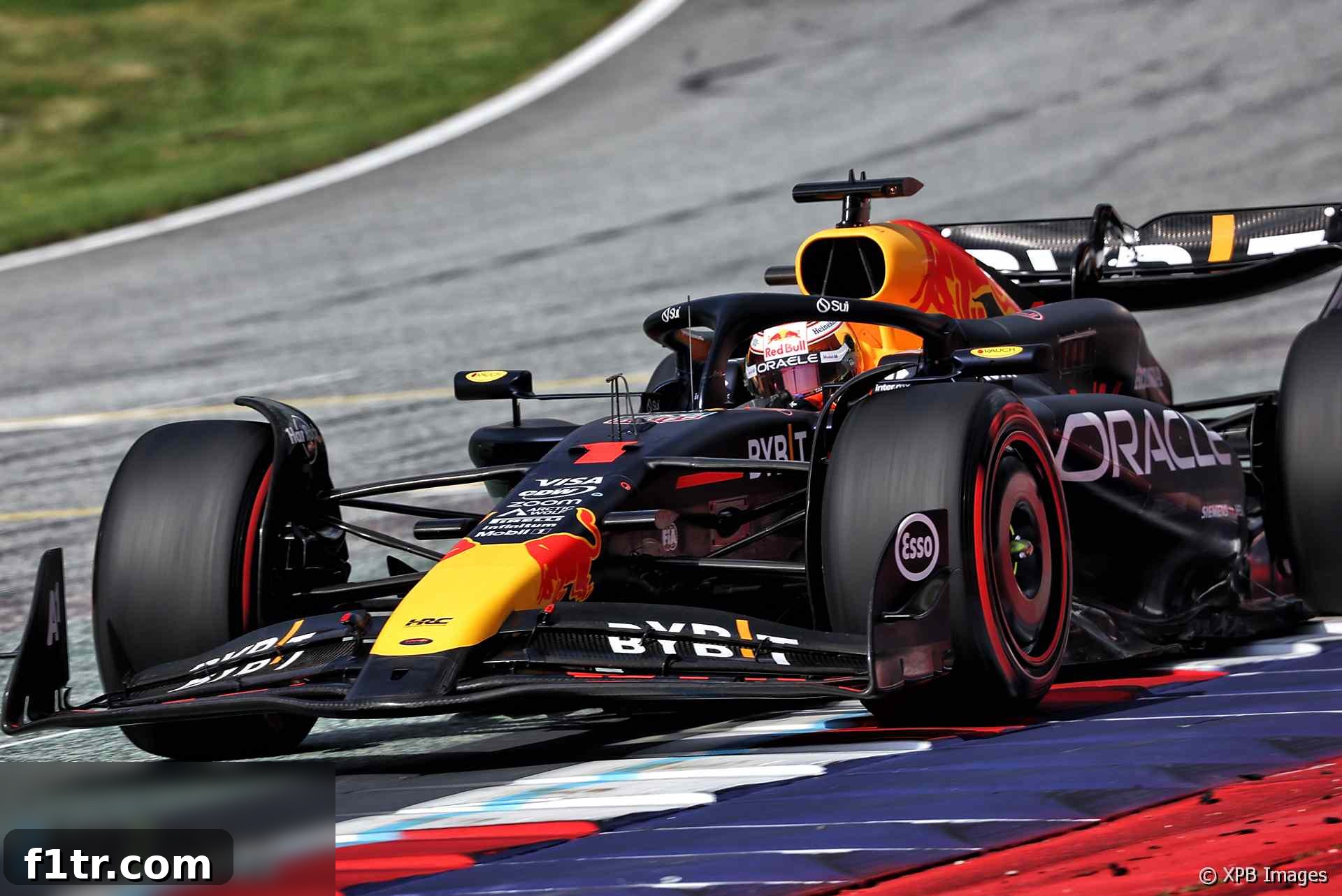
Max Verstappen Dominates Austrian Grand Prix Qualifying, Securing Pole Position at Red Bull Ring
The exhilarating qualifying session for the Austrian Grand Prix culminated in a familiar sight: Max Verstappen seizing a commanding pole position for his home team, Red Bull. The Dutchman, behind the wheel of his potent RB20, delivered a blistering lap time of 1’04.314, demonstrating his unwavering pace and mastery of the Red Bull Ring. This puts him in prime position to convert his advantage into another victory in front of the fervent orange army.
However, the competition was fierce and pushed Verstappen to his limits. McLaren’s Lando Norris continued his impressive run of form, securing a superb second place on the grid with a time of 1’04.718, showcasing the significant progress made by the Woking-based outfit. Mercedes’ George Russell also delivered a strong performance, locking in third place with 1’04.840, indicating a potential resurgence for the Silver Arrows at a track that has historically favored high-downforce cars. These top three drivers promise a thrilling start to Sunday’s race, setting the stage for an intense battle for victory.
A Deep Dive into the Qualifying Sessions: Q1, Q2, and the Pole Shootout in Q3
The qualifying hour at the picturesque Red Bull Ring was packed with drama, strategic gambles, and nail-biting finishes across all three segments. The circuit, known for its short lap and high-speed corners, always presents a unique challenge, demanding absolute precision from the drivers and optimal setup from the teams. The stakes were incredibly high, with every tenth of a second making a critical difference in grid position.
Q1: Setting the Pace and Early Exits
The first segment, Q1, saw all 20 cars take to the track, eager to lay down a marker and avoid an early elimination. The initial laps were crucial for understanding track conditions and tire performance. Carlos Sainz of Ferrari set the early pace, demonstrating Ferrari’s potential, though he would ultimately be overshadowed by others later on. Max Verstappen comfortably progressed, as did the McLarens and Mercedes, signaling their intent from the outset.
However, for some, Q1 proved to be the end of the road. Logan Sargeant of Williams and Zhou Guanyu of Sauber found themselves at the bottom of the timesheets, unable to extract the pace required to advance. Valtteri Bottas, Lance Stroll, and Alexander Albon also faced early exits, highlighting the unforgiving nature of the Red Bull Ring and the fierce competition throughout the field. Aston Martin, in particular, seemed to struggle for outright single-lap pace, which raised some eyebrows given their previous season’s strong performances.
Q2: The Fight for the Top Ten
As Q2 commenced, the pressure intensified, with drivers vying for one of the coveted ten spots in the final qualifying segment. Tire strategies became more critical, and teams pushed their cars to the limit. Max Verstappen continued to assert his dominance, clocking the fastest time in Q2, laying down a formidable marker for his rivals. Lando Norris and George Russell also showed exceptional pace, hinting at their strong Q3 performances to come. The midfield battle was particularly intense, with several drivers fighting tooth and nail for those remaining spots.
Ultimately, Daniel Ricciardo (RB), Kevin Magnussen (Haas), Pierre Gasly (Alpine), Yuki Tsunoda (RB), and Fernando Alonso (Aston Martin) were among those who narrowly missed out on Q3. Their elimination underscored the incredibly tight margins in Formula 1, where even a slight error or an imperfect lap can cost a driver a significant number of grid positions. Daniel Ricciardo, in particular, was agonizingly close, missing Q3 by just 0.015 seconds, a testament to the hyper-competitive nature of the sport.
Q3: The Ultimate Pole Position Showdown
The final Q3 segment was a high-stakes battle for pole position, with the fastest ten drivers unleashing their full potential. Max Verstappen, known for his ability to find an extra gear when it matters most, delivered a masterclass. His final lap was a testament to his skill and the Red Bull RB20’s optimized performance, resulting in a sensational 1’04.314, a time that his rivals simply couldn’t match.
Lando Norris, however, came remarkably close, showcasing McLaren’s impressive pace and his own growing confidence. His 1’04.718 secured him a front-row start, a significant achievement for the Briton. George Russell continued Mercedes’ strong weekend, snatching third place. Carlos Sainz and Lewis Hamilton put in solid efforts for Ferrari and Mercedes respectively, securing fourth and fifth. Charles Leclerc and Oscar Piastri rounded out the top seven, demonstrating their teams’ capabilities. Sergio Perez, in the second Red Bull, could only manage eighth, struggling to match his teammate’s blistering pace. Nico Hulkenberg of Haas delivered a standout performance, securing ninth place, while Esteban Ocon completed the top ten for Alpine, albeit with a significant gap to the cars ahead.
2024 Austrian Grand Prix Provisional Starting Grid
Here is the full provisional starting grid for the 2024 Austrian Grand Prix, detailing each driver’s position, car number, and qualifying time:
| Row 1 | 1. (1) Max Verstappen 1’04.314 Red Bull-Honda RBPT RB20 |
|
| 2. (4) Lando Norris 1’04.718 McLaren-Mercedes MCL38 |
||
| Row 2 | 3. (63) George Russell 1’04.840 Mercedes W15 |
|
| 4. (55) Carlos Sainz Jnr 1’04.851 Ferrari SF-24 |
||
| Row 3 | 5. (44) Lewis Hamilton 1’04.903 Mercedes W15 |
|
| 6. (16) Charles Leclerc 1’05.044 Ferrari SF-24 |
||
| Row 4 | 7. (81) Oscar Piastri 1’05.048 McLaren-Mercedes MCL38 |
|
| 8. (11) Sergio Perez 1’05.202 Red Bull-Honda RBPT RB20 |
||
| Row 5 | 9. (27) Nico Hulkenberg 1’05.385 Haas-Ferrari VF-24 |
|
| 10. (31) Esteban Ocon 1’05.883 Alpine-Renault A524 |
||
| Row 6 | 11. (3) Daniel Ricciardo 1’05.289 RB-Honda RBPT 01 |
|
| 12. (20) Kevin Magnussen 1’05.347 Haas-Ferrari VF-24 |
||
| Row 7 | 13. (10) Pierre Gasly 1’05.359 Alpine-Renault A524 |
|
| 14. (22) Yuki Tsunoda 1’05.412 RB-Honda RBPT 01 |
||
| Row 8 | 15. (14) Fernando Alonso 1’05.639 Aston Martin-Mercedes AMR24 |
|
| 16. (23) Alexander Albon 1’05.736 Williams-Mercedes FW46 |
||
| Row 9 | 17. (18) Lance Stroll 1’05.819 Aston Martin-Mercedes AMR24 |
|
| 18. (77) Valtteri Bottas 1’05.847 Sauber-Ferrari C44 |
||
| Row 10 | 19. (2) Logan Sargeant 1’05.856 Williams-Mercedes FW46 |
|
| 20. (24) Zhou Guanyu 1’06.061 Sauber-Ferrari C44 |
Detailed Qualifying Session Results: Lap Times and Margins
This table provides a comprehensive breakdown of each driver’s performance across Q1, Q2, and Q3, including their best lap times and the margins of improvement (or decline) between sessions. This data highlights the progression of speed and the critical differences that determined who advanced and who was eliminated in each stage of qualifying.
| P. | Driver | Team | Q1 | Q2 (v Q1) | Q3 (v Q2) |
|---|---|---|---|---|---|
| 1 | Max Verstappen | Red Bull | 1’05.336 | 1’04.469 (-0.867s) | 1’04.314 (-0.155s) |
| 2 | Lando Norris | McLaren | 1’05.450 | 1’05.103 (-0.347s) | 1’04.718 (-0.385s) |
| 3 | George Russell | Mercedes | 1’05.585 | 1’05.016 (-0.569s) | 1’04.840 (-0.176s) |
| 4 | Carlos Sainz Jnr | Ferrari | 1’05.263 | 1’05.016 (-0.247s) | 1’04.851 (-0.165s) |
| 5 | Lewis Hamilton | Mercedes | 1’05.541 | 1’05.053 (-0.488s) | 1’04.903 (-0.150s) |
| 6 | Charles Leclerc | Ferrari | 1’05.509 | 1’05.104 (-0.405s) | 1’05.044 (-0.060s) |
| 7 | Oscar Piastri | McLaren | 1’05.311 | 1’05.070 (-0.241s) | 1’05.048 (-0.022s) |
| 8 | Sergio Perez | Red Bull | 1’05.587 | 1’05.144 (-0.443s) | 1’05.202 (+0.058s) |
| 9 | Nico Hulkenberg | Haas | 1’05.596 | 1’05.262 (-0.334s) | 1’05.385 (+0.123s) |
| 10 | Esteban Ocon | Alpine | 1’05.574 | 1’05.274 (-0.300s) | 1’05.883 (+0.609s) |
| 11 | Daniel Ricciardo | RB | 1’05.569 | 1’05.289 (-0.280s) | Missed by 0.015s |
| 12 | Kevin Magnussen | Haas | 1’05.508 | 1’05.347 (-0.161s) | Missed by 0.073s |
| 13 | Pierre Gasly | Alpine | 1’05.598 | 1’05.359 (-0.239s) | Missed by 0.085s |
| 14 | Yuki Tsunoda | RB | 1’05.563 | 1’05.412 (-0.151s) | Missed by 0.138s |
| 15 | Fernando Alonso | Aston Martin | 1’05.656 | 1’05.639 (-0.017s) | Missed by 0.365s |
| 16 | Alexander Albon | Williams | 1’05.736 | Missed by 0.080s | |
| 17 | Lance Stroll | Aston Martin | 1’05.819 | Missed by 0.163s | |
| 18 | Valtteri Bottas | Sauber | 1’05.847 | Missed by 0.191s | |
| 19 | Logan Sargeant | Williams | 1’05.856 | Missed by 0.200s | |
| 20 | Zhou Guanyu | Sauber | 1’06.061 | Missed by 0.405s |
Key Incidents, Penalties, and Protests Affecting the Starting Grid
The Austrian Grand Prix qualifying was not without its share of controversies and steward decisions, which have had a direct impact on the final starting grid and the narratives heading into the race. These post-qualifying reviews are a standard part of Formula 1, ensuring fair play and adherence to regulations.
Penalties
- Zhou Guanyu: Pit Lane Start Due to Set-Up Change
Sauber’s Zhou Guanyu faced a significant penalty, being relegated to a pit lane start. This decision was made after the team undertook a set-up change on his car under Parc Fermé conditions following qualifying. F1 regulations strictly govern what modifications can be made to cars after qualifying to prevent teams from gaining an unfair advantage. A change of this nature typically triggers a penalty, forcing the driver to start from the pit lane once the race has begun, effectively putting him at the very back and at a disadvantage right from the off.
Protest
- McLaren’s Protest Dismissed Over Piastri’s Deleted Lap Time
One of the most talked-about incidents post-qualifying involved McLaren. The team lodged a protest against the qualifying results, specifically challenging the deletion of Oscar Piastri’s lap time in Q3. Piastri had shown strong pace, and a competitive lap could have elevated his starting position further up the grid. However, after a thorough review, the stewards ultimately dismissed McLaren’s protest. This decision means that Piastri’s original qualifying position stands, and the grid remains unchanged in this regard. These protests are a crucial part of F1, allowing teams to seek clarification and challenge decisions they believe are unfair or incorrect, but often, the stewards uphold their initial rulings based on telemetry and video evidence.
Investigations
- Verstappen Cleared of Driving Unnecessarily Slowly
Max Verstappen, despite his pole position heroics, was investigated for allegedly driving unnecessarily slowly during a qualifying lap, an action that can impede other drivers. After reviewing the telemetry and context, the stewards cleared Verstappen, concluding that his actions did not warrant a penalty. This outcome was a relief for Red Bull and the pole-sitter, ensuring his front-row start was secure. - Hamilton’s Team Fined Over Unsafe Release from Pit Garage
Lewis Hamilton’s Mercedes team received a fine following an unsafe release from the pit garage. Pit lane safety is paramount in F1, and any incident where a car is released into the path of another or in a manner that could cause a dangerous situation is taken seriously by the stewards. While Hamilton himself was not penalized, the team bore the financial consequences for the operational error. - Hulkenberg’s Team Reprimanded for Failing to Follow Race Director’s Notes
Haas, the team of Q3 surprise Nico Hulkenberg, was reprimanded for failing to follow the race director’s notes concerning joining the fast lane in the pit lane. These notes are critical for maintaining order and safety, especially during busy qualifying sessions. A reprimand serves as an official warning, reminding teams of their obligations to adhere to all procedural guidelines.
The Red Bull Ring: A Unique Challenge for Formula 1
The Red Bull Ring, nestled in the scenic Styrian mountains of Austria, is a favorite among drivers and fans alike for its challenging yet rewarding layout. At just 4.318 kilometers (2.683 miles), it is one of the shortest circuits on the Formula 1 calendar, leading to incredibly tight qualifying sessions where margins are often measured in milliseconds. Its undulating nature, with significant elevation changes, combined with a mix of fast corners and heavy braking zones, demands a versatile car setup. The track’s compact design also contributes to intense racing, with multiple DRS zones providing ample overtaking opportunities.
Qualifying at the Red Bull Ring is a true test of a driver’s ability to extract every ounce of performance over a single lap. The relatively short lap means that any small error can be severely punished, making precision and confidence key. The track’s character often rewards cars with good traction out of slow corners and strong straight-line speed, crucial for those long uphill sections and subsequent braking zones. This mixture of technical corners and high-speed blasts makes it a fascinating venue for both qualifying and the main race.
Race Outlook: What to Expect on Sunday
With Max Verstappen starting from pole position, Red Bull will undoubtedly be aiming for another dominant performance at their home race. However, the strong showing from Lando Norris and George Russell suggests that this year’s Austrian Grand Prix could be far from a straightforward affair. McLaren’s recent form, coupled with Mercedes’ improved pace, indicates that Verstappen will face significant pressure from behind. The Red Bull Ring’s characteristics often lead to close battles and strategic diversity, especially concerning tire degradation and potential safety car periods.
The race start will be critical, with the run down to Turn 1 offering a prime opportunity for overtakes. Tire strategy will also play a crucial role, given the potential for high wear on the fast and abrasive surface. Midfield teams like Ferrari, with Carlos Sainz and Charles Leclerc starting in the top six, will be looking to capitalize on any opportunities, while the likes of Sergio Perez will be eager to make up positions from eighth. With the potential for various strategic options and the ever-present threat of incidents on this tight circuit, the 2024 Austrian Grand Prix promises to be an unmissable spectacle.
Conclusion
The qualifying session for the Austrian Grand Prix delivered all the excitement and intrigue that Formula 1 fans have come to expect. Max Verstappen’s peerless performance secured him pole position, but the impressive challenges from Lando Norris and George Russell ensure that the race will be anything but predictable. With penalties, protests, and investigations adding layers to the pre-race narrative, the stage is now perfectly set for a thrilling Sunday at the Red Bull Ring. All eyes will be on the starting lights as the drivers prepare to battle it out for glory in Austria.
2024 Austrian Grand Prix Articles
- Austrian GP clash will have taught Norris how to race Verstappen – Ricciardo
- Verstappen was “lucky” tyre damage didn’t force him to retire like Norris
- Pirelli introducing new C6 tyre to improve racing on street tracks next year
- Norris admits ‘overreacting’ but queries why Verstappen avoided track limits penalty
- Norris and Verstappen’s Austrian GP collision “blown out of proportion” – rivals
Browse all 2024 Austrian Grand Prix articles
Related F1 Grids
- 2026 Japanese Grand Prix grid
- 2026 Chinese Grand Prix grid
- 2026 Australian Grand Prix grid
- 2025 Abu Dhabi Grand Prix grid
- 2025 Qatar Grand Prix grid
Browse all F1 grids
Miss nothing from RaceFans
Get a daily email with all our latest stories – and nothing else. No marketing, no ads. Sign up here: