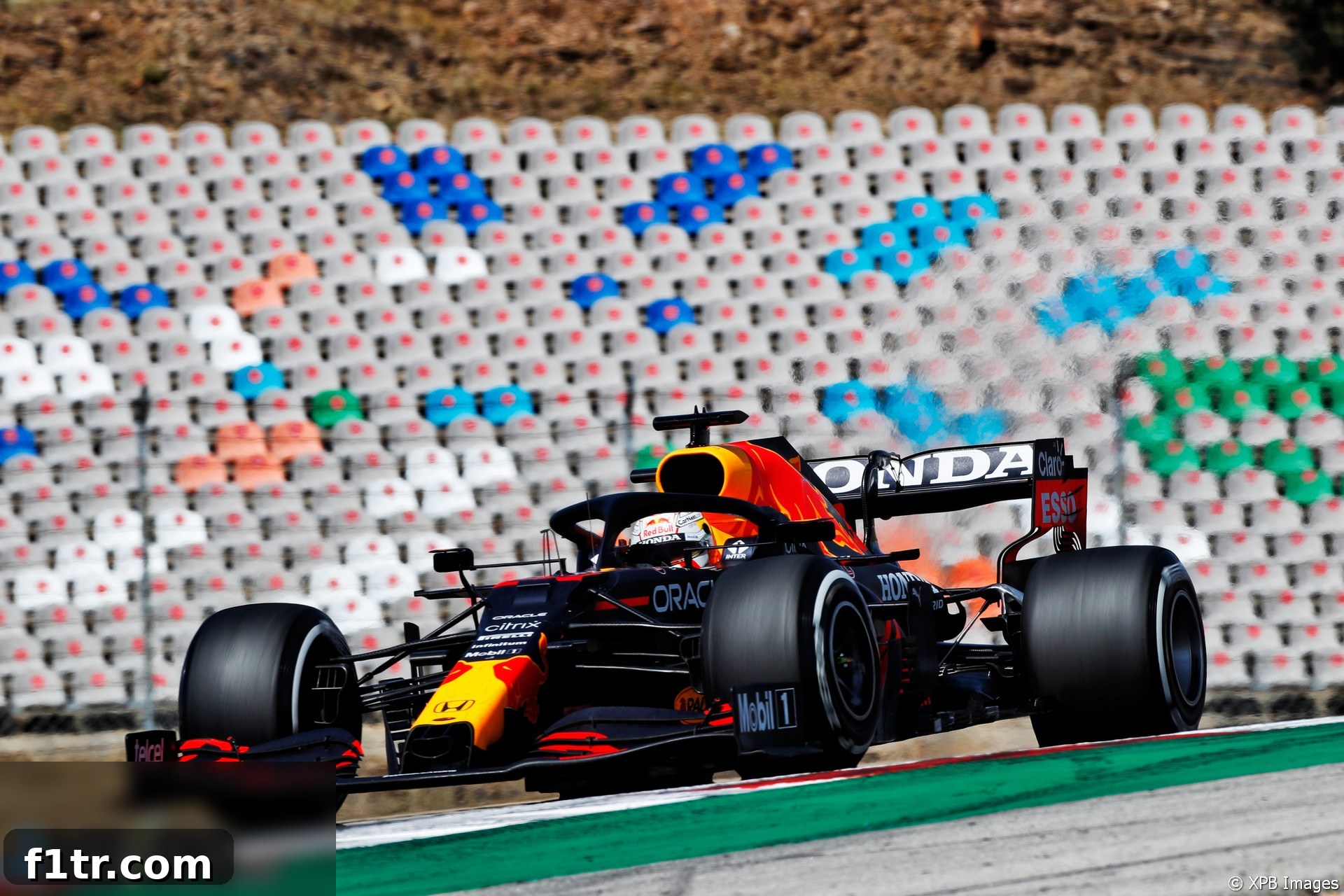
Max Verstappen found himself at the center of a post-race controversy at the 2021 Portuguese Grand Prix, as stewards nullified his fastest lap, stripping him of a crucial bonus point he believed he had earned. The Red Bull Racing driver’s immediate elation turned to bewilderment when his blistering final lap time was deleted due to a track limits infringement, reigniting debates about consistency and enforcement within Formula 1.
Advert | Become a Supporter & go ad-free
The Disappearing Fastest Lap: Verstappen’s Portuguese GP Frustration
Emerging from his car after a hard-fought race at the Algarve International Circuit, Max Verstappen was under the impression he had secured the fastest lap of the race, a valuable extra point that could prove significant in a championship battle. However, this achievement was short-lived. Race stewards swiftly intervened, ruling that Verstappen had exceeded track limits at Turn 14 during his fastest lap attempt. This decision led to the immediate deletion of the lap time, a call that left the Dutchman visibly perplexed.
“That’s a bit odd because they were not checking track limits in 14,” a bemused Verstappen commented, his tone reflecting a mix of surprise and mild exasperation. This statement highlighted a key point of contention for many drivers and teams: the perceived inconsistency in how track limits were monitored and enforced throughout a race weekend and even during a race itself.
A Shifting Rulebook: Track Limits Under Scrutiny
The issue of track limits at the Portuguese Grand Prix was not isolated to Verstappen’s fastest lap. Over the course of the race weekend, drivers were presented with no fewer than three distinct sets of guidelines regarding track limits. The final iteration, circulated on Saturday, explicitly warned competitors that lap times would be deleted if they ran too wide at Turn 14. This constant revision, while aimed at clarifying rules, often led to confusion and frustration among the paddock.
Red Bull team principal Christian Horner echoed his driver’s sentiments, articulating the broader discontent surrounding the regulations. “Track limits are a bone of contention, aren’t they? And the consistency of their application,” Horner told Sky Sports. His remarks underscored a fundamental challenge facing Formula 1: how to balance the need for strict adherence to circuit boundaries with the drivers’ natural instinct to push the limits in pursuit of speed, all while ensuring fair and consistent judgments.
The Algarve International Circuit, with its undulating terrain and wide run-off areas, often exacerbated the track limits issue. While these run-offs are designed for safety, they also present a tempting proposition for drivers looking to carry more speed through corners, blurring the line between legal maneuvering and gaining an unfair advantage. The lack of natural deterrents like gravel traps in certain areas meant that reliance on electronic sensors and human judgment from race control became paramount, leading to the subjective interpretations that so often draw the ire of teams.
Perez’s Parallel Frustration: Another Track Limits Incident
The track limits saga wasn’t exclusive to Verstappen. His Red Bull teammate, Sergio Perez, also experienced his own moment of frustration related to the rules. Perez accused McLaren driver Lando Norris of overtaking him with all four wheels off the track, a move that, if proven, would constitute a clear infringement.
Horner weighed in on Perez’s complaint as well, reinforcing the team’s overall dissatisfaction with how the rules were being applied. “He got overtaken by a car over the track limits,” Horner stated. “We get a document from the FIA, it changes from one day to the next, and the application of these are frustrating. Sergio was super-frustrated by that.” These incidents collectively painted a picture of a weekend marred by a lack of clarity and consistency in officiating, which impacted strategic decisions and race outcomes for Red Bull Racing.
Verstappen’s Race Performance: A Mixed Bag at Portimão
Despite the post-race fastest lap controversy, Max Verstappen’s performance throughout the Portuguese Grand Prix was a testament to his fighting spirit, even if the ultimate pace wasn’t quite there to challenge for victory. Having qualified a strong third on the grid, Verstappen seized an early opportunity during an Safety Car restart to expertly pass Lewis Hamilton, moving up into second place. His sights were then set on challenging Valtteri Bottas for the lead, demonstrating his characteristic aggression and hunger for victory.
“At the restart I tried to put the pressure onto Valtteri,” Verstappen recounted, describing his initial charge. However, the early promise eventually faded as the race wore on. “But in the end, I think we just lacked a little bit of pace overall so Lewis got by again.” Hamilton, demonstrating Mercedes’ superior long-run pace, managed to reclaim second position, leaving Verstappen to settle for third.
Car Concerns and Grip Challenges
Verstappen’s race wasn’t without its technical challenges. He reported issues with his car during the Grand Prix, notably mentioning difficulties with using third gear. Additionally, there appeared to be intermittent problems with the hybrid system’s battery, which could have contributed to the perceived lack of overall pace as the race progressed. These mechanical glitches, combined with the team’s struggles with tyre management, painted a complex picture of Red Bull’s weekend.
Beyond the technical issues, Verstappen highlighted a broader struggle for Red Bull at the Algarve circuit: understanding the tyres and the unique grip characteristics of the track surface. “This is, in general, a bit of an odd weekend in terms of grip,” he observed. The Portimão circuit is renowned for its low-grip asphalt, particularly challenging teams to find the optimal setup and extract performance from the Pirelli tyres.
Verstappen’s assessment suggested that Mercedes had a better handle on these intricate variables. “We were not, I think, on top of it here,” he conceded, acknowledging that their rivals had found a more effective way to manage the tyres and exploit the available grip, leading to their performance advantage. This difficulty in maximizing tyre performance on such a demanding surface became a critical differentiator between the two leading teams.
Lessons Learned and the Road Ahead
The 2021 Portuguese Grand Prix, while offering exciting on-track battles, proved to be a weekend of mixed emotions and valuable lessons for Max Verstappen and Red Bull Racing. The controversy surrounding the fastest lap and the broader track limits debate served as a stark reminder of the complexities of modern Formula 1 officiating. For Red Bull, the race exposed areas where they needed to improve, particularly in understanding the nuances of certain circuits and optimizing tyre performance under varying conditions.
Despite the challenges, Verstappen secured a respectable podium finish, demonstrating his unwavering determination. The team would undoubtedly conduct a thorough analysis of the car’s performance issues and tyre management strategies to address the shortcomings observed at Portimão. Looking ahead to the next race, the Spanish Grand Prix in Barcelona, Verstappen expressed cautious optimism: “But we’ll see what we can do in Barcelona.” The championship battle against Mercedes was intensifying, and every detail, from car setup to consistent rule application, would play a crucial role in determining the outcome of the season.
Advert | Become a RaceFans supporter andgo ad-free
2021 Portuguese Grand Prix Related Content
- Pirelli’s tyre choice for Portuguese GP wasn’t “too hard”, Hamilton concedes
- Who are the top F1 juniors bidding for a grand prix debut in 2022?
- 2021 Portuguese Grand Prix Star Performers
- Race gains encourage Ricciardo after ‘unacceptable’ qualifying performance
- Sainz says top-five finish was possible after first no-score for Ferrari
Browse all 2021 Portuguese Grand Prix articles