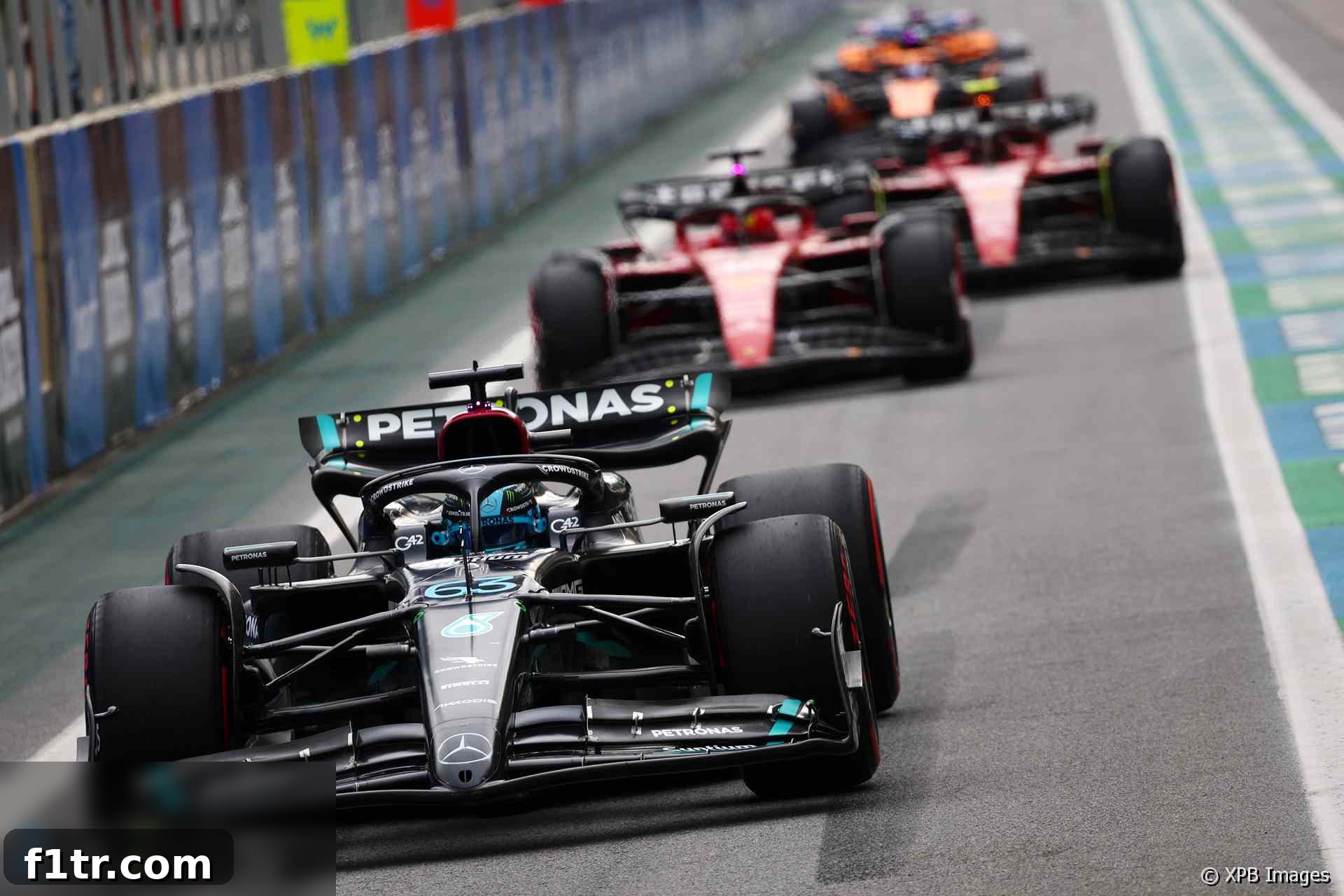
Brazilian Grand Prix: Russell, Gasly, Ocon Hit With Grid Penalties for Impeding in Qualifying
A dramatic qualifying session for the Brazilian Grand Prix saw three prominent drivers – George Russell, Pierre Gasly, and Esteban Ocon – receive two-place grid penalties for Sunday’s main race. The trio was penalized for impeding rivals, a critical offense under the FIA’s tightened regulations, particularly regarding conduct during the pit lane exit on the demanding Interlagos circuit.
Advert | Become a Supporter & go ad-free
The penalties stem from incidents where the drivers were deemed to have failed to comply with specific race director instructions. These directives govern the crucial section of the track between the pit exit line and the second Safety Car line, where the pit road merges with the active circuit. The FIA’s intensified focus on this area highlights a persistent challenge in Formula 1 qualifying: ensuring drivers can safely and fairly prepare for their flying laps without being hampered by competitors attempting to create clear track ahead.
FIA’s Stricter Stance: Safeguarding Qualifying Integrity at Interlagos
Ahead of the race weekend at the iconic Autódromo José Carlos Pace, Interlagos, race director Niels Wittich issued explicit guidance in his pre-event notes. This communication emphasized the importance of not delaying rivals in the circuit’s notoriously long and winding pit lane exit. This updated directive is part of a broader series of changes introduced by the FIA to mitigate the problem of drivers impeding one another during critical qualifying sessions, a scenario that has, in the past, led to frustration, compromised laps, and even potential safety hazards.
The revised guidance was crystal clear: if a driver wished to create a gap to a car ahead in any timed session by slowing down after the pit exit and before joining the main track, they were obligated to “drive as far to the left as possible to allow other drivers to pass them on the right side of the pit exit road.” This specific instruction was designed to maintain flow and prevent bottlenecks in a high-speed environment where milliseconds count. Unfortunately for Russell, Gasly, and Ocon, all three fell afoul of this updated and stringent regulation, leading directly to their post-qualifying summons to the stewards and subsequent penalties.
George Russell’s Costly Q1 Misstep
The first incident involved Mercedes driver George Russell during the initial phase of Q1. As he exited the pits, Russell was following his teammate, Lewis Hamilton. His intention was to create a suitable gap to Hamilton, a common practice for drivers seeking clear air for their qualifying runs. Behind Russell, Pierre Gasly was attempting a similar maneuver, slowing down to build his own buffer to the Mercedes ahead. However, the sequence of events quickly turned problematic.
After successfully building a gap, Gasly accelerated through the left-hander of the pit exit, momentarily receiving waved white flags from marshals, signaling a slow-moving vehicle. To his surprise, Gasly then encountered Russell’s Mercedes proceeding slowly, not on the far left of the lane as instructed, but conspicuously in the middle. Reacting swiftly, Gasly was forced to move sharply to the right, even briefly putting his wheels onto the grass verge in an desperate attempt to get around the impeding Mercedes. Ultimately, he had no choice but to pull in behind Russell, losing crucial momentum and potentially compromising his out-lap preparation.
Upon reviewing the incident, the stewards concluded that Russell had indeed failed to adhere to the explicit instructions to keep his car completely to the left side of the road at the pit exit. Their explanation was unequivocal: “As a result, following cars were not able to overtake, as intended by the race director’s instructions. This clearly violates the wording and the spirit of item 14 of the race director’s event notes.” The stewards’ reference to both the “wording” and “spirit” of the rule underscores the gravity of the infraction – it was not merely a technical breach but a failure to uphold the underlying principle of safe and fair track usage during qualifying.
Advert | Become a RaceFans supporter andgo ad-free
Consequently, George Russell was handed a two-place grid penalty for Sunday’s Grand Prix. This demoted him from his initial impressive sixth position on the grid down to eighth, a setback that could significantly impact his race strategy and his team’s aspirations for a strong points finish in Brazil.
Alpine Duo’s Dilemma: Gasly and Ocon Face Similar Sanctions
Russell was not alone in facing the wrath of the stewards. Later in the same Q1 session, similar incidents led to penalties for both Alpine drivers, Pierre Gasly and Esteban Ocon. Reigning pole winner Max Verstappen himself was observed navigating the pit exit by running his right-side wheels onto the grass to bypass both Sergio Perez and Esteban Ocon. Both Alpine drivers were perceived to be driving slowly in the middle of the pit exit road, obstructing the clear path required for others. Just moments before, Yuki Tsunoda faced his own challenge, forced to drive precariously close to the inside wall of the pit exit to overtake Gasly, who was also deemed to be improperly positioned.
These incidents highlighted a systemic issue with drivers struggling to balance the need for creating a gap with the imperative to stay clear of the racing line within the pit exit. The stewards’ investigations into Ocon and Gasly’s respective actions resulted in identical two-place grid drops, mirroring Russell’s penalty. For the Alpine team, this means both their drivers will start further down the pack, with Ocon now lining up in 14th place and Gasly immediately behind him in 15th. This double blow could severely hamper Alpine’s chances of scoring significant points in the race, intensifying their battle against rivals in the Constructors’ Championship.
Understanding the Penalties: Grid Drops vs. Superlicence Points
Despite the grid penalties, it’s noteworthy that no superlicence penalty points were issued to any of the drivers involved. This distinction is crucial in Formula 1. Grid penalties primarily affect a driver’s starting position for a specific race, influencing immediate tactical decisions. Superlicence penalty points, on the other hand, accumulate over a 12-month period and can lead to a race ban if a driver accrues 12 points. The stewards’ decision to impose only grid penalties suggests that while the infringements were serious enough to warrant a demotion for compromising track safety and fairness in qualifying, they were not deemed to be reckless or dangerous to the extent that would trigger superlicence sanctions.
Furthermore, these grid penalties will have no bearing on the grid for Saturday’s sprint race. Under the current Formula 1 weekend format, the sprint race has its own dedicated qualifying session, traditionally held on Saturday morning (Sprint Shootout), which determines its starting order. The penalties applied specifically to the main Grand Prix on Sunday, ensuring that the qualifying results from Friday still dictated the sprint race grid, while the long-term race consequences were appropriately managed.
The Broader Implications: Navigating Interlagos and Future Regulations
The spate of penalties at Interlagos underscores the ongoing tension between drivers’ need to manage tire temperatures and create optimal gaps for flying laps, and the FIA’s commitment to maintaining safety and fair play. The Interlagos pit exit, with its unique layout and length, often exacerbates this challenge, making adherence to strict guidance even more critical.
These incidents also fuel the broader debate within the F1 paddock about the effectiveness and clarity of the rules designed to prevent impeding. While the FIA has consistently refined these regulations, drivers often express frustration with their application in the heat of a qualifying session, where split-second decisions are made under immense pressure. The stewards’ consistent application of the rules in Brazil, however, sends a clear message: drivers must prioritize adherence to directives that ensure the safety and competitive integrity of qualifying, regardless of their strategic intentions.
As the Brazilian Grand Prix weekend progresses, the impact of these penalties will undoubtedly shape race strategies and potentially influence the outcome for Mercedes and Alpine. More importantly, these rulings serve as a potent reminder of the FIA’s unwavering resolve to enforce rules that keep the sport both safe and genuinely competitive for all participants.
Advert | Become a RaceFans supporter andgo ad-free
2023 Brazilian Grand Prix News and Updates
- Perez’s missed “open goal” in Miami was turning point in title fight – Horner
- F1 drivers insist new rules to prevent impeding in qualifying don’t work
- McLaren surprised by margin over rivals at track Norris thought would be “tough”
- “Follow Fernando’s line” – How Red Bull tried everything to get Perez past Alonso
- Mercedes’ Brazilian GP set-up was “conservative” after US GP disqualification
Browse all 2023 Brazilian Grand Prix articles