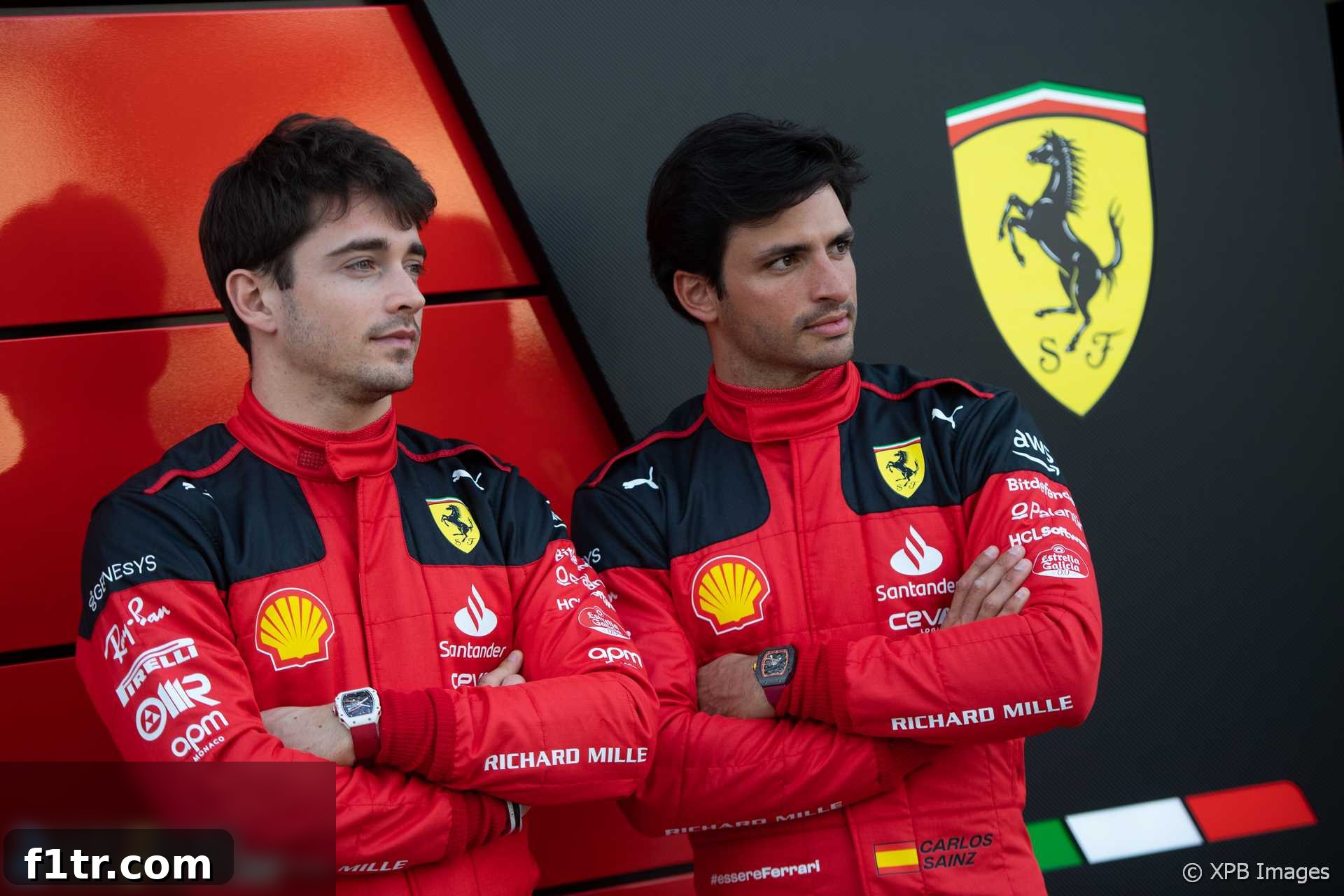
The rivalry between Charles Leclerc and Carlos Sainz Jnr has been a captivating narrative within Formula 1, consistently demonstrating a remarkable level of parity over their three seasons and 66 grands prix as teammates. Their combined point tally underscores this fierce intra-team competition, with Leclerc holding a slight edge at 673 points compared to Sainz’s 610.5. This narrow margin reflects not just individual talent but also the dynamic ebb and flow of fortune and performance that characterizes elite motorsport.
From the outset, Leclerc has often asserted his dominance in qualifying sessions, a testament to his raw speed and ability to extract maximum performance from the car over a single lap. Across their first two seasons together, he consistently outqualified Sainz, securing a 13-9 advantage in the head-to-head battle. This trend intensified in the most recent season, with Leclerc further extending his qualifying superiority to a significant 15-7 margin. This consistent qualifying edge has frequently placed Leclerc in a stronger strategic position for the races, often allowing him to dictate pace or avoid early-race skirmishes.
The intensity of their competition is perhaps best illustrated by the fact that for the second time in three seasons, their championship positions dramatically shifted at the final round. Two years prior, Sainz was the beneficiary of such a reversal, climbing from seventh to an impressive fifth place in the drivers’ standings at Leclerc’s expense during the season finale. However, the tables were turned in the most recent season. Sainz’s unfortunate no-score at Yas Marina proved costly, denying him what would have been his best-ever championship finish. He slipped from fourth to seventh, with Leclerc among the drivers who capitalized on his misfortune, securing a higher position in the standings.
Advert | Become a Supporter & go ad-free
When drivers operate at such a high level and with such proximity in performance, even minor setbacks can profoundly impact the balance. Both Leclerc and Sainz experienced significant reliability issues and unforeseen circumstances that directly affected their championship campaigns. Sainz was notably prevented from starting the Qatar Grand Prix due to a fuel system issue, a frustrating blow that cost him valuable points. Leclerc, on the other hand, faced a similar fate in Brazil, where a hydraulic problem on the formation lap forced him out before the race even began. These instances highlight the razor-thin margins and the role of external factors in shaping outcomes.
However, an overall assessment suggests that Leclerc might have endured a slightly tougher run of luck throughout the season. His year began with a devastating power unit failure while running in a strong third position in the season-opener, which not only cost him a podium but also resulted in a grid penalty for the subsequent race. Later in the season, during the United States Grand Prix in Austin, Leclerc’s car was disqualified due to excessive floor plank wear – a technical infringement that his teammate’s car, despite similar usage, was not subjected to checks for. This created a perception of inconsistent scrutiny and robbed Leclerc of further points. Yet, for sheer cruellest misfortune, it is difficult to surpass the incident involving Sainz in Las Vegas, where an uncapped drain cover caused irreparable damage to his car, leading to significant penalties despite being a victim of circumstance.
Despite the challenges, Carlos Sainz achieved a monumental feat that provided significant bragging rights within the paddock and the team: he was the only driver to win a Grand Prix in 2023 in a car other than the dominant Red Bull RB19. This singular victory at the Singapore Grand Prix was undoubtedly a highlight of his career and a moment Leclerc would readily have traded his eventual fifth-place championship finish for. Sainz’s triumph was a result of a remarkable return to form after the summer break, coinciding with Ferrari’s engineers finally gaining a deeper understanding and unlocking the full potential of their SF-23 chassis.
His resurgence was evident at Monza, the legendary ‘Temple of Speed’, where he snatched pole position and subsequently engaged in a fierce battle against the seemingly invincible Red Bulls, and later, against his own teammate Leclerc, for the final podium spot. In Singapore, Sainz once again demonstrated his exceptional prowess, securing pole position. Crucially, Leclerc, with commendable sportsmanship and team dedication, played a vital strategic role, acting as a buffer against rival teams to ensure Sainz could manage his race and secure Ferrari’s only Sunday victory of 2023 – a truly memorable result in a season otherwise dominated by Red Bull.
Following Singapore, the narrative shifted slightly. Further aerodynamic and suspension tweaks introduced to the Ferrari SF-23 at Suzuka seemed to align more closely with Charles Leclerc’s driving style. From that point onwards, Leclerc found an extra gear, consistently outpacing Sainz in qualifying sessions for the remainder of the season. His late-season form was stellar, and he came agonizingly close to securing a victory of his own at the inaugural Las Vegas Grand Prix. Leclerc was in contention for the win until Max Verstappen, ironically, benefited from a Safety Car period triggered by his own collision with George Russell, neutralizing Leclerc’s advantage and ultimately leading to Verstappen’s victory.
Advert | Become a RaceFans supporter andgo ad-free
As the Formula 1 circus headed to the final race of the season in Abu Dhabi, Carlos Sainz held a precarious 12-point lead over Leclerc in the championship standings. He also carried the psychological advantage of not having to relinquish his car to a junior driver for the crucial first practice session, unlike his teammate who had participated in several FP1 sessions for young driver development. However, his weekend took a drastic turn for the worse during second practice, where he suffered a heavy crash, severely compromising his car and subsequent performance. An unexpected elimination in Q1 the following day sealed his fate, leaving him battling outside the points as the laps dwindled down to the season’s conclusion. Conversely, Charles Leclerc delivered a masterful performance, upholding Ferrari’s honor with a third podium finish in the final four rounds of the championship – an impressive feat that matched his total podium count from the preceding 18 Grands Prix combined, underscoring his strong finish to the season.
While the individual performances of Leclerc and Sainz were commendable, the 2023 season proved to be a challenging and ultimately disappointing one for Ferrari as a team. They slipped one place in the Constructors’ Championship, finishing third behind a resurgent Mercedes. Despite their significant investment and development, the SF-23 struggled with consistency and often failed to match the pace of the dominant Red Bull. However, both Leclerc and Sainz can look back on their individual contributions to 2023 with considerable satisfaction, having pushed each other and extracted strong results under pressure. Their resilience and talent were evident, especially in moments where the car allowed them to compete at the front.
The lessons learned from 2023, coupled with the intense yet constructive rivalry between their two highly capable drivers, provide a foundation for optimism. If the forthcoming year’s car proves to be the significant step forward that Ferrari so desperately needs, then the standout performances at Monza and in Las Vegas served as clear warnings: Max Verstappen can expect to face not one, but two genuine and formidable competitors from the iconic red team. The synergy and competitive spirit between Leclerc and Sainz could well be the catalyst Ferrari needs to mount a sustained challenge at the very pinnacle of Formula 1, translating their individual brilliance into consistent team success and a renewed fight for the coveted world championship.
Advert | Become a RaceFans supporter andgo ad-free
| BAH | SAU | AUS | AZE | MIA | MON | SPA | CAN | AUT | GBR | HUN | BEL | NED | ITA | SIN | JAP | QAT | USA | MEX | BRZ | LAS | ABU | ||
| Leclerc | Q | ||||||||||||||||||||||
| R |
Unrepresentative comparisons omitted. Negative value: Leclerc was faster; Positive value: Sainz Jnr was faster
Advert | Become a RaceFans supporter andgo ad-free
Formula 1
- “Overtaking is overtaking”: Domenicali denies F1’s yo-yo racing is “artificial”
- The crashes F1 is trying to prevent may be rare – but the danger is obvious
- F1 returning to India soon after 2027 sounds like wishful thinking
- Verstappen loathes F1’s new generation of cars – but what do his rivals reckon?
- The ‘throwback weekend’ is back in fashion. But it’s a flawed concept – especially for F1
Browse all Formula 1 articles