Addressing Formula 1 Track Limits: The Red Bull Ring Sets a New Standard
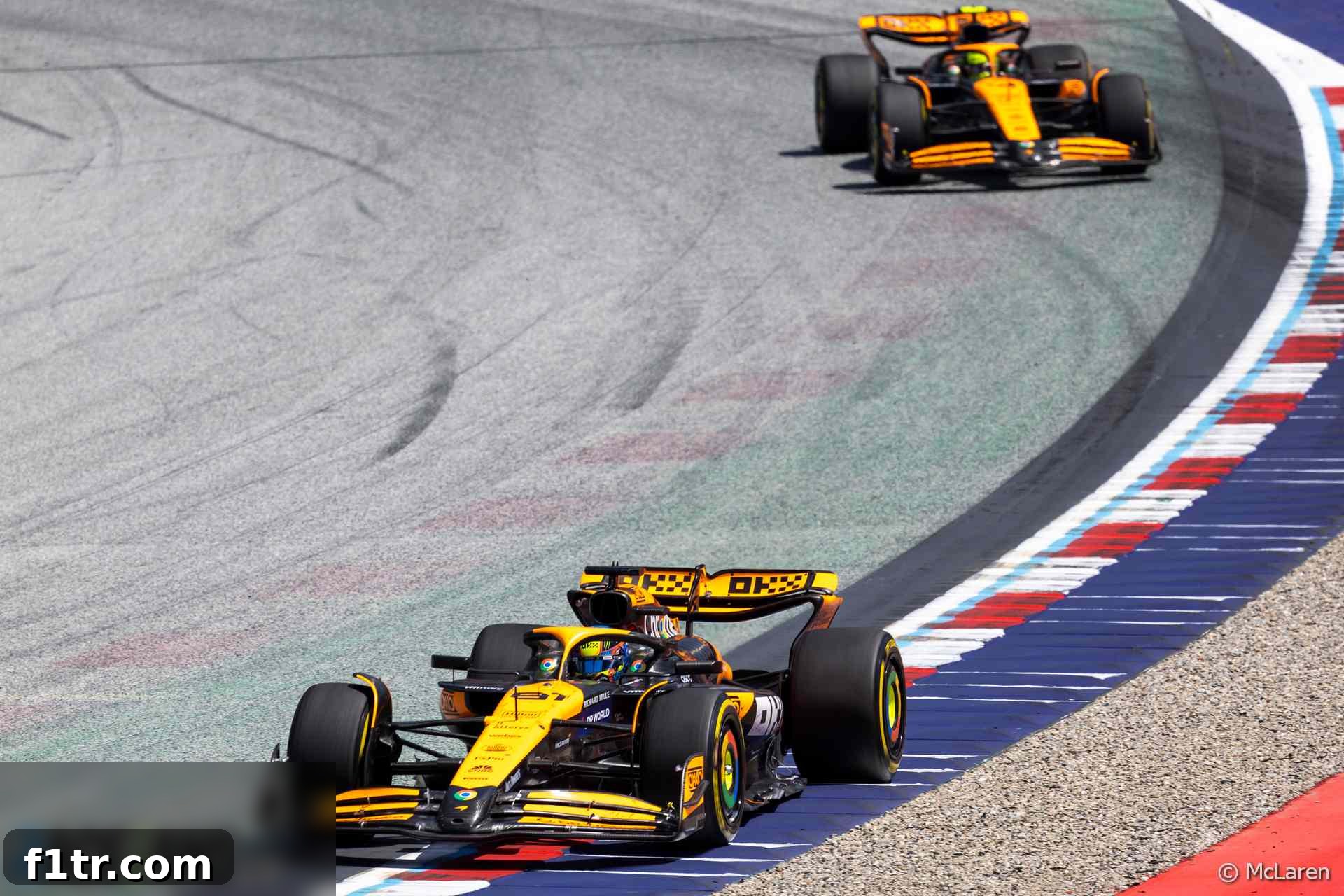
The perennial challenge of Formula 1 track limits, a source of significant contention and frustration for drivers, teams, and fans alike, appears to have found a promising solution at the Red Bull Ring. Following widespread criticism and chaotic scenes at last year’s Austrian Grand Prix, where over a thousand suspected infringements led to a dozen post-race penalties, the FIA urged circuit operators to implement effective changes. What transpired has been hailed as a model for sporting integrity and clarity, particularly at the circuit’s final two corners.
Advert | Become a Supporter & go ad-free
The Red Bull Ring, under immense pressure to prevent a repeat of 2023’s controversial spectacle, responded by strategically installing gravel traps at Turns 9 and 10. This physical deterrent, combined with ingenious modifications to the kerb design, has proven to be an immediate and resounding success. This proactive approach contrasts sharply with more ambiguous solutions seen elsewhere and offers a clear blueprint for other circuits grappling with similar issues.
Transforming the Track: How the Red Bull Ring Solved the T9 & T10 Conundrum
The implementation of gravel traps at the final two corners of the Red Bull Ring was more than just a superficial change; it represented a fundamental shift in how track limits are policed. In previous years, these corners were infamous for being hotspots of infringement, drivers often pushing the boundaries with impunity, knowing the run-off areas offered little penalty beyond a potential time deletion. The 2023 Grand Prix saw a staggering 45 track limits violations at these two turns during qualifying alone, leading to a cascade of deleted lap times and a confusing qualification session.
The solution implemented for this season has been remarkably effective. The new gravel traps are positioned directly beyond narrower kerbs, which themselves have been ingeniously redesigned. By painting over the inside part of the previous wider kerbs, the effective width drivers can utilize without crossing the white line has been significantly reduced. This means that any attempt to gain an advantage by running wide will inevitably result in a dip into the gravel, causing a loss of grip and momentum that instantly compromises a lap. This is a crucial distinction from setups at other tracks where wider kerbs act as an intermediate zone, allowing drivers to exceed the white line without immediate, tangible consequences.
The immediate impact of these modifications has been dramatic. In qualifying for this year’s Grand Prix, track limits infringements at Turns 9 and 10 plummeted from 45 to just one. This single instance involved Charles Leclerc, who spun off track and clearly ruined his lap, rather than attempting to gain an unfair advantage. This staggering reduction is a testament to the effectiveness of the “natural deterrent” approach, where the consequences of exceeding track limits are immediate and self-evident, eliminating the need for extensive post-session investigations by stewards.
While other circuits like Shanghai, Imola, and Catalunya have also experimented with adding or expanding gravel traps and tweaking track layouts this year, many have not achieved the same level of definitive success. Often, these gravel traps are separated from the track’s white line by wide kerbs, sometimes measuring up to two meters across – the approximate width of an F1 car. This design flaw inadvertently allows drivers to run beyond the white line, navigate the wide kerb, and either avoid the gravel entirely or brush it lightly enough to maintain momentum, thus still gaining an illicit advantage. The Red Bull Ring’s solution at Turns 9 and 10, by contrast, removes this ambiguous intermediate zone, ensuring that crossing the white line directly leads to a time-losing excursion.
Advert | Become a RaceFans supporter andgo ad-free
The Persistent Challenge: Turn 6 and the Quest for Consistency
Despite the unqualified success at Turns 9 and 10, the shadow of track limits controversy still loomed over the qualifying session. Oscar Piastri, for instance, controversially lost what would have been a third-place grid slot when his final flying lap of 1’04.786 was deleted for exceeding track limits at Turn 6. McLaren’s appeal against the decision was deemed inadmissible by the stewards, leaving the definitive facts of the incident untested in an official capacity. However, images from the incident suggest a marginal call, with Piastri’s right-hand wheels barely dipping into the gravel, arguably not enough to significantly impede his progress through the corner.
This incident at Turn 6 starkly highlights the difference in design philosophy compared to the improved Turns 9 and 10. The kerb at Turn 6 is considerably wider, providing drivers with a larger margin to exceed the white line without immediately suffering a significant time loss. This design effectively creates an opportunity for drivers to push the absolute limits, sometimes crossing the boundary just enough to gain an edge without severe penalty. Piastri was not an isolated case; Yuki Tsunoda, Pierre Gasly, and Charles Leclerc also had lap times deleted at Turn 6 during qualifying. In a telling statistic, the number of track limits violations at Turn 6 actually increased this year compared to last, rising from two to four. This escalation underscores the urgent need to replicate the proven solution from Turns 9 and 10 at Turn 6 and other problematic corners across the calendar.
Piastri’s understandable frustration stemmed from the paradox of celebrating significant improvements at one part of the track while facing a penalty at another for an issue that felt equally ambiguous. His experience emphasizes that a holistic, consistent approach to track limits across the entire circuit is essential for fairness and driver confidence. The success at the Red Bull Ring’s final corners has indeed garnered widespread praise from other drivers, who are now advocating for the same effective approach to be adopted universally.
Driver Perspectives: The Value of Clear Boundaries
The introduction of the new track limit solution at the Red Bull Ring has been met with overwhelmingly positive feedback from the drivers, who value clarity and immediate consequences over ambiguous rules and delayed penalties. Formula 2 race winner and former F1 starter, Oliver Bearman, was particularly effusive in his praise, describing himself as a “huge fan” of the new system. Bearman highlighted how the combination of narrower kerbs and strategically placed gravel traps empowers drivers to accurately judge how hard they can push without inadvertently exceeding the boundaries.
Advert | Become a RaceFans supporter andgo ad-free
“The fact is that if you’re able to stay within the track, or within the kerbs, you know it’s the track limits,” Bearman stated, articulating a sentiment shared by many in the paddock. He contrasted this clear feedback with the subjective difficulties of determining whether a car is “on top of the white line or almost over it,” a common complaint that has plagued track limits enforcement. While some circuits, like Barcelona, have attempted to mitigate this by increasing the width of the white line, Bearman argues that the Red Bull Ring’s physical deterrent is “perfect.”
The inherent genius of the Red Bull Ring’s solution lies in its nature as a “natural deterrent.” A strip of gravel immediately penalizes a driver by causing a loss of grip and time. This instant feedback mechanism means drivers do not need to rely on stewards’ interpretations or wait for post-lap telemetry analysis to understand if they have erred. Pushing right up to the edge of the gravel, while staying within the track limits, becomes a precise calculation rather than a gamble. This system encourages drivers to explore the limits of the circuit responsibly, knowing that any transgression carries an immediate and unambiguous penalty.
Bearman vividly recalled his struggles with track limits at previous Austrian Grands Prix, stating, “Last year, I don’t want to count how many track limits penalties there were – not least for me – I struggled with it.” He emphasized that the new setup is precisely “what you want” as a driver: the ability to use all of the kerb while confidently remaining within the designated track limits. By reducing the width of the usable kerb and immediately introducing a punishing gravel trap, the ambiguity is removed. “It should really be a solution implemented everywhere. It’s perfect,” he concluded, encapsulating the strong consensus among drivers that this approach offers the most equitable and understandable way to manage track limits.
The Future of Track Limits: A Blueprint for Formula 1
The remarkable improvement in track limits compliance observed during qualifying at the Red Bull Ring offers a compelling case study for the entire sport. If this success is replicated and sustained throughout the Grand Prix, Formula 1, under the guidance of the FIA, can rightfully consider this approach a significant triumph. The implications extend far beyond a single circuit; this model holds the potential to become a universal blueprint for resolving track limits issues at other circuits globally.
The issue of track limits has long been a thorny subject, often leading to controversy that detracts from the pure spectacle of racing. The delicate balance between allowing drivers to push their cars to the absolute maximum and enforcing rules to ensure fair play and prevent dangerous excursions is critical. The Red Bull Ring’s strategy demonstrates that this balance can be achieved through clever circuit design rather than relying solely on arbitrary lines and retrospective penalties. This method not only reduces the workload on race stewards but, more importantly, enhances the sporting integrity of the competition by making the rules clear and the consequences immediate.
Moving forward, the FIA and circuit designers face the challenge of consistently applying such solutions across the Formula 1 calendar. Every track presents unique characteristics, but the underlying principle – using natural, physical deterrents to define track limits – remains adaptable. By standardizing effective solutions like the gravel-kerb combination seen at Turns 9 and 10, Formula 1 can move towards a future where track limits discussions are minimized, allowing the focus to remain firmly on the breathtaking skill and daring of the drivers, rather than the nuances of white lines and digital policing. The Red Bull Ring has shown the way, and the motorsport world will be watching closely to see if this paradigm shift becomes the new global standard for fair and exciting racing.
Miss nothing from RaceFans
Get a daily email with all our latest stories – and nothing else. No marketing, no ads. Sign up here:
Advert | Become a RaceFans supporter andgo ad-free
2024 Austrian Grand Prix
- Austrian GP clash will have taught Norris how to race Verstappen – Ricciardo
- Verstappen was “lucky” tyre damage didn’t force him to retire like Norris
- Pirelli introducing new C6 tyre to improve racing on street tracks next year
- Norris admits ‘overreacting’ but queries why Verstappen avoided track limits penalty
- Norris and Verstappen’s Austrian GP collision “blown out of proportion” – rivals
Browse all 2024 Austrian Grand Prix articles