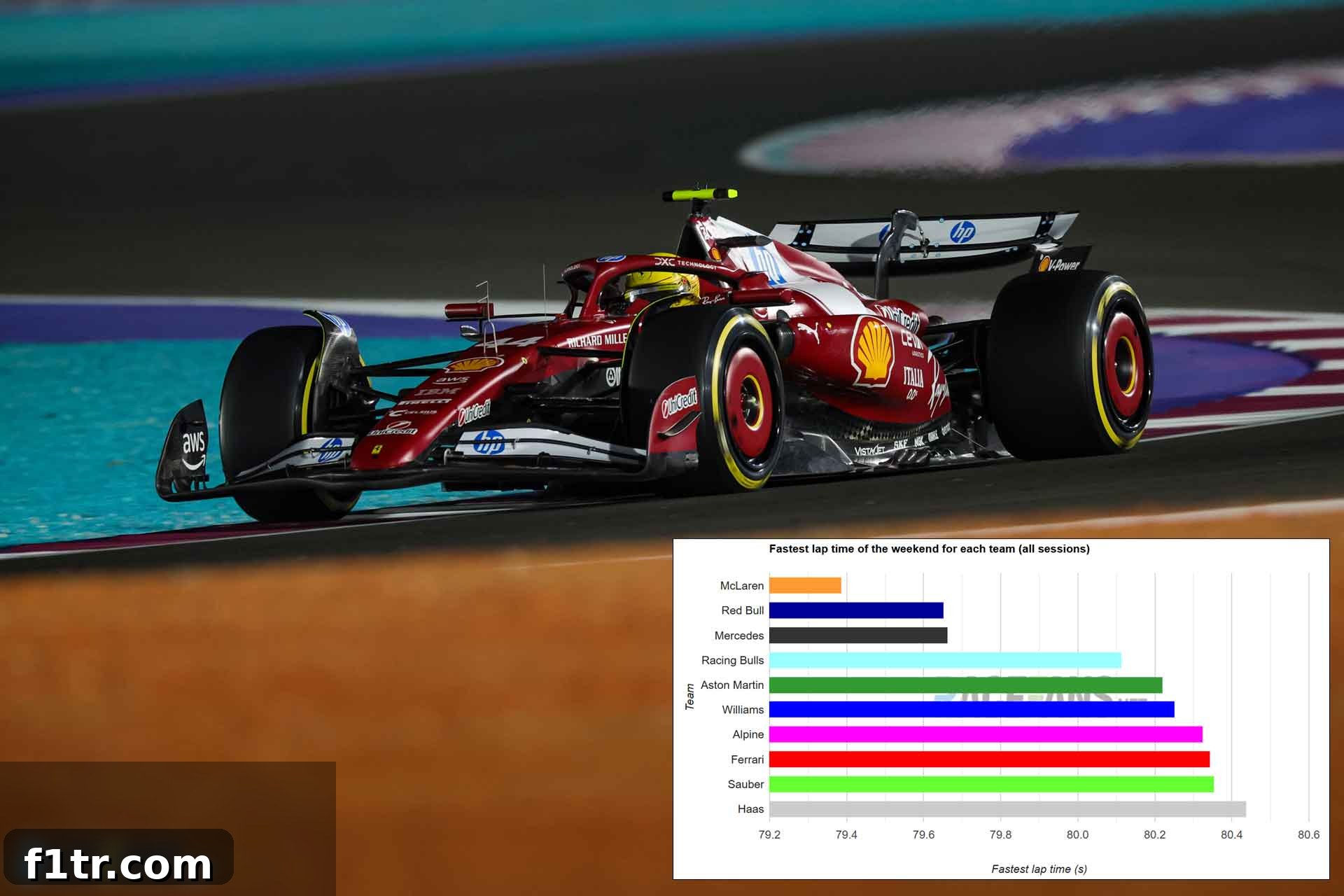
The Losail International Circuit presented a starkly contrasting weekend for two prominent Formula 1 teams, with Ferrari grappling through what appears to be their most uncompetitive outing in over four years, while Williams showcased a remarkable resurgence. The Maranello-based squad found themselves struggling significantly for pace, barely outperforming their customer teams, an indicator of underlying issues that demand immediate attention. This stark performance drop has raised concerns within the team and among their dedicated fanbase, marking a low point in their recent competitive history at a critical juncture of the season.
From Practice to Qualifying: Shifting Fortunes and Strategic Gambles
The competitive landscape of a Formula 1 Grand Prix weekend often sees dramatic shifts between Friday’s practice sessions and Saturday’s all-important qualifying. In Losail, Williams stood out as a prime example of a team that successfully leveraged Friday’s sessions to make significant strides. Following a challenging event at the same venue 12 months prior, the team arrived with a clear strategy. A bold set-up choice, implemented early in the weekend, paid dividends, delivering a noticeable improvement in their overall pace. This proactive approach allowed them to hit the ground running, surprising many with their newfound competitiveness on a circuit where they had previously struggled to find grip and balance.
While many of their rivals managed to extract more performance from their cars between Friday’s free practice and Saturday’s qualifying sessions, the groundwork laid by Williams on Friday proved robust. Despite the conventional performance leap seen across the grid, Williams maintained a strong enough pace to propel one of their drivers into Q3, a testament to their effective engineering and strategic decision-making. This achievement underscores the importance of a well-executed weekend plan, particularly at a circuit like Losail, which demands precision and adaptability from both car and driver.
A Deep Dive into Sector Times: Unpacking Driver Potential and Car Performance
The intricate details of qualifying often lie hidden within the sector times, offering a granular view of where performance is gained or lost. For Alexander Albon of Williams, the sector analysis reveals an intriguing narrative. Despite recording identical best times in both Q1 and Q2 – 1’20.629 – his individual sector performances suggest that he possessed the potential to achieve an even quicker lap. This scenario often arises when a driver strings together a near-perfect lap across different attempts, but fails to consolidate all their optimal sector times into a single, cohesive run. It highlights the fine margins in Formula 1 qualifying, where even a slight imperfection can prevent a driver from maximizing their car’s potential.
Examining the ultimate lap times, which represent a hypothetical best lap achievable by combining a driver’s fastest times in each individual sector, provides further insight. For instance, Oscar Piastri, who ultimately secured pole position, demonstrated exceptional consistency and raw speed across all three sectors. His dominant performance saw him clinch the fastest time in Sector 2 and Sector 3, reinforcing McLaren’s strong package at Losail. Lando Norris, his teammate, also showed strong form, particularly in the final two sectors, underscoring the team’s overall competitive advantage. Max Verstappen, despite struggling in later sectors compared to his rivals, still managed to secure the fastest time in Sector 1, indicative of Red Bull’s straight-line speed or initial cornering prowess.
Conversely, drivers like Charles Leclerc, despite his best efforts to wrestle his Ferrari into Q3, showed significant disparities across sectors. While managing a respectable Sector 3 time, his struggles in Sector 2 suggest challenges with the car’s balance or grip in the medium-speed corners, a common characteristic of an uncompetitive chassis. The ultimate lap deficit column further illustrates how much more pace some drivers could have extracted, had they linked their optimal sector performances seamlessly. This detailed breakdown reveals the fine line between a good qualifying lap and a truly exceptional one, distinguishing between raw speed and the ability to execute a flawless, cohesive run under immense pressure.
| P. | # | Driver | S1 | S2 | S3 | Ultimate lap (deficit) |
|---|---|---|---|---|---|---|
| 1 | 81 | Oscar Piastri | 29.209 (2) | 26.919 (1) | 23.257 (1) | 1’19.385 (+0.002) |
| 2 | 4 | Lando Norris | 29.212 (3) | 26.978 (3) | 23.305 (2) | 1’19.495 |
| 3 | 63 | George Russell | 29.214 (4) | 26.987 (4) | 23.429 (4) | 1’19.630 (+0.032) |
| 4 | 1 | Max Verstappen | 29.160 (1) | 27.064 (5) | 23.427 (3) | 1’19.651 |
| 5 | 12 | Andrea Kimi Antonelli | 29.279 (5) | 26.954 (2) | 23.561 (9) | 1’19.794 (+0.052) |
| 6 | 14 | Fernando Alonso | 29.358 (6) | 27.170 (9) | 23.549 (8) | 1’20.077 (+0.142) |
| 7 | 6 | Isack Hadjar | 29.473 (8) | 27.125 (6) | 23.516 (6) | 1’20.114 |
| 8 | 55 | Carlos Sainz Jnr | 29.546 (13) | 27.164 (8) | 23.534 (7) | 1’20.244 (+0.007) |
| 9 | 10 | Pierre Gasly | 29.487 (9) | 27.194 (10) | 23.585 (10) | 1’20.266 (+0.058) |
| 10 | 16 | Charles Leclerc | 29.520 (11) | 27.286 (15) | 23.505 (5) | 1’20.311 (+0.032) |
| 11 | 27 | Nico Hulkenberg | 29.545 (12) | 27.140 (7) | 23.629 (13) | 1’20.314 (+0.039) |
| 12 | 30 | Liam Lawson | 29.602 (14) | 27.235 (13) | 23.589 (11) | 1’20.426 (+0.007) |
| 13 | 5 | Gabriel Bortoleto | 29.469 (7) | 27.354 (16) | 23.610 (12) | 1’20.433 (+0.101) |
| 14 | 87 | Oliver Bearman | 29.517 (10) | 27.233 (12) | 23.688 (17) | 1’20.438 |
| 15 | 23 | Alexander Albon | 29.613 (15) | 27.209 (11) | 23.632 (14) | 1’20.454 (+0.175) |
| 16 | 22 | Yuki Tsunoda | 29.660 (16) | 27.464 (18) | 23.637 (15) | 1’20.761 |
| 17 | 44 | Lewis Hamilton | 29.774 (18) | 27.270 (14) | 23.744 (19) | 1’20.788 (+0.119) |
| 18 | 31 | Esteban Ocon | 29.717 (17) | 27.419 (17) | 23.728 (18) | 1’20.864 |
| 19 | 18 | Lance Stroll | 29.782 (19) | 27.496 (20) | 23.771 (20) | 1’21.049 (+0.009) |
| 20 | 43 | Franco Colapinto | 29.965 (20) | 27.492 (19) | 23.680 (16) | 1’21.137 |
Teams’ Performance: A Ranking of Contenders and Underperformers
The Losail Grand Prix qualifying session painted a clear picture of the current pecking order among Formula 1 teams, with Ferrari’s performance being a particularly disheartening narrative. Despite Charles Leclerc’s commendable effort to muscle his SF-25 into Q3, the car was visibly a handful, requiring immense skill to manage. Leclerc himself experienced a high-speed double spin during the session, underscoring the inherent difficulties and unpredictable nature of the car’s handling. This struggle reflects a deeper issue within the team’s current package, making it exceptionally challenging for their drivers to extract competitive lap times consistently.
By the conclusion of qualifying, Ferrari found themselves trailing drivers from seven other teams on pure pace. This included teams like Alpine, which have themselves faced recent performance struggles but demonstrated a stronger showing in Losail. The stark reality was echoed by Leclerc, who candidly stated the team had “zero performance,” highlighting the severity of their competitive deficit. Compounding Ferrari’s woes, Mercedes driver Lewis Hamilton also suffered an unexpected exit in Q1, further illustrating the unforgiving nature of the Losail circuit and the intensely competitive field.
Indeed, Ferrari’s classification as the eighth-fastest team on raw pace marks a significant regression, representing their least competitive performance since the 2021 Austrian Grand Prix. In a concerning parallel to that previous low point, only their two customer teams – Haas and Sauber (which competed as Alfa Romeo in 2021) – recorded slower lap times. This situation raises serious questions about the direction of their car development and their ability to keep pace with the leading constructors. The consistency of this underperformance, particularly relative to their direct competitors and even mid-field teams, suggests systemic issues that require urgent and effective solutions to regain their competitive edge.
In stark contrast to Ferrari’s struggles, Williams continues to be the standout team in terms of year-on-year improvement at the Losail International Circuit. Their strategic gamble and focused development have allowed them to make the largest leap forward compared to their performance in previous seasons. This significant progress showcases their dedication and effectiveness in optimizing their package for various track characteristics. Conversely, Ferrari registered the smallest year-on-year improvement, underscoring the stagnation or even regression in their competitive standing at this particular venue.
Field Performance: Record-Breaking Laps and the Evolution of Speed
Despite some teams experiencing challenges, the overall performance of the Formula 1 field at Losail demonstrated the relentless pursuit of speed. Oscar Piastri’s pole-winning lap of 1’19.387 was not just impressive; it shattered the existing track record for the Losail International Circuit. This remarkable achievement, well over a second quicker than the previous F1 record set just last year, highlights the continuous evolution of Formula 1 car performance. Factors such as improved aerodynamic efficiency, enhanced engine power delivery, and increasingly sophisticated tire compounds contribute to these blistering lap times. Furthermore, drivers are constantly pushing the boundaries of what’s possible, adapting to tracks and conditions with unparalleled precision.
The Losail circuit itself, with its fast, flowing corners and demanding layout, provides an ideal canvas for showcasing the raw speed of modern F1 machinery. The cooler evening temperatures during qualifying often contribute to optimal track conditions, allowing teams to run their cars in their most aggressive setups and drivers to extract every ounce of performance. Piastri’s record-breaking lap serves as a benchmark for the current generation of F1 cars, illustrating the incredible pace and engineering prowess that defines the pinnacle of motorsport. It sets a new standard for future events at Losail, challenging subsequent competitors to push even harder to match or surpass this formidable benchmark.
Miss nothing from RaceFans
Get a daily email with all our latest stories – and nothing else. No marketing, no ads. Sign up here:
2025 Qatar Grand Prix
- Norris wins 2025 F1 title and ends Verstappen’s four-year reign as champion
- McLaren “helping Stefano with TV ratings” with Qatar strategy error, jokes Brown
- Alpine are guaranteed to finish last in 2025 – but will set an obscure points record
- Norris take note: The F1 points leader usually loses three-way title fights
- Mercedes grateful for Red Bull’s statement on Antonelli after “disappointing” online abuse
Browse all 2025 Qatar Grand Prix articles