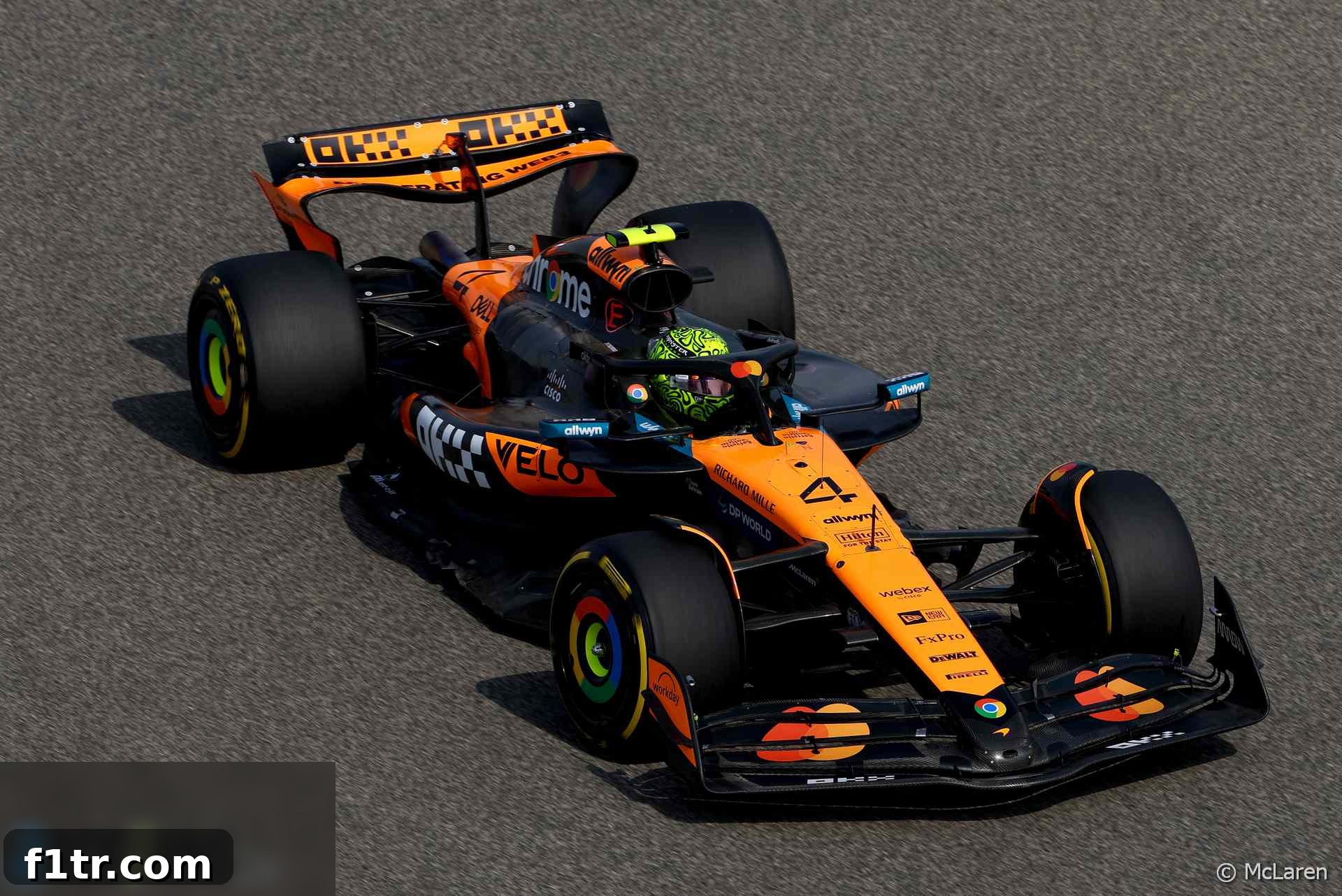
Lando Norris, the McLaren driver, has urged caution regarding the team’s seemingly dominant pace during practice sessions for the Bahrain Grand Prix. Despite teammate Oscar Piastri topping the timesheets and Norris himself being the only other driver to break the 1’31 mark, Norris dismissed the notion that McLaren currently holds a significant half-second advantage over their rivals.
Advert | Become a Supporter & go ad-free
The impressive showing in practice immediately raised eyebrows within the paddock and among fans, especially recalling McLaren’s varied qualifying performances this season. While they secured pole position by almost four-tenths of a second at the season’s inaugural race, the gap tightened to less than a tenth in China, and Max Verstappen ultimately outpaced them for pole in Japan. Norris’s comments suggest that Friday’s performance might not be a true reflection of the competitive landscape heading into qualifying and the race.
Deconstructing Practice Pace: Engine Modes and Strategic Sandbagging
Norris offered a crucial insight into why McLaren’s Friday pace might be misleading, attributing the perceived gap to the varying engine modes employed by different teams during practice. “I don’t think they turned up [their engines],” Norris candidly explained to the official F1 channel, referring to McLaren’s competitors. He elaborated on the common practice in Formula 1 where teams often operate their power units at reduced settings during early practice sessions, conserving mileage and masking their true performance capabilities ahead of the critical qualifying and race sessions.
“Everyone just looks at the times sheets, they have no idea about the information on who turns up and who doesn’t,” Norris emphasized, highlighting the internal knowledge that often contradicts external perceptions. He quantified the impact of these engine modes, estimating their value to be substantial in Bahrain. “It’s [worth] like three and a half, four tenths around here, so that puts us immediately back in the same position as the Mercedes. So I wouldn’t say we’re any quicker.” This statement recalibrates expectations, suggesting that McLaren’s real advantage, if any, is far narrower than what the raw lap times from practice indicated. Such strategic ‘sandbagging’ is a well-known tactic in F1, allowing teams to gather data without revealing their full hand, making a true assessment of pace challenging until the final qualifying runs.
The Bahrain Challenge: Extreme Conditions and Tyre Management
Beyond the strategic use of engine modes, Norris pointed to the demanding conditions at the Bahrain International Circuit as a significant factor influencing performance and driver feel. The second practice session (FP2) was considered the most representative in terms of lap times, primarily because it took place during the cooler evening hours that mirror qualifying and race conditions. However, even then, the circuit presented immense challenges. “It’s kind of a weird day because everything feels dreadful, but I think relatively our pace was still in a reasonable place,” Norris remarked, painting a vivid picture of the physical and technical difficulties faced by drivers.
He underscored the dominant role of environmental factors. “It’s just the temperature,” Norris explained. “It is hot, it’s windy. It’s more the temperature which makes such a big difference.” The high ambient and track temperatures, combined with gusting winds, drastically alter the car’s balance, grip levels, and aerodynamic efficiency. These conditions make the car feel less responsive and more unpredictable, demanding a higher level of precision and adaptability from the drivers. The fine margins in Formula 1 mean that even slight fluctuations in temperature and wind can significantly impact lap times and tyre wear, turning a seemingly benign day into a constant battle for control and performance.
Advert | Become a RaceFans supporter andgo ad-free
The Cruciality of Rear Tyre Preservation
In the challenging Bahrain heat, one of the most critical aspects of performance becomes tyre management, particularly for the rear tyres. “The big challenge is how can you look after the rear tyres in the best way possible,” Norris stated, highlighting a universal struggle for all teams. The high temperatures exacerbate tyre degradation, especially under the heavy traction demands of Bahrain’s slower corners and acceleration zones. Overheating the rear tyres can lead to a significant loss of grip, reduced stability, and ultimately, slower lap times and increased wear over a race stint.
Drivers must meticulously balance aggression with preservation, finding the optimal line and throttle application to minimize slip and heat build-up. This intricate dance requires constant feedback between the driver and the car, adapting driving style lap by lap as tyre performance evolves. The team’s setup choices also play a crucial role, influencing how the car distributes forces to the tyres and how effectively it can cool them. Mastering rear tyre management is often the key differentiator between a strong race performance and a struggle to maintain pace, especially on a circuit as thermally demanding as Bahrain.
Discarding Pre-Season Data: A Fresh Start
Adding another layer of complexity to the weekend, Norris revealed that much of the knowledge gleaned from pre-season testing, also conducted in Bahrain, felt irrelevant under the current conditions. “A lot of it is that we came into this weekend with a lot of our information from the pre-season test. But it’s basically like you throw all of that in the bin and just start again because it’s so different today. We’re seconds off what we were doing,” he admitted. This statement underscores the dynamic nature of Formula 1, where track conditions, ambient temperatures, and even slight changes in wind direction can dramatically alter the car’s behavior.
While pre-season testing provides a baseline understanding of the car’s characteristics and allows teams to validate initial designs, the specific conditions encountered during a race weekend are rarely identical. The circuit’s surface evolves, wind patterns shift, and the car’s setup might require radical adjustments to perform optimally. This means teams often have to re-evaluate their entire strategy and setup philosophy based on real-time data from Friday practice, effectively starting from a blank slate. Despite the difficulties of this adaptation process, Norris viewed it as a positive, acknowledging the work ahead: “So it’s difficult, but I think a good starting point to the weekend, plenty of things for the team and myself to work on.” This iterative process of data collection, analysis, and adjustment is a fundamental aspect of F1, pushing engineering and driving capabilities to their limits.
McLaren’s Proactive Approach to Norris’s Setup Challenges
In parallel with addressing the external challenges, McLaren has been actively working to fine-tune Lando Norris’s car setup to better suit his driving style and improve his comfort level behind the wheel. Team principal Andrea Stella shed light on the efforts being made to resolve specific handling issues Norris has experienced. “On Lando’s side, there’s especially a particular phase of driving the car that doesn’t make him entirely comfortable,” Stella explained. This indicates a very specific aspect of the car’s behavior that Norris finds difficult to manage, suggesting a nuanced issue rather than a broad performance deficit.
Stella confirmed that the team has achieved a profound understanding of the problem. “I think we’ve achieved a very good understanding of what that is.” While details of these proprietary adjustments remain confidential, Stella provided an encouraging overview of their proactive strategy. “It would be inappropriate to share the details, but let me say that even for this race, we’ve made some adjustments to the car – going back to some solutions that we think may improve the predictability of the car in relation to Lando’s driving input.” The emphasis on “predictability” is key; a predictable car allows a driver to push harder with greater confidence, knowing how the car will react to their inputs, especially at the limit.
Advert | Become a RaceFans supporter andgo ad-free
This tailored approach highlights the intricate relationship between driver and machine in Formula 1. Each driver possesses a unique style, and optimizing the car’s setup to match that style can unlock significant performance. McLaren’s willingness to revert to previous solutions suggests a thorough and iterative process, drawing on their extensive data and engineering expertise. Stella concluded with a sense of anticipation: “So it’s actually an interesting weekend even from this point of view, and we look forward to seeing what we will learn.” The outcomes of these setup changes will be closely monitored, as they could be crucial for Norris’s performance and the team’s overall competitiveness throughout the Bahrain Grand Prix weekend and potentially beyond.
Looking Ahead: The True Test Awaits
As the Bahrain Grand Prix weekend progresses, the true picture of McLaren’s pace and their standing relative to rivals like Red Bull and Mercedes will undoubtedly emerge during qualifying and the race. Lando Norris’s pragmatic assessment of the practice sessions serves as a vital reminder that early results can often be deceiving in the highly strategic world of Formula 1. The combination of hidden engine modes, challenging environmental conditions, the specific demands of tyre management, and the ongoing efforts to fine-tune car setups all contribute to a complex performance mosaic.
McLaren’s focused efforts on both understanding the track’s unique challenges and addressing Lando Norris’s specific car handling preferences demonstrate their commitment to maximizing every ounce of performance. While the practice times offered a glimpse of potential, the real test lies in how McLaren, and Norris in particular, can convert that promise into a strong showing when it truly counts. The insights from Norris and Stella underscore the relentless pursuit of perfection in F1, where every tenth of a second and every degree of comfort can make a world of difference.
Further Reading on the 2025 Bahrain Grand Prix
- Hamilton making “drastic shift” in driving style to master Ferrari’s car
- Leclerc revealed Ferrari strategy details to Gasly before Bahrain Grand Prix
- Lawson made “very significant step forward” in Bahrain – Mekies
- Russell’s transponder was ‘frazzled and charred’ after Bahrain Grand Prix DRS drama
- “Don’t give me too much now”: Hamilton’s search for speed at Ferrari continues
Browse all 2025 Bahrain Grand Prix articles