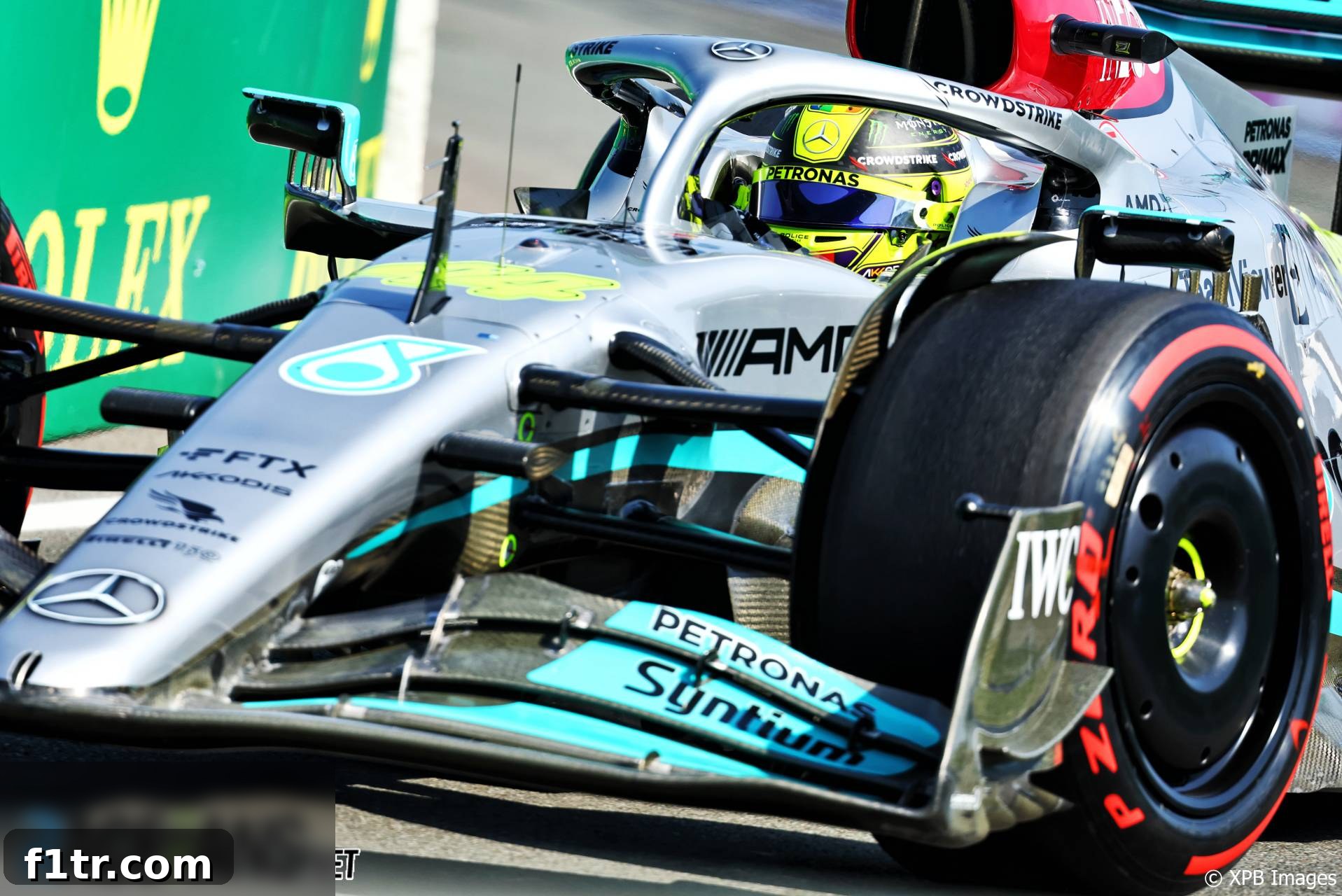
Following a highly encouraging double podium finish at the French Grand Prix, the Mercedes-AMG Petronas Formula 1 team is preparing for a significantly tougher challenge as the F1 calendar moves to the Hungaroring for the Hungarian Grand Prix. Despite securing their best result of the 2022 season at Paul Ricard, Mercedes anticipates that replicating such a strong performance on the tight, twisty Hungarian circuit will be exceptionally difficult, a sentiment echoed by the team’s motorsport strategy director, James Vowles.
Advert | Become a Supporter & go ad-free
The Paul Ricard Success: A Deep Dive into Mercedes’ Performance
The French Grand Prix at Paul Ricard saw Mercedes drivers Lewis Hamilton and George Russell clinch second and third places respectively, marking a crucial turning point in their challenging 2022 campaign. This achievement was particularly sweet for Russell, who executed a brilliant overtake on Sergio Perez in the closing stages of the race to secure the final podium spot. James Vowles attributed this strong showing to the unique characteristics of the Paul Ricard circuit, which allowed the team to leverage the growing strengths of their W13 challenger.
“I think where we are at the moment is clearly we are improving the car race-on-race, and our race pace is getting there,” Vowles commented. He highlighted that while the team has made significant strides in race trim, their qualifying performance continues to be an area of concern. “But qualifying isn’t at the moment. We are struggling to really get into the mix with them, and there is going to be certain tracks like Paul Ricard and Silverstone where we are able to use that race pace to our advantage.”
Indeed, the smooth, high-speed corners and open layout of Paul Ricard played perfectly into the W13’s evolving strengths, enabling both Hamilton and Russell to manage their tyres effectively and maintain consistent pace throughout the race. The circuit’s design, with its expansive run-off areas, also offered a degree of forgiveness, allowing drivers to push closer to the limit without immediate penalty.
Beyond the circuit characteristics, Vowles also acknowledged that Mercedes benefited from the challenges faced by their rivals. Carlos Sainz, a strong contender for Ferrari, started from the back of the grid due to engine penalties, effectively removing a formidable competitor from the front-running battle. “In the case of Sainz, he had engine penalties which meant he started from the back of the grid. Had he been in front, he was an incredibly fast car and it would have been difficult to beat, so we have an element of realism,” Vowles explained. Furthermore, there was a noticeable pace discrepancy between the two Red Bull drivers at Paul Ricard, with Sergio Perez struggling to match Max Verstappen’s speed, which inadvertently opened the door for Russell to capitalize on the opportunity.
“It’s fair to say there are weeks where it is difficult to distinguish between the two Ferraris and the two Red Bulls. There are weeks where Perez’s pace is similar to Verstappen or offset by simply a small amount. This weekend looked to be a larger difference,” Vowles added, underlining the opportunistic nature of their French Grand Prix success. While the podium was well-earned, the team remains grounded in their understanding of the competitive landscape.
The Hungaroring Hurdle: Exposing Mercedes’ Weakness
The upcoming Hungarian Grand Prix at the Hungaroring presents a stark contrast to Paul Ricard and is expected to expose the W13’s inherent weaknesses, particularly its struggle in single-lap qualifying pace. The Hungaroring is notoriously known as a “Monaco without the walls” – a tight, technical circuit with a relentless series of corners and very few genuine overtaking opportunities. This characteristic places an immense premium on qualifying position, as track position is king in Hungary.
Vowles articulated this challenge clearly: “It’s very difficult at Budapest if you start behind to move back forward through the field again. There are opportunities, it’s just more difficult.” The absence of long straights, combined with the continuous demand for aerodynamic grip through its numerous slow and medium-speed corners, means that a car’s raw pace and qualifying performance are paramount. For a team like Mercedes, which has demonstrably strong race pace but an inconsistent qualifying showing, this circuit poses a significant threat to their ambitions of continuing their podium streak.
The W13 has shown significant improvement over the course of the season, particularly in managing the porpoising phenomenon that plagued its early races. However, the car still struggles to unlock its full potential over a single qualifying lap, often lagging behind Red Bull and Ferrari. This becomes a critical issue at the Hungaroring, where starting further down the grid can effectively neuter even the strongest race pace due to the difficulty of making overtakes. Drivers can often find themselves stuck in DRS trains, unable to make progress regardless of their car’s outright speed.
The team’s hope for a strong result in Hungary will, therefore, heavily rely on extracting every ounce of performance from the W13 during Saturday’s qualifying session. Any misstep or inability to get the tyres into their optimal operating window could prove costly, pushing them into the midfield where the fight for positions is even more intense and overtaking opportunities are scarce.
Balancing Optimism with Pragmatism: Mercedes’ Forward Vision
Despite the looming challenges, James Vowles remains encouraged by the renewed sense of optimism and belief within the Mercedes team. After a difficult start to the season, which saw the dominant Silver Arrows struggling to even contend for podiums, the recent improvements and consistent points finishes have undoubtedly boosted morale. “I am incredibly pleased to see that people are getting carried away,” Vowles stated, acknowledging the natural human tendency to celebrate success.
However, he quickly tempered this enthusiasm with a healthy dose of realism, emphasizing that the team is not yet where it needs to be to consistently challenge for victories. “The whole point of motorsport is to create some of the highest highs you can ever feel and some of the lowest lows as well. But we are not where we need to be yet to be winning, that’s the short answer to it, especially for example on qualifying pace and Hungary will expose that weakness somewhat.”
Vowles’ assessment underscores the methodical approach Mercedes is taking. They recognize the significant progress made, especially in understanding and developing the W13, but they also acknowledge the gap that still exists to the front-runners in specific areas. The journey of car development is a continuous process, and the team is focused on sustained improvement rather than quick fixes. “We have made steps forward and I can see progress, and we can see progress for how we are going to move forward again across the next few races, but in Budapest we have to be realistic,” he explained.
The current iteration of the W13 is, according to Vowles, a “strong race car.” The challenge lies in maximizing its potential under varying circuit conditions and ensuring that its race pace advantage isn’t negated by a poor starting position. “Where we are with this car is a strong race car but we may not be able to use all of it in the conditions that are presented to us. We need to do a better job than we have been doing to make sure we are qualifying where the car should be, towards the front.” This highlights the team’s ongoing effort to fine-tune the car’s setup for qualifying, addressing the inherent balance and grip issues that seem to prevent it from truly unleashing its speed over a single lap.
For Mercedes, the Hungarian Grand Prix is not just another race; it’s a crucial litmus test. It will provide invaluable data on how their car performs on a high-downforce, low-speed circuit, offering further insights into areas that require immediate attention for future development. While outright victory might be a stretch, a strong qualifying performance followed by a solid points finish would be considered a successful outcome, demonstrating the team’s ability to adapt and perform even on tracks that don’t naturally suit their current package.
The F1 landscape is constantly evolving, and Mercedes is determined to close the gap to the front. The lessons learned at the Hungaroring will undoubtedly feed into their ongoing development plan, as they push to return to championship-winning contention. The blend of realism and unwavering ambition will define their approach for the remainder of the season, with every race serving as a stepping stone towards their ultimate goal.
Advert | Become a RaceFans supporter andgo ad-free
2022 French Grand Prix Related Articles
- Ferrari’s season of missed chances led to “difficult” criticism for Binotto
- McLaren looking into why their starts are “more inconsistent” this year
- Mercedes expect Hungarian GP will ‘expose our qualifying weakness’
- Hamilton and Russell ‘out-performing a car that’s not good enough’ – Wolff
- “We need to decide now”: Inside Sainz and Ferrari’s French GP strategy dilemma
Browse all 2022 French Grand Prix articles