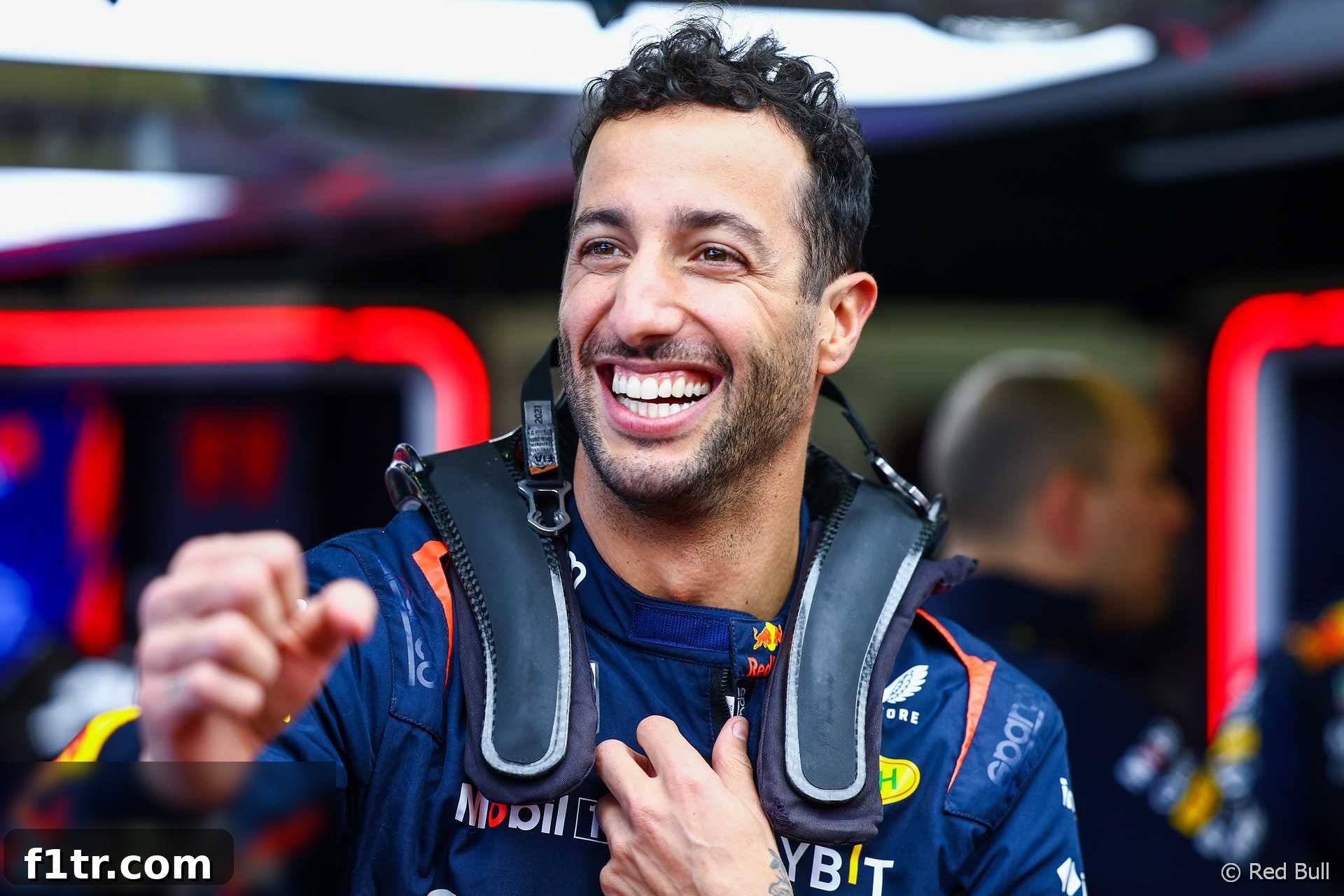
The familiar grin and undeniable charisma of Daniel Ricciardo have once again graced the Formula 1 paddock, a sight that simultaneously delights fans and fuels fervent speculation about his future. Having returned to Red Bull as their third driver for the 2023 season, Ricciardo’s presence at events like his home Australian Grand Prix is more than just a ceremonial appearance; it’s a pivotal moment in his career hiatus and a constant reminder of the unfinished business that many believe he still has in Formula 1.
Following a challenging end to his tenure with McLaren, which saw his contract prematurely terminated for 2023, Ricciardo made the strategic decision to rejoin the Red Bull family last November. This move, while initially raising eyebrows, has revealed itself to be multifaceted, encompassing both high-profile promotional activities and the more discreet, yet crucial, responsibilities of a reserve driver. His recent high-octane drive of a Red Bull RB7 around Australia served as a vivid demonstration of his enduring appeal and Red Bull’s masterful utilization of his superstar status beyond the confines of competitive racing.
However, Ricciardo’s role extends far beyond brand promotion. When trackside, he stands ready to assume the wheel of the potent RB19 should either reigning world champion Max Verstappen or his experienced teammate Sergio Perez be unable to compete. This critical backup function is shared with Red Bull’s promising junior talents, Liam Lawson and Dennis Hauger, who also contribute extensively to the team’s simulator development at their state-of-the-art F1 base in Milton Keynes. Ricciardo’s wealth of experience, boasting eight Grand Prix victories and over a decade in the sport, provides an invaluable safety net for the championship-contending team.
Red Bull team principal Christian Horner has clarified the scope of Ricciardo’s duties, confirming his attendance at several races throughout the year in his reserve capacity. Horner also hinted at the possibility of Ricciardo undertaking “a bit of tyre testing” in the current RB19, in addition to his simulator work. These on-track opportunities are vital for keeping a driver physically and mentally prepared for the rigors of F1 machinery. Crucially, given Ricciardo’s current base in the USA, a significant portion of his engagement with Red Bull and its myriad partners will revolve around promotional work – a role perfectly suited to his globally recognized persona and engaging personality, exemplified by his widely publicized RB7 road trip across Australia.
Ricciardo himself has offered candid insights into his current mindset. Last month, he expressed keen interest in participating in Pirelli tyre tests, seeing them as an ideal way “just to stay race fit.” Yet, he also admitted to not being “foaming at the mouth yet” for a full-time return to the cockpit of an F1 car. His reflections suggested a desire for a different kind of engagement with racing, indicating that if he were to compete in other categories, it would be “only for fun,” highlighting a noticeable shift in priorities. This sentiment underscores a deeper narrative of a driver taking a necessary step back to recalibrate and rediscover his passion away from the intense pressure cooker of Grand Prix racing.
Indeed, a significant emphasis for Ricciardo concerning his 2023 plans was not directly linked to engineering a race return in 2024. Instead, he expressed a profound desire to utilize the mental space and freedom that a season away from active F1 competition would afford him. He openly shared how, over the preceding winter, he had been “really trying to savour” the ability to dedicate his full attention to personal activities, such as quality time with family and friends. This mental break allowed him to enjoy life without the constant obligation of factoring in rigorous training schedules, demanding travel, and the relentless off-season development work that his previous F1 teams would have imposed upon him.
Speaking to media, including RaceFans, at Red Bull’s 2023 season launch, Ricciardo articulated his cautious approach to his future: “I’m trying not to put too much stress on it [evaluating if I want to return]. I really just want to let it happen naturally.” This philosophy is a stark contrast to the often single-minded ambition typical of F1 drivers, hinting at a more holistic view of his career and personal well-being. He reinforced this outlook, adding, “I’m really happy to be taking the year I’m taking. At least currently where I sit, it does really feel right.”
As the F1 season approached, Ricciardo structured his time to gradually transition from a ‘holiday feel’ back into a work-ready state. While he aims to thoroughly enjoy his new role, after nearly twelve years as a professional racing driver, he acknowledged the significant possibility that his re-immersion into the paddock environment could serve as the crucial catalyst, reigniting his competitive desire and setting him on a path back to a full-time race seat. The allure of the grid, the roar of the engines, and the pure thrill of competition are powerful forces for any racing driver, and Ricciardo is no exception.
The pivotal question on everyone’s mind is: will Daniel Ricciardo ultimately find his way back into a race seat after the professional setback of being let go by McLaren a year before his contract was due to expire? Not everyone shares an optimistic view. Alan Jones, the esteemed 1980 Formula 1 World Champion and a fellow Australian, expressed his skepticism, stating recently that he “doubts” Ricciardo will be on the F1 grid next year. Jones’s perspective stems from the current landscape of the sport and the perceived lack of available top-tier seats.
“At the end of the day,” Jones commented, “there is probably no reason why Red Bull won’t re-sign Perez and obviously Verstappen [is already signed]. I can’t see anybody at Ferrari resigning or going away, so I just can’t see where he can go.” This assessment highlights the intensely competitive nature of F1, where driver seats are a precious commodity. Jones further elaborated on his viewpoint, adding, “Really, in my own opinion, I think he concentrated and spent a bit too much time for his activities out of the cockpit rather than in it.” This critique touches upon a debate common in professional sports: the balance between athletic focus and broader personal and commercial endeavors. While modern athletes are increasingly encouraged to build personal brands, traditionalists often prioritize singular dedication to the craft.
Ricciardo’s off-track activities are indeed diverse and well-documented, contributing significantly to his public profile. His family owns a farm in Western Australia, an endeavor he has often highlighted when engaging in work there. He has also ventured into ranch work in the USA, demonstrating his willingness to explore different experiences. His genuine love for American sports is also well-known; he’s often been spotted in the stands during Buffalo Bills games, a passion he shares with many of his F1 peers. Beyond sports, his exuberant and relatable personality propelled him to become one of the biggest stars of F1’s immensely popular Netflix docuseries, Drive to Survive. One can easily imagine program commissioners eagerly seeking avenues to create new shows featuring Ricciardo, especially given the extensive focus on his departure from McLaren in the latest series. Adding to his expanding media portfolio, he has an upcoming Hulu series of his own, further cementing his status as a personality beyond the racetrack.
If Daniel Ricciardo fails to secure an F1 seat for the 2024 season, historical trends suggest that his chances of a successful return will significantly diminish. The sport’s history indicates that only a select few Grand Prix winners have managed to endure a two-year absence from F1 and subsequently make a triumphant comeback. This makes his current sabbatical a high-stakes gamble on his future competitive career.
Niki Lauda stands as one of the earliest and most high-profile examples of such a return. The two-time world champion famously chose to leave F1 in late 1979 after a particularly frustrating season marred by eleven non-finishes. Like Ricciardo, Lauda harbored significant passions outside of racing, notably his own airline, Lauda Air. He dedicated himself full-time to running his burgeoning aviation business until McLaren, recognizing his unparalleled talent and marketability, successfully enticed him out of retirement with a record-breaking salary offer in 1982. Lauda’s return was not merely symbolic; he went on to win a third world championship in 1984, proving that a hiatus, if managed correctly and driven by renewed motivation, could lead to even greater success.
Following Lauda’s remarkable example, Alan Jones himself retired from F1 after the 1981 season. He later expressed regret over his decision to leave Williams and for not pursuing Ferrari’s mid-season inquiry in 1982. After a one-off cameo appearance with Arrows in 1983, Jones split his time between sports car racing and, much like Ricciardo, enjoying life in his native Australia for two years. He was eventually lured back to F1 by the new entrant Team Haas (formerly Lola), a team he was already familiar with from his sports car and CART racing endeavors, demonstrating that established relationships and new opportunities can be powerful motivators for a comeback.
Kimi Raikkonen, the “Iceman,” found himself in a remarkably similar predicament to Ricciardo in 2009. While Ricciardo faced McLaren’s decision to replace him despite a valid contract, Ferrari made a similar move with their 2007 world champion, opting to sign Fernando Alonso. The outcome for Raikkonen was a two-year break from F1, during which he continued to receive a salary from Ferrari for the first year. In his time away, Raikkonen ventured into the World Rally Championship, showcasing his versatility, but eventually grew restless for the unique thrill of F1. After discussions with several teams, he made a successful return to the sport with Lotus. Ricciardo, an eight-time Grand Prix winner and a global superstar, undoubtedly holds significant leverage, just as Raikkonen did, to command a high price for his services. His marketability and proven winning capability make him a valuable, albeit potentially expensive, asset for any team.
However, Ricciardo’s recent years with McLaren were largely underwhelming, marked by a significant struggle to adapt to the car, which saw his performance dip considerably. This period, unfortunately, may have made his perceived value, and consequently his asking price, too high for some teams, especially those with more modest budgets. This was notably highlighted last year during a revealing conversation between Haas team principal Gunther Steiner and driver Kevin Magnussen, captured in the new season of Drive to Survive. Steiner’s blunt assessment was unequivocal: “We can’t afford him, Kevin. He wants 10 fucking million. Minimum!” This candid exchange perfectly illustrates the financial realities and constraints that can influence driver choices, even for a driver of Ricciardo’s caliber and popularity.
Fernando Alonso, another F1 veteran, embarked on a two-year sabbatical from the sport in 2019. His departure was driven by frustration with driving an uncompetitive McLaren in F1, coupled with his concurrent successful participation in the World Endurance Championship with Toyota, where he pursued motorsport’s coveted Triple Crown. Alonso explicitly wanted the freedom to evaluate his options for when F1 introduced its significant technical regulation overhaul in 2021. While Alonso maintained close ties with McLaren during his break, other F1 teams were well aware of his continuing ambitions to return. He meticulously spent 2020 orchestrating his comeback, demonstrating an intense and focused understanding of what he wanted from his career. This contrasts sharply with Ricciardo’s current public comments, which emphasize a more natural, less predetermined approach – a difference in philosophy that might influence how potential future team negotiations unfold.
Beyond the personal freedoms and the genuine excitement of rejoining his former team, there’s a clear strategic convenience for both Daniel Ricciardo and Red Bull in continuing their arrangement for the foreseeable future. Ricciardo remains an enormous promotional asset for Formula 1 globally, and Red Bull, as a brand, will undoubtedly want to retain such an influential figure under its umbrella for as long as possible. A premature return to an F1 race seat, particularly if followed by further underwhelming performances, could paradoxically diminish his ‘stock’ and tarnish the cherished image of him as Red Bull’s perpetually cheerful Grand Prix winner. For now, he is largely remembered for his victorious Red Bull days, a powerful marketing image.
For many years, David Coulthard served as Red Bull’s go-to man for street demonstrations and other high-profile publicity stunts requiring an F1 car. However, at 52 years old, Coulthard’s physical demands for such roles are naturally evolving. Ricciardo’s recent Australian road trip perfectly exemplifies the kind of indefinitely sustainable, high-impact promotional role that Red Bull might envision for him, tapping into his energy and ongoing relevance. This transition hints at a longer-term symbiotic relationship between Ricciardo and the energy drink giant, extending his career value far beyond competitive racing.
Conversely, a year or two away from active F1 competition could actually enhance Ricciardo’s value proposition in a race seat. The longer he remains out of a competitive car, his initial high asking price is likely to decrease, making him a more financially viable option for a wider range of teams. Yet, crucially, his promotional stock and global fan appeal remain exceptionally high, arguably superior to almost every other driver currently on the grid or in the reserve ranks. This unique combination of potentially reduced cost and enduring marketability could, in the future, make him an even more attractive signing for teams seeking a blend of talent, experience, and powerful brand representation.
Ultimately, Daniel Ricciardo’s Formula 1 future hinges entirely on his personal commitment and desire to return. For a comeback to be successful, particularly in a sport as demanding as F1, it must be a 100% committed decision, devoid of hesitation or doubt. The journey ahead for the Honey Badger remains one of the most compelling narratives in contemporary Formula 1, watched with bated breath by fans and pundits alike.
| Driver | Length of absence | Reason for exit |
|---|---|---|
| Juan Manuel Fangio | 0.5 years | His team didn’t make a car for the next season |
| Peter Revson | 7 years | Struggled as F1 rookie, became Can-Am champion to earn F1 return |
| Patrick Tambay | 1 year | Left F1 for Can-Am, won the title and returned to F1 |
| Niki Lauda | 2 years | Retired to run an airline. Enticed back by record salary |
| Alan Jones | 1 year | Retired, returned for a one-off race |
| Alan Jones | 2.5 years | Enticed out of retirement to reunite with old boss Carl Haas |
| Alain Prost | 1 year | Booted out by Ferrari, then signed with Williams to return |
| Nigel Mansell | 1.5 years | Fell out with Williams after they signed Prost. Won CART title and Bernie Ecclestone negotiated a F1 return |
| Johnny Herbert | 1 year | Couldn’t find a seat, starred in Japanese F3000 and earned part-time F1 return |
| Fernando Alonso | 1 year | His manager prepared him for Renault seat by making him reserve driver for a year |
| Felipe Massa | 1 year | Lost Sauber seat, joined Ferrari in test role, then Sauber signed him back |
| Jacques Villeneuve | 1 year | Sacked by BAR, signed with Sauber and made early comeback with Renault |
| Michael Schumacher | 3 years | Retired, enticed back by the new Mercedes F1 team |
| Kimi Raikkonen | 2 years | Paid to spend a year on sidelines by Ferrari, got bored and returned to F1 |
| Robert Kubica | 8 years | Career stalled by injury. Starred in WRC and recovered to be F1-ready again |
| Fernando Alonso | 2 years | Fed up of uncompetitive cars, left F1 to win WEC title. Returned with Alpine |
| Esteban Ocon | 1 year | Lost seat, joined Mercedes in reserve role, then made return with Renault |
2023 F1 season
- FIA president cleared of alleged interference in two 2023 races
- First week viewing figures for new Drive to Survive season fall again
- Max who? Drive to Survive season six prefers its favourite faces
- RaceFans’ complete 2023 season review
- The F1 drivers who pulled off the 10 biggest charges through the field in 2023
Browse all 2023 F1 season articles