Montoya’s Silverstone Masterclass: A Resurgent McLaren Shines Amidst Raikkonen’s Title Trouble at the 2005 British Grand Prix
The hallowed tarmac of Silverstone, a circuit synonymous with Formula 1 history, played host to the 2005 British Grand Prix, an event that would deliver both a triumphant return to form for one driver and a significant blow to the championship aspirations of another. Juan Pablo Montoya, after a challenging start to his McLaren career, brilliantly broke his 2005 duck, claiming his inaugural victory for the Woking-based team in a truly commanding fashion. Yet, the jubilant celebrations were tinged with a familiar frustration for his teammate, Kimi Raikkonen. For the second consecutive weekend, the ‘Iceman’ found his relentless assault on Fernando Alonso’s championship lead stymied by a crippling engine failure, a setback that compounded his frustrations and intensified the title fight.
The 2005 Formula 1 season had been a thrilling rollercoaster of high-stakes drama, with the introduction of new aerodynamic and engine regulations placing immense pressure on both car performance and reliability. Silverstone, renowned for its high-speed corners like Copse and Maggotts, and its demanding layout, was expected to provide another captivating chapter in this unfolding saga. Coming into the British Grand Prix, Fernando Alonso and Renault had established a formidable lead in the Constructors’ and Drivers’ Championships, built on a foundation of consistent performance and astute strategic execution. McLaren, despite flashes of incredible outright pace from Raikkonen, had been plagued by mechanical woes, particularly recurring engine failures, which had cost the Finnish driver crucial points and critical grid positions, allowing Alonso to build a significant cushion.
Pre-Race Drama: Engine Woes and Grid Penalties Reshape the Weekend
The ominous signs for McLaren’s primary championship hopeful began even before the main event unfolded. The final practice session for the British Grand Prix had barely commenced when the number nine McLaren-Mercedes of Kimi Raikkonen coasted to an ignominious halt on the circuit. Initially, the absence of visible smoke from the exhaust led some observers to speculate a repeat of Montoya’s hydraulic failure in France, a different but equally debilitating mechanical issue that had hampered his teammate. However, the diagnosis soon confirmed the worst fears: another catastrophic engine problem. Under the stringent 2005 regulations, which mandated that an engine must last two full race weekends, this catastrophic failure meant an automatic 10-place grid penalty for Raikkonen. This was his second such penalty in as many races, a truly devastating blow to his championship aspirations, effectively neutralizing any raw speed advantage the McLaren MP4-20 might possess.
This dramatic turn of events in practice fundamentally altered the complexion of the entire weekend. The die was cast for a race that, based purely on Friday and Saturday morning practice times, had promised to be a dominant McLaren benefit. Now, Raikkonen’s qualifying position would be severely compromised, arguably to an even greater degree than his teammate, Juan Pablo Montoya. Montoya himself was already facing a handicap, compelled to run fifth in the qualifying order due to his own mechanical retirement in France, also a frustrating engine-related issue. The pressure on both McLaren drivers was immense: Raikkonen to minimize the damage and recover positions, and Montoya to finally deliver on his considerable promise and secure a much-needed victory for the team.
Beyond the McLaren garage, other teams were grappling with their own challenges and opportunities. Toyota had shown impressive outright speed over single laps during the practice sessions, hinting at their potential to challenge the front runners. However, the elusive consistency required for a strong, sustained race pace continued to evade the Japanese squad, leaving them with an uphill battle for Sunday. Home favourite Jenson Button, driving for BAR-Honda, was also tantalizingly close to the ultimate pace, much to the delight of the fervent Silverstone crowd, but just fell short of true contention for pole position, reflecting the fiercely competitive nature of the field.
Qualifying Spectacle: Alonso on Pole, Montoya’s Brilliant Lap
With Kimi Raikkonen effectively removed from the fight for pole position due to his impending grid penalty, an open opportunity presented itself at the front of the grid. It was an opportunity seized, predictably, by none other than Fernando Alonso. The young Spaniard, demonstrating supreme skill and strategic acumen, set a blistering fastest time to claim pole position for Renault. Remarkably, he achieved this impressive feat despite carrying more fuel than almost anyone else in the top ten, with the notable exceptions of Raikkonen and Michael Schumacher. Raikkonen, despite his engine penalty, still managed to clock the second-fastest time, a powerful testament to the sheer speed of the McLaren MP4-20, though this pace would unfortunately relegate him to a twelfth-place start after penalties were applied. Michael Schumacher, meanwhile, endured a minor off at the demanding Stowe corner during his flying lap, which dropped him to tenth fastest, eventually translating to a ninth-place grid slot following various penalties and adjustments.
The massive and enthusiastic support from the Silverstone faithful undoubtedly buoyed Jenson Button, who capitalized admirably on Raikkonen’s misfortune to secure a coveted front-row start for BAR-Honda. This was a fantastic result for the local hero and the British-based team, igniting hopes for a strong performance on home soil. However, the real standout performance of the qualifying session, a true highlight of individual brilliance, belonged to Juan Pablo Montoya. The Colombian produced a scintillating lap, a display of raw speed, precision, and aggressive commitment, that placed him a highly promising third on the grid. This strong starting position, combined with his proven race craft and the inherent speed of the McLaren, set the stage for what many hoped would be a strong, much-needed showing from the often-mercurial driver.
Race Day Thrills: A Blistering Start and Intense Early Battles
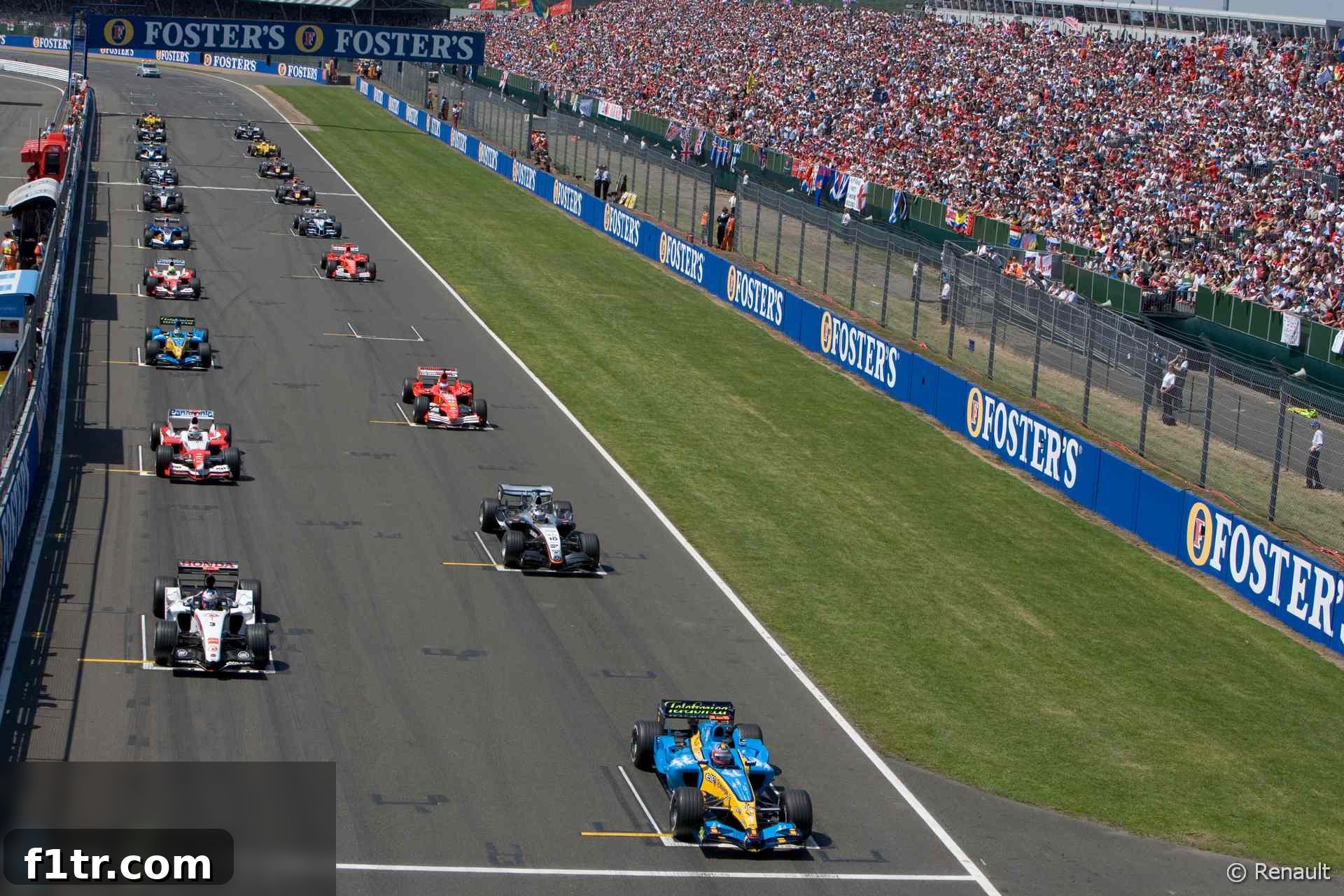
As the iconic five red lights extinguished on Sunday afternoon, the tension crackled palpably across the Silverstone circuit. And as quickly as they vanished, Montoya delivered on his qualifying promise with a truly phenomenal start. He executed a perfect launch, catapulting past Jenson Button with ease and then aggressively positioning himself on the outside of Fernando Alonso at the famously fast and challenging Copse corner. Alonso, renowned for his fair but firm racing, allowed him a critical sliver of racing room, and Montoya, with characteristic bravery and precision, squeezed his McLaren through the narrow gap. This audacious and brilliant move saw the Colombian snatch the lead before the end of the very first lap, immediately putting him in control of the British Grand Prix.
Despite his blistering start, Montoya couldn’t immediately sprint away from Alonso in the opening laps. The two front-runners only gradually pulled away from Jenson Button, who held a solid third position, tending to suggest that Alonso’s true pace, perhaps due to a heavier fuel load from his pole-setting strategy, was being expertly contained. Further back, the most captivating and desperate battle of the early stages involved Kimi Raikkonen. Starting from twelfth position, he was on a relentless mission to salvage championship points. He sliced through the midfield with surgical precision, quickly leaping to eighth place, right on the tail of Michael Schumacher. Ironically, Schumacher was being smartly held back by Jarno Trulli, the very driver who had publicly lambasted the German just weeks prior for his perceived lack of support for the drivers’ stance regarding the controversial United States Grand Prix at Indianapolis. This added an extra layer of intrigue and personal rivalry to their on-track duel.
Schumacher, uncharacteristically, seemed hesitant to make a decisive move on Trulli, perhaps struggling with the Ferrari’s pace on the day or unwilling to take unnecessary risks in the early stages. Raikkonen, meanwhile, scrambled frantically behind them, searching for any opportunity to advance his McLaren. His best shot at an overtake arose after a lap three rolling restart, necessitated by Takuma Sato’s stalled BAR on the grid. However, a momentary twitch of oversteer at the demanding Becketts complex thwarted his attempt to attack Schumacher down the long Hangar Straight. It was clear, though, that Raikkonen possessed significantly greater underlying pace than the Ferrari, especially under braking into Stowe, a point he would later emphatically demonstrate. Up ahead, Montoya continued to lead Alonso comfortably, followed by Button, Rubens Barrichello, and Giancarlo Fisichella, forming the initial top five in what was shaping up to be a fascinating strategic race.
Strategy Unfolds: The Pit Stop Chess Match and Crucial Overtakes
The new aerodynamic regulations of the 2005 season were making their presence felt once again, even at Silverstone, a circuit generally considered more conducive to overtaking than the previous Magny-Cours venue. Alonso, ever the astute strategist, pressed Montoya relentlessly, keenly aware that the pit stop window presented his best, and perhaps only, opportunity to leapfrog the leading McLaren. As expected, Montoya pitted one lap before Alonso, an aggressive strategic move designed to capitalize on clear air and a fast out-lap. However, the Renault man’s pit window was critically delayed by traffic – specifically, the need to lap the slower cars of Jacques Villeneuve and David Coulthard. This minor impediment, a few precious seconds lost, proved decisive. As Montoya emerged from his stop, he roared back up alongside Alonso and through into the complex of Maggotts and Becketts, mirroring his stunning move on lap one. Status quo restored, much to McLaren’s relief and Renault’s frustration, cementing Montoya’s position at the front.
Further down the field, pit strategy continued to play a crucial role in shaping the running order. Rubens Barrichello made the first of his planned three stops, which, to no one’s surprise, saw him drop behind his Ferrari teammate, Michael Schumacher, highlighting the disparity in their respective fuel loads and race plans. Jenson Button initially capitalized on this, making a clean stop, but Giancarlo Fisichella, with a slicker overall stop and perhaps a more aggressive tire strategy, managed to jump both Barrichello and Button, moving ahead in the running order. The midfield battles were intense and constantly evolving, with each position crucial for championship points and team standings, demonstrating the fine margins of modern Formula 1.
In the chasing pack, Jarno Trulli, Michael Schumacher, and Kimi Raikkonen stopped in that precise sequence. Due to their varied strategies, fuel loads, and the inherent speed differentials of their cars, they resumed the race in reverse order, with Raikkonen now having clear track ahead of the Ferraris and Toyotas. Raikkonen’s charge from the back was unrelenting. He managed to catch up to the Montoya-Alonso battle towards the end of his first stint, showcasing the immense, undeniable pace of his McLaren MP4-20. With an impressive display of skill and determination, he even smartly passed Alonso into Stowe, albeit for a fleeting moment before his own scheduled pit stop. Sadly for Raikkonen, this would be the last significant on-track encounter between the Finn and the two leaders at the very front of the race. His battle against the clock and against persistent bad luck continued, but his raw speed was evident for all to see.
The Race to the Flag: Montoya’s Dominance and Raikkonen’s Podium Redemption
As the race progressed into its latter stages, a sense of inevitability began to settle over the Silverstone circuit. Juan Pablo Montoya, now firmly in control and demonstrating exceptional race management, was steadily extending his lead over Fernando Alonso. The Colombian proved particularly adept at navigating through backmarker traffic without losing valuable momentum, maintaining a consistent gap. Giancarlo Fisichella, despite his strong early showing and opportunistic gains in the pits, was largely holding station in third, unable to genuinely challenge the relentless pace of the front two. Behind him, Jenson Button was steadily being reeled in by the relentlessly charging Kimi Raikkonen, who was making the absolute most of his car’s superior speed and his raw talent to recover from his earlier grid penalty.
Remarkably, the 2005 British Grand Prix proved to be a race of exceptional reliability across the field, a stark contrast to some earlier events in the season that had been marred by high attrition. Takuma Sato, after his initial stall on the grid, managed to get his BAR going again and impressively completed the race distance. The only official retirement of the day was Narain Karthikeyan, marking a disappointing end for the Indian driver’s race. His teammate, Tiago Monteiro, however, was classified for a remarkable twelfth consecutive time, an impressive feat of consistency for the struggling Jordan team, highlighting their robust if not quick machinery.
Montoya held a significant and increasingly comfortable gap over Alonso when he made his final scheduled pit stop of the afternoon. Alonso, ever the tactician and never one to give up, chose to stay out for a crucial four laps longer, hoping to gain precious time with a lighter car and clear track. Once again, the scenario set up a thrilling, hair-raising sprint into the complex of Maggotts and Becketts as the two championship protagonists emerged from their respective stops. But this time, Montoya had accumulated sufficient margin, emerging comfortably ahead to solidify his lead definitively. Things did not go as smoothly for Giancarlo Fisichella, though. During his final pit stop, he experienced another frustrating stall, an issue he vehemently blamed on the car itself rather than driver error. This critical and costly error allowed Kimi Raikkonen to seize the opportunity, jumping ahead into third place and securing a well-deserved, if hard-fought, podium finish, a strong recovery given his starting position.
Aftermath and Profound Championship Implications
The stark contrast in moods between the two McLaren drivers in the aftermath of the race could not have been more pronounced. For Juan Pablo Montoya, the victory was a moment of pure, unadulterated jubilation and profound vindication. After a challenging integration into the McLaren team, a series of mechanical misfortunes, and occasional clashes of personality, this win at Silverstone was a powerful statement of intent. It proved his enduring speed and his ability to deliver under immense pressure. It was a clear indication that he had finally found his rhythm with the team and the formidable MP4-20 chassis, signaling a potential turning point in his McLaren career.
Conversely, for Kimi Raikkonen, despite salvaging a valuable podium position, the overriding emotion was one of deep disappointment and regret. Foiled yet again by persistent engine reliability issues and the subsequent grid penalties, he spoke candidly in post-race interviews of his growing fear that his championship hopes were rapidly fading. The continuous mechanical setbacks, particularly on weekends where the McLaren chassis demonstrated superior pace to the Renault, were a bitter pill to swallow for the naturally stoic Finn. With the British Grand Prix concluded, the championship standings reflected this growing disparity: Fernando Alonso now led Raikkonen by a significant margin of 77 points to 51, a gap that felt increasingly insurmountable with each passing race and each successive McLaren engine failure. The 2005 F1 season was shaping up to be a true test of perseverance, both for Raikkonen and for the McLaren team’s ability to overcome their Achilles’ heel of reliability.
Montoya’s triumph at Silverstone was not just a personal milestone; it was a crucial morale boost for the entire McLaren-Mercedes team. It demonstrated the sheer potential and blistering pace of the MP4-20 and served as a potent reminder that even with Raikkonen’s misfortunes, the team possessed the speed to win races convincingly. However, the recurring engine issues for Raikkonen cast a long, lingering shadow over the celebrations, highlighting a fundamental flaw that threatened to derail their ultimate championship challenge against the relentless consistency and strategic brilliance of Fernando Alonso and Renault. The 2005 F1 season, though still in its mid-stages, was becoming a captivating tale of two McLarens: one delivering brilliant, dominant victories, the other battling constant adversity and mechanical fragility in the relentless pursuit of a world title.
Formula 1 Insights & Further Reading
Explore more in-depth analyses and reports from the exciting world of Formula 1, keeping you updated on all the latest developments:
- F1 returning to India soon after 2027 sounds like wishful thinking
- Verstappen loathes F1’s new generation of cars – but what do his rivals reckon?
- The ‘throwback weekend’ is back in fashion. But it’s a flawed concept – especially for F1
- Is Formula 1’s double race cancellation a blessing in disguise?
- Todt admits Schumacher crashed on purpose – but did it really cost him two titles?
Browse all Formula 1 articles