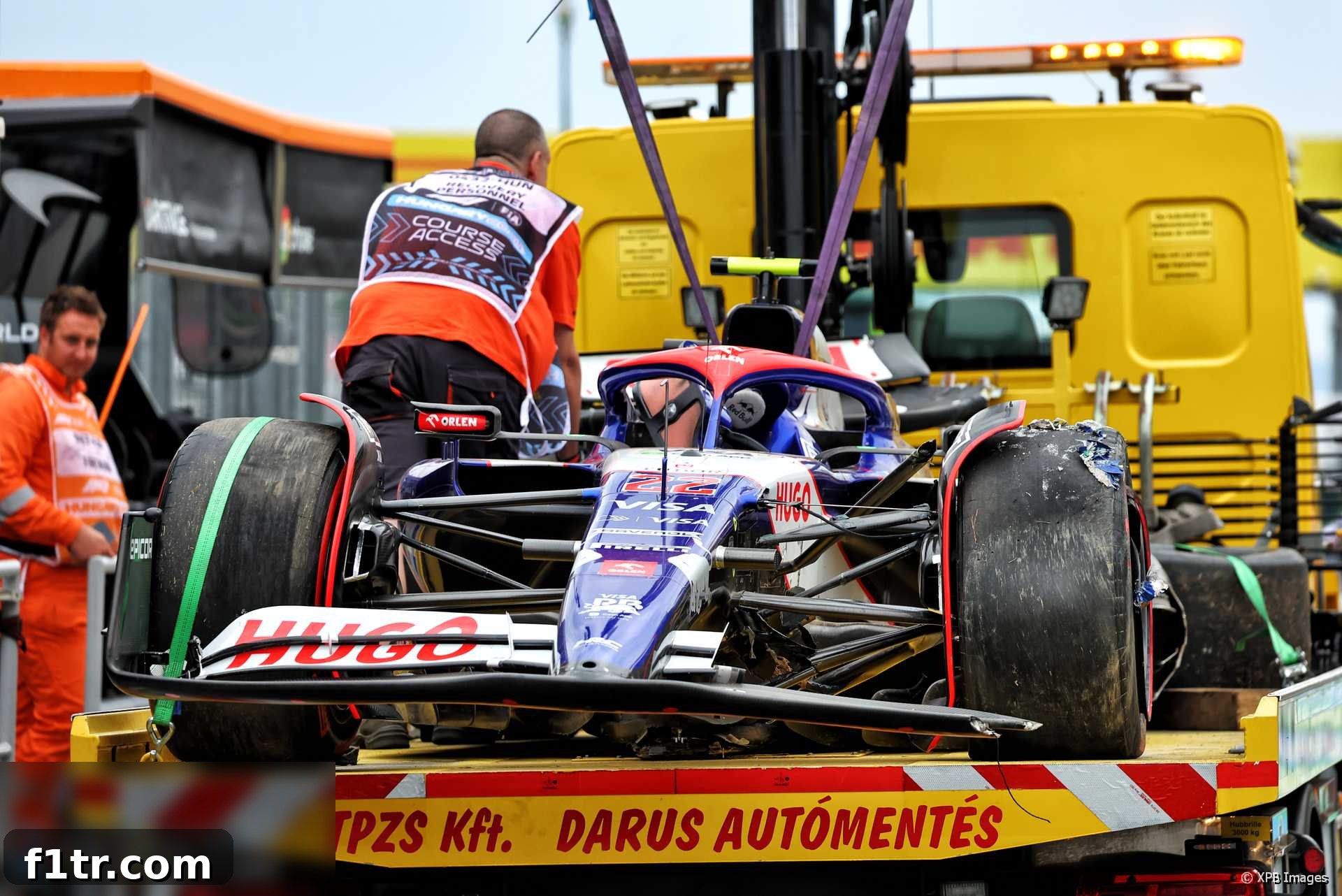
Yuki Tsunoda, the dynamic RB driver, faced a significant setback during the crucial Q3 session of the Hungarian Grand Prix qualifying, admitting deep concern over the substantial damage sustained to his car following a heavy crash. The incident, which brought out the red flag and added dramatic tension to the final moments of qualifying, now casts a shadow over his prospective tenth-place grid start, raising fears that he may be forced to commence the race from the pit lane.
The high-stakes Q3 session, with just over two minutes remaining, saw Tsunoda pushing the limits on the challenging Hungaroring circuit. His lap, which had shown considerable promise, came to an abrupt and violent end at the exit of Turn 5. This particular corner has been a focal point of discussion due to the recent installation of a grass strip, intended to deter drivers from exceeding track limits. However, in a twist of irony, this deterrent became the catalyst for Tsunoda’s dramatic accident.
As the RB car ran wide, half of the tyre made contact with the grass strip. What followed was an unexpected and alarming sequence of events: Tsunoda’s car appeared to be launched into the air upon hitting the join between the freshly laid grass and the asphalt runoff. The sudden loss of control propelled the car into the outside barrier with considerable force, causing severe damage and immediately prompting the red flag, suspending the session and intensifying the already palpable pressure on the track.
Speaking to the official F1 channel immediately after the session, a visibly disappointed Tsunoda shared his immediate thoughts on the dramatic turn of events. “I didn’t expect it,” he confessed, still processing the speed and ferocity of the impact. He elaborated on his approach to the corner, stressing his intent: “I just ran wide there. I was comfortably within the track. I was on the limit, obviously, in Q3.” The “on the limit” declaration underscores the relentless pursuit of perfection required in the final qualifying stage, where even fractions of a second can dictate grid positions.
Tsunoda further detailed the contributing factors from his perspective, suggesting that the conditions might have played a role in exaggerating the incident. “Half of the tyre went on the grass, but with that kind of thing, it normally happens probably because it was wet, which kind of exaggerated it and I went wide.” While the track wasn’t explicitly wet, the possibility of localized dampness or a subtle change in surface grip could have contributed to the unexpected reaction from his car. He lamented the lost potential of the lap: “Until that corner – even Turn 5 – that lap was great. So it’s a big shame.” His frustration was palpable, knowing a strong grid position was within reach.
The suspension of Q3 created a tense wait before the session could resume for its final two minutes. During this brief, frenetic period, it was Tsunoda’s teammate, Daniel Ricciardo, who managed to improve his lap time at the chequered flag, subtly shifting the grid order. This improvement ultimately relegated Tsunoda to tenth place, a position he had earned through his earlier efforts but which now felt precarious given the state of his car. The immediate concern shifted from performance to reparability.
The severity of the impact and the extent of the damage to his RB car weigh heavily on Tsunoda’s mind. His post-qualifying comments revealed a deep sense of responsibility and worry for his team. “To be honest, I’m more worried more about the car rather than my body,” he stated, highlighting the physical toll on the machinery over any personal discomfort. This sentiment is common among drivers who understand the immense effort and resources invested by their teams. “So to be honest. Very big shame. I’m disappointed.”
The prospect of a pit lane start looms large. If the damage to his chassis, gearbox, or any critical components proves too extensive or requires parts that fall outside the parc fermé regulations, the team might be forced to undertake significant repairs that necessitate starting from the pit lane. This would be a major disadvantage, placing him at the very back of the field and significantly hindering his chances of scoring valuable championship points in the race. “I hope my car is good. Obviously I feel bad for the team. That lap was enough to probably be in a very good position,” he added, emphasizing the dual disappointment of a missed opportunity for a better grid slot and the burden placed on his dedicated mechanics.
The incident at the Hungarian Grand Prix qualifying serves as a stark reminder of the fine margins and unpredictable nature of Formula 1. The introduction of new track limit deterrents, while designed to improve consistency, can sometimes introduce unforeseen challenges, as evidenced by Tsunoda’s “launch” moment. Teams and drivers are constantly adapting to circuit changes, and moments like these underscore the ever-present risks involved in pushing cutting-edge machinery to its absolute limit.
For the RB team, this crash presents a significant challenge. The mechanics now face a race against time, working tirelessly through the night to assess and repair the extensive damage. Such repairs are not just a logistical headache but also carry financial implications, as components like the chassis, suspension, and aerodynamic elements can be incredibly expensive. The hope is that the damage is primarily cosmetic or to easily replaceable parts, allowing Tsunoda to start from his hard-earned tenth position.
A pit lane start would dramatically alter Yuki Tsunoda’s race strategy and objectives. Starting from P10 offers a genuine opportunity to fight for points, potentially even challenging for higher positions if race conditions align. However, beginning from the pit lane means an uphill battle, requiring exceptional pace, astute strategy, and perhaps a touch of luck to climb through the field. Overtaking at the Hungaroring, while possible, is notoriously difficult, making a strong starting position even more critical.
This incident also places a spotlight on Tsunoda’s overall season performance. The young Japanese driver has shown flashes of brilliance and consistency, but high-profile incidents like this can inevitably draw scrutiny. Maintaining composure and delivering strong results under pressure are key attributes for securing a long-term future in Formula 1. How he recovers from this setback and performs in the race, regardless of his starting position, will be closely watched by the team and the broader F1 community.
Ultimately, the drama of Q3 in Hungary underscores the relentless pursuit of performance in Formula 1. Every millisecond counts, every corner is a challenge, and every decision can have profound consequences. Yuki Tsunoda’s crash is a testament to the fine line between triumph and tribulation in the pinnacle of motorsport. The focus now shifts to the RB garage, where the monumental task of preparing his car for Sunday’s race has already begun. All eyes will be on whether he can line up on the grid in P10, or if his weekend will begin with the more daunting challenge of a pit lane start, fighting from the very back of the pack.