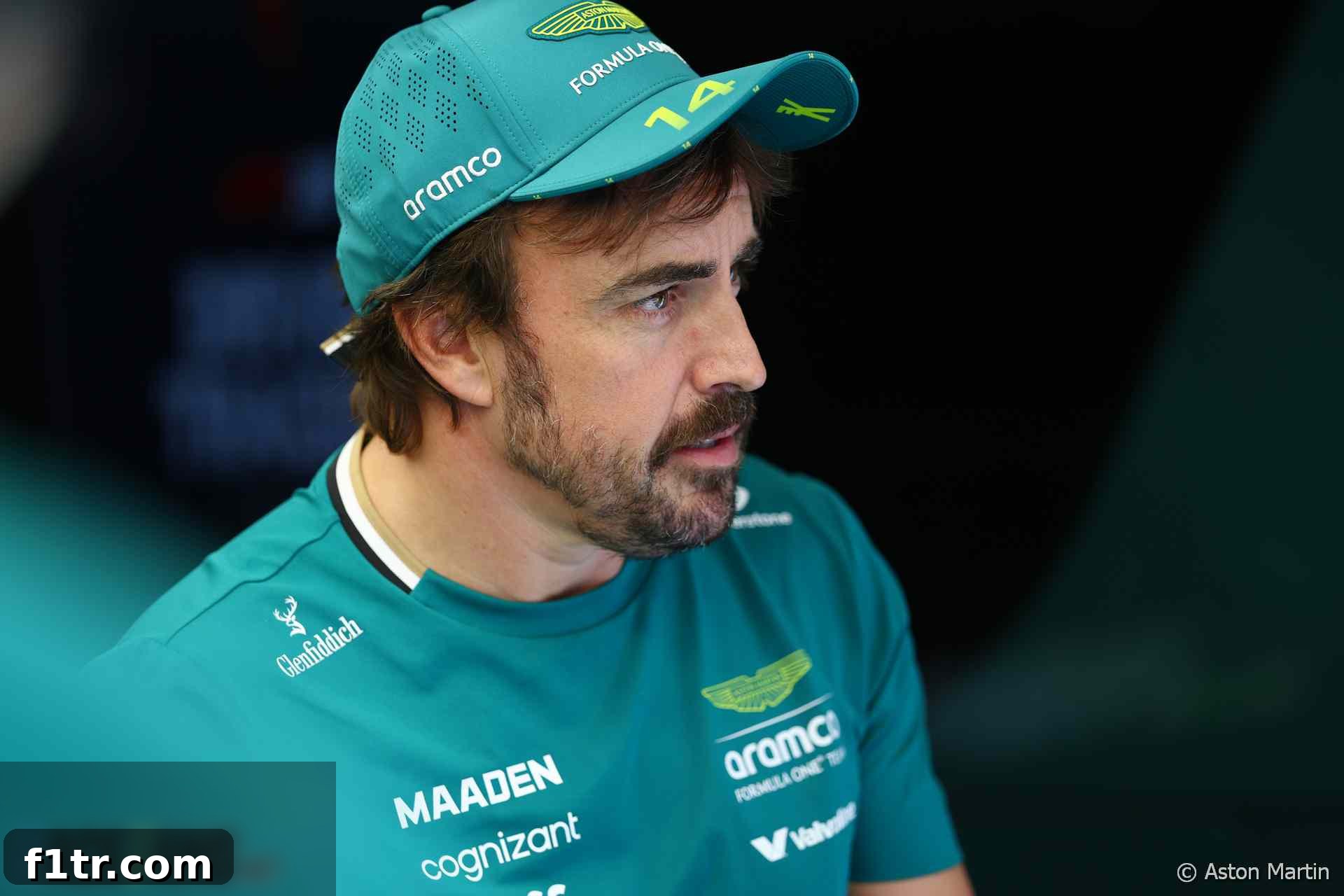
Fernando Alonso Sidelined from Hungarian GP FP1 Due to Back Injury; Felipe Drugovich Steps In for Aston Martin
Aston Martin has officially announced that two-time Formula 1 World Champion Fernando Alonso will not participate in the crucial first practice session (FP1) for the Hungarian Grand Prix. The seasoned Spaniard is currently managing a muscular back injury sustained in the days following the intense Belgian Grand Prix, prompting the team to exercise caution.
In a significant development for the team’s junior talent, reserve driver Felipe Drugovich will step into Alonso’s AMR24 for FP1 at the Hungaroring. While Drugovich will gain valuable track time, the team has confirmed that a final decision regarding Alonso’s participation in FP2, qualifying, and the remainder of the Hungarian Grand Prix weekend will be made in due course, pending his ongoing treatment and recovery.
Aston Martin’s Statement on Alonso’s Injury and Precautionary Measures
Aston Martin released a statement detailing the situation: “In the days following the Belgian Grand Prix, Fernando Alonso has been managing a muscular injury in his back. As he continues with treatment this morning, he has chosen to sit out of FP1 as a precautionary measure, allowing him maximum opportunity to recover for the rest of the weekend.”
The statement continued, confirming the immediate replacement: “Felipe Drugovich will drive in FP1 alongside Lance Stroll. A decision will then be made on Fernando’s participation in FP2 and the remainder of the weekend in due course.” This proactive approach underscores the team’s commitment to driver welfare, especially for a veteran like Alonso whose experience is invaluable, but whose physical condition must take precedence.
Felipe Drugovich’s Role: A Second FP1 Appearance This Season
This marks Felipe Drugovich’s second outing in an Aston Martin F1 car during an FP1 session this year. The reigning 2022 Formula 2 champion previously took the wheel of Alonso’s car during the Bahrain Grand Prix weekend. That earlier appearance was part of Formula 1’s mandatory requirement for teams to run “inexperienced drivers” in at least two FP1 sessions per car over the course of the season, fulfilling one of Aston Martin’s four required junior driver runs.
However, the circumstances surrounding Drugovich’s participation in Hungary are different. Unlike his Bahrain stint, this latest appearance will not count towards Aston Martin’s junior driver obligations. This distinction arises from a specific F1 regulation which states: “Each competitor must advise the FIA in writing seven days prior to the start of the relevant competition with the details of the driver that they will use.” Due to the sudden nature of Alonso’s injury, Aston Martin was understandably unable to provide the FIA with the requisite seven days’ notice for Drugovich’s substitution. This highlights the strict protocols governing driver changes and the meticulous planning required for fulfilling junior driver mandates.
Understanding F1’s Junior Driver and Substitution Regulations
Formula 1’s regulations regarding junior driver participation in practice sessions are designed to provide opportunities for promising young talents to gain crucial experience in current F1 machinery. Each team is mandated to run a driver who has not competed in more than two F1 Grand Prix races in at least two FP1 sessions per car throughout the season, totaling four sessions for a two-car team. This rule serves as a vital bridge between junior categories and the pinnacle of motorsport, allowing teams to assess potential future stars and develop their skills on the grandest stage.
The “seven-day notice” clause for these mandated junior driver runs ensures that the FIA has adequate time to verify the eligibility of the nominated driver and to maintain the sporting integrity of the championship. When a substitution occurs due to unforeseen circumstances, such as a driver injury, this specific notice period often cannot be met, thus rendering the session ineligible for counting towards the junior driver quota. This scenario for Drugovich underscores the practical challenges teams face when unexpected events disrupt their meticulously planned schedules.
Beyond junior driver runs, F1 also has clear rules on general driver substitutions. If Alonso’s back injury proves more persistent and requires extended recovery time, Aston Martin does have the option to substitute him again for FP2 and FP3. These changes are permissible before qualifying. However, once a driver has taken part in a qualifying session, they cannot be substituted for the remainder of that Grand Prix event. This regulation ensures consistency and fairness during the critical stages of the race weekend, preventing teams from making strategic changes post-qualifying.
The Impact of Missing FP1: Strategy and Performance at the Hungaroring
Missing FP1, while not ideal, is a calculated risk for Aston Martin and Fernando Alonso. FP1 is crucial for drivers to familiarize themselves with the track conditions, test different car setups, and gather initial data ahead of qualifying and the race. For a demanding circuit like the Hungaroring, often dubbed “Monaco without walls” due to its tight, twisty, and physically taxing nature, every minute of track time is valuable.
Alonso, renowned for his meticulous approach to car setup and his ability to extract maximum performance, will certainly feel the absence of FP1. However, his vast experience and innate talent mean he can often adapt quickly even with limited running. The team will rely heavily on Lance Stroll’s data from FP1, alongside simulations and engineering expertise, to provide Alonso with a solid baseline setup for FP2. The primary concern remains Alonso’s physical well-being; pushing through a back injury could have long-term consequences and hinder his performance in the crucial qualifying and race sessions.
Aston Martin’s decision reflects a priority on Alonso’s health, hoping that sacrificing FP1 will allow him to be fully fit and competitive for the rest of the weekend. With the Constructors’ Championship battle being incredibly tight, particularly in the midfield, every point counts. Losing their star driver for a significant portion of the weekend would be a severe blow to their ambitions.
The Broader Significance of Reserve Drivers in Modern F1
The situation with Fernando Alonso and Felipe Drugovich highlights the ever-increasing importance of strong reserve driver programs in Formula 1. In an era of intense competition, demanding physical challenges, and stringent health and safety protocols, having a capable and race-ready reserve driver is not merely a formality but a strategic necessity. Drugovich’s swift integration into the FP1 session demonstrates Aston Martin’s preparedness and the depth of talent within their driver development program.
Reserve drivers like Drugovich are often tasked with extensive simulator work, providing valuable feedback to the engineering teams, and are constantly on standby to step in at a moment’s notice. Their ability to quickly adapt to the car and track conditions, even under pressure, is paramount. Drugovich, as an F2 champion, brings a high level of professionalism and skill, making him an ideal choice for such a critical substitution. These opportunities, even if not counting towards official junior driver quotas, are invaluable for a young driver’s career progression, offering direct experience with an F1 car in a competitive environment.
F1 Teams’ Junior Practice Drivers in 2025
Teams extensively utilize their junior driver rosters to fulfill obligations and provide vital experience. The following table showcases some of the junior drivers deployed by various F1 teams to complete their requirement to give practice opportunities to inexperienced racers, highlighting the pipeline of talent within the sport:
| Team | Car | Event | Practice driver | Event | Practice driver |
|---|---|---|---|---|---|
| McLaren | 4 | Austrian Grand Prix | Alex Dunne | Mexican Grand Prix | Pato O’Ward (car TBC) |
| 81 | |||||
| Ferrari | 16 | Bahrain Grand Prix | Dino Beganovic | Austrian Grand Prix | Dino Beganovic |
| 44 | |||||
| Red Bull | 1 | Bahrain Grand Prix | Ayumu Iwasa | ||
| 22/30 | British Grand Prix | Arvid Lindblad | |||
| Mercedes | 12 | Australian Grand Prix | Andrea Kimi Antonelli | Chinese Grand Prix | Andrea Kimi Antonelli |
| 63 | Bahrain Grand Prix | Frederik Vesti | |||
| Aston Martin | 14 | Bahrain Grand Prix | Felipe Drugovich | ||
| 18 | |||||
| Alpine | 7/43 | Australian Grand Prix | Jack Doohan | Chinese Grand Prix | Jack Doohan |
| 10 | |||||
| Haas | 31 | Spanish Grand Prix | Ryo Hirakawa | Mexican Grand Prix | Ryo Hirakawa |
| 87 | Bahrain Grand Prix | Ryo Hirakawa | Abu Dhabi Grand Prix | Ryo Hirakawa | |
| Racing Bulls | 6 | Australian Grand Prix | Isack Hadjar | Chinese Grand Prix | Isack Hadjar |
| 30/22 | |||||
| Williams | 23 | Spanish Grand Prix | Victor Martins | ||
| 55 | Bahrain Grand Prix | Luke Browning | |||
| Sauber | 5 | Australian Grand Prix | Gabriel Bortoleto | Chinese Grand Prix | Gabriel Bortoleto |
| 27 | British Grand Prix | Paul Aron | Hungarian Grand Prix | Paul Aron |
Further Reading on the 2025 Hungarian Grand Prix
Stay updated with all the developments and discussions surrounding the Hungarian Grand Prix weekend by exploring our related articles:
- Leclerc admits problem which struck Ferrari in Hungary is likely to recur
- Permane impressed by Lawson’s progress after “breakthrough” in Austria
- Albon expects “dogfight” as Williams aim to hold fifth place
- Mercedes eye more wins post-break after dropping revised rear suspension
- McLaren pair equal Senna and Prost’s run in second-fastest ever Hungarian GP
Browse all 2025 Hungarian Grand Prix articles