The Suzuka Showdown: Leclerc and Magnussen’s Controversial Clash at the 2018 Japanese Grand Prix
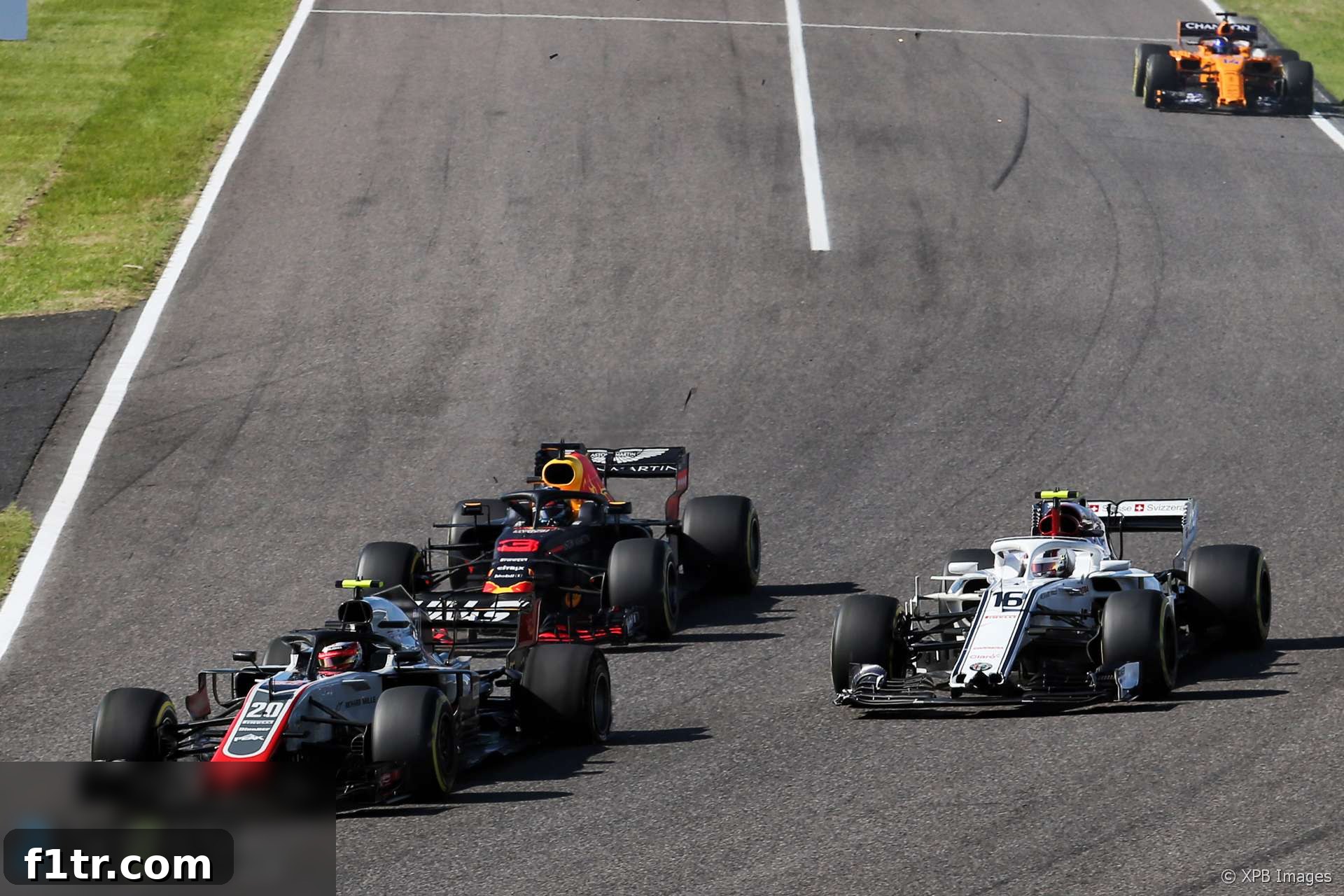
The 2018 Formula 1 Japanese Grand Prix delivered its usual blend of high-speed drama and tactical intrigue, but one particular incident ignited a fiery debate between drivers, stewards, and fans alike. A dramatic collision between then-Sauber driver Charles Leclerc and Haas’s Kevin Magnussen on the main straight at Suzuka left Magnussen out of the race and Leclerc questioning the very rules of engagement in Formula 1. The incident, which occurred early in the race, brought into sharp focus the complex regulations surrounding defensive driving and blocking maneuvers, prompting calls for greater clarity from the sport’s governing body.
An Unfolding Drama: The Collision on the Main Straight
The incident unfolded with breathtaking speed as the cars powered down the iconic Suzuka start/finish straight. Leclerc, driving for Sauber, was attempting to overtake Kevin Magnussen, who was defending his position. As Leclerc pulled out to the right to make his move, Magnussen also moved across the track. The cars made contact, a glancing blow that had severe consequences for the Haas driver. The impact resulted in a left-rear puncture for Magnussen, and the ensuing damage to his car, particularly the floor, was significant enough to force him to retire from the race. For Leclerc, while his car was able to continue, the event sparked a deeper frustration regarding the consistency of stewarding decisions.
The collision was more than just a racing incident; it was a flashpoint that highlighted the fine line between aggressive defense and illegal blocking. Both drivers were pushing hard, as is expected in Formula 1, but the interpretation of their actions post-race would become the subject of intense scrutiny.
Charles Leclerc’s Perspective: A Plea for Consistency
Following the race, a visibly frustrated Charles Leclerc expressed his surprise that Kevin Magnussen’s defensive move was allowed to stand without penalty. For Leclerc, the incident bore a striking resemblance to a controversial event from the 2016 Belgian Grand Prix involving Max Verstappen and Kimi Räikkönen. In that instance, Verstappen had been criticized for moving late and aggressively while defending, a maneuver that many, including Leclerc, believed had subsequently been deemed impermissible.
“For me there was a similar situation with Kimi or Max one or two years ago in Spa where Max moved at the really last moment and everyone really agreed that it was dangerous really to do that and it was not allowed anymore,” Leclerc recounted to the media. His bewilderment was palpable: “Strangely it has been expected today. I will have to get some response on that to just know what I can do in the car.”
Leclerc’s comments underscored a common sentiment among drivers: the need for clear, consistent application of the rules. When precedents are set, drivers expect those precedents to guide future decisions. The perceived inconsistency in this case left Leclerc, a rising star in the sport, questioning the boundaries within which he could operate on track, potentially impacting his future defensive and offensive strategies.
The Official Verdict: Charlie Whiting’s Detailed Analysis
Despite Leclerc’s concerns, the FIA race director at the time, Charlie Whiting, offered a different interpretation based on the evidence reviewed by the stewards. Whiting’s analysis painted a nuanced picture, suggesting that Magnussen’s move was not a direct reaction to Leclerc pulling out to overtake, but rather a nearly simultaneous decision that resulted in the unfortunate contact.
Whiting explained the intricate timing involved: “If you analyse it very, very carefully what you see is two cars coming down with Kevin not moving and then Charles catches, catches, catches. He decides to go to the right at exactly the same time – on the video there’s one frame difference and then Kevin moves. So I think it’s impossible to say that Kevin blocked him, it was just that he’d made the decision that he was going to go right fractionally after Charles had.”
This “one frame difference” was crucial to the stewards’ understanding. It implied that Magnussen’s move was not a reactive block intended to impede Leclerc after he had already committed to a line, but rather a pre-emptive or coincident change of direction. In the high-speed, split-second world of Formula 1, such marginal differences in timing can completely alter the interpretation of an incident. Whiting emphasized the need for a meticulous review to fully grasp the situation: “You have to look at it quite a few times and analyse it in a little the detail to see that but I think it was just unfortunate and that’s what the stewards felt.”
The Precedent: Verstappen vs. Räikkönen at Spa 2016
Leclerc’s reference to the Max Verstappen and Kimi Räikkönen incident at the 2016 Belgian Grand Prix is significant, as it was a pivotal moment in the discussion of defensive driving rules in modern F1. During that race, Verstappen, then a teenager, employed aggressive defensive tactics, particularly moving late under braking, to hold off Räikkönen. These maneuvers were widely criticized for being dangerous and for setting a potentially perilous precedent.
The controversy surrounding Verstappen’s driving at Spa led to an informal clarification from the FIA, reinforcing the “one move” rule and specifically advising against moving in the braking zone to defend a position. This guideline was intended to enhance safety and prevent late, unpredictable changes of direction that could lead to high-speed collisions. The spirit of this clarification was that drivers should not be able to react to an overtaking attempt by moving into the path of the following car once the attacking car has committed to a specific line, especially at high speeds.
The contrast between the two incidents, as seen by the stewards, lay in the timing and intent. While Verstappen’s moves were perceived as reactive and dangerously late, Magnussen’s movement was deemed to be part of his original defensive line, even if it coincided with Leclerc’s decision to move right. This subtle distinction underpinned the stewards’ final decision in Japan.
The Stewards’ Ruling: A “Racing Incident”
Ultimately, the stewards concluded that the collision between Magnussen and Leclerc was a “racing incident” and took no action against either driver. This classification is frequently used in motorsport when an incident is deemed to be a consequence of two drivers racing hard and fairly, rather than a deliberate or negligent act by one party. It signifies that no single driver was solely or primarily to blame for the contact, and therefore, no penalty was warranted.
The “racing incident” ruling, while often frustrating for drivers who feel wronged, reflects the inherent challenges of close-quarters racing. In a sport where cars travel at immense speeds and drivers make split-second decisions, contact is sometimes unavoidable. The stewards’ role is not merely to assign blame but to determine if any rule violation occurred that warrants a penalty, considering factors like intent, timing, and the specific circumstances of the track and race.
Implications for Defensive Driving in Formula 1
The Suzuka incident served as another reminder of the continuous evolution and interpretation of Formula 1’s sporting regulations, particularly concerning defensive driving. The “one move” rule, which dictates that a driver can make only one defensive move to block an opponent, remains a cornerstone. However, the precise application of this rule in the heat of battle, especially regarding the timing of moves and the assessment of intent, continues to be a complex area.
Drivers constantly push the boundaries, seeking every possible advantage, and it is up to the FIA and its stewards to ensure fair play and, most importantly, safety. Incidents like the one involving Leclerc and Magnussen, while resolved without penalty, contribute to the ongoing dialogue about how best to balance aggressive racing with clear, enforceable rules. For young drivers like Charles Leclerc, understanding these nuances is crucial as they hone their racecraft and push for success at the pinnacle of motorsport.
The 2018 Japanese Grand Prix provided a compelling snapshot of the intricate dance between drivers and regulations. While the immediate outcome was a “racing incident,” the detailed analysis by Charlie Whiting and the drivers’ reactions underscored the ever-present need for clarity in Formula 1’s rulebook, ensuring that the spectacle of racing remains both thrilling and fair.
2018 F1 season
- F1 feared “death knell” for Drive to Survive after Ferrari and Mercedes snub
- McLaren staff told us we were “totally crazy” to take Honda engines in 2018 – Tost
- ‘It doesn’t matter if we start last’: How Red Bull’s junior team aided Honda’s leap forward
- Honda’s jet division helped F1 engineers solve power unit problem
- McLaren Racing losses rise after Honda split
Browse all 2018 F1 season articles