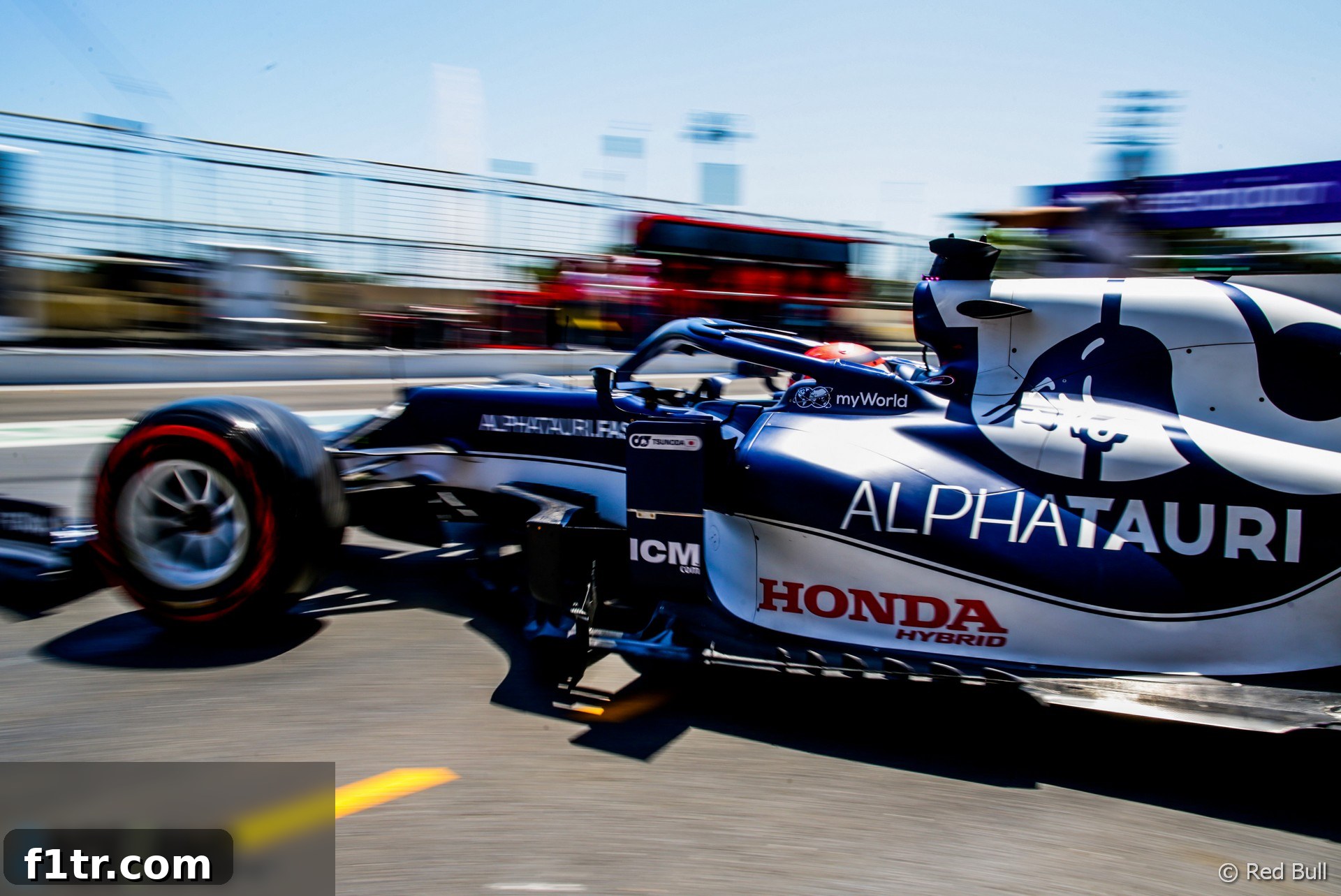
AlphaTauri Team Principal Franz Tost has offered a candid assessment of Yuki Tsunoda’s development, emphasizing the young driver’s need to master the art of recognizing his limits on track. Despite this crucial learning curve, Tost expressed considerable praise for the rookie’s significant progress, particularly after Tsunoda secured his maiden Q3 appearance in Formula 1.
The incident that brought Tsunoda’s qualifying session to an abrupt end occurred during his second flying lap in Q3 at the Azerbaijan Grand Prix, where he unfortunately crashed at Turn 3. Prior to this, Tsunoda had impressively qualified in eighth place, a position that ultimately translated to seventh on the grid following a penalty for Lando Norris. This strong showing marked AlphaTauri’s most competitive qualifying performance of the season, yet it was overshadowed by the subsequent accident, which Tost highlighted as a key area for the Japanese driver’s ongoing development.
Advert | Become a Supporter & go ad-free
Understanding the Edge: Tsunoda’s Learning Curve
“Yuki, I must say, from Friday onwards, showed all the time an improvement and went faster and faster,” Tost remarked, acknowledging the steady upward trajectory of Tsunoda’s performance throughout the weekend. “His Q2 time was really very fast and he was also there in Q3. On his last run, he pushed too much and braked too late. He has to learn to recognise when he’s on the limit.”
This statement encapsulates a fundamental challenge for all aspiring F1 drivers: finding the razor-thin line between ultimate speed and an inevitable error. In a sport where milliseconds separate triumph from disappointment, the ability to consistently operate at the absolute peak of the car’s performance envelope, without overstepping, is paramount. Tost elaborated on this delicate balance: “If you are within the same tenths as other top drivers, then there’s not so much space anymore to be faster. You must recognise as a driver, ‘I can’t brake later. I can’t push harder’.” This cognitive awareness, the instant decision-making under immense pressure, is a skill that only comes with experience and a deep understanding of both the car and the track conditions.
Despite the Q3 mishap, Tost remained overwhelmingly optimistic about Tsunoda’s future. He views the incident as an integral part of a larger developmental process. “But once more, this is a kind of a learning process. And I must say that during this weekend he already made a big step forward in understanding the car and also from the technical feedback side. Therefore, I’m quite positive that we will get him in the right way because he has an unbelievable natural speed.” This “unbelievable natural speed” is precisely why AlphaTauri, and by extension the Red Bull junior program, has invested so heavily in Tsunoda. It’s a raw talent that needs careful honing, and moments like the Baku crash, while frustrating, offer invaluable lessons.
The Rookie Journey: Navigating F1’s Demands
Tsunoda’s brief Formula 1 career has been a rollercoaster of exhilarating highs and challenging lows. He has demonstrated undeniable flashes of strong pace, proving his potential to compete at the highest level. However, these moments have been interspersed with frustrating race weekends, a common narrative for many rookies adapting to the pinnacle of motorsport. Tost, himself a seasoned observer of young talent, understands that development takes time and experience, especially for the sport’s youngest driver.
“From the beginning of the season, we must not forget there were a couple of race tracks which he didn’t know,” Tost explained, highlighting one of the significant hurdles faced by new entrants to F1. Unlike seasoned veterans who have hundreds of laps under their belt at various circuits, rookies are often encountering many tracks for the very first time in an F1 car, adding another layer of complexity to an already demanding sport. “It was the first time in Portimao, for example, and in Portimao, we simply didn’t get the most out of our car from the set-up side and so on.” This speaks to the broader team effort required; a driver’s performance isn’t just about their skill, but also about the team providing an optimal setup for unfamiliar conditions.
Furthermore, external factors can play a role, as Tost recalled: “And then in Barcelona he had a technical failure – he could have scored points there, but it was not his fault.” Such instances, while out of the driver’s control, can hinder momentum and mask true performance. However, Tost noted Tsunoda’s resilience and adaptability: “But he’s learning and here in Baku – we all know it’s a difficult racetrack, it’s not so easy – and until the third qualifying, he was really on a good level and showed good pace.” Baku, with its unique blend of tight street sections and high-speed straights, is notoriously challenging, making Tsunoda’s initial performance all the more impressive.
Learning from Mistakes: The Imola vs. Baku Perspective
The AlphaTauri team principal drew a clear distinction between different types of incidents, emphasizing the varying degrees of “cleverness” a driver must acquire. “You never should crash, but to crash in Q3 is one story,” Tost mused, implying that a Q3 crash, while not ideal, can be understood in the context of pushing for the absolute maximum at a critical moment. Drivers are expected to extract every ounce of performance when vying for top grid positions, and sometimes, that comes with an inherent risk. The fine margin between a pole position lap and a crash in Q3 is a testament to the extreme demands placed on drivers.
However, Tost’s criticism was sharper regarding an earlier incident: “What I didn’t like was the crash in Q1 in the first run in Imola, because with such a competitive car, you don’t do this. But that’s the cleverness he has to learn.” Crashing early in Q1, especially in a car capable of easily progressing, demonstrates a lack of strategic thinking and risk management. In such scenarios, the primary goal is to safely set a competitive lap time to advance, not to chase the absolute ultimate pace from the outset. This distinction is crucial for rookie development: understanding *when* to take risks and *when* to prioritize a clean, safe lap. This “cleverness,” as Tost calls it, is not merely about raw speed but about intelligent racing.
“And this cleverness runs in parallel with the experience. You can’t expect that a young driver knows everything,” Tost concluded, perfectly encapsulating the AlphaTauri philosophy. They understand that patience, mentorship, and opportunities to learn from mistakes are essential. Tsunoda is not just being evaluated on his lap times, but on his holistic development as a Formula 1 driver, which includes maturity, race craft, and the mental fortitude to manage pressure and risk.
Advert | Become a RaceFans supporter andgo ad-free
The Path Forward for Yuki Tsunoda
Yuki Tsunoda represents the future generation of Formula 1 talent, and his journey, while still in its nascent stages, is under intense scrutiny. His performances thus far confirm his immense raw talent, characterized by blistering speed and an aggressive driving style. However, the comments from Franz Tost serve as a vital reminder that F1 is as much a mental game as it is a physical one, demanding precision, discipline, and strategic thinking alongside outright pace.
AlphaTauri, as a dedicated proving ground for Red Bull’s young drivers, is perfectly positioned to guide Tsunoda through these crucial developmental phases. The team’s commitment, coupled with Tsunoda’s evident willingness to learn and adapt, paints a promising picture for his future in the sport. While crashes and mistakes are inevitable rites of passage for many rookies, the key lies in how effectively these experiences are integrated into a driver’s learning process. For Tsunoda, the Q3 incident in Baku, far from being a setback, has been framed by his team principal as another vital lesson in his ongoing education as a top-tier racing driver. His ultimate success will hinge on his ability to harness his natural speed with the strategic intelligence and measured aggression that defines a true Formula 1 champion.
2021 Azerbaijan Grand Prix: Further Insights
- Aston Martin also confirms it followed Pirelli’s tyre restrictions before crash
- Pirelli confirm teams not to blame for Baku tyre failures following investigation
- “Tyres should not explode like that” says Villeneuve as Pirelli prepares to reveal findings
- Why Alonso is able to enjoy F1 more now than when he left
- Penalty for Safety Car error was just one of Latifi’s frustrations in Baku
Browse all 2021 Azerbaijan Grand Prix articles