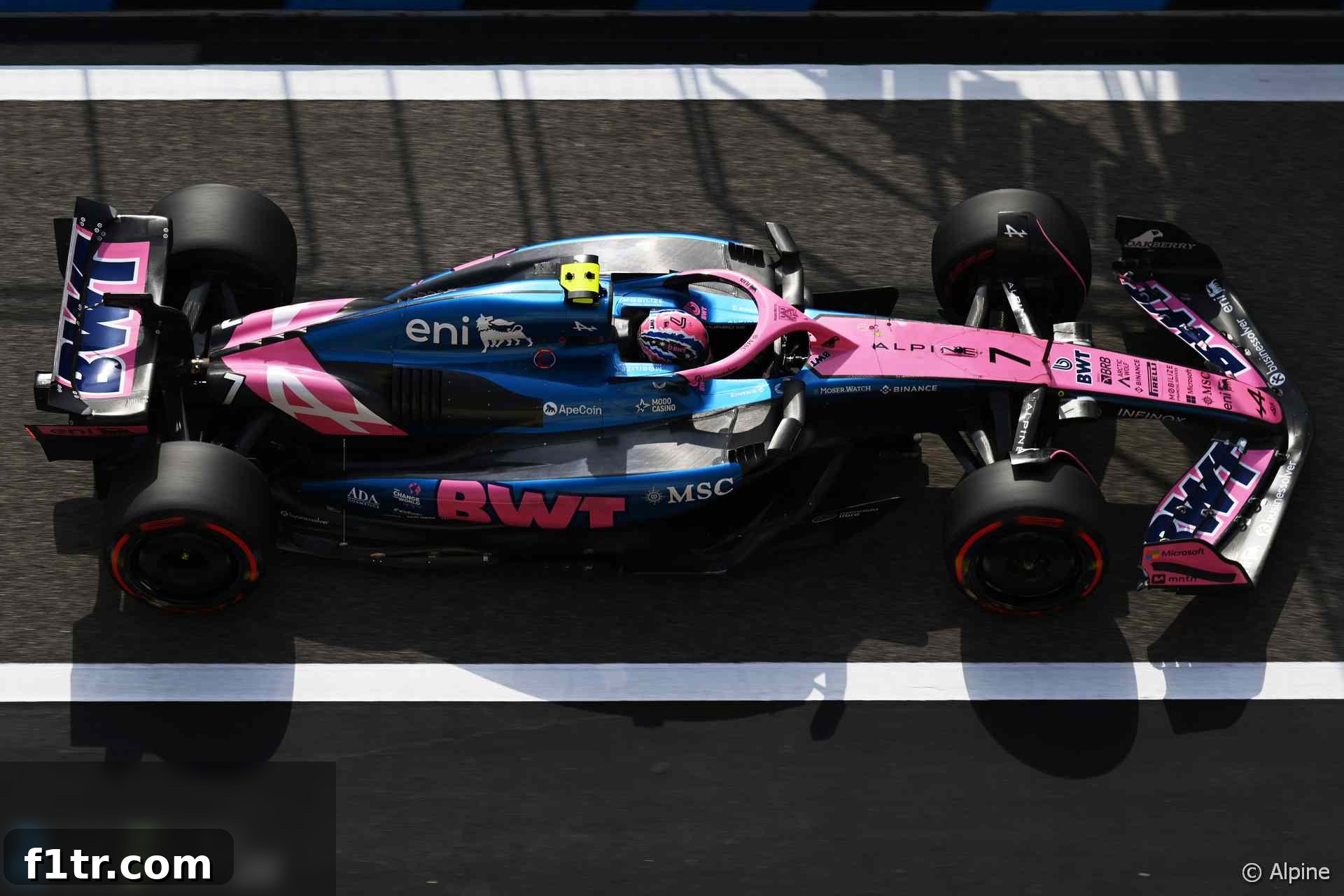
In the high-stakes world of Formula 1, news often breaks with a predictable inevitability, a cliché that perfectly encapsulates the recent announcement from Alpine. The team has confirmed that Argentine talent Franco Colapinto will step into the cockpit, replacing Australian driver Jack Doohan from the upcoming Grand Prix in Imola. While perhaps “not a surprise” to keen observers of the F1 paddock, this move signifies a pivotal moment for all parties involved, stirring considerable debate about driver development, team strategy, and the cutthroat nature of top-tier motorsport.
The murmurs surrounding Doohan’s future began long before his brief stint with Alpine even concluded. Speculation intensified with the return of Flavio Briatore to Formula 1 as a consultant for Alpine in the middle of last year. Briatore, a figure known for his keen eye for talent and often controversial influence, was widely believed to be a strong advocate for Colapinto. This perceived favoritism cast a shadow over Doohan’s position, creating an environment of uncertainty that is rarely conducive to a young driver’s performance. The final, almost comical, confirmation came when one of Colapinto’s sponsors inadvertently let slip his impending Imola debut during an interview for an Argentinian news channel last week. Despite initial denials from the team, Alpine officially confirmed the switch this morning, with Colapinto set to take over Doohan’s seat for at least the next five rounds of the championship.
Doohan’s departure marks another chapter in the ruthless narrative of Formula 1, where driver seats are among the most coveted and precarious positions in professional sports. He is not the first driver to face such a fate this year; Liam Lawson, for instance, experienced a similar exit from his sister squad, albeit with a fortunate parachute landing at Racing Bulls. This raises critical questions: Was Jack Doohan’s performance genuinely below expectations, thereby justifying Alpine’s decision? Or was he a victim of circumstances, including external pressures and a lack of sustained faith from his team? Furthermore, is Franco Colapinto the prodigious talent Alpine believes him to be, capable of immediately delivering the results that Alpine seeks, or is this a gamble driven by more than just raw pace?
Assessing the Change: Arguments For and Against
The decision to replace a driver mid-season is rarely taken lightly, reflecting a deep conviction from the team’s management, or perhaps, a significant amount of pressure. Alpine’s choice to promote Colapinto over Doohan can be viewed through several lenses, each offering a distinct perspective on the fairness and wisdom of the move.
Arguments For the Change: Why Colapinto Over Doohan?
From Alpine’s perspective, the case for replacing Doohan primarily hinges on his on-track performance during his inaugural races. In his seven races since debuting for Alpine at Yas Marina last year, Jack Doohan demonstrably struggled to distinguish himself from the competitive midfield. A key metric for any F1 driver is consistency and the ability to convert opportunities into points. Unfortunately for Doohan, a series of incidents and a failure to score a single championship point painted a challenging picture. His tenure was marred by too many crashes, often at critical junctures, which not only hindered his progress but also proved costly for the team.
Conversely, Franco Colapinto’s trajectory in Formula 2 last year offered a compelling argument for his immediate readiness. He showcased a rapid adaptation to the demands of a high-level single-seater series, demonstrating that it is not unrealistic to expect a driver promoted from Formula 2 to be competitive immediately. While not entirely error-free, Colapinto consistently proved to be a much closer match for his more experienced teammates, demonstrating a raw pace and race craft that Doohan, perhaps unfairly, has yet to consistently display at the pinnacle of motorsport. After a similar number of competitive appearances in their respective series, Colapinto appeared to be the more promising prospect with a higher ceiling for immediate impact. Therefore, from a purely performance-driven standpoint, this was a tough but potentially fair call by Alpine to seek an immediate performance uplift.
Arguments Against the Change: Doohan Deserved More
However, the narrative is far from one-sided. Many would argue that Jack Doohan was not afforded a fair chance to fully prove his capabilities. During his relatively short spell at Alpine, Doohan showed tangible signs of progress, indicating that he was on a steep learning curve. His lap time deficit to seasoned teammate Pierre Gasly was often respectable for a rookie, particularly when considering the extremely close nature of the F1 midfield. While this closeness exaggerated the gap in terms of track positions, his underlying pace was developing. Notably, he even managed to qualify ahead of his teammate last week, a significant milestone for any rookie and a clear indicator of improving form and confidence. To cut short his season immediately after such a performance feels particularly harsh.
Moreover, the argument that Colapinto is inherently less crash-prone than Doohan doesn’t entirely hold water. Colapinto himself proved no less susceptible to incidents during his time with Williams last year, demonstrating that young drivers, regardless of their talent, often go through a learning phase riddled with mistakes. Critics also point to external factors influencing this decision. It appears that Colapinto’s drive at Alpine is partly, if not significantly, thanks to the substantial sponsorship he brings to the team. In an era where commercial considerations often intertwine with sporting merit, this aspect cannot be overlooked. Ultimately, many believe Doohan deserved the stability of a full season to genuinely prove himself and demonstrate his potential, a fair chance that Alpine, regrettably, did not grant him.
The Author’s Perspective: A Question of Faith and Strategy
It’s easy to empathize with Jack Doohan. The life of a Formula 1 hopeful is incredibly demanding, and being unceremoniously dropped mid-season is a blow to any aspiring champion. However, a dispassionate review of his initial F1 outings reveals performances that, while showing flashes of potential, weren’t consistently impressive. He crashed out on the first lap last weekend in Miami, mirroring a similar incident at his home race just two months prior. He tangled with rivals in China and squandered a genuine chance to score points in Bahrain, incidents that collectively prevented him from building momentum. This pattern of errors and missed opportunities contributed to him being tied at the bottom of RaceFans’ driver ratings with the only other driver to lose his seat this year, Liam Lawson. From a purely results-oriented perspective, the numbers weren’t telling a compelling story for Doohan.
Yet, the team’s handling of the situation also deserves scrutiny. Alpine demonstrated a conspicuous lack of unwavering faith in Doohan, and it’s difficult to imagine that this constant pressure and perceived instability didn’t profoundly impact his performance. The writing seemed to be on the wall once they needlessly benched him for the first practice session at Suzuka, one of the most challenging and critical tracks on the calendar for a rookie to gain experience. Such decisions send a clear message to a driver, potentially undermining their confidence and focus at a crucial stage of their development.
Given the circumstances, judging whether Doohan truly deserved to retain his seat based solely on his on-track performances feels somewhat naive. Formula 1 is a complex sport, and young drivers require nurturing, consistent feedback, and, crucially, a stable environment to thrive. Any team serious about developing and running two competitive cars should be prepared to stand by the drivers they invest in for longer than a mere six rounds. If Doohan is now being deemed not up to the required standard, then Alpine’s management must critically ask themselves why they placed him in the car in the first place, and what their internal development pipeline truly signifies. This decision reflects not just on Doohan, but also on Alpine’s long-term strategy for cultivating and retaining talent.
The Broader F1 Context: Driver Development and Performance Pressure
The F1 driver market is a hyper-competitive arena where talent, funding, and opportunity must align perfectly. Driver academies, like Alpine’s, are designed to identify and groom future champions, but the transition from junior categories to Formula 1 is a monumental leap. Rookies face immense pressure not only to perform immediately but also to integrate seamlessly into a complex engineering environment and adapt to the unique demands of F1 machinery.
Jack Doohan, a product of the Alpine Academy and son of motorcycle racing legend Mick Doohan, arrived with significant expectations. His junior career showcased flashes of brilliance, making his F1 promotion a natural progression. However, the step up highlighted the gap between F2 and F1, where every millisecond and every decision carries far greater consequences. The constant comparisons, the unforgiving nature of the media, and the internal pressure from a team searching for performance can be overwhelming for even the most resilient individuals. His story is a poignant reminder of how quickly fortunes can change in F1, and how even promising talents can be caught in the churn of the driver market.
Franco Colapinto’s entry, championed by an influential figure like Flavio Briatore, adds another layer to this dynamic. Briatore’s history of identifying and managing top talents, from Michael Schumacher to Fernando Alonso, lends a certain weight to his backing. If Colapinto can immediately deliver on the promise Briatore sees in him, Alpine’s gamble might pay off. However, the pressure on Colapinto will be equally intense. He arrives with the added expectation of justifying the team’s mid-season change and Briatore’s endorsement, under the relentless scrutiny that accompanies every F1 debut.
This episode also spotlights the strategic dilemmas faced by F1 teams. Balancing long-term driver development with the immediate need for points and commercial stability is a perpetual challenge. Alpine, currently struggling in the Constructors’ Championship, is undoubtedly seeking any avenue to improve its standing. A driver change, even a controversial one, is a tangible action taken in pursuit of better results. Whether this specific change will yield the desired outcome for Alpine, or if it merely reshuffles the deckchairs on a struggling ship, remains to be seen as the season progresses. The coming races, starting with Imola, will be crucial in validating or questioning Alpine’s bold strategic move.
Your Voice: Have Alpine Made the Right Call?
The debate surrounding Alpine’s decision to replace Jack Doohan with Franco Colapinto is far from settled. Many fans feel a deep sympathy for Doohan, believing he was not given a sufficient opportunity to adapt and prove himself in the incredibly challenging environment of Formula 1. Others might argue that in such a competitive sport, performance demands are immediate, and a team cannot afford to wait indefinitely for a driver to hit their stride, especially when a promising alternative is available. This situation encapsulates the tough realities of F1, where careers can be made or broken in a handful of races.
We invite you to consider all sides of this complex issue. Do you believe Alpine made a justified decision based on Doohan’s performance and Colapinto’s potential? Or do you think Doohan was prematurely discarded, a casualty of F1’s relentless pressure and perhaps some internal team politics? Cast your vote below and share your informed opinions in the comments section. Your insights contribute to the vibrant discussion that defines the Formula 1 community.
Further Debates and Polls
- What must Formula 1 fix with its new rules – and what should it leave unchanged?
- ADUO: Do F1 teams who fall behind deserve to get help to catch up?
- F1 is considering doubling its sprint races. Do you want more or fewer?
- Will this be a fight or a rout? 20 questions for the 2026 Formula 1 season
- Which Formula 1 team has the best-looking car – and the worst – for the 2026 season?
Browse all debates and polls