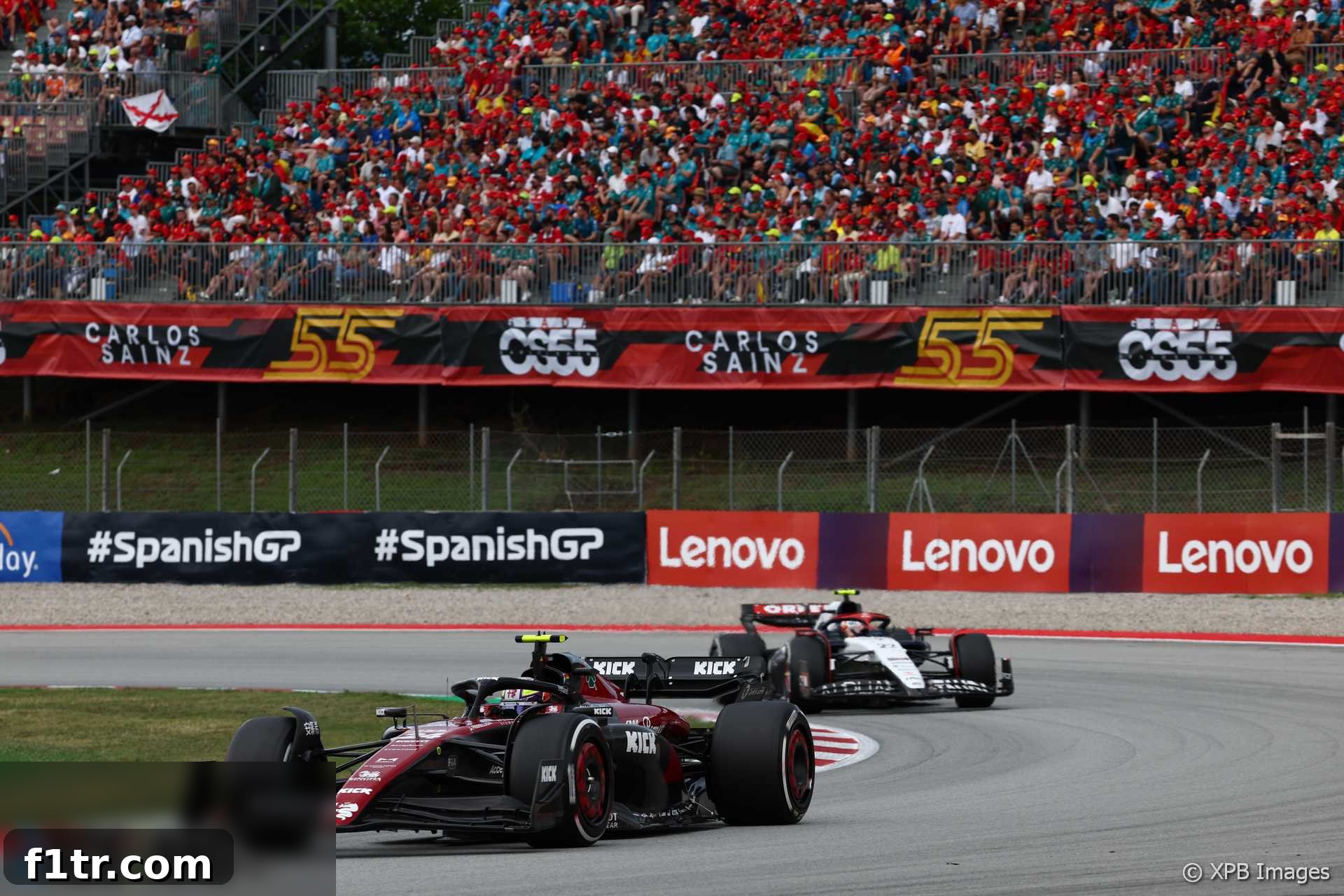
Yuki Tsunoda, the spirited AlphaTauri driver, voiced strong discontent following the Spanish Grand Prix, labeling a five-second time penalty as “unfair” and “ridiculous.” The controversial incident involved a battle with Alfa Romeo’s Guanyu Zhou at Turn 1 on Lap 56, a moment that sparked considerable debate within the F1 paddock and among fans.
The penalty, which ultimately relegated Tsunoda to P12 and out of the points, was issued by the FIA stewards after they concluded he had forced Zhou off the track during their wheel-to-wheel confrontation. However, Tsunoda vehemently disagreed with this assessment, arguing that his rival had exaggerated the extent of the contact to influence the stewards’ decision.
“It was a ridiculous penalty,” a visibly frustrated Tsunoda told media, including RaceFans, at the Circuit de Catalunya after the race. “It feels really unfair.” His comments immediately brought the incident under scrutiny, highlighting the persistent tension between drivers’ on-track perceptions and the stewards’ post-race analyses.
Tsunoda explained his perspective on the critical moment at Turn 1. As he held the inside line, defending his position against Zhou, he believed he had left sufficient space for the Alfa Romeo driver on the outside. His accusation centered on Zhou’s actions immediately after the maneuver.
“I left the room and I feel like he just gave it up early stages,” Tsunoda asserted. “He went outside and pretended like he got forced out. But definitely, there was still space outside there. Obviously, I gave pressure, but there’s still space behind me. So, I don’t understand why there’s a penalty. Feels really harsh.” This statement underscores a common dilemma in Formula 1 racing: the fine line between aggressive, hard racing and exceeding track limits or forcing a competitor off the track. Tsunoda felt he was merely applying legitimate pressure, forcing Zhou to take a wider line, which is a standard racing tactic.
Another point of contention for Tsunoda was the timing and process of the penalty notification. The decision was announced before the race concluded, a practice that often leaves drivers and teams frustrated, as it denies them the opportunity for immediate dialogue or clarification. Tsunoda expressed a desire for a more collaborative approach from the governing body.
“It’s good to have a bit of discussion with the FIA because they gave five seconds without discussion, and the race is over,” he lamented. “It feels unfair.” This sentiment reflects a broader call from many drivers for greater transparency and communication from the FIA stewards, particularly in high-stakes situations that can drastically alter race outcomes.
The stewards, however, presented a different interpretation of the events, grounding their decision in the established “driving standards guidelines.” Their ruling explicitly stated that Car 24 (Zhou) was entitled to “racing room” given his position relative to Car 22 (Tsunoda) at and after the apex of Turn 1. “Car 22 [Tsunoda] moved across to the outside of the corner, forcing Car 24 off the track,” the stewards concluded, indicating a clear violation of the rules designed to ensure fair wheel-to-wheel combat.
This “racing room” principle is a cornerstone of Formula 1 regulations, stipulating that drivers must leave a car’s width for a competitor who is significantly alongside them through a corner. The interpretation of “significantly alongside” and the precise moment a driver is “forced off” the track often leads to subjective judgments, which can be a source of frustration for drivers like Tsunoda who feel they acted within the spirit of racing.
AlphaTauri’s head of vehicle performance, Guillaume Dezoteux, offered a nuanced perspective on the incident. While acknowledging the stewards’ decision regarding the penalty, he was quick to praise Tsunoda’s overall performance during the race, highlighting the young Japanese driver’s tenacity and speed. “Yuki drove fantastically,” Dezoteux stated. “He was able to stay with Ocon for most of the race, which is encouraging regarding our race pace.”
Dezoteux’s comments underscore the bittersweet nature of the penalty. Despite a strong drive that demonstrated AlphaTauri’s improved race pace, the five-second sanction effectively nullified Tsunoda’s efforts to secure a points finish. “Unfortunately, while defending Zhou in Turn 1, he didn’t leave enough space at the apex and received a five-second penalty for this, ending up P12,” Dezoteux added. This official team stance, while accepting the penalty, still subtly points to the contentious nature of such rulings, where marginal calls can have significant consequences.
The incident at the Spanish Grand Prix serves as a vivid reminder of the constant scrutiny under which Formula 1 drivers operate. Every maneuver is analyzed, often frame-by-frame, by experienced stewards who apply a complex set of rules and guidelines. The debate over aggressive racing versus fair play, track limits, and the interpretation of racing standards is an ever-present feature of the sport, fueling discussions among fans, pundits, and team personnel alike.
For Yuki Tsunoda, this penalty was particularly disheartening. In a season where AlphaTauri has often struggled for pace and points, any opportunity to score is precious. A P12 finish, just outside the points, feels like a missed opportunity exacerbated by a decision he views as fundamentally unjust. The incident contributes to the ongoing narrative of drivers feeling disconnected from the decision-making process, calling for more direct engagement with the FIA before penalties are finalized.
Ultimately, while the stewards’ decision is final, the controversy surrounding Tsunoda’s penalty in the Spanish Grand Prix highlights the inherent challenges of officiating a sport as fast-paced and intensely competitive as Formula 1. It reignites discussions about consistency in penalties, the interpretation of racing room, and the critical balance between penalizing dangerous driving and allowing drivers to race hard. These debates are crucial for the evolution of the sport, ensuring fair competition while maintaining the thrilling spectacle that draws millions of fans worldwide.
Bringing the F1 news from the source
RaceFans strives to bring its readers news directly from the key players in Formula 1. We are able to do this thanks in part to the generous backing of our RaceFans Supporters. This support is invaluable in maintaining our independent journalism and commitment to delivering in-depth, original content.
By contributing £1 per month or £12 per year (or the equivalent in other currencies), you directly help cover the essential costs involved in producing original journalism: extensive travel to races, meticulous writing and reporting, creating compelling content, robust hosting infrastructure, consistent communication with sources, and continuous platform development.
We have been proudly supported by our readers for over 10 years, a testament to the quality and independence of our coverage. If you enjoy our unique insights, exclusive interviews, and unbiased analysis, please consider becoming a RaceFans Supporter today. As an added benefit, all our Supporters can also browse the site completely ad-free, enhancing their reading experience. Sign up or find out more via the links below:
- Become a RaceFans Supporter
- RaceFans Supporter FAQ
2023 Spanish Grand Prix
- Ben Sulayem raises safety concerns over “too many people on the grid” at races
- Why Ferrari say their change in design is the result of “discipline”, not “copying”
- Hamilton and Russell were seeking tow from Sainz when they collided – Mercedes
- Red Bull’s Spanish GP diffuser update was ‘inspired by rivals’ including Williams
- Why McLaren always doubted second-row start in Spain would lead to points finish
Browse all 2023 Spanish Grand Prix articles