The exhilarating journey and eventual decline of Daniel Ricciardo’s Formula 1 career serve as a powerful testament to why team mate contests are so profoundly important in the pinnacle of motorsport. These intra-team rivalries, often overlooked by casual fans, are the crucible in which F1 careers are forged and broken, revealing a driver’s true mettle against the most direct competition imaginable: their own team mate in identical machinery.
Few observers in 2014 anticipated the seismic impact Red Bull’s fresh recruit would have. Standing opposite a dominant Sebastian Vettel, who had just clinched his fourth consecutive World Championship, was an unenviable position. Yet, Ricciardo defied all expectations, not just matching, but decisively outperforming the reigning champion. This immediate ascendancy shocked the paddock and firmly established Ricciardo as a rising star.
Considering his more recent struggles, it’s easy to gloss over the sheer brilliance that made Ricciardo one of the most highly-rated talents in those formative years. To truly grasp the magnitude of his achievement, one might imagine the uproar if a driver like Max Verstappen, after winning another championship this year, were to be unequivocally beaten by his new team mate in 2025. That was the scale of Ricciardo’s triumph over Vettel, a victory that propelled him into the F1 elite.
However, it was Verstappen who would ultimately pose the most serious challenge to Ricciardo’s status within Red Bull. As their third season together unfolded, Ricciardo made the fateful decision to sever ties with the team that had nurtured his career. This choice, while understandable at the time given the perceived favoritism and the raw pace Verstappen was demonstrating, would prove to be a pivotal moment. We now know that he was walking away from what soon became a championship-winning car. Yet, how much of Red Bull’s subsequent glory he would have claimed remains a significant doubt, such has been Verstappen’s unparalleled grip on the team and its direction ever since Ricciardo’s departure.
Following his Red Bull exit, Ricciardo embarked on a two-season stint with Renault. During this period, he consistently demonstrated his class, maintaining the upper hand over two different team mates. This proved his capacity to lead a mid-field team, albeit without a significant title challenge. But his next move, to McLaren, brought him face-to-face with another formidable and rapidly developing talent: Lando Norris. This time, there was no question of Ricciardo jumping ship early on. The situation became so untenable that McLaren ultimately decided to cut his three-year contract short by an entire season, a devastating blow that left Ricciardo’s F1 career seemingly hanging by a thread.
A glimmer of hope appeared when Red Bull extended a lifeline last year, placing him at their junior team, then known as AlphaTauri (now RB). The opportunity for a comeback was palpable, but his return was almost immediately derailed by an unfortunate crash during practice at Zandvoort, which resulted in a wrist injury that sidelined him for several races. Upon his full-time return to the cockpit at the end of the year and into 2024, Ricciardo found himself consistently measuring up poorly against his latest team mate, Yuki Tsunoda. Red Bull had hoped he would emphatically demonstrate his worthiness for a glorious return to the top team, but his performances fell significantly short, leaving his future in Formula 1 on increasingly shaky ground. As the 2024 season progressed, it became painfully clear that his time as a full-time F1 driver was indeed drawing to a close.
2011: HRT – A Glimpse of Untapped Potential
Team mate: Vitantonio Liuzzi*
Daniel Ricciardo’s Formula 1 debut in mid-2011 with the struggling HRT team was a baptism of fire. Points were an entirely unrealistic aspiration, given that HRT was languishing at the very back of the grid and would ultimately fold at the end of the following year. Yet, even in the slowest car, Ricciardo managed to make a notable impression against a driver Red Bull knew intimately: their former racer, the experienced Vitantonio Liuzzi. Ricciardo, then a raw talent, consistently matched or even outpaced Liuzzi in qualifying and races, showcasing a natural speed and car control that belied his inexperience. This early demonstration of pace, despite the uncompetitive machinery, subtly signaled to the Red Bull hierarchy that their junior program was nurturing a truly special talent. His brief stint laid the groundwork for his eventual promotion within the Red Bull family.
*Narain Karthikeyan was also Ricciardo’s team mate for one race
2012: Toro Rosso – The First Full Season
Team mate: Jean-Eric Vergne
For his inaugural full season in Formula 1, Red Bull wisely moved Ricciardo to their dedicated junior team, known at the time as Toro Rosso. This placement was crucial for his development, allowing him to gain vital experience in a more competitive environment. Here, he was paired with Jean-Eric Vergne, another highly-rated Red Bull junior who also embarked on his first full F1 season that year. The two young drivers were in direct competition, not just for points, but for the coveted future seat at the senior Red Bull Racing team. Ricciardo showed flashes of brilliance, notably scoring points in his home race in Australia, demonstrating his ability to seize opportunities. The season was a learning curve for both, but Ricciardo’s raw speed and sunny disposition were starting to make him a standout.
2013: Toro Rosso – The Battle for Red Bull
Team mate: Jean-Eric Vergne
The 2013 season with Toro Rosso saw Daniel Ricciardo and Jean-Eric Vergne continue their fierce rivalry, with both drivers acutely aware that a promotion to Red Bull Racing was on the line. Ricciardo’s one-lap pace proved to be consistently superior to his team mate’s, often out-qualifying Vergne with a spectacular flourish. However, in terms of race results and points gathered, Vergne narrowly held the upper hand during their first season together. The competition was incredibly tight, with both drivers pushing the limits. Yet, it was Ricciardo’s explosive qualifying speed and tenacious racecraft that truly caught the eye of the Red Bull management. When Mark Webber announced his retirement from Formula 1 at the end of the year, opening up a highly desirable seat, Red Bull ultimately made the decisive choice, picking his fellow Australian, Daniel Ricciardo, to step up to the top team. This promotion was a clear endorsement of Ricciardo’s undeniable potential and a recognition of his ability to perform under pressure, setting the stage for a career-defining move.
2014: Red Bull – An Unforgettable Debut
Team mate: Sebastian Vettel
The 2014 season marked Daniel Ricciardo’s move to Red Bull Racing, a year that would indelibly stamp his name in Formula 1 history. His debut race on home ground in Australia was bittersweet; a glorious third-place finish, celebrating with the fans, was tragically soured by a post-race disqualification for a technical infringement regarding fuel flow. However, this early setback only fueled his determination. Better days were swiftly on the horizon. The season saw the introduction of new hybrid power units, and while Mercedes dominated, Red Bull struggled with their Renault engines. Yet, when the all-conquering Mercedes faltered at the Canadian Grand Prix, Ricciardo seized the opportunity with incredible precision, securing his maiden F1 victory. He then repeated this feat with two more stunning wins in back-to-back races in Hungary and Belgium, showcasing his incredible overtaking prowess and strategic intelligence. These victories were not just impressive; they thoroughly discomfited his world champion team mate, Sebastian Vettel, who struggled to adapt to the new regulations and Ricciardo’s undeniable pace. Vettel, a four-time world champion, found himself consistently outmaneuvered and eventually made the shock decision to leave Red Bull for Ferrari at the end of the year, a move undoubtedly influenced by Ricciardo’s unexpected dominance.
2015: Red Bull – Navigating Engine Woes
Team mate: Daniil Kvyat
Having established himself as the clear leader within Red Bull, Daniel Ricciardo entered the 2015 season as the team’s undisputed top dog. However, the team’s fortunes were hampered by their underperforming Renault power units, which were significantly outmatched by Mercedes and Ferrari. This became painfully clear as Ricciardo and his new team mate, Daniil Kvyat, failed to secure a single race win throughout the year. Despite Ricciardo’s status, Kvyat proved to be a surprisingly tough competitor, narrowly out-scoring the Australian by a mere three points. While it was an incredibly close fight, Ricciardo’s campaign was arguably more severely impacted by a greater share of reliability issues, which cost him valuable points. Kvyat’s aggressive driving style, while occasionally yielding strong results, also led to a propensity for getting involved in incidents, which didn’t ultimately help his long-term cause with the team. This intense internal rivalry, combined with the team’s struggles, set the stage for further changes within the Red Bull driver lineup, culminating in Kvyat’s demotion just four races into the following season.
2016: Red Bull – The Arrival of Max Verstappen
Team mate: Max Verstappen*
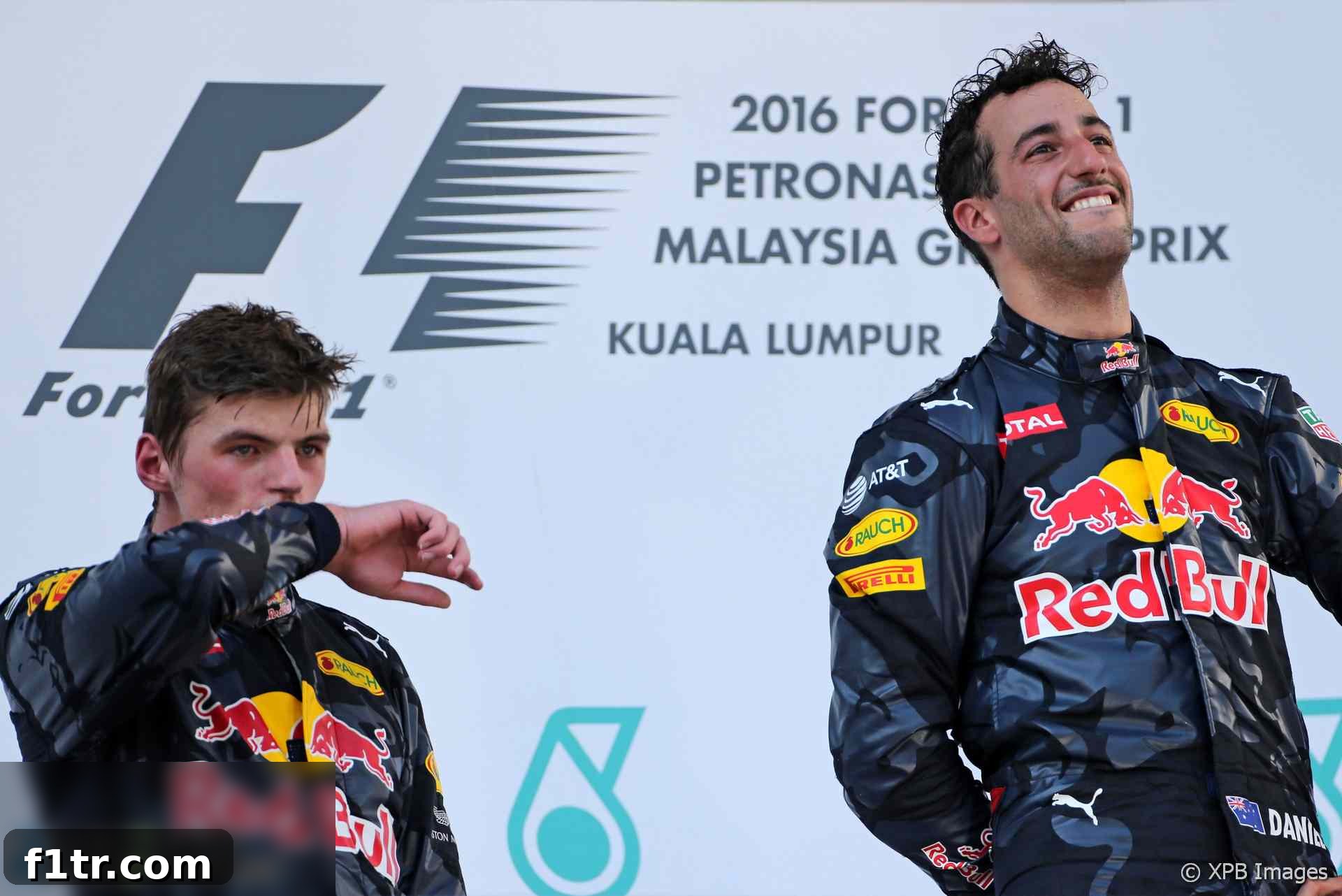
Daniil Kvyat’s demotion from Red Bull Racing just four races into the 2016 season paved the way for the sensational arrival of Max Verstappen, a move that would forever alter the dynamic within the team and Ricciardo’s career trajectory. Red Bull’s latest hiring proved to be an immediate force to be reckoned with, snatching a stunning victory on his debut at the Spanish Grand Prix after the warring Mercedes drivers, Lewis Hamilton and Nico Rosberg, famously collided. This triumph was also aided by Ricciardo ending up on a less-than-ideal strategy, highlighting the immediate pressure Verstappen brought. Despite Verstappen’s spectacular start, Ricciardo largely held the upper hand in terms of overall results and consistency across their 17 races together that season, including a memorable victory at the Malaysian Grand Prix. He showcased maturity and raw pace, initially positioning himself as the team’s established leader. However, the writing was on the wall; the raw, unadulterated speed and audacious talent of Verstappen meant that this balance of power wouldn’t stay in Ricciardo’s favor for long.
*Daniil Kvyat was also Ricciardo’s team mate for four races
2017: Red Bull – Underpowered and Unreliable
Team mate: Max Verstappen
The 2017 season continued to test Red Bull Racing’s patience and capabilities, as they grappled with their persistently underpowered and unreliable Renault engines. This frustrating situation meant that their two highly talented drivers, Daniel Ricciardo and Max Verstappen, only managed to see the chequered flag together in seven of the 20 races, a testament to the mechanical woes plaguing the team. Despite these significant challenges, Ricciardo often made the most of the opportunities that arose. He remarkably out-scored Verstappen over the course of the season, a feat that underscored his consistency and opportunistic brilliance. His standout performance was a terrific, come-from-behind victory in Azerbaijan, where he clawed his way back from 17th place to take the win in a chaotic race. While Ricciardo continued to demonstrate his racecraft and ability to capitalize on unique circumstances, Verstappen’s sheer core pace advantage, particularly in qualifying and on more conventional circuits, was becoming increasingly undeniable. The dynamic between the two was evolving, with Verstappen’s raw speed and aggressive style beginning to overshadow Ricciardo’s more measured, but equally effective, approach.
2018: Red Bull – Boiling Point and Departure
Team mate: Max Verstappen
The 2018 season began with a burst of promise for Daniel Ricciardo, who, with two impressive victories in the first six races (China and Monaco), appeared to have an outside chance of fighting for the championship. His confidence was high, and he seemed to be holding his own against the ever-faster Max Verstappen. However, the season took a dramatic turn at round four in Azerbaijan. During a fierce battle for position, Ricciardo and Verstappen engaged in a contentious collision that put both Red Bull drivers out of the race. This incident, and the team’s handling of it, had a profound psychological impact on Ricciardo. It solidified his growing belief that the team’s future was increasingly centered around Verstappen, and it set his mind firmly on moving on from Red Bull. He eventually made the surprising decision to join Renault, seeking a fresh challenge and a chance to lead a works team. By the time he walked out of the Red Bull garage for the last time, there was no longer any doubt who the team’s ‘alpha driver’ was. The Verstappen era had truly begun, and Ricciardo, despite his significant contributions, felt compelled to find a new path.
2019: Renault – A New Challenge
Team mate: Nico Hulkenberg
Daniel Ricciardo’s highly anticipated move to Renault for the 2019 season represented a significant gamble, leaving a front-running team for one still building towards contention. The central question was whether Ricciardo could find championship success if given a quick enough car. There seemed little cause to doubt his capabilities as he quickly made himself at home with the French manufacturer. He almost immediately asserted his authority, eclipsing his experienced team mate, Nico Hulkenberg, with a comprehensive margin in both qualifying and race performance. Ricciardo’s raw speed, racecraft, and charismatic leadership proved invaluable for Renault. His dominance over Hulkenberg was so thorough that it ultimately led to Renault replacing his team mate for the following year, a clear sign of Ricciardo’s impact and the team’s desire to build around him. Despite some initial struggles with the car’s performance, Ricciardo’s individual brilliance shone through, confirming his status as a top-tier driver capable of elevating a team.
2020: Renault – A Final Strong Season
Team mate: Esteban Ocon
To the palpable disgust of then-Renault team principal Cyril Abiteboul, Daniel Ricciardo decided to move on from the team even before the pandemic-delayed 2020 season officially began. An attractive opportunity to join McLaren presented itself, and he swiftly grabbed it, despite admitting later that it had been an even harder decision than his initial switch from Red Bull to Renault. Despite the impending departure, Ricciardo continued to prove himself a formidable force on track. He delivered a spectacular season, not only beating his new team mate, Esteban Ocon, but doing so even more effectively than he had Hulkenberg the previous year. Ricciardo’s consistent strong performances, including two podium finishes, were a highlight of Renault’s season, showcasing his ability to maximize the car’s potential and his exceptional race management. This season, however, proved to be the final time Ricciardo would comprehensively hold the upper hand over a full season against a team mate, marking the end of a chapter where he consistently demonstrated his undeniable competitive edge.
2021: McLaren – A Bittersweet Victory
Team mate: Lando Norris
Daniel Ricciardo’s much-anticipated move to McLaren in 2021 was meant to rekindle his championship aspirations, but it quickly became apparent that he was struggling to adapt to the unique characteristics of the McLaren chassis, particularly its braking philosophy. While his sensational victory in the 2021 Italian Grand Prix at Monza was a dream result, leading a McLaren 1-2 finish and partially vindicating his decision to leave Red Bull and Renault, it was a rare highlight in a season-long struggle. This triumph, while glorious, was achieved in the teeth of a consistent beating by his rapidly developing team mate, Lando Norris, a driver 11 years his junior. Norris consistently outperformed Ricciardo in both qualifying and race pace, showcasing a deep understanding of the car. Even with the significant points bump from that Monza victory, which occurred on a day when McLaren strategically instructed Norris to follow his team mate home, Ricciardo was decisively out-scored over the course of the entire season. This stark performance gap began to raise serious questions about Ricciardo’s future and his ability to recapture his previous form.
2022: McLaren – The Final Chapter with Woking
Team mate: Lando Norris
The 2022 season brought drastically overhauled technical regulations, and with them, a glimmer of hope for Daniel Ricciardo that a new car concept might better suit his driving style. However, if he harbored such hopes, he was profoundly disappointed. Shortly before the season began, McLaren underscored Lando Norris’s growing importance by renewing his contract for the second time in nine months, a telling sign of how the balance of power had irrevocably shifted within the team. Norris routed Ricciardo even more emphatically than the year before, consistently out-qualifying and out-racing him with alarming regularity. The performance gap was wider, and Ricciardo frequently found himself unable to extract the same pace from the McLaren as his young team mate. The struggles were evident, and the pressure mounted. At mid-season, in a move that shocked the F1 world but had been widely speculated, McLaren announced they had cut Ricciardo’s three-year contract short by a year, effectively ending his tenure with the team. This marked a devastating blow to his career, leaving him without a full-time F1 seat for the following season and raising questions about whether he would ever return to the grid.
2023: AlphaTauri – A Lifeline and A Setback
Team mate: Yuki Tsunoda
In a compelling narrative of the prodigal son’s return, Red Bull extended a crucial lifeline to Daniel Ricciardo at the end of 2022. The team offered their former star driver a potential route back to a top team, initially as a reserve driver for Red Bull Racing, and then, mid-season, as a replacement for the struggling Nyck de Vries at AlphaTauri. To begin with, the signs were promising. Ricciardo’s first weekend back in Hungary went remarkably well, displaying flashes of his old form and charisma. However, his comeback was brutally interrupted when he broke a wrist during practice at Zandvoort, forcing him out for five crucial races. Upon his return, he delivered a superb second-row qualifying spot in Mexico, followed by an impressive seventh-place finish, seeming to indicate Red Bull had been wise to keep faith in him. Despite this highlight, team mate Yuki Tsunoda, who had been gaining experience and confidence, picked up more points overall during their shared races. This raised the pressing question: could Ricciardo do better with a little more familiarity and consistent time in the car?
2024: RB – The Definitive End
Team mate: Yuki Tsunoda
The answer to the question posed at the end of 2023, unfortunately for Daniel Ricciardo, was a resounding no. The 2024 season with the rebranded RB team (formerly AlphaTauri) was intended as his final audition for a Red Bull seat, or at least to solidify his place in Formula 1. Again, there were occasional, tantalizing glimpses of the old Ricciardo – a superb qualifying and race performance in the Miami sprint event, for instance. These moments, however, were fleeting and inconsistent. Over the course of the season, he consistently struggled to match the pace and consistency of his team mate, Yuki Tsunoda, who continued to grow in confidence and performance. Ricciardo’s inability to regularly outperform Tsunoda left Red Bull with little cause to keep the faith in his long-term prospects. Motorsport consultant Helmut Marko, a key figure in Red Bull’s driver decisions, let it be known that the team would decide on their future driver arrangements in September. By the Singapore Grand Prix weekend, it had become an open secret within the paddock that this was to be Ricciardo’s last race as a full-time F1 driver. His journey in Formula 1, marked by incredible highs and poignant lows, had reached its definitive conclusion, cementing his legacy as a fierce competitor whose career was undeniably shaped by the relentless demands of intra-team battles.