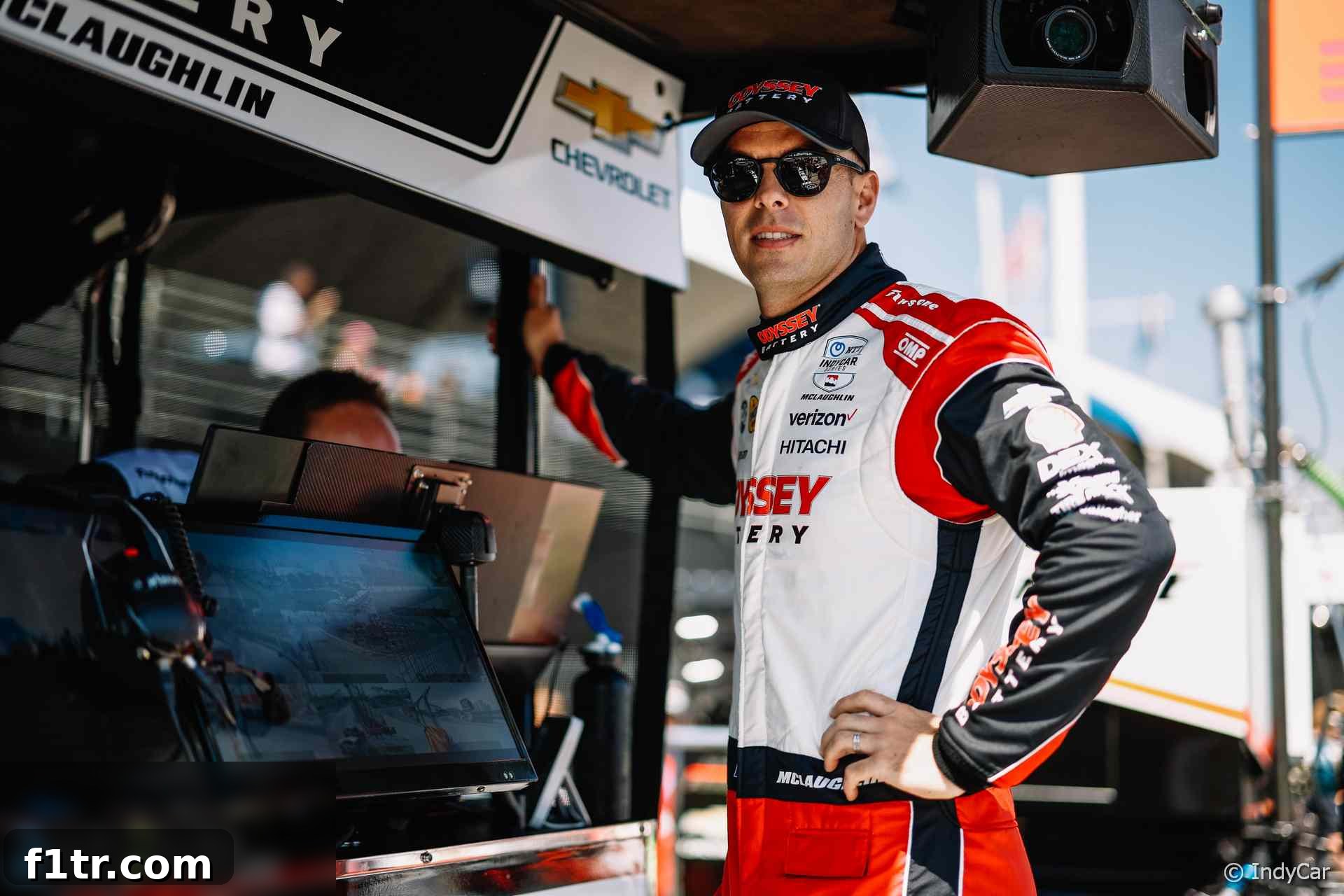
In a significant and widely discussed development that has sent ripples through the NTT IndyCar Series paddock, Team Penske has found itself at the center of controversy following penalties issued for the misuse of the push-to-pass system during the season-opening Grand Prix of St. Petersburg. Scott McLaughlin, one of the implicated drivers, has formally acknowledged and accepted his disqualification from the event, a decision that has sparked extensive debate among fans and competitors alike.
Advert | Become a Supporter & go ad-free
His teammate, Will Power, who managed to retain his finishing position but incurred a points deduction for a less severe infraction, has also publicly confirmed his acceptance of the penalty. The third Penske driver involved, Josef Newgarden, who was disqualified alongside McLaughlin, has yet to issue a public statement or acknowledge the series’ shocking announcement, which came roughly 24 hours prior to his teammates’ acknowledgements, adding another layer of intrigue to the unfolding saga.
IndyCar Uncovers Push-to-Pass Misuse at St. Petersburg
The penalties stem from an investigation revealing that both Scott McLaughlin and Josef Newgarden utilized their cars’ push-to-pass systems during restarts, a maneuver explicitly prohibited under IndyCar’s stringent regulations. The push-to-pass system, a common feature in modern open-wheel racing, is designed to provide drivers with a temporary boost in horsepower, offering a strategic advantage for overtaking on straights or exiting corners. Its usage is strictly governed by rules concerning deployment duration, total allowance per race, and crucially, specific track zones and race conditions where it can be activated.
IndyCar’s official statement on the matter indicated that Team Penske had “manipulated the overtake system,” allowing all three of its entries – McLaughlin, Newgarden, and Power – to activate the push-to-pass feature during starts and restarts. While Will Power’s car was found to have the capability, the investigation determined he did not deploy the system at unauthorized times. Conversely, his teammates, McLaughlin and Newgarden, were found to have actively used it, leading to their full disqualifications from the St. Petersburg race.
Will Power Accepts Penalty, Maintains Innocence in Usage
Will Power, the seasoned Australian driver, conveyed his profound disappointment upon learning of the penalty. His infraction, classified as a technical breach rather than active misuse, resulted in the loss of 10 points from the 40 he had earned for securing a commendable second-place finish. Power explained, “There was an oversight by our team, and I was unaware of the situation until it was brought to our attention following Long Beach.” This suggests a systemic issue within the team’s software or operational procedures rather than a deliberate driver action in his case.
He further clarified his personal adherence to the rules: “As per the rules, I did not utilise the push-to-pass capabilities during any start or restart during the St. Petersburg race. While I accept the penalty, I want it to be known that I did nothing wrong and followed the rules.” Power’s statement carefully distinguishes between the team’s technical oversight and his own actions on track, emphasizing his compliance with the usage regulations. Looking ahead, Power affirmed his focus remains steadfastly on the upcoming race at Barber Motorsports Park, signaling a desire to move past the controversy and concentrate on competition.
Scott McLaughlin’s Explanation: A Mistake of Habit, No Advantage Gained
Scott McLaughlin, a prominent figure and championship contender, expressed his unwavering loyalty to Team Penske amidst the unfolding scandal. “I fully stand with every one of my team mates,” he asserted, underlining the solidarity within the legendary racing outfit. His statement then delved into the specifics of his own breach, addressing directly the question of why he deployed the system during a prohibited period.
“Simply put, a mistake was made,” McLaughlin stated, taking full responsibility for his action. He passionately emphasized his commitment to integrity, stating, “I have the highest level of integrity and it is important to protect both my own reputation and that of the team.” McLaughlin provided context for his brief, albeit illegal, activation: “I was not aware of the situation with the software. In this instance, I used a single, very brief (1.9 second) deployment of push-to-pass in a section of the track exit of turn nine where it is typically utilised throughout the race.”
This explanation paints a picture of an instinctive, habitual action under the immense pressure of race conditions, rather than a malicious attempt to gain an unfair advantage. He elaborated further, “I hit the button out of habit, but I did not pass any cars nor did I gain any time advantage. The data, which IndyCar has, confirms all of this information.” While accepting the severe penalty of disqualification, McLaughlin made it explicitly clear that he believes his actions, though technically illegal, did not yield any competitive benefit over his rivals. His assertion resonates with the principle of fair competition, stating he “would take no pleasure in achieving success in any way other than honestly.” Like Power, McLaughlin concluded by turning his attention to the future: “We will all press forward from here and focus on the task at hand this weekend in Barber.”
The Silence of Josef Newgarden and Broader Implications for Team Penske
While McLaughlin and Power have offered their respective explanations and accepted their penalties, the silence from Josef Newgarden remains a focal point. As a two-time series champion and one of IndyCar’s most recognizable stars, Newgarden’s lack of public comment adds an air of uncertainty to the situation. His silence could be a strategic decision, perhaps on legal advice or in coordination with Team Penske, as the team potentially navigates internal investigations and manages public relations.
This incident casts a shadow over Team Penske, one of the most successful and revered teams in motorsport history. Known for its meticulous preparation and ethical standards, the “manipulation” of a critical performance system represents a significant blot on its esteemed reputation. The severity of IndyCar’s response—disqualification and points deductions—underscores the series’ commitment to maintaining a level playing field and protecting the integrity of its competition. This incident may prompt a thorough internal review within Team Penske regarding its technical oversight, software management, and driver communication protocols. For the series, it could lead to enhanced scrutiny and more sophisticated methods of monitoring technical compliance across all teams.
Moving Forward: Rebuilding Trust and Focusing on the Championship Battle
The push-to-pass controversy serves as a stark reminder of the fine lines governing technical regulations in elite motorsport. Even seemingly minor infractions, particularly those related to performance-enhancing systems, can lead to severe consequences. For Scott McLaughlin and Josef Newgarden, the disqualifications mean a significant setback in their championship aspirations, as critical points from the season opener have been wiped away. Will Power’s points deduction also impacts his early-season standing, though less dramatically.
As the IndyCar series moves to Barber, all eyes will be on Team Penske and its drivers. Rebuilding trust, both with the series officials and the fanbase, will be paramount. The team’s response in upcoming races, both on track and in their public dealings, will be crucial in demonstrating their commitment to fair play and moving past this contentious chapter. The focus now shifts to the relentless pursuit of performance within the boundaries of the rules, as the championship battle continues to unfold, albeit with an unexpected early twist.
Advert | Become a RaceFans supporter andgo ad-free
IndyCar
- IndyCar driver McLaughlin cleared of injury after crashing through barrier at Barber
- Schumacher says his IndyCar feels like ‘an F2 car, just with better tyres’
- IndyCar “way faster than Formula 1” in some corners, says Grosjean
- FIA to award more F1 superlicence points to IndyCar drivers from 2026
- Schumacher to race full-time in IndyCar with RLL in 2026
Browse all IndyCar articles