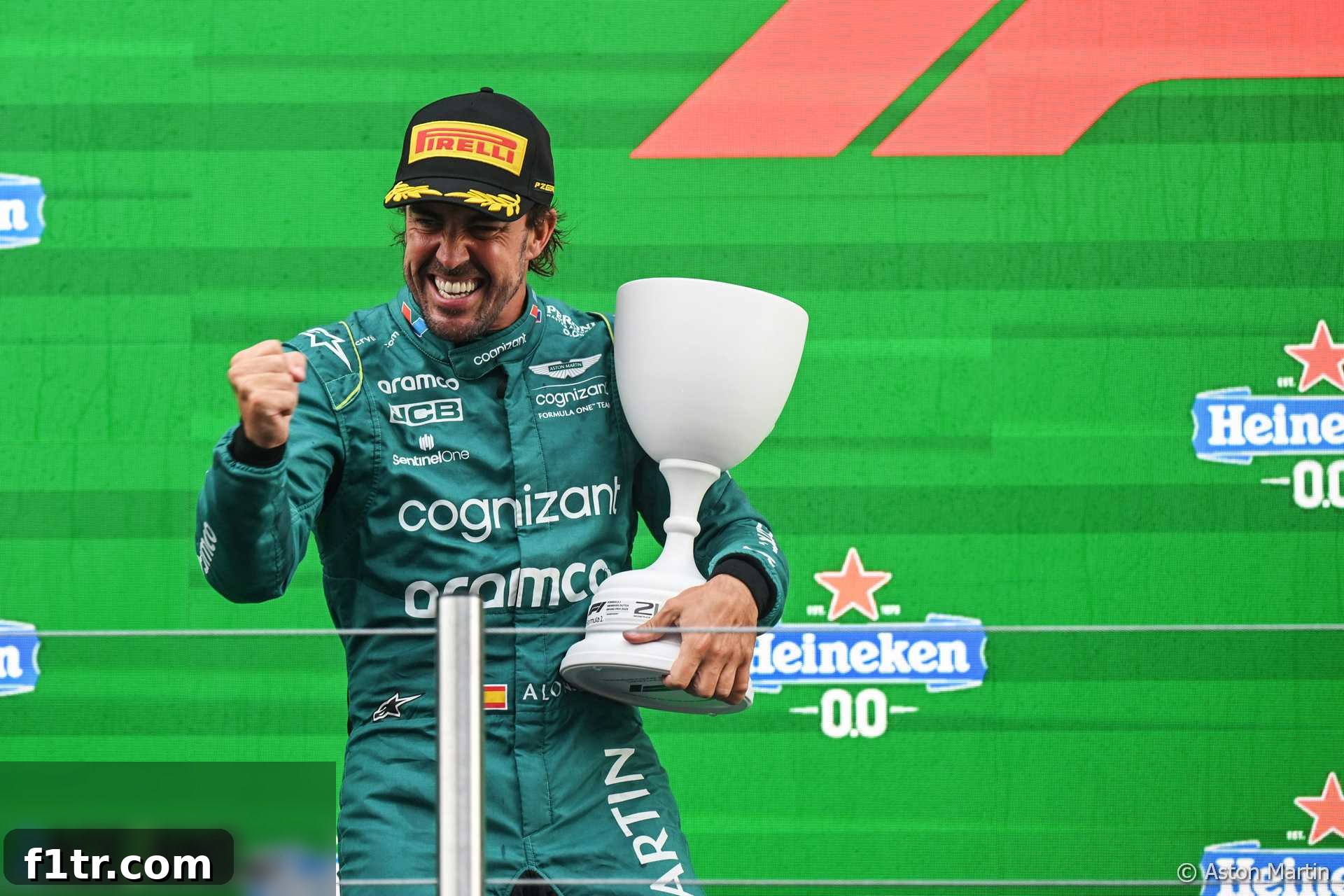
Fernando Alonso’s Podium at Zandvoort: A Turning Point for Aston Martin’s F1 Season?
After a challenging period, Fernando Alonso delivered a masterful performance at the Dutch Grand Prix, securing a commendable second-place finish. This achievement marked his first podium in five races, sparking considerable excitement and speculation about Aston Martin’s potential return to their formidable early-season form. While the celebratory spray of champagne offered a moment of triumph, the seasoned Spaniard remained cautiously optimistic, raising the crucial question of whether this result truly signals a sustained resurgence for the Silverstone-based team.
Advert | Become a Supporter & go ad-free
The Zandvoort Upgrades: A Strategic Bet on Performance Recovery
Aston Martin arrived at the demanding Zandvoort circuit equipped with a series of significant aerodynamic upgrades, most notably a redesigned floor. This crucial component was not an isolated development but rather a successor to enhancements introduced at the preceding Spa-Francorchamps round, underscoring the team’s relentless commitment to continuous evolution. The primary objective behind these updates was unambiguous: to recapture the competitive edge that saw Alonso consistently challenging at the sharp end of the grid during the opening stages of the 2023 Formula 1 season.
However, the initial evaluation of these vital upgrades encountered an unforeseen hurdle during Friday’s practice sessions. A power unit problem on Lance Stroll’s car significantly curtailed the team’s planned data collection program. This setback meant that Aston Martin had fewer opportunities than desired to fully understand, fine-tune, and optimize the new package ahead of the critical qualifying session and Sunday’s main event. Despite this unexpected disruption, the team demonstrated remarkable resilience, extracting the maximum performance from every available lap and making swift adjustments.
Qualifying Insights: Navigating the Competitive Landscape
As qualifying unfolded, the new floor appeared to yield tangible benefits, particularly for Fernando Alonso. He expertly navigated the tricky conditions of the Zandvoort circuit, securing a highly respectable fifth position on the starting grid. Lance Stroll, also running the upgraded package, qualified 11th. While Alonso’s performance was a clear positive, the mixed results across both cars prompted Aston Martin’s Performance Director, Tom McCullough, to offer a nuanced perspective on their true pace.
McCullough candidly observed that qualifying “wasn’t really representative” of outright car speed, noting that, “If, operationally, you can do a good job with both your cars and you can make the most of the opportunity, you can maybe outqualify cars that are quicker than you.” This insight underscored the razor-thin margins and intense competition characterizing the 2023 grid, where meticulous execution and seizing fleeting opportunities can significantly influence starting positions. He further elaborated on the closely matched field, stating, “It’s very tight, lots of teams, very, very close.”
The performance director also shed light on the dynamic interaction between a car’s inherent characteristics and the unique demands of different track layouts. “I think what’s happening is that some characteristics on some tracks that are suiting our base package better and worse, and then also other teams aren’t standing still. So it’s a relative game,” he explained. This strategic viewpoint acknowledges the perpetual development arms race in Formula 1, where a team’s progress is always benchmarked against its rivals. Crucially, the earlier Spa upgrades, despite initial limited dry running, had reportedly met with the team’s satisfaction, establishing a positive precedent for the Zandvoort iteration and providing a foundation for subsequent improvements.
The Race Day Triumph: Alonso’s Masterclass and Stroll’s Resilience
Sunday’s Dutch Grand Prix proved to be a dramatic and unpredictable affair, commencing with an abrupt downpour that immediately tested every team’s strategic acumen and every driver’s skill. Fernando Alonso, showcasing his legendary wet-weather prowess and acute strategic awareness, delivered a masterclass in challenging conditions. His decisive and early switch to intermediate tires proved to be an inspired call, rapidly propelling him through the field to the front of the pack. This tactical brilliance, combined with the AMR23’s improved performance, ultimately secured a brilliant second-place finish.
This result was not only Alonso’s best since the Canadian Grand Prix in June – another race where Aston Martin introduced significant sidepod and floor upgrades – but also a powerful testament to the effectiveness of the updated package and the team’s sharper operational execution. For Lance Stroll, the race presented a different, more challenging narrative. He unfortunately found himself on slick tires for an extended period during the initial rain shower, losing crucial track position and valuable time as conditions deteriorated. Despite a valiant effort to recover ground, he was unable to break into the points-paying positions.
Nevertheless, Stroll remained remarkably upbeat about the team’s overall performance throughout the weekend. “It’s a tight grid but I think that this weekend was definitely very promising,” he remarked, acknowledging the significant step forward in competitiveness. He enthusiastically described Alonso’s second place as a “huge result,” highlighting the considerable morale boost it provided for the entire Aston Martin crew and emphasizing the collective effort behind the team’s renewed pace.
Advert | Become a RaceFans supporter andgo ad-free
Alonso’s Cautious Outlook: “Too Early to Say”
Despite the undeniable success and palpable excitement at Zandvoort, Fernando Alonso, ever the pragmatist and a veteran of countless Formula 1 seasons, tempered expectations regarding a full return to the early-season form that saw him clinch an astonishing four consecutive podium finishes. “It’s too early to say,” Alonso cautiously stated after the race, reflecting on the inherently unpredictable and rollercoaster nature of the Formula 1 season where fortunes can shift rapidly.
He did, however, express palpable satisfaction and confidence regarding the car’s immediate improvements. “I think that the car is better than the previous events, that’s for sure,” he confirmed with conviction. A key indicator of this improvement was the car’s enhanced driveability and consistent pace: “I felt the car was easier to drive. We were more competitive. We’ve been in the top five in every session this weekend. It was not only in the race where we were fast. We felt competitive since Friday.” This sustained performance across all sessions – from the initial practice runs through qualifying to the main race – strongly suggests a fundamental gain in the car’s performance rather than a mere stroke of luck or a perfectly executed one-off strategy.
The Monza Litmus Test: A Different Challenge Awaits
Alonso’s caution is particularly well-founded, especially with the iconic Italian Grand Prix at Monza looming next on the Formula 1 calendar. Known reverently as the “Temple of Speed,” Monza presents a stark and challenging contrast to the high-downforce, twisty, and undulating nature of Zandvoort. The legendary circuit demands minimal downforce settings, prioritizing outright straight-line speed and drag efficiency above almost all else, thereby pushing different aspects of car design, aerodynamic philosophy, and setup to their absolute limits.
Alonso himself highlighted this crucial distinction and its implications: “Monza next week is a completely different layout, minimum downforce there and drag. Let’s see if we can still be competitive.” The performance at Monza will therefore serve as a critical litmus test for the AMR23’s updated package. If Aston Martin can maintain genuine competitiveness on such a uniquely demanding and high-speed track, it would provide far stronger and more compelling evidence of a comprehensive return to form across a broader spectrum of circuit characteristics. The intense battle for second place in the Constructors’ Championship remains fiercely contested, with McCullough acknowledging, “McLaren have come strong recently, and Mercedes and Ferrari are fierce competitors and a lot of other people are really close as well. So we’ll keep developing the car as hard as we can do.”
Indeed, the mid-season fight for supremacy behind the dominant Red Bull Racing has intensified dramatically. McLaren’s recent surge in performance, coupled with the consistent threat posed by Mercedes and the sporadic but potent pace of Ferrari, means Aston Martin cannot afford to become complacent or rest on their Zandvoort laurels. Each upgrade, each strategic decision, and each championship point gained will be absolutely vital in their ambitious pursuit of securing a high position in the constructors’ standings.
The Road Ahead: Sustaining Momentum and Proving Consistency
The Dutch Grand Prix podium was undoubtedly a significant morale booster and a tangible reward for Aston Martin’s relentless development efforts throughout a challenging middle phase of the season. It provided concrete evidence that their current upgrade path is yielding positive results, moving the AMR23 demonstrably closer to its impressive early-season potential. However, the true measure of their success and the definitive answer to whether this marks a turning point will lie in their ability to consistently challenge at the front and adapt seamlessly to the diverse circuit demands in the remaining races of the season.
Fernando Alonso’s cautious optimism perfectly encapsulates the team’s current position: hopeful and encouraged by recent gains, yet acutely aware of the formidable challenges and the demanding nature of Formula 1 competition. The upcoming races, beginning with the unique high-speed test of Monza, will provide invaluable data and a much clearer picture of whether Zandvoort was merely a brilliant flash of individual and team performance, or if it indeed signals the definitive turning point in Aston Martin’s ambitious quest for sustained Formula 1 glory.
Advert | Become a RaceFans supporter andgo ad-free
2023 Dutch Grand Prix Related Articles
- Azerbaijan GP defeat was key to record-equalling run of wins – Verstappen
- “Too early to say” if podium signals return to form for Aston Martin – Alonso
- Verstappen makes history with unbeaten hat-track in first home races
- Perez is ‘doing his job and will be our driver in 2024’, Horner insists
- Ferrari had the “sixth or seventh fastest car” at Zandvoort – Sainz
Browse all 2023 Dutch Grand Prix articles