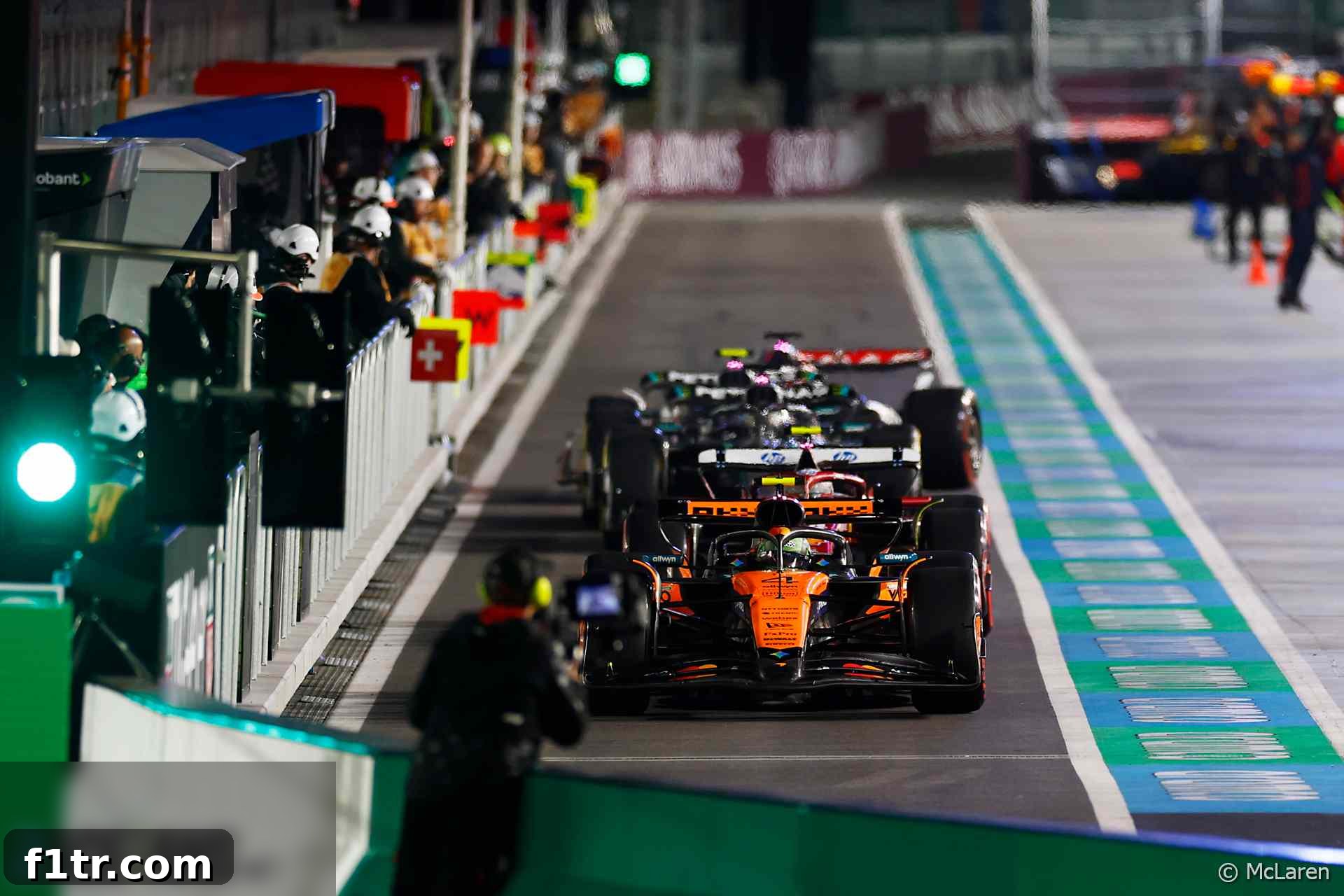
The highly anticipated Las Vegas Grand Prix commenced with a captivating start on Thursday, as McLaren’s dynamic young driver, Lando Norris, impressively set the fastest lap. However, the initial optimism needs to be tempered with the understanding that Norris was among a select group of drivers who managed to complete a representative lap on the soft compound tires. This crucial detail leaves the true competitive landscape shrouded in uncertainty ahead of the all-important qualifying session, making predictions for the weekend’s main event incredibly challenging for both fans and pundits alike.
Despite the prevailing ambiguity, Norris conveyed a surprisingly optimistic outlook regarding McLaren’s performance. This positive assessment is particularly noteworthy given that the Las Vegas Street Circuit was not initially expected to favor the characteristics of their car. The unique demands of the temporary street circuit, combined with cool temperatures and a freshly laid, low-grip surface, typically present a complex engineering challenge for teams. McLaren’s early pace suggests they may have found a better balance and understanding of their package than anticipated, a promising sign for the Woking-based squad as they aim to consolidate their position among the top contenders in Formula 1.
Teams’ 2024 Performance in Context: A Shifting Landscape
Reflecting on the previous season, the established pecking order often saw Red Bull and McLaren dominating the top ranks. Yet, the 2024 campaign witnessed a significant shake-up, particularly at tracks with unique characteristics that allowed other teams to shine. Mercedes and Ferrari frequently challenged for pole positions and race victories, often denying the traditional front-runners the coveted front-row starts. Notably, Pierre Gasly, then driving for Alpine, delivered a stellar performance, showcasing how an unexpected surge from a midfield team could disrupt the established order. This prior season’s volatility serves as a critical backdrop for understanding the current challenges in interpreting practice times, especially on a novel circuit like Las Vegas where unexpected variables can profoundly influence car performance and driver confidence. The competitive context of 2024 underscored the fluid nature of Formula 1, where strategic development and adaptability to diverse track layouts were paramount for success.
Navigating the Chaos: Teams’ Progress and Unforeseen Obstacles
Advert | Become a Supporter & go ad-free
Mercedes had arrived in Las Vegas with considerable hype, widely tipped by many experts and fans alike to deliver a strong performance, given their previous form and the theoretical suitability of the track’s long straights for their power unit. However, it was Charles Leclerc of Ferrari who quickly stole the headlines on Thursday, demonstrating blistering pace from the outset and topping the first practice session. His strong showing continued into the second session, where he again looked remarkably quick, consistently setting competitive sector times and building momentum. Unfortunately, his promising run was abruptly curtailed by an unexpected gearbox fault, which forced him to retire prematurely and significantly compromised his team’s data collection for the critical long runs and qualifying simulations.
Leclerc’s misfortune continued when he attempted his first qualifying simulation run on soft tires. Pushing the limits of the challenging street circuit, he went wide at Turn 9, invalidating his lap time. This incident, while minor in isolation, had a ripple effect across the track, triggering yellow flags. These flags proved to be detrimental to several other drivers, including McLaren’s Oscar Piastri, who were on their own flying laps with fresh soft tires, effectively spoiling their crucial qualifying simulation attempts and leaving them without benchmark data for optimal setup. The narrow windows for performance runs, coupled with the unforgiving nature of a street circuit, amplified the impact of even minor disruptions.
The subsequent chaos further exacerbated the situation during the second practice session. Less than half of the field managed to record uninterrupted flying laps on the soft compound tires. Among the fortunate few were drivers from Aston Martin, Mercedes, and Racing Bulls, alongside Lando Norris, Alexander Albon, and Nico Hulkenberg. The vast majority of the grid, however, were denied the opportunity to complete their crucial soft-tire runs due to a series of frustrating red flags. The session was halted not once, but twice, owing to persistent issues with a dislodged manhole cover on the track. This unprecedented disruption significantly hampered teams’ ability to gather essential performance data, leaving them with an incomplete picture of tire degradation, optimal car balance, and true competitive pace ahead of the critical qualifying session. The limited running meant that many teams would head into Friday with significant unknowns, relying more on simulations and limited data than desired.
Advert | Become a RaceFans supporter andgo ad-free
Unveiling the True Pace: Practice Times and Team Insights
The culmination of these disrupted sessions means that the competitive picture remains far from complete. Key contenders such as Max Verstappen, Oscar Piastri, and both Ferrari drivers were unable to set truly representative times on the softest compounds under ideal conditions. This absence of critical data makes direct comparisons challenging and adds an extra layer of intrigue to the upcoming qualifying session. Teams will be working overtime to extrapolate meaningful insights from the limited information available, focusing on individual sector times and partial runs to piece together a coherent strategy for Friday.
Despite the challenges, Lando Norris provided a deeply encouraging assessment of McLaren’s pace, offering a glimmer of optimism for the team. “I think we have a better feeling in the car than what we had last year,” Norris remarked, underscoring the significant progress the team believes it has made in understanding and optimizing their car for diverse conditions. He added, “that was felt I would say already [from] lap one of today,” indicating an immediate positive impression and a strong baseline setup. This positive feedback from a driver of Norris’s caliber suggests that McLaren may have indeed found solutions to some of the underlying handling issues that plagued them in previous seasons or at similar high-speed, low-grip venues.
To further enhance their understanding and performance, the McLaren team dedicated the initial two practice sessions to evaluating revised front and rear wing flaps. These aerodynamic components are crucial for managing downforce and drag, especially on a circuit like Las Vegas with its long straights demanding low drag, yet tight corners requiring sufficient grip. Following extensive analysis, the team opted to remove the updated rear wing flaps for the second hour of running, a tactical decision based on real-time data and driver feedback, aiming to find the optimal compromise between straight-line speed and cornering stability. Similarly, Red Bull also introduced an update for their front wing, continuously refining their championship-winning package. Despite the fragmented sessions, Max Verstappen appeared capable of matching the front-runners’ laps throughout much of Thursday’s running, a testament to Red Bull’s inherent pace and the reigning champion’s ability to extract maximum performance even under adverse circumstances.
Ultimately, Thursday’s two practice sessions in Las Vegas generated more questions than definitive answers. The series of disruptions, from gearbox failures to unprecedented manhole cover issues, ensured that no team could fully execute their planned programs. However, there is compelling evidence to suggest that McLaren, in particular, has made significant strides in addressing their historical weaknesses at what was once considered a ‘bogey track’ for them. The positive feedback from Norris and the team’s methodical approach to aero evaluation indicate a promising trajectory. As teams scramble to synthesize their limited data, the stage is set for a thrilling and unpredictable qualifying session, where adaptability and strategic foresight will be paramount. The true pecking order will only begin to emerge as the cars hit the track for Friday’s crucial competitive runs.
| P. | # | Driver | Team | FP1 time | FP2 time | Gap | Laps |
|---|---|---|---|---|---|---|---|
| 1 | 4 | Lando Norris | McLaren-Mercedes | 1’35.258 | 1’33.602 | 38 | |
| 2 | 12 | Andrea Kimi Antonelli | Mercedes | 1’35.538 | 1’33.631 | 0.029 | 48 |
| 3 | 16 | Charles Leclerc | Ferrari | 1’34.802 | 1’33.763 | 0.161 | 45 |
| 4 | 27 | Nico Hulkenberg | Sauber-Ferrari | 1’36.170 | 1’33.879 | 0.277 | 39 |
| 5 | 6 | Isack Hadjar | Racing Bulls-Honda RBPT | 1’35.299 | 1’33.893 | 0.291 | 46 |
| 6 | 30 | Liam Lawson | Racing Bulls-Honda RBPT | 1’35.709 | 1’33.901 | 0.299 | 44 |
| 7 | 63 | George Russell | Mercedes | 1’35.534 | 1’34.037 | 0.435 | 43 |
| 8 | 23 | Alexander Albon | Williams-Mercedes | 1’34.968 | 1’34.067 | 0.465 | 40 |
| 9 | 1 | Max Verstappen | Red Bull-Honda RBPT | 1’35.109 | 1’34.105 | 0.503 | 40 |
| 10 | 44 | Lewis Hamilton | Ferrari | 1’35.561 | 1’34.127 | 0.525 | 43 |
| 11 | 18 | Lance Stroll | Aston Martin-Mercedes | 1’35.894 | 1’34.191 | 0.589 | 40 |
| 12 | 10 | Pierre Gasly | Alpine-Renault | 1’35.589 | 1’34.373 | 0.771 | 44 |
| 13 | 55 | Carlos Sainz Jnr | Williams-Mercedes | 1’35.179 | 1’34.435 | 0.833 | 47 |
| 14 | 81 | Oscar Piastri | McLaren-Mercedes | 1’35.450 | 1’34.493 | 0.891 | 39 |
| 15 | 22 | Yuki Tsunoda | Red Bull-Honda RBPT | 1’35.071 | 1’34.692 | 1.090 | 43 |
| 16 | 43 | Franco Colapinto | Alpine-Renault | 1’36.758 | 1’34.824 | 1.222 | 46 |
| 17 | 87 | Oliver Bearman | Haas-Ferrari | 1’35.990 | 1’34.986 | 1.384 | 45 |
| 18 | 14 | Fernando Alonso | Aston Martin-Mercedes | 1’35.746 | 1’35.012 | 1.410 | 37 |
| 19 | 31 | Esteban Ocon | Haas-Ferrari | 1’36.123 | 1’35.228 | 1.626 | 48 |
| 20 | 5 | Gabriel Bortoleto | Sauber-Ferrari | 1’36.398 | 1’35.499 | 1.897 | 40 |
Advert | Become a RaceFans supporter andgo ad-free
Miss nothing from RaceFans
Get a daily email with all our latest stories – and nothing else. No marketing, no ads. Sign up here:
2025 Las Vegas Grand Prix
- Losing win through strategy error “hurts more” than Las Vegas disqualification – Piastri
- FIA feels McLaren’s Las Vegas GP disqualification is “draconian”, claims Brown
- Why did McLaren’s messages to Norris and Piastri not mention plank problems?
- McLaren explain Las Vegas disqualifications – including their “counterproductive” reaction
- McLaren’s first double disqualification ended their second-longest points streak
Browse all 2025 Las Vegas Grand Prix articles