The 2022 Canadian Grand Prix delivered a captivating blend of strategic brilliance, unexpected twists, and high-stakes racing, largely dictated by pivotal safety car interventions. While a single pit stop strategy was theoretically viable, the majority of the field found themselves opting for two, a testament to the unpredictable nature of Circuit Gilles Villeneuve and the interventions that peppered the first third of the race.
Advert | Become a Supporter & go ad-free
The early stages of the race were swiftly reshaped by a pair of Virtual Safety Car (VSC) periods. The first VSC was triggered by an unfortunate retirement for Red Bull’s Sergio Perez on lap 9. In a cruel twist of irony for Perez, his teammate, Max Verstappen, was arguably the primary beneficiary. Under the VSC, the reduced speed on track allowed drivers to make a ‘cheaper’ pit stop, losing less time than a regular green flag stop. Verstappen, who had been leading comfortably, seized this opportunity to switch to fresh tyres. Lewis Hamilton, running in fourth place at the time, also capitalized on this window, along with several other drivers further down the order who sought to gain an advantage by pitting early. These strategic calls immediately locked the participating drivers into a two-stop strategy, betting on the fresh rubber to carry them through the middle stint.
Just a few laps later, the strategic landscape shifted once more when the second VSC was deployed in response to Mick Schumacher’s retirement. This second intervention presented another crucial decision point. Many of the drivers who had not pitted under the first VSC, including the new race leader Carlos Sainz Jnr, now headed for the pits. This meant that by approximately one-third distance, a significant portion of the grid had already completed their first pit stop, largely dictated by these safety car periods, and the two-stop approach became the de facto strategy for the front-runners.
As the race passed its halfway mark, the tension escalated between Verstappen and Sainz. The Ferrari driver was gradually closing the gap to the Red Bull, putting immense pressure on the championship leader. In response to Sainz’s relentless pursuit and a desire to ensure Verstappen had optimal tyre life for the final sprint, Red Bull made the brave call to bring Verstappen in for his second pit stop under green flag conditions. This decision inevitably incurred a greater time loss compared to a safety car stop, highlighting their confidence in Verstappen’s ability to recover. However, this calculated gamble was soon overshadowed just six laps later when Yuki Tsunoda crashed at Turn 2, prompting the deployment of the full Safety Car.
Tsunoda’s incident instantly reset the race and sparked intense debate about its impact on the outcome. For Carlos Sainz, it was a moment of immense good fortune. The Safety Car allowed him to make a ‘free’ pit stop, bolt on a fresh set of tyres, and rejoin the race right behind Verstappen, completely nullifying any advantage Verstappen had gained from his earlier stop. For Verstappen, it was a frustrating turn of events, wiping out his hard-earned lead and placing him under immediate threat from a fully committed Sainz on equal, fresh tyres. Had the race run its course without this final interruption, it would have taken several more laps for Verstappen to catch Sainz, and even then, overtaking would have been a significant challenge on older tyres. Whether Verstappen would have had any more success passing his rival than Sainz did in the thrilling final laps of the actual race is a captivating ‘what if’ scenario that remains a subject of pure speculation, underscoring the profound impact of safety cars on Formula 1 strategy.
Beyond the leading battle, the race was rife with strategic missteps and heroic recoveries. Fernando Alonso’s impressive front-row start ultimately yielded disappointment. His race was severely compromised, not only by an emerging engine problem but also by strategic misfortune. He notably stayed out during the first VSC period and then failed to reach the pit lane entrance in time to take advantage of the second, missing crucial opportunities for a ‘cheap’ stop. This series of events left him on an suboptimal strategy and ultimately cost him valuable positions as the race progressed.
McLaren, too, endured a torrid time in the pits. During the second VSC, the team attempted a ‘double stack’ with their drivers, a risky but often rewarding manoeuvre under safety car conditions. However, the execution was flawed. Daniel Ricciardo’s pit stop took an agonizingly long time, leading to a significant delay for his teammate, Lando Norris, who was waiting behind him. To compound the misery, the crew then brought out the wrong tyres for Norris, resulting in an even longer stop. This series of errors meant Norris’s stop took far longer than even Kevin Magnussen’s front wing change, severely damaging both McLaren drivers’ prospects and highlighting the critical importance of flawless pit stop execution.
In stark contrast to McLaren’s woes, Charles Leclerc delivered a masterful strategic drive from the back of the grid. Starting from 19th after engine penalties, Leclerc’s team opted for a daring one-stop strategy, starting him on the hard compound tyres. Despite losing vital time in the pits and subsequently finding himself stuck behind a ‘DRS train’ – a scenario where multiple cars are closely following each other, all benefiting from DRS and making overtaking incredibly difficult – Leclerc demonstrated exceptional pace and race craft. He meticulously managed his tyres and picked his moments, successfully climbing an astonishing 14 places to cross the finish line in a well-deserved fifth position. His performance was a testament to both his driving prowess and Ferrari’s bold strategic call, proving that sometimes, swimming against the tide can yield significant rewards.
Advert | Become a RaceFans supporter andgo ad-free
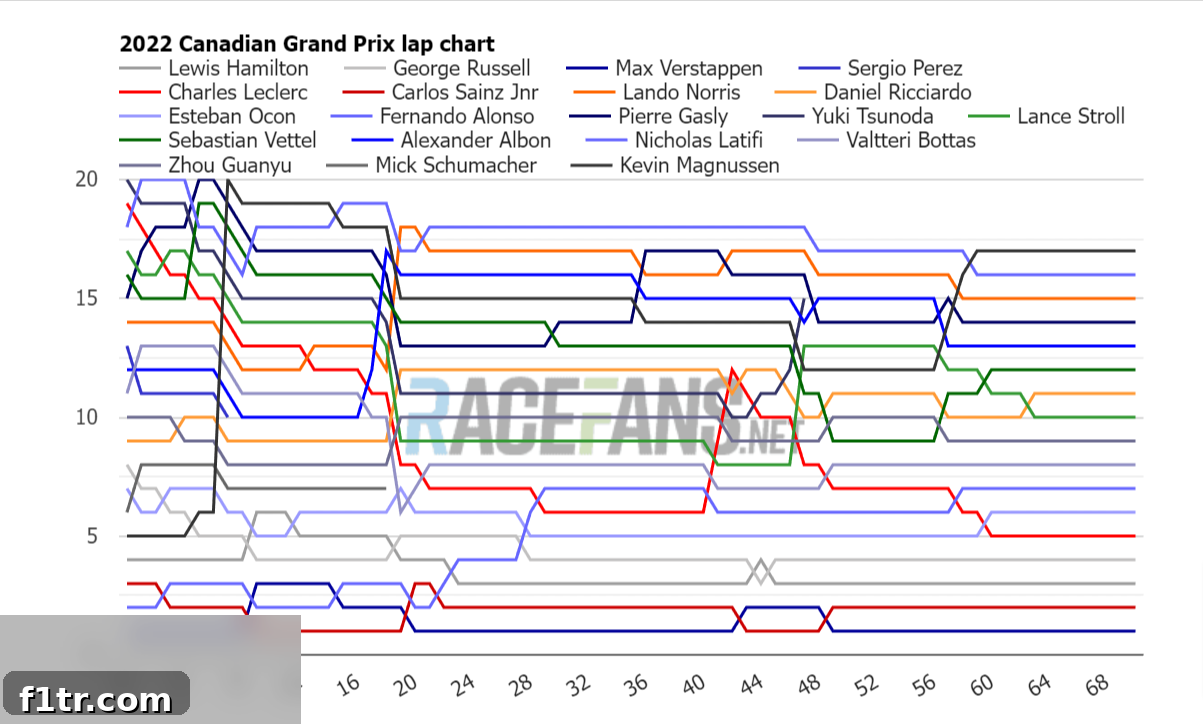
2022 Canadian Grand Prix lap chart
The positions of each driver on every lap. Click name to highlight, right-click to reset. Toggle drivers using controls below:
Go ad-free for just £1 per month>> Find out more and sign up
2022 Canadian Grand Prix race chart
The gaps between each driver on every lap compared to the leader’s average lap time. Very large gaps omitted. Scroll to zoom, drag to pan and right-click to reset. Toggle drivers using controls below:
Position change
| Driver | Start position | Lap one position change | Race position change |
|---|---|---|---|
| Lewis Hamilton | 4 | 0 | 1 |
| George Russell | 8 | 1 | 4 |
| Max Verstappen | 1 | 0 | 0 |
| Sergio Perez | 13 | 2 | Charles Leclerc | 19 | 1 | 14 |
| Carlos Sainz Jnr | 3 | 0 | 1 |
| Lando Norris | 14 | 0 | -1 |
| Daniel Ricciardo | 9 | 0 | -2 |
| Esteban Ocon | 7 | 1 | 1 |
| Fernando Alonso | 2 | 0 | -5 |
| Pierre Gasly | 15 | -2 | 1 |
| Yuki Tsunoda | 20 | 1 | |
| Lance Stroll | 17 | 1 | 7 |
| Sebastian Vettel | 16 | 1 | 4 |
| Alexander Albon | 12 | 0 | -1 |
| Nicholas Latifi | 18 | -2 | 2 |
| Valtteri Bottas | 11 | -2 | 3 |
| Zhou Guanyu | 10 | 0 | 1 |
| Mick Schumacher | 6 | -2 | |
| Kevin Magnussen | 5 | 0 | -12 |
2022 Canadian Grand Prix lap times
All the lap times by the drivers (in seconds, very slow laps excluded). Scroll to zoom, drag to pan and toggle drivers using the control below:
Go ad-free for just £1 per month>> Find out more and sign up
2022 Canadian Grand Prix fastest laps
Each driver’s fastest lap:
| Rank | Driver | Car | Fastest lap | Gap | On lap |
|---|---|---|---|---|---|
| 1 | Carlos Sainz Jnr | Ferrari | 1’15.749 | 63 | |
| 2 | Max Verstappen | Red Bull | 1’15.839 | 0.090 | 64 |
| 3 | Charles Leclerc | Ferrari | 1’15.901 | 0.152 | 62 |
| 4 | Lewis Hamilton | Mercedes | 1’16.167 | 0.418 | 69 |
| 5 | George Russell | Mercedes | 1’16.418 | 0.669 | 63 |
| 6 | Zhou Guanyu | Alfa Romeo-Ferrari | 1’16.578 | 0.829 | 63 |
| 7 | Valtteri Bottas | Alfa Romeo-Ferrari | 1’16.927 | 1.178 | 60 |
| 8 | Fernando Alonso | Alpine-Renault | 1’17.010 | 1.261 | 64 |
| 9 | Esteban Ocon | Alpine-Renault | 1’17.110 | 1.361 | Set on 2 laps |
| 10 | Lance Stroll | Aston Martin-Mercedes | 1’17.421 | 1.672 | 64 |
| 11 | Lando Norris | McLaren-Mercedes | 1’17.495 | 1.746 | 63 |
| 12 | Pierre Gasly | AlphaTauri-Red Bull | 1’17.810 | 2.061 | 60 |
| 13 | Daniel Ricciardo | McLaren-Mercedes | 1’17.932 | 2.183 | 59 |
| 14 | Alexander Albon | Williams-Mercedes | 1’17.951 | 2.202 | 59 |
| 15 | Sebastian Vettel | Aston Martin-Mercedes | 1’17.956 | 2.207 | 63 |
| 16 | Kevin Magnussen | Haas-Ferrari | 1’18.046 | 2.297 | 11 |
| 17 | Yuki Tsunoda | AlphaTauri-Red Bull | 1’18.309 | 2.560 | 15 |
| 18 | Nicholas Latifi | Williams-Mercedes | 1’18.540 | 2.791 | 61 |
| 19 | Sergio Perez | Red Bull | 1’18.844 | 3.095 | 7 |
| 20 | Mick Schumacher | Haas-Ferrari | 1’18.967 | 3.218 | 13 |
Advert | Become a RaceFans supporter andgo ad-free
2022 Canadian Grand Prix tyre strategies
The tyre strategies for each driver:
| Stint 1 | Stint 2 | Stint 3 | |
|---|---|---|---|
| Max Verstappen | C4 (9) | C3 (34) | C3 (27) |
| Carlos Sainz Jnr | C4 (20) | C3 (29) | C3 (21) |
| Lewis Hamilton | C4 (9) | C3 (35) | C3 (26) |
| George Russell | C4 (19) | C3 (26) | C3 (25) |
| Charles Leclerc | C3 (41) | C4 (29) | |
| Esteban Ocon | C4 (19) | C3 (30) | C4 (21) |
| Fernando Alonso | C4 (28) | C3 (21) | C4 (21) |
| Valtteri Bottas | C3 (49) | C4 (21) | |
| Zhou Guanyu | C4 (19) | C3 (30) | C3 (21) |
| Lance Stroll | C3 (47) | C4 (23) | |
| Daniel Ricciardo | C4 (19) | C3 (30) | C3 (21) |
| Sebastian Vettel | C4 (5) | C3 (14) | C3 (51) |
| Alexander Albon | C4 (18) | C3 (30) | C3 (22) |
| Pierre Gasly | C4 (5) | C3 (31) | C3 (34) |
| Lando Norris | C3 (19) | C3 (23) | C4 (28) |
| Nicholas Latifi | C4 (9) | C3 (28) | C3 (33) |
| Kevin Magnussen | C4 (7) | C3 (63) | |
| Yuki Tsunoda | C4 (9) | C3 (38) | C3 (0) |
| Mick Schumacher | C4 (18) | ||
| Sergio Perez | C3 (7) |
Go ad-free for just £1 per month>> Find out more and sign up
2022 Canadian Grand Prix pit stop times
How long each driver’s pit stops took:
| Driver | Team | Pit stop time | Gap | On lap | |
| 1 | Yuki Tsunoda | AlphaTauri | 23.248 | 9 | |
| 2 | Sebastian Vettel | Aston Martin | 23.406 | 0.158 | 5 |
| 3 | Yuki Tsunoda | AlphaTauri | 23.450 | 0.202 | 47 |
| 4 | Alexander Albon | Williams | 23.530 | 0.282 | 48 |
| 5 | Pierre Gasly | AlphaTauri | 23.557 | 0.309 | 5 |
| 6 | Pierre Gasly | AlphaTauri | 23.613 | 0.365 | 36 |
| 7 | Sebastian Vettel | Aston Martin | 23.681 | 0.433 | 19 |
| 8 | Max Verstappen | Red Bull | 23.704 | 0.456 | 43 |
| 9 | Fernando Alonso | Alpine | 23.779 | 0.531 | 28 |
| 10 | Alexander Albon | Williams | 23.804 | 0.556 | 18 |
| 11 | Lewis Hamilton | Mercedes | 23.841 | 0.593 | 44 |
| 12 | Lewis Hamilton | Mercedes | 23.845 | 0.597 | 9 |
| 13 | Esteban Ocon | Alpine | 23.945 | 0.697 | 49 |
| 14 | George Russell | Mercedes | 23.951 | 0.703 | 19 |
| 15 | Zhou Guanyu | Alfa Romeo | 23.980 | 0.732 | 49 |
| 16 | Nicholas Latifi | Williams | 24.020 | 0.772 | 9 |
| 17 | George Russell | Mercedes | 24.069 | 0.821 | 45 |
| 18 | Lando Norris | McLaren | 24.134 | 0.886 | 42 |
| 19 | Carlos Sainz Jnr | Ferrari | 24.215 | 0.967 | 20 |
| 20 | Max Verstappen | Red Bull | 24.217 | 0.969 | 9 |
| 21 | Zhou Guanyu | Alfa Romeo | 24.281 | 1.033 | 19 |
| 22 | Daniel Ricciardo | McLaren | 24.833 | 1.585 | 49 |
| 23 | Carlos Sainz Jnr | Ferrari | 24.881 | 1.633 | 49 |
| 24 | Fernando Alonso | Alpine | 25.139 | 1.891 | 49 |
| 25 | Lance Stroll | Aston Martin | 25.252 | 2.004 | 47 |
| 26 | Esteban Ocon | Alpine | 25.684 | 2.436 | 19 |
| 27 | Valtteri Bottas | Alfa Romeo | 26.089 | 2.841 | 49 |
| 28 | Charles Leclerc | Ferrari | 26.199 | 2.951 | 41 |
| 29 | Daniel Ricciardo | McLaren | 27.937 | 4.689 | 19 |
| 30 | Nicholas Latifi | Williams | 30.034 | 6.786 | 37 |
| 31 | Kevin Magnussen | Haas | 38.262 | 15.014 | 7 |
| 32 | Lando Norris | McLaren | 43.032 | 19.784 | 19 |
2022 Canadian Grand Prix
- Alfa Romeo see “great future in F1” for Zhou after best result so far
- Ocon has “big hopes” for Alpine’s Silverstone upgrade package
- Hamilton’s Canada podium especially satisfying after run of “bad luck” – Wolff
- Verstappen urges Red Bull to find more pace after close win in Canada
- More confident Sainz is now a contender for wins – Binotto
Browse all 2022 Canadian Grand Prix articles