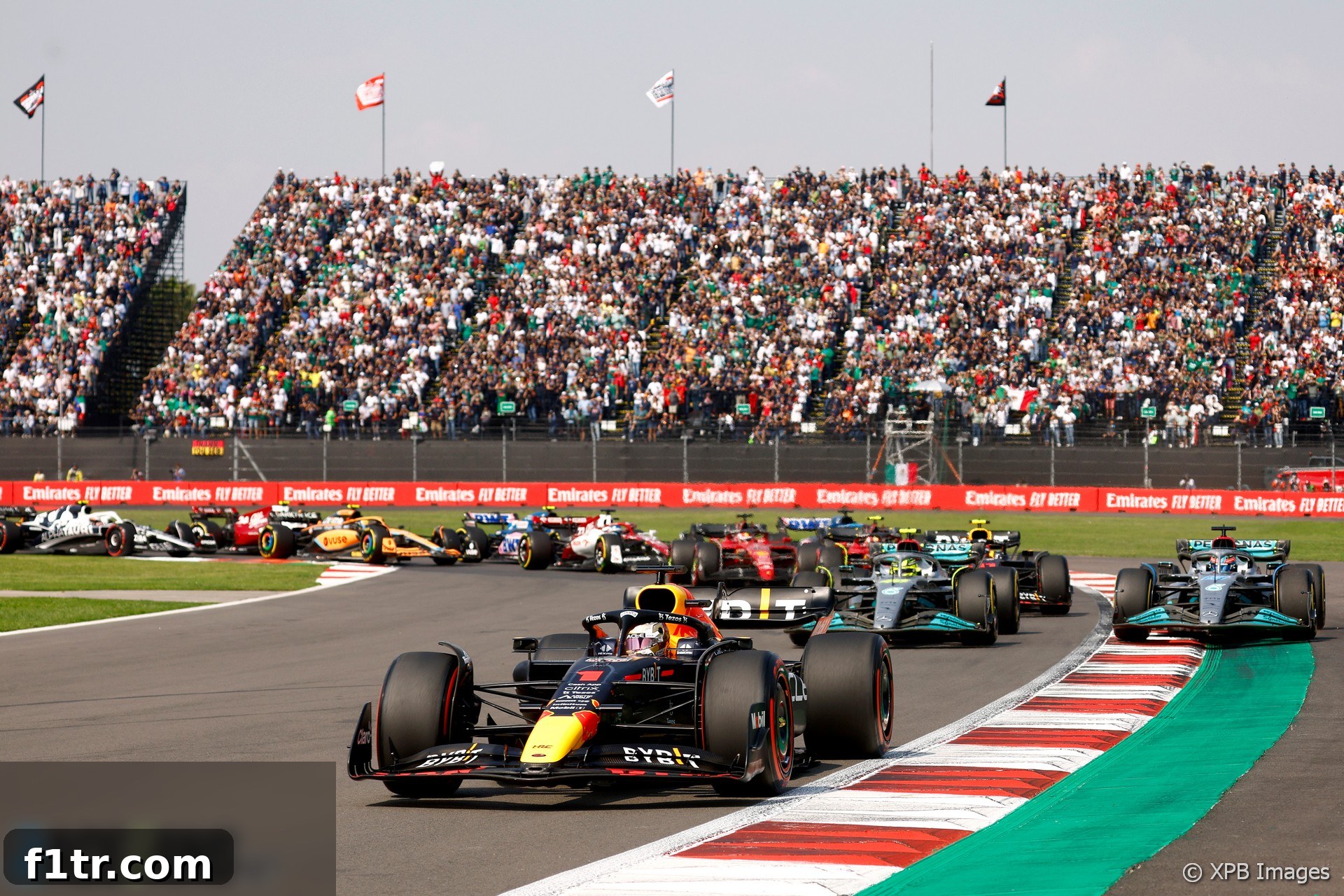
For the first time since Formula 1 introduced its groundbreaking Aerodynamic Testing Restriction (ATR) rules in 2021, Mercedes-AMG F1 will no longer be the team operating with the most stringent development limitations for its new car. This significant shift in allocation marks a crucial turning point in the competitive dynamics of the 2023 season, placing reigning champions Red Bull Racing at a distinct disadvantage, while offering a strategic boost to their rivals.
Advert | Become a Supporter & go ad-free
The ATR regulations were meticulously designed to introduce a handicap system for top-performing teams each season, fostering closer competition and promoting a more unpredictable championship across the grid. Consequently, for the upcoming 2023 season, Red Bull Racing, having clinched the Constructors’ Championship with overwhelming dominance in 2022, is permitted the least amount of aerodynamic development time. Conversely, Williams Racing, which concluded the 2022 season in last place, will benefit from the most generous development allocation, offering them a crucial opportunity to improve their performance.
Red Bull finished the previous season with what was widely regarded as the strongest and most efficient car on the grid, securing victories in all but one of the final eleven races. This unparalleled performance established a formidable benchmark. As the new season approaches, a pivotal question looms: Will the disadvantage imposed by their significantly reduced development allocation be sufficient for their rivals to narrow the gap, challenge their supremacy, or even surpass them? This intricate balancing act between past success and future potential will define the narrative of the early 2023 season.
Christian Horner, Red Bull Racing’s team principal, addressed the team’s predicament with a pragmatic outlook during their season launch event. Speaking to media outlets, including RaceFans, he affirmed, “I think that we’re doing the best with what we’ve got. The team has had to adapt to the handicap that we have, and they’ve done a wonderful job in doing that.” His comments underscore the internal focus on efficiency and optimization within the team, rather than lamenting the restrictions.
Horner further elaborated on the uncertainty surrounding the impact of the reduced allocation: “Is it enough? We’ll find out in a couple of weeks’ time as a starting point. But it’s certainly a significant handicap that we carry for the majority of the year.” This candid assessment highlights the substantial challenge ahead for Red Bull, suggesting that while the team has prepared diligently, the true test will come on the track. The emphasis on efficiency and intelligent resource allocation will be paramount throughout the season, transforming their development strategy into a high-stakes balancing act.
“The team has obviously accepted that, we’ve looked to adapt to ensure that we’re as efficient as we possibly can be. We’ll see when RB19 runs on the track in anger if we’ve done enough,” Horner concluded, emphasizing the team’s commitment to maximizing every opportunity despite the regulatory constraints. The performance of the RB19, expected to be an evolution of its dominant predecessor, will serve as the ultimate verdict on their adaptive capabilities and the effectiveness of their development program under pressure.
Advert | Become a RaceFans supporter andgo ad-free
Understanding F1’s Aerodynamic Testing Restrictions (ATR) and Their Impact for 2023
Formula 1’s aerodynamic testing restrictions remain fundamentally unchanged for the 2023 season. The core principle dictates that the volume of development each team is permitted to conduct is directly proportional to their championship finishing position from the preceding year. This tiered system ensures a sliding scale, theoretically preventing perpetual dominance by any single team. Teams finishing lower in the Constructors’ Championship gain more development freedom, while those at the top face tighter constraints.
Interestingly, only one team concluded the 2022 championship in the exact same position it held a year prior, and thus, maintains an unchanged development allocation for 2023: Aston Martin. The remaining nine teams have all experienced shifts in their championship standings, leading to adjustments in their respective ATR allocations. Coincidentally, Aston Martin’s seventh-place finish is the benchmark position that entitles a team to 100% of the permitted wind tunnel and Computational Fluid Dynamics (CFD) development time.
To put this into perspective, a 100% allocation translates to a substantial allowance of 320 wind tunnel testing runs and 2,000 aerodynamic test geometries for restricted CFD simulations. This represents a critical volume of research and development capacity that teams utilize to refine their car’s aerodynamic performance. Teams finishing behind Aston Martin receive incrementally more development time, with Williams at the very bottom of the standings receiving the maximum 115% allocation. Conversely, teams finishing ahead of Aston Martin face reductions, which would ordinarily place Red Bull Racing at 70%, mirroring Mercedes’ allocation in the previous year.
However, Red Bull Racing faces a further, compounding disadvantage. As a direct consequence of their penalty for exceeding the Formula 1 budget cap in 2021, their testing allocation for 2023 was subjected to an additional 10% reduction. This punitive measure brings their total allowable aerodynamic development down to a significantly constrained 63%. This double whammy of being the reigning champion and incurring a financial penalty creates an unprecedented challenge for the Milton Keynes-based squad, forcing an extremely disciplined and efficient approach to their car development.
While Red Bull shoulders the lowest allocation, other teams have also seen notable shifts. Alfa Romeo, for instance, experienced the most significant proportional cut, falling from 110% to 95% as they impressively rose from eighth to sixth in the Constructors’ standings. Conversely, AlphaTauri, Red Bull’s junior team, finds itself in the exact opposite situation, benefiting from an increased allocation due to their lower finish, which could prove vital for their progress.
Advert | Become a RaceFans supporter andgo ad-free
The severity of Red Bull’s curtailed development restriction remains a key point of speculation. The experience of other top teams that operated with lower allocations in previous years suggests that such restrictions can significantly limit the extent to which a team can explore radical or diverse aerodynamic concepts. This often necessitates a more conservative development path, focusing on iterative improvements rather than revolutionary designs. However, if a team possesses profound confidence in the fundamental philosophy of its current design and is refining a proven, high-performing package, then these development restrictions may pose less of a debilitating headache.
This latter scenario may well be the strategic position Red Bull Racing finds itself in. Given that they commanded the car to beat at the close of last year, and the technical regulations for 2023 feature only minor revisions, their design continuity is a significant asset. The team has already indicated that the RB19 – which notably was not visually presented at their launch event – will be a clear evolution of last year’s championship-winning car. This approach suggests a focus on optimizing an already successful platform, rather than embarking on a risky, time-consuming overhaul, potentially mitigating some of the impact of their reduced development time.
Should the reigning champions commence the new season demonstrating a similar level of dominance to how they concluded the previous one, it would inevitably spark widespread questioning regarding the overall effectiveness of the recently introduced ATR scheme. Furthermore, sustained Red Bull supremacy would undoubtedly add fuel to the arguments of those who already felt that the penalty imposed for their budget cap infringement was too lenient. The 2023 season, therefore, stands as a critical test not just for Red Bull, but for the regulatory framework designed to ensure competitive fairness and sustainability in Formula 1.
*Due to their penalty for exceeding the budget cap in 2021, Red Bull’s allocation this year is reduced from 70% to 63%
Advert | Become a RaceFans supporter andgo ad-free
Related F1 Articles
- FIA President Cleared of Alleged Interference in Two 2023 Races
- First Week Viewing Figures for New Drive to Survive Season Fall Again
- Max Who? Drive to Survive Season Six Prefers Its Favourite Faces
- RaceFans’ Complete 2023 Season Review
- The F1 Drivers Who Pulled Off the 10 Biggest Charges Through the Field in 2023
Browse all 2023 F1 season articles