Austrian Grand Prix: A Scrutiny of Driving Standards and Widespread Penalties
The 2023 Formula 1 Austrian Grand Prix proved to be a weekend brimming with intense on-track action, but equally, a fervent display of strict officiating. A remarkable number of infringements led to numerous penalties, highlighting the relentless pressure on drivers and teams to adhere to the sport’s evolving regulations. From spirited overtaking maneuvers pushing the boundaries of fair play to persistent struggles with track limits and critical pit lane operations, the race at the Red Bull Ring underscored the demanding nature of top-tier motorsport where every millimeter and millisecond counts. This detailed review delves into the key incidents that shaped the stewards’ decisions, shedding light on the application of the F1 rulebook and its implications for the competitors.
Advert | Become a Supporter & go ad-free
Nyck de Vries Earns First Super License Penalty Points for Aggressive Defense
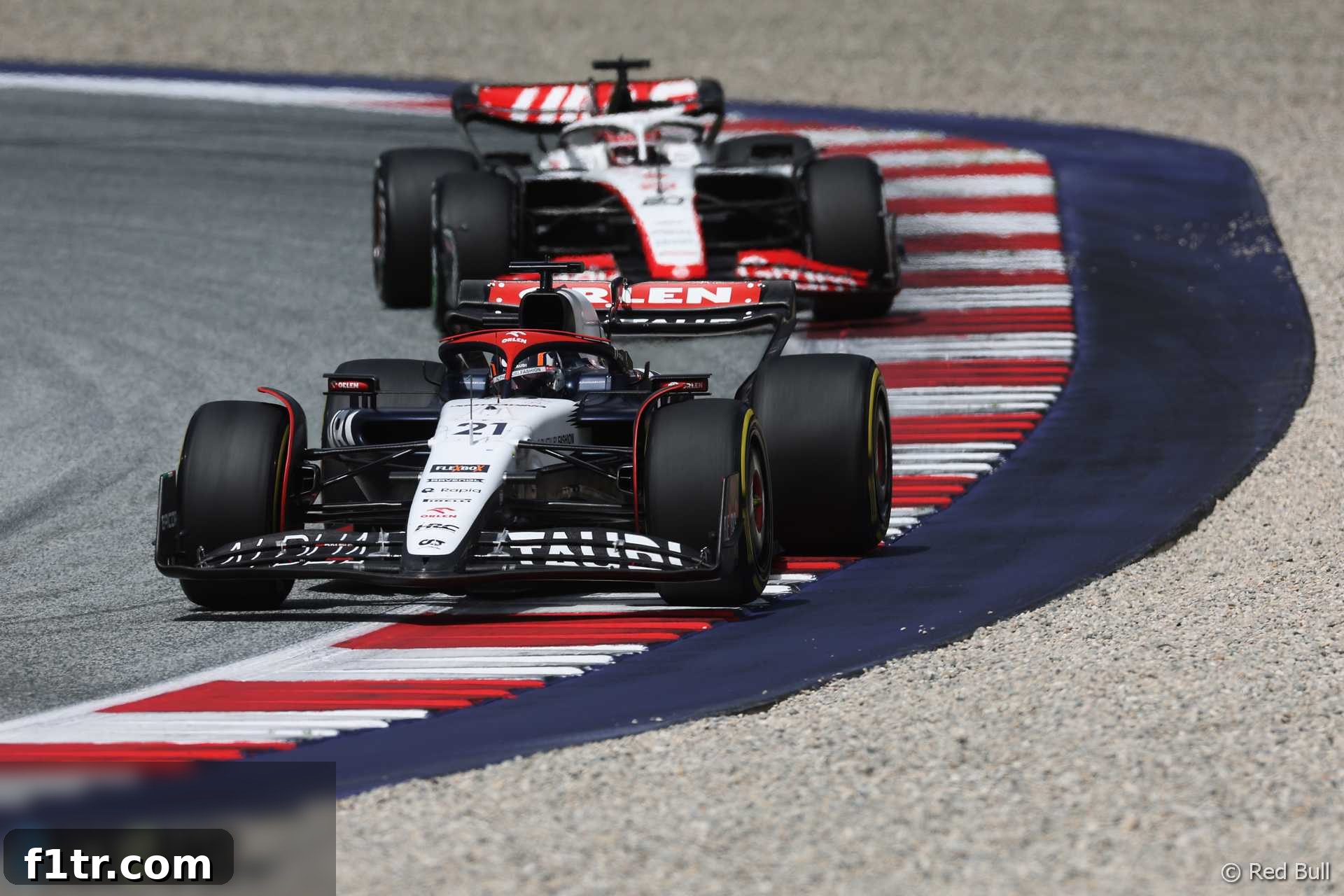
Nyck de Vries, the AlphaTauri rookie, found himself under the spotlight during the Austrian Grand Prix, receiving the first penalty points on his super license. The incident in question occurred when he forced Kevin Magnussen’s Haas off the track while defending his position. This was a crucial moment for De Vries, who has been striving to establish himself in Formula 1 since his debut at Monza the previous year.
The stewards’ investigation into the Turn 6 incident was thorough, ultimately concluding that Magnussen, in car 20, was sufficiently alongside De Vries’s car 21 to warrant racing room. Magnussen had attempted to execute an overtake around the outside of the challenging Turn 6, a corner known for its high-speed entry and demanding exit, often testing the limits of driver commitment and spatial awareness. The official statement from the stewards articulated their decision clearly: “At and from the apex of turn six, car 20 [Magnussen] was on the outside and was clearly level and then in front of car 21 [De Vries]. In accordance with the Driving Standards Guidelines, Car 20 should have been given racing room.”
Understanding F1’s Driving Standards Guidelines on Overtaking
The F1 Driving Standards Guidelines serve as a critical framework for stewarding decisions, aiming to ensure fair and safe racing. These guidelines explicitly state the conditions under which an overtaking car is entitled to racing room. For a car being overtaken to be required to yield sufficient space, the overtaking car must have “a significant portion of the car alongside the car being overtaken.” Furthermore, the maneuver must be executed “in a safe and controlled manner, while enabling the car to clearly remain within the limits of the track.” In the case of De Vries and Magnussen, the stewards deemed that Magnussen met these criteria, making De Vries’s defensive move a breach of protocol.
As a consequence of this infringement, De Vries was handed a five-second time penalty, which was applied during the race, in addition to two penalty points on his super license. While two points might seem minor, accumulating 12 penalty points within a 12-month period results in an automatic one-race ban. For a young driver like De Vries, who is fighting to secure his future in the sport, any penalty points carry significant weight, emphasizing the need for precision and adherence to racing etiquette.
Widespread Track Limits Infringements Plague Austrian Grand Prix
Beyond the specific incident involving De Vries, the Austrian Grand Prix will perhaps be most remembered for the sheer volume of track limits penalties issued throughout the weekend. The Red Bull Ring, with its fast, sweeping corners and gravel-free run-off areas, has historically posed a challenge for drivers attempting to maximize cornering speed without exceeding the white lines. This year, the enforcement was particularly stringent, leading to widespread frustration among drivers and teams, and raising questions about the consistency and practical application of the rules.
A staggering total of nine drivers received penalties during the Grand Prix, with seven of them specifically sanctioned for track limits infringements. These included high-profile names such as Lewis Hamilton, Yuki Tsunoda, Carlos Sainz Jnr, Alexander Albon, Pierre Gasly, Logan Sargeant, and Kevin Magnussen. Each of these drivers was initially given a five-second time penalty for their transgressions, which accumulated throughout the race. The consistent application of these penalties underscored the FIA’s commitment to policing the track boundaries, but it also sparked considerable debate about the nature of modern F1 circuits and the feasibility of drivers staying within limits at maximum attack.
Yuki Tsunoda’s Multiple Infringements and Additional Penalty
Among the drivers penalized for track limits, AlphaTauri’s Yuki Tsunoda stood out with a particularly high number of offenses. The Japanese driver was found to have exceeded the track limits on a remarkable seven occasions during the race. Such repeated breaches led to a progressive accumulation of penalties, culminating in an additional ten-second time penalty on top of his initial five-second sanctions. This multi-layered penalty structure is designed to deter continuous infringements, but for Tsunoda, it severely hampered his race performance and any hopes of scoring points. The frequency of these penalties for multiple drivers underscored a broader issue at the Red Bull Ring, reigniting discussions about alternative solutions for track limit enforcement, such as gravel traps or more unforgiving kerbs, which might naturally deter drivers from straying off track without the need for constant stewarding intervention.
Advert | Become a RaceFans supporter andgo ad-free
AlphaTauri Escapes Further Penalty After Pit Stop Investigation
Adding to AlphaTauri’s eventful weekend, the team also came under scrutiny for a potential procedural breach during Yuki Tsunoda’s pit stop. Following his track limits penalties, Tsunoda was required to serve a five-second time penalty. The rules governing such penalties are extremely precise: no work can be done on the car, nor can it be touched by any pit equipment, until the full penalty time has elapsed. The stewards initiated an investigation into whether AlphaTauri had correctly served Tsunoda’s five-second time penalty, specifically scrutinizing if the front jack had made contact with the car prematurely.
After a meticulous review of video evidence, particularly footage from the FIA pit box overhead camera, the stewards ultimately decided not to penalize AlphaTauri further. Their statement detailed the ambiguity they encountered: “Video evidence from the FIA pit box overhead camera shows the jack moving towards the front of the car as the car stops. It appears very close but after the expiration of the five-second time penalty, there appears to be a small further forward movement leading us to have doubt as to whether the jack was touching the car during the penalty period. In this case the competitor is given the benefit of the doubt.” This decision highlights the fine margins in Formula 1, where even minuscule movements can trigger an investigation, and the crucial principle of giving the competitor the ‘benefit of the doubt’ when definitive proof of a breach is lacking.
Esteban Ocon Penalised for Unsafe Pit Release
Another incident in the pit lane led to a penalty for Esteban Ocon and his Alpine team. The stewards ruled that Alpine had released Ocon’s car in an unsafe fashion, creating a dangerous situation that forced Logan Sargeant, in the Williams, to take significant evasive action. Pit lane safety is paramount in Formula 1, given the congested environment and the high-speed movements of cars and personnel.
The details of the incident, as outlined by the stewards, were clear: “Car two [Sargeant] was seen to have to significantly slow to avoid car 31 [Ocon] which was exiting the pit whilst car two was attempting to enter the pit box. Video also showed that car 31 was released after car two had passed the relevant pit lane marker.” This meant that Alpine had released Ocon into the path of Sargeant, despite Sargeant already being committed to entering his pit box and having passed the designated pit lane marker which signals a car’s impending entry. Such an unsafe release is a serious breach of safety regulations and carries immediate consequences, as it can easily lead to collisions in a confined space. Consequently, Ocon was handed a five-second time penalty for the team’s error, further illustrating the unforgiving nature of the F1 rulebook when it comes to operational precision.
The 2023 Austrian Grand Prix served as a stark reminder of the meticulous nature of Formula 1 stewarding. From on-track battles for position, demanding adherence to racing standards, to the precise execution required within the pit lane, every aspect of the competition is under intense scrutiny. The sheer number of penalties, particularly for track limits, sparked debate but ultimately reinforced the FIA’s commitment to maintaining strict adherence to the rules. These decisions invariably shape the outcome of the race and the narrative of the championship, pushing drivers and teams alike to operate with unparalleled precision and discipline.
Become a RaceFans Supporter
RaceFans is run thanks in part to the generous support of its readers. By contributing £1 per month or £12 per year (or the same in whichever currency you use) you can help cover the costs of creating, hosting and developing RaceFans today and in the future.
Become a RaceFans Supporter today and browse the site ad-free. Sign up or find out more via the links below:
- Become a RaceFans Supporter
- RaceFans Supporter FAQ
Advert | Become a RaceFans supporter andgo ad-free
2023 Austrian Grand Prix
- Mercedes left scratching heads by lack of performance at Austrian GP
- Verstappen’s determination to grab every point makes him a record-breaker
- Austrian GP track limits farce was avoidable like ‘IndyGate’ and Spa 2021 – Brown
- Alpine now “definitely beatable” for McLaren after upgrade – Brown
- Paddock Diary: 2023 Austrian Grand Prix
Browse all 2023 Austrian Grand Prix articles