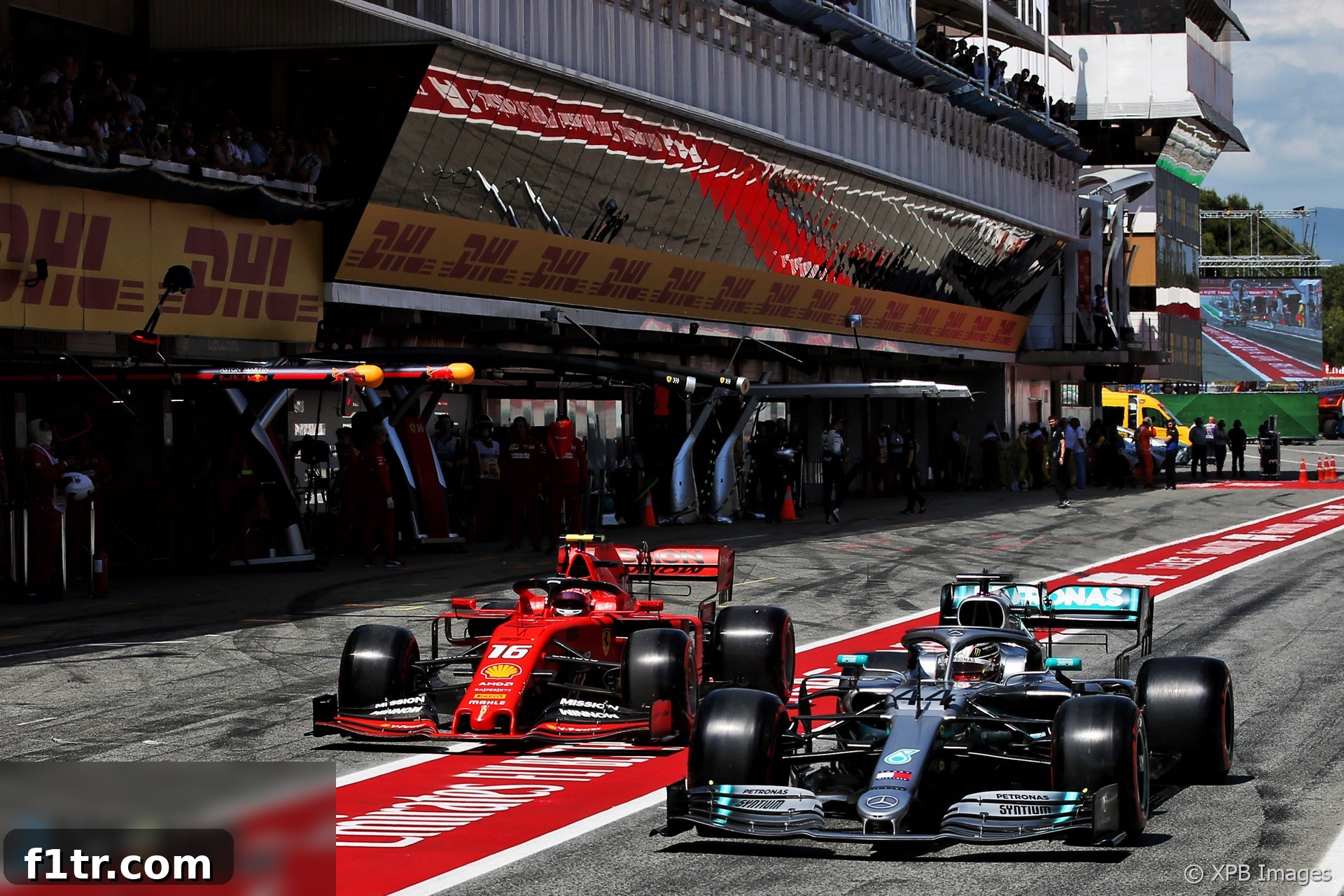
The highly anticipated Scuderia Ferrari team found themselves lagging significantly behind the dominant Mercedes in qualifying for the Spanish Grand Prix. However, a subtle hint from Sebastian Vettel after the session suggested that their strategists had prioritized race pace over a single-lap qualifying showdown, setting up their cars with the grueling race ahead in mind.
Advertisement: Support our work and enjoy an ad-free experience.
While it might seem overly optimistic to imagine a scenario where Mercedes, having demonstrated a crushing eight-tenths of a second advantage over their nearest rivals on Saturday, would face substantial competition during the race, Formula 1 has a knack for unpredictable outcomes. As history has shown, team performance can fluctuate dramatically based on the various Pirelli tyre compounds and evolving track conditions throughout a Grand Prix weekend. This variability often opens the door for strategic gambles and unexpected challenges.
Ferrari’s approach in qualifying strongly hinted at a deliberate strategic pivot. Acknowledging the apparent impossibility of out-qualifying Mercedes on raw pace, the Maranello squad opted for fewer sets of soft tyres during the qualifying sessions. This decision wasn’t a concession to defeat but a calculated move to retain more strategic flexibility for Sunday’s race. Critically, Ferrari now possesses an extra set of fresh medium-compound tyres compared to Mercedes. This suggests a strong inclination towards a two-stop strategy, potentially utilizing a soft-medium-medium sequence, which could unlock different performance windows during the Grand Prix.
Pirelli’s official recommendations painted a conservative picture for race strategy. According to the tyre supplier, a soft-hard single-stop strategy would necessitate drivers running the soft compound until approximately lap 27. This projection, implying a subsequent 39-lap stint on the hard tyre, appears exceptionally cautious, particularly for a team with Mercedes’ proven ability to manage tyres. It wouldn’t be surprising to see Mercedes attempt an earlier pit stop if they commit to this one-stop route, potentially giving them an advantage. However, if Ferrari indeed plans to execute a more aggressive two-stopper, they could make their first stop even earlier, capitalizing on the ‘undercut’ – pitting before a rival to gain track position through faster laps on fresh rubber, a tactic often potent on circuits where track position is paramount.
Mario Isola, Pirelli’s motorsport director, acknowledged that a soft-medium one-stop strategy might be theoretically possible but described it as “really, really marginal.” This underlines the fine margins teams operate within. Regardless of the chosen path, Ferrari’s array of tyre options undoubtedly provides them with tactical flexibility. Yet, this flexibility will only translate into a genuine challenge if they can find a way to significantly close the performance gap to Mercedes on race day. Raw pace remains a fundamental requirement, even with the smartest strategy.
One potential silver lining for Ferrari lies in their straight-line speed. The red cars topped the speed trap charts in qualifying, indicating strong aerodynamic efficiency for high-speed sections. This high top speed could prove crucial, not only in defending against potential Red Bull assaults but also in launching a challenge against Mercedes on the long run down to Turn 1 at the start of the race. A strong initial getaway and superior straight-line performance could see them threaten the Silver Arrows early on, potentially creating an opportunity to unsettle Mercedes’ rhythm.
Go ad-free for just £1 per month>> Find out more and sign up
The Mercedes garage itself isn’t immune to internal pressures. The battle between their two star drivers, Lewis Hamilton and Valtteri Bottas, is a championship narrative in its own right. Their fight for supremacy could intensify on the opening lap at the demanding Circuit de Catalunya, where overtaking opportunities are historically limited compared to a track like Baku. This dynamic adds another layer of intrigue, as any intra-team skirmish could inadvertently create an opening for a rival.
While Hamilton appeared to find strong form in final practice, Bottas ultimately looked the marginally quicker of the two Mercedes drivers. The significant gap between them in qualifying, however, was somewhat misleading. Mercedes’ chief race engineer, Andrew Shovlin, elaborated on team principal Toto Wolff’s explanation: “He abandoned his final run in the second session due to a yellow flag at Turn 12, which meant the battery pack was not charged ready for the final session.” This technical glitch forced Hamilton onto the track earlier in Q3 to manage his out-lap, leading him to encounter traffic and less optimal track conditions. Shovlin added, “By the final run, it seemed that the track had lost a bit of pace and there was some gravel down so few cars were able to improve.” This clarifies that Hamilton’s Q3 performance was not a true reflection of his potential pace or the gap between the Mercedes drivers.
Beyond the Mercedes vs. Ferrari tussle, Red Bull Racing looms as a significant disruptor to Ferrari’s carefully laid plans. The RB15s, while not quite matching the front two in ultimate single-lap pace, demonstrated commendable consistency and strength over race stints. Their performance in Baku, particularly during the second stint, highlighted their ability to sustain strong pace over longer runs. Given their close proximity to Ferrari’s pace in qualifying, and their historical strength in race trim, Red Bull could easily find themselves in a position to challenge Ferrari, potentially splitting the red cars and making it an even tougher ask for the Scuderia to prevent Mercedes from securing yet another dominant one-two finish.
Advertisement: Support our content and become a RaceFans supporter tobrowse ad-free.
Qualifying Performance: A Deeper Look
The qualifying session at Circuit de Catalunya provided critical insights into the pecking order and potential race dynamics. Valtteri Bottas delivered a stellar performance to snatch pole position, demonstrating the raw speed of the Mercedes W10. Lewis Hamilton, despite his Q3 battery issue, secured a front-row start, highlighting Mercedes’ inherent advantage. Ferrari’s Sebastian Vettel and Charles Leclerc locked out the second row, showcasing their improved, albeit still insufficient, pace. Red Bull’s Max Verstappen and Pierre Gasly were not far behind, hinting at their race-day threat.
Qualifying Times in Full
| Driver | Car | Q1 | Q2 (vs Q1) | Q3 (vs Q2) | |
| 1 | Valtteri Bottas | Mercedes | 1’16.979 | 1’15.924 (-1.055) | 1’15.406 (-0.518) |
| 2 | Lewis Hamilton | Mercedes | 1’17.292 | 1’16.038 (-1.254) | 1’16.040 (+0.002) |
| 3 | Sebastian Vettel | Ferrari | 1’17.425 | 1’16.667 (-0.758) | 1’16.272 (-0.395) |
| 4 | Max Verstappen | Red Bull | 1’17.244 | 1’16.726 (-0.518) | 1’16.357 (-0.369) |
| 5 | Charles Leclerc | Ferrari | 1’17.388 | 1’16.714 (-0.674) | 1’16.588 (-0.126) |
| 6 | Pierre Gasly | Red Bull | 1’17.862 | 1’16.932 (-0.930) | 1’16.708 (-0.224) |
| 7 | Romain Grosjean | Haas | 1’18.042 | 1’17.066 (-0.976) | 1’16.911 (-0.155) |
| 8 | Kevin Magnussen | Haas | 1’17.669 | 1’17.272 (-0.397) | 1’16.922 (-0.350) |
| 9 | Daniil Kvyat | Toro Rosso | 1’17.914 | 1’17.243 (-0.671) | 1’17.573 (+0.330) |
| 10 | Daniel Ricciardo | Renault | 1’18.385 | 1’17.299 (-1.086) | 1’18.106 (+0.807) |
| 11 | Lando Norris | McLaren | 1’17.611 | 1’17.338 (-0.273) | |
| 12 | Alexander Albon | Toro Rosso | 1’17.796 | 1’17.445 (-0.351) | |
| 13 | Carlos Sainz Jnr | McLaren | 1’17.760 | 1’17.599 (-0.161) | |
| 14 | Kimi Raikkonen | Alfa Romeo | 1’18.132 | 1’17.788 (-0.344) | |
| 15 | Sergio Perez | Racing Point | 1’18.286 | 1’17.886 (-0.400) | |
| 16 | Nico Hulkenberg | Renault | 1’18.404 | ||
| 17 | Lance Stroll | Racing Point | 1’18.471 | ||
| 18 | Antonio Giovinazzi | Alfa Romeo | 1’18.664 | ||
| 19 | George Russell | Williams | 1’19.072 | ||
| 20 | Robert Kubica | Williams | 1’20.254 |
Sector Times: Unpacking Car Performance
Analyzing sector times provides a granular view of where each car excels or struggles on the Circuit de Catalunya. Ferrari’s strong showing in Sector 1 (Vettel fastest, Leclerc third fastest) suggests good low-speed cornering and traction out of the early turns. Mercedes, however, demonstrated superior overall balance, with Bottas leading in Sectors 2 and 3, which feature a mix of high-speed sweeps and tighter technical sections. Red Bull also showed promise in the latter sectors, indicating their potential for strong race pace once the fuel load drops.
| Driver | Sector 1 | Sector 2 | Sector 3 |
|---|---|---|---|
| Valtteri Bottas | 21.488 (2) | 28.040 (1) | 25.878 (1) |
| Lewis Hamilton | 21.560 (4) | 28.116 (2) | 26.112 (2) |
| Sebastian Vettel | 21.284 (1) | 28.357 (4) | 26.611 (6) |
| Max Verstappen | 21.685 (7) | 28.274 (3) | 26.322 (3) |
| Charles Leclerc | 21.537 (3) | 28.405 (5) | 26.513 (5) |
| Pierre Gasly | 21.833 (13) | 28.429 (6) | 26.358 (4) |
| Romain Grosjean | 21.664 (6) | 28.448 (8) | 26.765 (10) |
| Kevin Magnussen | 21.833 (13) | 28.438 (7) | 26.612 (7) |
| Daniil Kvyat | 21.802 (12) | 28.701 (9) | 26.702 (8) |
| Daniel Ricciardo | 21.713 (9) | 28.761 (11) | 26.749 (9) |
| Lando Norris | 21.732 (10) | 28.733 (10) | 26.811 (11) |
| Alexander Albon | 21.796 (11) | 28.801 (13) | 26.848 (12) |
| Carlos Sainz Jnr | 21.634 (5) | 28.791 (12) | 27.128 (16) |
| Kimi Raikkonen | 21.705 (8) | 29.055 (16) | 26.973 (13) |
| Sergio Perez | 21.886 (17) | 28.908 (14) | 27.015 (14) |
| Nico Hulkenberg | 21.979 (18) | 29.063 (17) | 27.118 (15) |
| Lance Stroll | 21.835 (15) | 28.997 (15) | 27.550 (17) |
| Antonio Giovinazzi | 21.852 (16) | 29.097 (18) | 27.559 (18) |
| George Russell | 22.113 (19) | 29.400 (19) | 27.559 (18) |
| Robert Kubica | 22.227 (20) | 29.726 (20) | 28.097 (20) |
Speed Trap: The Battle for Straight-Line Supremacy
The speed trap data provides crucial insights into engine power and aerodynamic setups. Ferrari cars, notably Charles Leclerc and Sebastian Vettel, recorded the highest speeds, indicating their powerful engines and potentially lower downforce settings compared to Mercedes. This top-speed advantage could be a significant asset on the long pit straight and for executing overtakes, or defending positions, against rivals. Mercedes drivers, in contrast, were further down the speed trap list, suggesting they opted for a higher downforce setup to optimize cornering performance, a trade-off that has historically worked well for them at Barcelona.
| Pos | Driver | Car | Engine | Speed (kph/mph) | Gap |
|---|---|---|---|---|---|
| 1 | Charles Leclerc | Ferrari | Ferrari | 325.0 (201.9) | |
| 2 | Sebastian Vettel | Ferrari | Ferrari | 324.2 (201.4) | -0.8 |
| 3 | Daniel Ricciardo | Renault | Renault | 324.0 (201.3) | -1.0 |
| 4 | Lance Stroll | Racing Point | Mercedes | 323.5 (201.0) | -1.5 |
| 5 | Carlos Sainz Jnr | McLaren | Renault | 323.1 (200.8) | -1.9 |
| 6 | Sergio Perez | Racing Point | Mercedes | 322.4 (200.3) | -2.6 |
| 7 | Kimi Raikkonen | Alfa Romeo | Ferrari | 322.1 (200.1) | -2.9 |
| 8 | Lando Norris | McLaren | Renault | 321.8 (200.0) | -3.2 |
| 9 | Daniil Kvyat | Toro Rosso | Honda | 321.8 (200.0) | -3.2 |
| 10 | Alexander Albon | Toro Rosso | Honda | 320.9 (199.4) | -4.1 |
| 11 | Valtteri Bottas | Mercedes | Mercedes | 319.9 (198.8) | -5.1 |
| 12 | Antonio Giovinazzi | Alfa Romeo | Ferrari | 319.8 (198.7) | -5.2 |
| 13 | Lewis Hamilton | Mercedes | Mercedes | 319.6 (198.6) | -5.4 |
| 14 | Kevin Magnussen | Haas | Ferrari | 318.6 (198.0) | -6.4 |
| 15 | Nico Hulkenberg | Renault | Renault | 318.2 (197.7) | -6.8 |
| 16 | Romain Grosjean | Haas | Ferrari | 318.2 (197.7) | -6.8 |
| 17 | Pierre Gasly | Red Bull | Honda | 317.2 (197.1) | -7.8 |
| 18 | Max Verstappen | Red Bull | Honda | 316.4 (196.6) | -8.6 |
| 19 | George Russell | Williams | Mercedes | 316.2 (196.5) | -8.8 |
| 20 | Robert Kubica | Williams | Mercedes | 313.4 (194.7) | -11.6 |
Drivers’ Remaining Tyres: The Strategic Playbook
The tyre allocation after qualifying is perhaps the most fascinating aspect for race strategists. Each team’s remaining sets of new and used hard, medium, and soft tyres reveal their tactical intent and the options available to them for the Grand Prix. Understanding these tyre inventories is key to predicting the unfolding drama of the race.
Mercedes drivers, Lewis Hamilton and Valtteri Bottas, both have one new hard and one new medium set, but crucially, zero new softs and four used softs. This means they are heavily committed to a one-stop strategy, likely soft-medium or soft-hard, requiring careful tyre management on the used softs in the first stint. Ferrari’s Sebastian Vettel and Charles Leclerc, in contrast, also have one new hard, but two new mediums, and three used softs. This extra set of new mediums gives them the strategic flexibility to attempt a two-stop strategy, such as soft-medium-medium, allowing them to push harder in certain stints or react to safety cars more effectively.
Red Bull’s tyre strategy presents a different picture. Max Verstappen has one used hard, one new medium, and one new soft, along with three used softs. This unique mix suggests he might be able to consider an aggressive soft-soft-medium or soft-medium-soft strategy if the conditions allow, giving him more fresh soft rubber than the Mercedes drivers for a potential final push. Pierre Gasly’s allocation is closer to Mercedes’, with one new hard, one new medium, and four used softs, hinting at a more conventional one-stop for him.
Further down the grid, the variations are even more pronounced. Nico Hulkenberg and Antonio Giovinazzi, for instance, each have three new soft sets and two used softs, alongside their new hard and medium. This generous allocation of new softs provides a strong incentive for a multi-stop strategy, giving them more aggressive options to gain track position if their race pace allows. Conversely, drivers like Daniil Kvyat and Alexander Albon of Toro Rosso have two new mediums but no new hards (one used hard), suggesting their strategic choices might be more restricted, relying on the medium compound for longevity. The diversity in tyre choices underscores the varied approaches teams are taking to tackle the Spanish Grand Prix, promising a complex and engaging strategic battle.
| Driver | Team | Hard | Medium | Soft | |||
|---|---|---|---|---|---|---|---|
| New | Used | New | Used | New | Used | ||
| Lewis Hamilton | Mercedes | 1 | 0 | 1 | 0 | 0 | 4 |
| Valtteri Bottas | Mercedes | 1 | 0 | 1 | 0 | 0 | 4 |
| Sebastian Vettel | Ferrari | 1 | 0 | 2 | 0 | 0 | 3 |
| Charles Leclerc | Ferrari | 1 | 0 | 2 | 0 | 0 | 3 |
| Max Verstappen | Red Bull | 0 | 1 | 1 | 0 | 1 | 3 |
| Pierre Gasly | Red Bull | 1 | 0 | 1 | 0 | 0 | 4 |
| Daniel Riccairdo | Renault | 1 | 0 | 1 | 0 | 0 | 4 |
| Nico Hulkenberg | Renault | 1 | 0 | 1 | 0 | 3 | 2 |
| Kevin Magnussen | Haas | 1 | 0 | 1 | 0 | 0 | 4 |
| Romain Grosjean | Haas | 1 | 0 | 1 | 0 | 0 | 4 |
| Carlos Sainz Jnr | McLaren | 1 | 0 | 1 | 0 | 1 | 4 |
| Lando Norris | McLaren | 1 | 0 | 1 | 0 | 1 | 4 |
| Sergio Perez | Racing Point | 1 | 0 | 1 | 0 | 1 | 4 |
| Lance Stroll | Racing Point | 1 | 0 | 1 | 0 | 2 | 3 |
| Kimi Raikkonen | Alfa Romeo | 1 | 0 | 1 | 0 | 1 | 4 |
| Antonio Giovinazzi | Alfa Romeo | 1 | 0 | 1 | 0 | 3 | 2 |
| Daniil Kvyat | Toro Rosso | 0 | 1 | 2 | 0 | 0 | 3 |
| Alexander Albon | Toro Rosso | 0 | 1 | 2 | 0 | 1 | 3 |
| George Russell | Williams | 1 | 0 | 2 | 0 | 1 | 3 |
| Robert Kubica | Williams | 1 | 0 | 2 | 0 | 1 | 3 |
Over to you
As the grid lines up for the Spanish Grand Prix, the critical question remains: Is there a realistic chance for any team to break Mercedes’ formidable streak and prevent a fifth consecutive one-two finish? How will Ferrari’s calculated gamble on tyre strategy play out against Mercedes’ raw pace? And what about the ever-competitive midfield battle, with teams like Red Bull, Haas, and McLaren vying for crucial points and potentially disrupting the front-runners’ strategies?
Share your insightful views and predictions on the Spanish Grand Prix in the comments section below. Your analysis and opinions are invaluable to the discussion!
2019 Spanish Grand Prix: Related Articles
Explore more in-depth analysis and coverage of the 2019 Spanish Grand Prix through our dedicated articles:
- 2019 Spanish Grand Prix Star Performers
- Top ten pictures from the 2019 Spanish Grand Prix
- Another Mercedes one-two sets up Hamilton vs Bottas title fight
- Paddock Diary: Spanish Grand Prix day four
- Mercedes’ return to dominance makes Schumacher’s wins record realistic for Hamilton
Browse all 2019 Spanish Grand Prix articles