The iconic Marina Bay Street Circuit, host to the thrilling Singapore Grand Prix, faces potential alterations to a significant four-corner stretch due to an ambitious urban redevelopment project. As one of the most distinctive and challenging venues on the Formula 1 calendar, any modification to its layout carries substantial weight, impacting not only the racing spectacle but also the historical tapestry of the sport. The proposed changes, driven by crucial infrastructure development within Singapore, highlight the dynamic interplay between world-class sporting events and the evolving landscape of modern cities.
Specifically, turns 16 through 19 of the Marina Bay circuit are under review. These corners currently navigate around and beneath a temporary grandstand, offering spectators a unique vantage point over ‘The Float @ Marina Bay’ – a vast floating platform central to Singapore’s National Day Parade celebrations. However, the lifespan of ‘The Float’ is drawing to a close. Plans are firmly in place for its demolition in January 2022, paving the way for a brand-new, permanent structure known as NS Square. This monumental project is slated for completion by 2025, promising a state-of-the-art national landmark that will serve as a permanent stage and community space, as reported by The Straits Times.
The current configuration sees Formula 1 cars executing a sharp right turn off Raffles Avenue at Turn 16, initiating a complex loop that takes them beneath the grandstand, before rejoining the main road at Turn 19. This intricate sequence demands precision and skill from drivers, contributing to the circuit’s reputation for being both physically and mentally taxing. With the impending construction of NS Square, the feasibility of maintaining this specific section of the track becomes untenable. Consequently, race organizers and city planners are exploring alternative routes that would bypass the construction zone entirely.
The most probable solution involves directing cars straight to the existing Turn 20, effectively eliminating the current Turns 16, 17, 18, and 19. Such a modification would significantly streamline that sector of the track, potentially reducing the overall number of corners on the Marina Bay Street Circuit from 23 to just 19. This would not only shorten the lap but also alter its character, potentially increasing average speeds through that section and perhaps changing the strategic dynamics of the race. While the necessity of these changes is clear from an urban development perspective, the racing community will keenly observe their impact on the unique challenge that the Singapore Grand Prix has always presented.
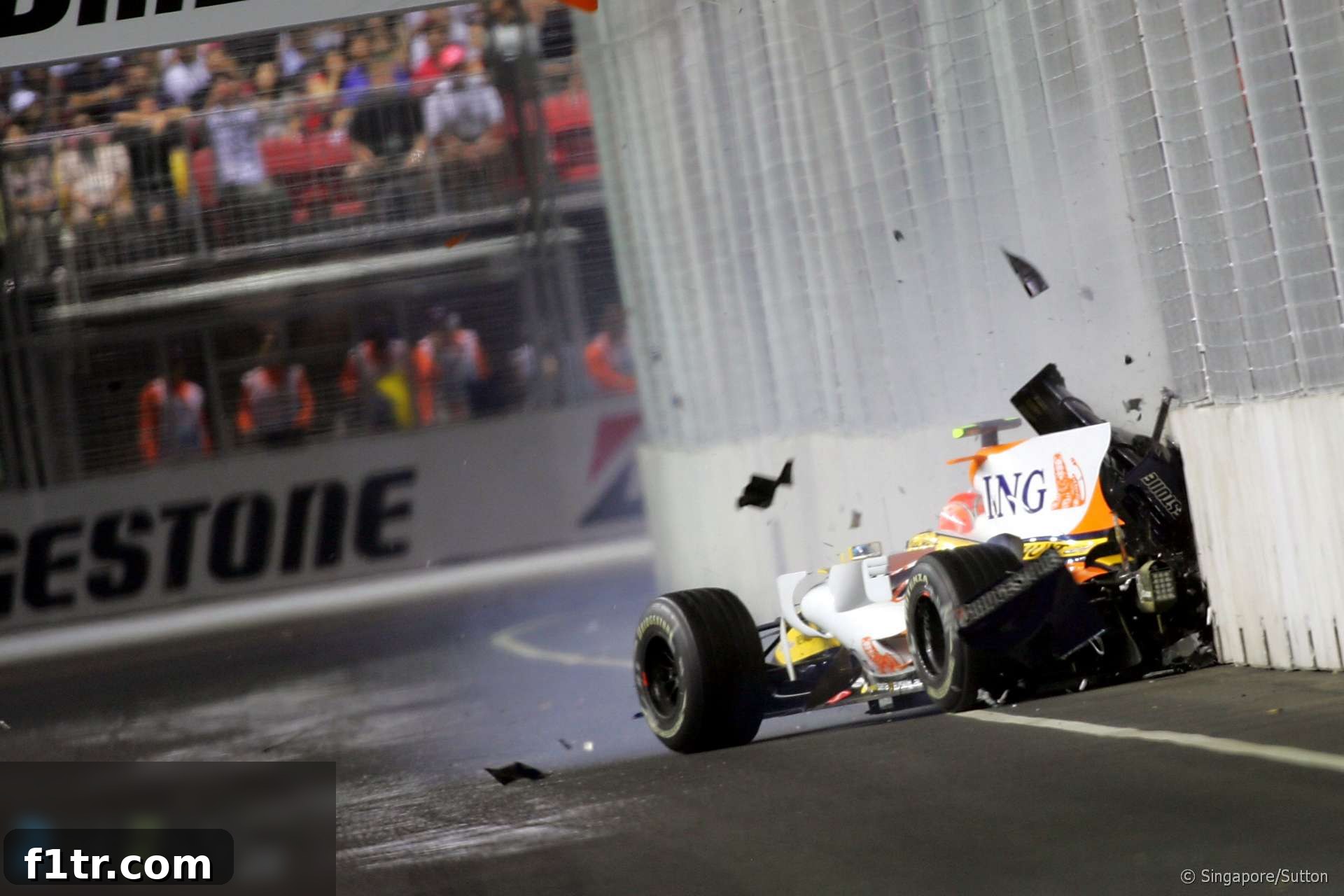
Of particular historical note, this proposed alteration would lead to the disappearance of Turn 17, a corner etched into Formula 1’s memory for its central role in one of the sport’s most infamous controversies: the ‘Crashgate’ scandal. This incident, which unfolded during the circuit’s inaugural race in 2008, remains a dark chapter in F1 history, casting a long shadow over what should have been a celebratory debut for the sport’s first-ever night race. The very idea of this corner being bypassed brings a poignant sense of closure to an era defined by controversy and intrigue.
The ‘Crashgate’ scandal involved Renault driver Nelson Piquet Jnr, who, under instructions from his team, deliberately crashed his car at Turn 17 during the 2008 Singapore Grand Prix. The timing of this crash was no coincidence; it was meticulously orchestrated to trigger a Safety Car period at a specific moment in the race. This timing was crucial for Piquet Jnr’s teammate, Fernando Alonso, who had made an unexpectedly early pit stop. The Safety Car deployment allowed Alonso to circulate at reduced speeds while his rivals were forced to pit under Safety Car conditions, effectively promoting him up the order. Alonso went on to win the race, a victory that was initially celebrated but later revealed to be tainted by a shocking act of sporting fraud.
The truth behind Alonso’s controversial victory only began to unravel the following year, culminating in a seismic revelation that rocked the Formula 1 world. Exactly ten years prior to the original publication of this article, the full extent of the conspiracy came to light. Facing an impending FIA World Motor Sport Council hearing on the deeply damaging allegations, the Renault F1 team issued a statement confirming that it would not contest the charges. In a desperate attempt to mitigate the fallout, the team announced the immediate departure of its charismatic yet controversial managing director, Flavio Briatore, and its executive director of engineering, Pat Symonds. Both individuals were subsequently handed severe bans from the sport, although these were later reduced on appeal. The scandal exposed a shocking breach of sporting integrity at the highest levels of a major Formula 1 team.
Even as the scandal unfolded and sent shockwaves through the sporting world, many within the F1 paddock admitted that the revelations, while sensational, came as little surprise. Nick Fry, who served as CEO of Brawn GP at the time, later recounted in his forthcoming book, ‘Drive. Survive. Win.’, that a pervasive sense of unease had settled over the pit lane immediately after the 2008 race. Fry noted that “most of us involved in the sport suspected something odd had happened” given the highly unusual confluence of events: Fernando Alonso’s inexplicably early pit stop followed almost immediately by Piquet Jnr’s seemingly random, isolated crash. This peculiar sequence of events delivered Renault its first victory in nearly two years, a triumph that felt distinctly out of place.
“An incident like that – a crash out of nowhere in isolation on the track – doesn’t happen fortuitously,” Fry emphasized, capturing the collective suspicion that permeated the paddock that night. He added, “There was a general feeling in the pit lane that night it was all a bit too coincidental.” This insider perspective highlights how quickly the highly competitive and perceptive environment of Formula 1 recognized the tell-tale signs of manipulation. The impending disappearance of Turn 17, therefore, not only marks a physical change to the circuit but also symbolically turns a new page on a significant, albeit ignominious, chapter in F1 history, allowing the circuit to shed a notorious part of its past as it embraces a future transformed by urban renewal.
Current Singapore Grand Prix track layout
The Marina Bay Street Circuit has always been lauded for its challenging nature, a characteristic largely attributable to its intricate layout that winds through the heart of Singapore. As a permanent fixture since 2008, it has set the benchmark for night races in Formula 1, dazzling fans with its illuminated urban backdrop. The integration of the track with the city’s infrastructure means that it is uniquely susceptible to urban development projects. The construction of NS Square is a testament to Singapore’s continuous evolution, and the circuit must adapt to ensure the Grand Prix can continue to thrive.
The exact nature and final design of the modified section of the track will be crucial. While a reduction in the number of turns might suggest a faster, less complex sequence, the design team will undoubtedly work to preserve the essence of the Marina Bay experience. The challenge lies in creating a section that is still engaging for drivers and provides ample overtaking opportunities, or at least maintains the strategic complexity that has become synonymous with the Singapore Grand Prix. The balance between maintaining competitive racing and accommodating essential urban growth is a delicate one, and the success of this adaptation will be a key determinant of the circuit’s future appeal.
The history of Formula 1 is replete with circuits that have undergone significant changes, some for the better, some sparking debate among purists. From the iconic chicanes added to Monza to the wholesale redesigns seen at various venues, circuit evolution is a constant in the sport. For Singapore, this particular modification offers a chance to shed a controversial past while embracing a modern future. The new NS Square complex will be a symbol of national pride, and its integration with the Grand Prix circuit must reflect this ambition. The discussions and planning involved are meticulous, ensuring that the spectacle of Formula 1 continues to be a highlight of Singapore’s annual calendar, attracting tourists and enthusiasts from around the globe.
Ultimately, the transformation of Turns 16-19 and the removal of the infamous ‘Crashgate’ corner signify more than just a minor tweak to a race track. It represents the ongoing narrative of Formula 1, a sport constantly adapting to new challenges, whether technological, environmental, or infrastructural. As Singapore continues to develop, its Grand Prix circuit will evolve alongside it, ensuring that while some corners may disappear into history, the thrill and drama of Formula 1 racing under the city lights will remain a timeless attraction for decades to come. The future Marina Bay Street Circuit, with its refined layout, will stand as a testament to both Singapore’s progressive urban vision and its enduring commitment to motorsports excellence.
2019 F1 season
- Crying in the Melbourne car park at 2019 grand prix was my career low – Ocon
- McLaren Racing reports reduced £71 million loss in 2019
- Kvyat: Hockenheim podium last year was “my biggest achievement” so far
- How the FIA’s new encrypted fuel flow meter targets Ferrari’s suspected ‘aliasing’ trick
- “He smashed my office door”: 23 must-see moments from ‘Drive to Survive’ season two
Browse all 2019 F1 season articles