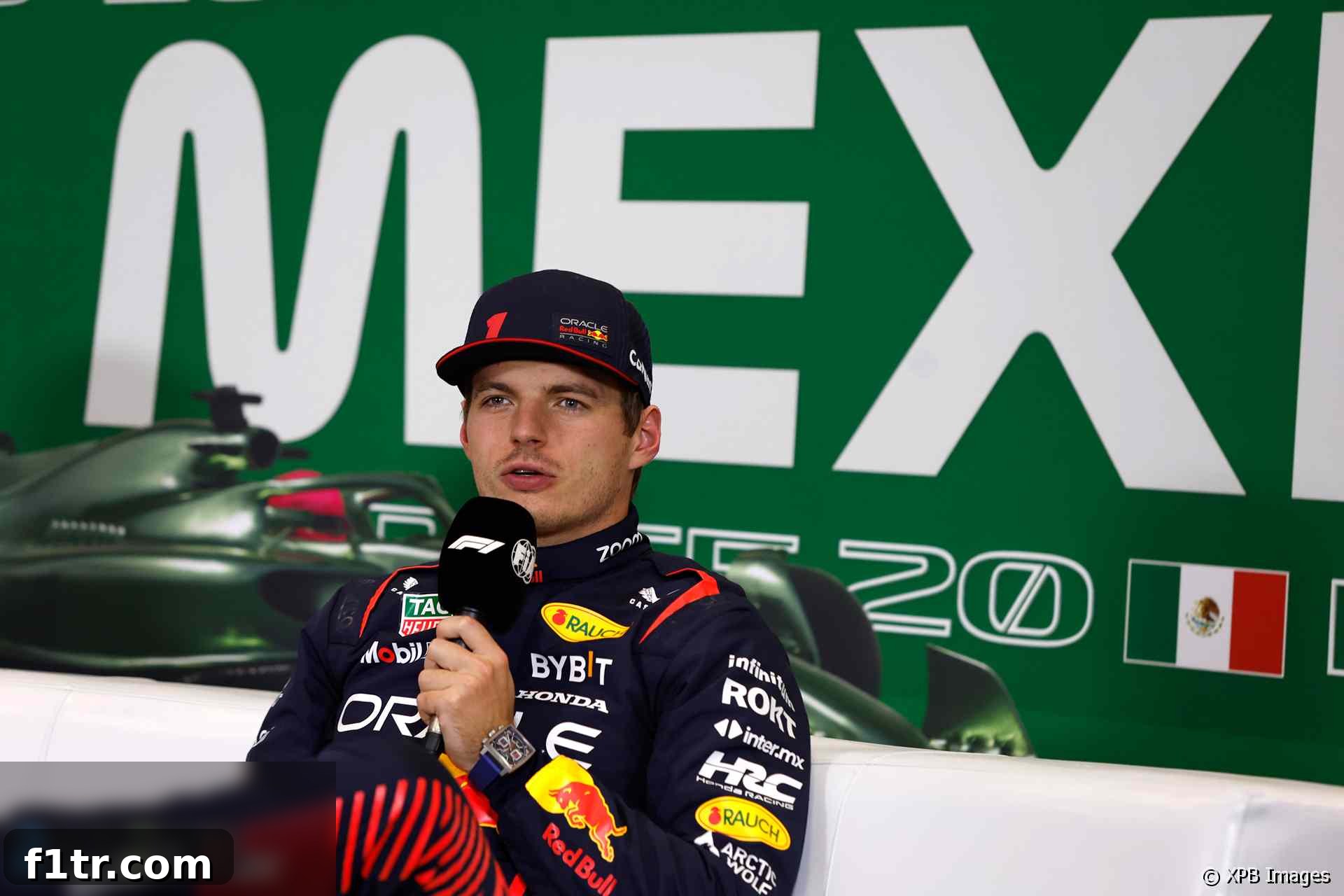
In a surprising turn of events at the Autodromo Hermanos Rodriguez, reigning Formula 1 World Champion Max Verstappen found himself grappling with the unique challenges of the Mexico City circuit during qualifying. Despite dominating all three practice sessions with formidable pace, the Red Bull ace was unable to translate that advantage into a front-row start, ultimately being outpaced by the formidable Ferrari drivers in the crucial Q3 segment. This unexpected dip in performance saw him relegated to third on the grid, a position he candidly attributed to an inability to consistently find the necessary improvements between sessions, a characteristic flaw exacerbated by the demanding nature of the high-altitude track.
Advert | Become a Supporter & go ad-free
Verstappen’s Uncharacteristic Qualifying Struggle in Mexico
The 2023 Formula 1 season has largely been a story of Max Verstappen’s unrelenting dominance, with the Dutchman consistently setting new benchmarks for performance. Entering the Mexican Grand Prix weekend, expectations were sky-high, particularly after he showcased blistering speed throughout Friday and Saturday’s practice sessions. He topped the timings in FP1, FP2, and FP3, leading many to predict another pole position for the Red Bull maestro. His initial pace in Q1 affirmed this belief, as he comfortably led the pack. However, a subtle shift began to emerge in Q2, where he slipped to second, hinting at a growing challenge.
The true test came in Q3, the pinnacle of qualifying, where the top ten drivers vie for pole position. It was here that Verstappen’s momentum seemed to falter. The Ferrari pairing, displaying impressive adaptability to the tricky conditions, managed to extract more performance when it mattered most. Their final runs proved decisive, pushing Verstappen off the front row and securing a surprising lockout for the Scuderia. This outcome was a rare sight in a season where Verstappen has so frequently started from the very front, underscoring the particular difficulties presented by the Autodromo Hermanos Rodriguez.
The Enigmatic Challenge of Autódromo Hermanos Rodríguez
The Mexico City circuit stands out on the Formula 1 calendar not just for its vibrant atmosphere but also for its exceptionally unique aerodynamic and engine challenges. Situated at an altitude of over 2,200 meters (7,200 feet) above sea level, the thin air significantly reduces aerodynamic downforce. While teams typically run maximum downforce wing settings, the actual downforce generated is comparable to low-downforce tracks like Monza, creating a peculiar sensation for the drivers. This “low downforce, high drag” scenario means cars struggle for grip, especially through corners, and drivers must constantly battle for stability.
Furthermore, the thin air also impacts engine performance, necessitating specific power unit settings to compensate for the lack of oxygen. Cooling becomes another critical factor, as both the engine and brakes operate at their limits. These combined factors contribute to a track that is notoriously difficult to master, demanding a delicate balance between aggression and precision. The surface itself, often described as low-grip and prone to overheating tires, adds another layer of complexity. Drivers frequently report a fine line between finding pace and sliding wide, leading to tire degradation and a loss of performance, particularly towards the end of a lap.
Verstappen’s Own Analysis: The Elusive Perfect Lap
Max Verstappen, known for his incisive post-session analyses, offered a clear explanation for his qualifying struggles. He articulated a belief that the Red Bull car, and his own driving, simply didn’t evolve sufficiently through the qualifying sessions to maintain the initial advantage. “I personally just expected it to be a little bit better in the evolution through qualifying from our side and I think that’s what we were lacking a little bit,” he stated. He noted that while Q1 and Q2 were acceptable, the necessary improvements for Q3 simply weren’t materializing at the same rate as his competitors.
Verstappen particularly highlighted the unique challenge of achieving a “perfect lap” at the Autodromo Hermanos Rodriguez. He elaborated on the delicate tightrope walk drivers face due to the low-grip conditions. “This track is also extremely difficult in qualifying to basically hit the perfect lap because it’s so low-grip,” he explained. The temptation to push harder, to extract those crucial extra tenths, often leads to diminishing returns. “If you try to push a little bit more, you might overheat the tyres or you have a little slide and that’s I think what happened to me today.”
He painted a vivid picture of the consequences of over-pushing: a slight imbalance leads to sliding, which in turn overheats the tires. This chain reaction has a devastating impact on performance, especially in the final sector. “I tried to find a little bit more time but then the balance wasn’t exactly there and then you’re sliding, you overheat your tyres, and then in the last sector you have no tyres left. And that’s basically what happened. It’s just this track it’s very, very difficult to put a perfect lap together.” His description perfectly encapsulates the frustrating experience of pushing too hard on a low-grip surface, where marginal gains can quickly turn into significant losses.
The Tight Margins of Formula 1 Qualifying
The F1 qualifying format is a brutal test of precision and nerve, especially on circuits where grip levels are transient and track evolution plays a significant role. Verstappen’s observations about the sensitivity of performance here underline how fine the margins are at the pinnacle of motorsport. Even the slightest misjudgment can cost precious tenths of a second, which, in a tightly contested Q3, can mean the difference between pole position and a mid-pack start.
Despite the Ferrari drivers also failing to improve on their final Q3 runs, Verstappen felt that his car’s propensity to slide from the middle sector onwards prevented him from mounting a serious challenge. “I still felt quite bad in the middle sector. I was sliding around quite a bit,” he admitted, indicating a consistent struggle with balance throughout his fastest laps. This lack of rear grip meant he was unable to maximize traction out of corners, directly impacting his ability to carry speed down the straights and through subsequent corners. While he attempted to regain lost time in later segments, the initial deficit compounded by tire degradation proved insurmountable. “My first sector wasn’t probably ideal. I improved a bit, but not enough.”
He concluded by emphasizing the critical role of driver feel and car balance in these demanding conditions. “But it’s just feeling and then around here when you slide a bit too much, like I said, it doesn’t come together. When it’s so tight, one or two tenths can be easily found or lost and I think that’s what happened in qualifying.” This insight highlights that success on a track like Mexico isn’t just about raw speed, but about an exquisite harmony between driver input, car setup, and tire management – a harmony that Verstappen and Red Bull momentarily lost in the decisive moments of qualifying.
Implications for Race Day: Starting from P3
Starting from third on the grid at the Mexican Grand Prix presents a different set of challenges and opportunities for Max Verstappen. While not ideal, it’s far from a disastrous position, especially for a driver of his caliber and in a car as competitive as the Red Bull RB19. The long run down to Turn 1 at the Autodromo Hermanos Rodriguez offers significant slipstream opportunities, meaning a strong start could see him challenge the Ferraris immediately. However, the bunched field also increases the risk of incidents in the opening laps.
The strategic battle will also be fascinating. With the high altitude and hot track temperatures contributing to significant tire degradation, race strategy will be paramount. Teams will be closely monitoring tire wear, and the optimal pit stop windows could shift. Verstappen’s ability to manage his tires and exploit any strategic advantages from his team will be key to his charge through the field. Overtaking at this circuit can be tricky, but the long straights followed by heavy braking zones, particularly into Turns 1 and 4, do offer some opportunities. Given his relentless race pace and strategic prowess, a P3 start doesn’t rule out a victory, but it does add an intriguing layer of complexity to what might otherwise have been a more straightforward weekend for the dominant Dutchman.
Advert | Become a RaceFans supporter andgo ad-free
2023 Mexican Grand Prix Insights
Explore more perspectives and analysis from the thrilling 2023 Mexican Grand Prix weekend:
- ‘I’m so s*** in qualifying’: Norris berates himself despite pole-winning lap
- Ferrari reaping the benefits of having F1’s most closely-matched team mates
- Norris had “no chance” to beat Verstappen in Mexico even without Q1 exit
- Transcript: How Ricciardo’s race went awry soon after he was told to “bring it home”
- Mercedes see “very encouraging signs” from Austin floor update
Browse all 2023 Mexican Grand Prix articles