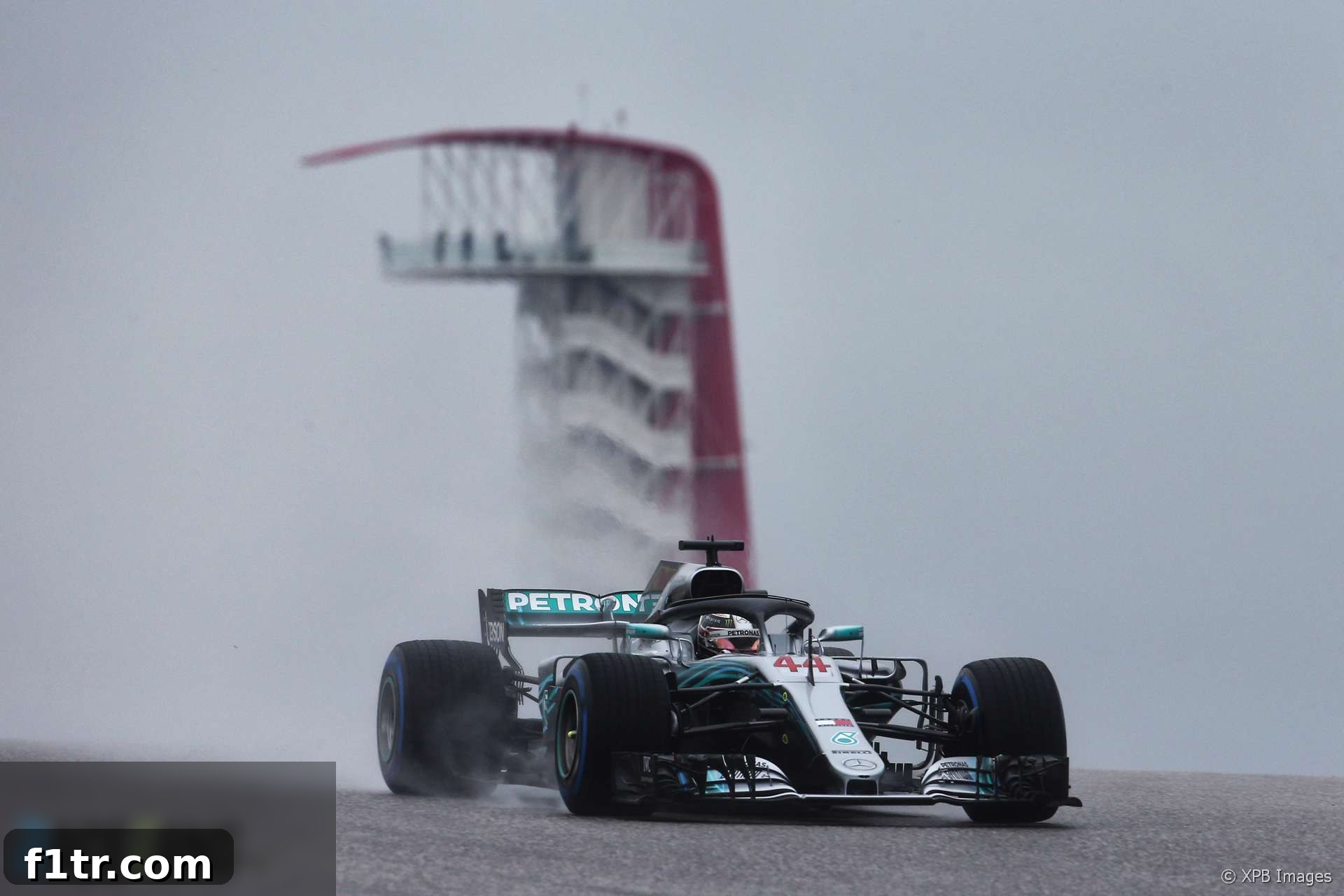
The highly anticipated United States Grand Prix at the Circuit of the Americas (COTA) in Austin, Texas, kicked off with challenging conditions, especially during the second free practice session. While the initial practice offered a somewhat drier track, FP2 plunged drivers into a true test of skill and car setup as heavy rain swept across the circuit. Amidst these demanding circumstances, Lewis Hamilton of Mercedes once again demonstrated his exceptional wet-weather prowess, topping the session’s timesheets despite completing only a single flying lap.
The day’s events began with a partially wet track for Free Practice 1 (FP1), which saw Hamilton also emerge fastest, indicating early strength from the Mercedes camp. However, the weather intensified dramatically by the time Free Practice 2 (FP2) commenced. Persistent, heavy rainfall transformed the 5.513-kilometer COTA circuit into a treacherous, fully soaked arena, prompting extreme caution from all teams and drivers. The saturated track surface, coupled with reduced visibility from heavy spray, meant that any attempt at a fast lap carried significant risk, while also yielding limited truly representative data for the dry conditions expected later in the weekend.
The treacherous conditions during FP2 led to a notably subdued start, with the pit lane remaining eerily quiet for the first half of the session. Teams were hesitant to send their precious machinery out onto the slippery asphalt, prioritizing car preservation and the conservation of limited wet weather tire allocations. For many, the risk-reward calculation simply didn’t add up, especially for drivers already confident in their car’s wet setup or those looking to save components for the more crucial qualifying and race sessions. This strategic patience was evident across the grid, with several key contenders opting to sit out the majority, if not the entirety, of the session.
When the brave few did venture out, it was Lewis Hamilton who made the most significant statement. Known for his extraordinary ability to excel in adverse weather conditions, the Mercedes driver executed a masterclass in car control and precision. He managed to clock a remarkable lap time of 1’48.716 on his sole serious attempt, a testament to his confidence and the underlying strength of the Mercedes W09 in the wet. While this time was predictably 1.2 seconds slower than his benchmark from the earlier, drier FP1 session, its significance lay in its commanding lead over the rest of the field in arguably more challenging circumstances. Hamilton’s swift and decisive performance underscored his championship-leading form and his comfort level on a soaking track, potentially sending a psychological message to his rivals about his adaptability and raw speed, regardless of the elements.
Hamilton’s team mate, Valtteri Bottas, adopted a completely different approach, opting to remain in the pits for the entire session. This decision likely stemmed from a combination of factors: avoiding unnecessary risks, preserving engine mileage, and perhaps acknowledging that Hamilton’s single lap provided sufficient data for the team on the extreme wet conditions. Similarly, Red Bull Racing’s star driver Daniel Ricciardo and both Haas F1 Team drivers, Romain Grosjean and Kevin Magnussen, also chose to stay garage-bound, highlighting a common strategy among teams with established setups or those facing engine component limits. Their absence from the track meant foregoing direct wet-weather experience but mitigated the risk of crashes or component damage that could jeopardize their weekend.
However, not all drivers shared this conservative approach. Among those who did venture out, Pierre Gasly delivered a standout performance for Toro Rosso. The young Frenchman, destined to be Max Verstappen’s team mate for the upcoming 2019 season, impressively lapped just one second shy of Hamilton’s leading time, securing the second-fastest spot. This strong showing underscored Gasly’s growing confidence and demonstrated the potential of the Toro Rosso-Honda package in trickier conditions. His future team mate, Max Verstappen, also showed his customary flair in the wet, guiding his Red Bull-TAG Heuer to the third-quickest time. Verstappen’s brief but effective stint further solidified his reputation as a formidable talent in any weather, showcasing Red Bull’s underlying pace even when many others were cautious.
The session’s initiation was somewhat delayed, with no cars daring to leave the pit lane for a considerable period. It was Brendon Hartley, Gasly’s team mate at Toro Rosso and a driver who had missed out on the first practice session, who finally broke the deadlock, becoming the first to venture onto the sodden track. Hartley’s early efforts paid off, as he diligently completed 19 laps – the most of any driver – and ultimately secured a commendable sixth position. His extensive running would have provided invaluable data for Toro Rosso, particularly useful for understanding tire degradation and car balance in the extreme wet.
Meanwhile, the Ferrari Scuderia drivers, Kimi Räikkönen and Sebastian Vettel, both set lap times but found themselves in unfamiliar territory at the lower end of the top ten, finishing ninth and tenth respectively. This performance might suggest a more cautious approach from the championship contenders, perhaps avoiding unnecessary risks given the critical stage of the season. Alternatively, it could hint at a slight struggle to find optimal balance and grip in the particularly adverse conditions compared to their Mercedes and Red Bull rivals. Ferrari’s conservative strategy, or their car’s characteristics in heavy rain, will be a point of interest as the weekend progresses and championship aspirations hang in the balance.
Other notable performances included Fernando Alonso, who guided his McLaren-Renault to an impressive fourth place, demonstrating his perennial ability to extract performance even from less competitive machinery in challenging conditions. Nico Hülkenberg of Renault also had a strong showing, finishing fifth. These midfield successes highlight how wet practice sessions can often shuffle the pecking order, offering opportunities for teams and drivers to shine when raw pace might be less of a differentiator than car control and strategic decision-making.
As the session concluded, the overall picture remained one of uncertainty for the remainder of the United States Grand Prix weekend. While Lewis Hamilton’s dominance in FP2 was undeniable, the ever-present threat of changing weather conditions means that teams will have to remain adaptable. The data gathered, albeit limited for some, will be crucial in fine-tuning setups for potential wet qualifying or race scenarios. Drivers like Gasly and Hartley gain significant confidence from their strong wet-weather showings, potentially making them dark horses should the rain persist. Conversely, teams that opted out completely will face a steeper learning curve if further wet running occurs. The COTA circuit, known for its challenging layout, becomes even more demanding under rain, emphasizing driver skill, tire management, and strategic acumen as paramount.
The critical takeaway from Free Practice 2 at the Circuit of the Americas was clear: Lewis Hamilton is a formidable force regardless of the weather. His solitary, dominant lap set the tone for Mercedes, while key rivals like Bottas and Ricciardo played a waiting game. The midfield saw flashes of brilliance, particularly from Toro Rosso, hinting at potential upsets. As the teams prepare for qualifying and the race, the specter of unpredictable weather looms large, promising a thrilling and strategically complex United States Grand Prix where adaptability will be key to success. The stage is set for a dramatic weekend where every decision, every lap, and every drop of rain could prove pivotal in the championship battle.
| Pos. | No. | Driver | Car | Best lap | Gap | Laps |
|---|---|---|---|---|---|---|
| 1 | 44 | Lewis Hamilton | Mercedes | 1’48.716 | 3 | |
| 2 | 10 | Pierre Gasly | Toro Rosso-Honda | 1’49.728 | 1.012 | 10 |
| 3 | 33 | Max Verstappen | Red Bull-TAG Heuer | 1’49.798 | 1.082 | 5 |
| 4 | 14 | Fernando Alonso | McLaren-Renault | 1’51.728 | 3.012 | 3 |
| 5 | 27 | Nico Hulkenberg | Renault | 1’52.208 | 3.492 | 6 |
| 6 | 28 | Brendon Hartley | Toro Rosso-Honda | 1’52.505 | 3.789 | 19 |
| 7 | 9 | Marcus Ericsson | Sauber-Ferrari | 1’53.070 | 4.354 | 9 |
| 8 | 2 | Stoffel Vandoorne | McLaren-Renault | 1’53.354 | 4.638 | 10 |
| 9 | 7 | Kimi Raikkonen | Ferrari | 1’53.443 | 4.727 | 7 |
| 10 | 5 | Sebastian Vettel | Ferrari | 1’53.912 | 5.196 | 8 |
| 11 | 16 | Charles Leclerc | Sauber-Ferrari | 1’54.101 | 5.385 | 9 |
| 12 | 18 | Lance Stroll | Williams-Mercedes | 1’54.637 | 5.921 | 5 |
| 13 | 11 | Sergio Perez | Force India-Mercedes | 1’54.963 | 6.247 | 6 |
| 14 | 31 | Esteban Ocon | Force India-Mercedes | 1’55.348 | 6.632 | 6 |
| 15 | 35 | Sergey Sirotkin | Williams-Mercedes | 1’55.446 | 6.730 | 8 |
| 16 | 55 | Carlos Sainz Jnr | Renault | |||
| 17 | 3 | Daniel Ricciardo | Red Bull-TAG Heuer | |||
| 18 | 8 | Romain Grosjean | Haas-Ferrari | |||
| 19 | 20 | Kevin Magnussen | Haas-Ferrari | |||
| 20 | 77 | Valtteri Bottas | Mercedes |
Second practice visual gaps
Lewis Hamilton – 1’48.716
+1.012 Pierre Gasly – 1’49.728
+1.082 Max Verstappen – 1’49.798
+3.012 Fernando Alonso – 1’51.728
+3.492 Nico Hulkenberg – 1’52.208
+3.789 Brendon Hartley – 1’52.505
+4.354 Marcus Ericsson – 1’53.070
+4.638 Stoffel Vandoorne – 1’53.354
+4.727 Kimi Raikkonen – 1’53.443
+5.196 Sebastian Vettel – 1’53.912
+5.385 Charles Leclerc – 1’54.101
+5.921 Lance Stroll – 1’54.637
+6.247 Sergio Perez – 1’54.963
+6.632 Esteban Ocon – 1’55.348
+6.730 Sergey Sirotkin – 1’55.446
Drivers more than ten seconds off the pace omitted from the visual gap graphic.
Further Coverage of the 2018 United States Grand Prix
- Verstappen leaving rivals breathless in Mexican altitude
- Raikkonen ends longest-ever wait between wins
- 300 team radio messages from the United States Grand Prix
- 2018 United States Grand Prix Star Performers
- Top ten pictures from the 2018 United States GP
Browse all 2018 United States Grand Prix articles