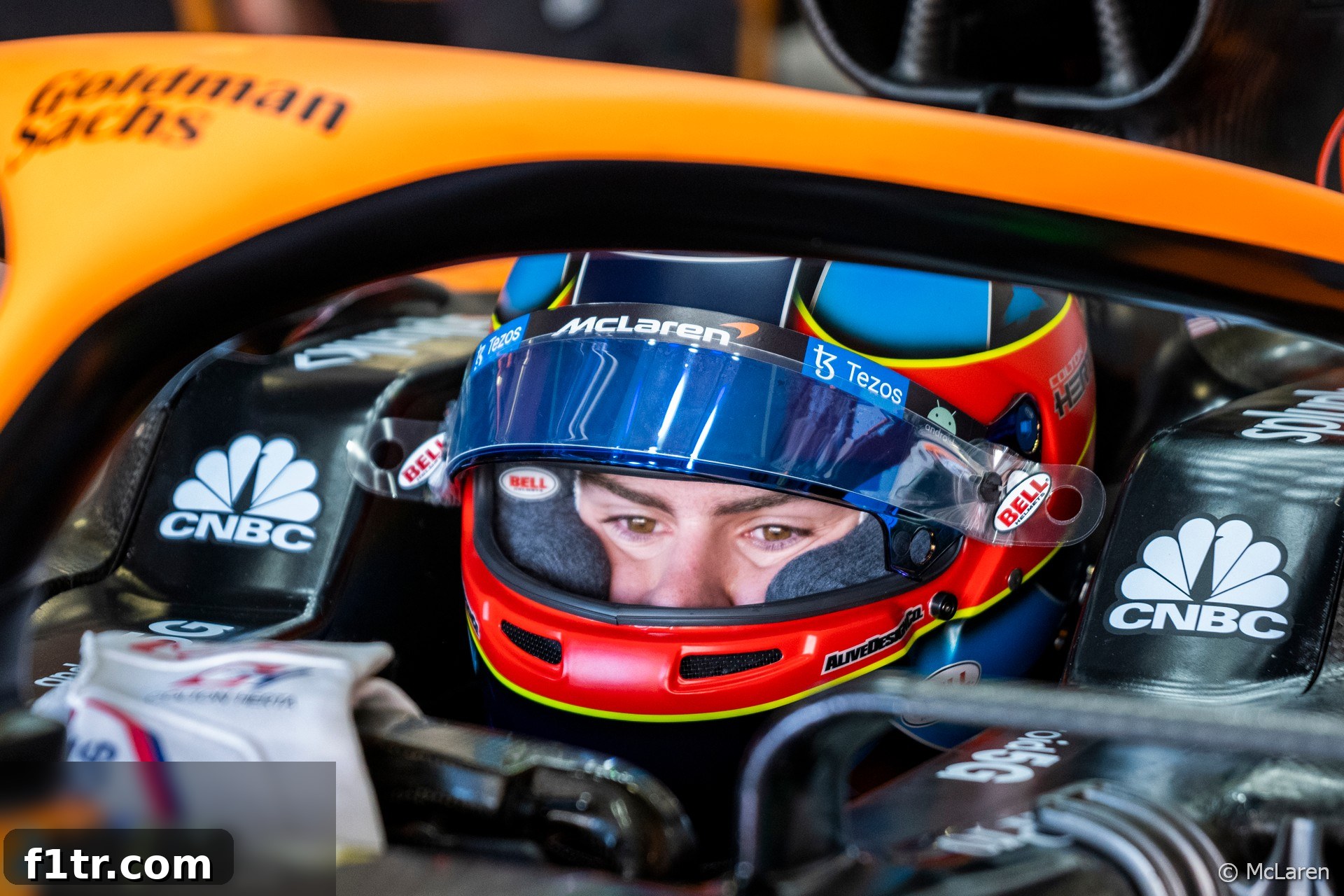
The Formula 1 Super Licence, a prerequisite for any driver aspiring to compete in the pinnacle of motorsport, boasts a rich and complex history, predating even the direct management of the FIA. Its origins trace back to the Commission Sportive Internationale (CSI), which later evolved into the Federation Internationale du Sport Automobile (FISA), before eventually falling under the overarching authority of the FIA. This journey through different governing bodies underscores the licence’s enduring significance and the continuous evolution of motorsport regulations.
From its inception, the process by which drivers qualify for this highly coveted licence has been a magnet for debate and scrutiny. Long before the recent controversy surrounding the FIA’s refusal to grant Colton Herta a Super Licence for the 2023 F1 season, the system faced challenges. In the early nineties, amidst concerns over driving standards across the F1 grid, the notion of charging drivers for the privilege of competing was introduced. This was ostensibly a mechanism to filter out those deemed not quick enough to race alongside the sport’s elite, yet it quickly drew criticism. A notable instance occurred in 1992 when Japanese Formula 3000 race-winner Akihiko Nagaya was controversially denied a licence, highlighting early tensions between perceived merit and the opaque criteria of the time.
As Formula 1 professionalized, the debate surrounding the Super Licence intensified. Throughout the 2000s, a recurring point of contention was the annual renewal cost. Despite most F1 drivers earning substantial six-figure salaries, the price of the Super Licence became a multi-year argument, revealing an underlying dissatisfaction with the financial aspects of the system. These early controversies laid the groundwork for a more structured, albeit still imperfect, approach to driver qualification.
A pivotal moment arrived in 2015 with the introduction of a points-based system. This significant regulatory change was not primarily aimed at preventing slow drivers from reaching F1, but rather at ensuring that prospective competitors were adequately prepared for the immense demands of the sport’s highest tier by requiring a certain period of competition in recognized car racing series. Popularly, and perhaps somewhat reductively, this reform is often cited as the FIA’s direct response to Red Bull’s decision to promote Max Verstappen to Formula 1 after only a single year in single-seater racing. The system established a crucial threshold: 40 points, accumulated over three years, are needed to qualify for an F1 Super Licence. Initially, the original points structure heavily rewarded success in GP2 (now Formula 2), with a championship win granting 50 points, and a proposed ‘future FIA F2 championship’ even offering up to 60. However, these figures were later adjusted and consolidated, setting the maximum points obtainable for winning F2 at 40, directly aligning it with the minimum requirement for an F1 entry.
In the contemporary racing landscape, Formula 2 has unequivocally cemented its status as F1’s premier feeder and support series, serving as the undisputed final stepping stone for aspiring F1 drivers. The statistics speak volumes: since the points system’s implementation in 2016, 15 of the 22 drivers making their F1 race debut have transitioned directly from F2 or its predecessor, GP2. Of the remaining seven, five joined F1 as mid-season replacements or one-off stand-ins. This means that in a span of seven years, teams have started a season with a rookie driver lacking F2 experience on only two occasions. This overwhelming trend clearly indicates that excelling in F2 is now widely perceived as the only truly realistic pathway to an F1 seat.
However, this reliance on F2 comes with its own set of challenges for young drivers. While the series is currently experiencing some of its most competitive years among teams, the performance disparities between outfits can still be significant. Furthermore, reliability issues have increasingly emerged as a frustrating factor, preventing talented drivers from securing results that truly reflect their abilities. These external variables can drastically impact a driver’s Super Licence points tally, even if their raw speed and skill are undeniable. Drivers are keenly aware that success is not solely about their talent, but also about securing a seat with one of the few teams capable of delivering a title-contending package, which then makes them attractive to an F1 team. The pressure to perform in F2 is immense, as is the cost of entry, often placing a heavy financial burden on aspiring F1 stars.
One of the system’s most frequently debated aspects is its top-heavy points distribution, particularly within F2. While the experience of driving an F2 car offers valuable preparation for F1, irrespective of finishing position, the Super Licence system enforces a starkly different philosophy. It acknowledges the top three F2 finishers as being of F1 standard, awarding each the full 40 points required. However, the points drastically drop for fourth and fifth place, offering only 30 and 20 points respectively. This means a driver finishing third is granted a Super Licence, while a highly talented driver in fourth might still fall short, despite having gained almost identical on-track experience. The 2022 F2 season, with a record 28 races, offers more track time than ever before, theoretically reducing the impact of a single bad weekend. Yet, it also amplifies the effect of team performance inequalities over a longer period. This raises a crucial question: is finishing fifth in a competitive F2 season truly worth less than it was a few years ago, given the expanded calendar and intensified competition?
The contemporary Super Licence debate largely orbits around the points value assigned to IndyCar, North America’s premier open-wheel series. While an IndyCar champion also receives the maximum 40 points, the allocation for second and third place mirrors that of fourth and fifth in F2, receiving 30 and 20 points respectively. Racing at the forefront of IndyCar is undeniably a highly demanding and relevant experience for an F1 driver, and vice-versa, given that both are professional open-wheel categories requiring exceptional skill. This year, for instance, IndyCar witnessed a thrilling conclusion with five drivers still in title contention going into the final race of a 17-race season. Yet, the driver who finished a commendable fifth in that incredibly competitive championship only garnered a mere eight Super Licence points. To put this into perspective, finishing fifth in Indy Lights, North America’s F2 equivalent, would earn five points. However, drivers in Indy Lights are primarily focused on impressing the IndyCar paddock, not F1, which underscores the geographical and regulatory disconnect in the current system.
Despite these disparities, there appears to be little immediate threat to F2’s dominant position as the primary path to F1. A critical re-evaluation of the Super Licence points system, however, could potentially strengthen F2 itself by re-distributing points in a less top-centric manner. F2 is already unique among motorsport series for awarding the same points to the champion and the runner-up. Nonetheless, interest in such reform from those at the helm of the championship appears minimal. F2 CEO Bruno Michel, in a recent press session, firmly rejected the idea of making an exception for IndyCar star Colton Herta to enter F1. He stated, “There are already points attributed to the American championships in the overall table of the FIA, to get a Super Licence. So I think this has already been taken into consideration.”
Colton Herta’s case became a high-profile example of the Super Licence system’s rigidity. Despite consistently demonstrating impressive pace and securing seven wins within his first four seasons – an achievement shared by only 21 drivers in Indy car racing history since 1905 – Herta, driving for Andretti Autosport, finished 10th in the IndyCar standings in a challenging year. This result left him short of the 40 points required for a 2023 Super Licence. The FIA definitively rejected any workaround, drawing criticism from many. The idea of Red Bull placing Herta in F2 a year or two prior to bolster his Super Licence chances is highly improbable; it is extremely rare for a successful professional driver to pause their established career, let alone leave a top-tier open-wheel team, to compete in a junior series. For a proven IndyCar talent, an intermediary step is generally not expected or desired.
Michel, however, staunchly defends the current framework. “For me, it’s a quite simple answer that’s been said by almost everybody. There is a rule, there are tables and we apply the tables. And that’s exactly the same if you ask me if Formula 3 drivers who have been finishing fifth or sixth in the championship can have a Super Licence. In the table they cannot. And I think that’s the way it has to be.” He further insisted there was no bias against American drivers, citing the presence of many US talents in F3 and Logan Sargeant in F2. “Whether they come from our championships or whether they come from Indy for me is not an issue at all, as long as they have enough points to get their Super Licence,” Michel concluded, emphasizing adherence to the established point system.
The rejection of a workaround for Herta prompted 2019 F2 champion Nyck de Vries to caution that such a dispensation would “almost kill and jeopardise the ladder” of F1 support series. Yet, ironically, de Vries’ own career trajectory highlights some of the system’s inherent shortcomings. He eventually secured an F1 seat only after winning a world championship in Formula E – a series that itself took several years to be fully integrated into the Super Licence points table. Prior to this, he had competed in GP3 (F3’s predecessor) and F2, but notably also in the F2-rivalling Formula Renault 3.5 series. This circuitous path for a proven champion underscores the system’s occasional lack of clarity and agility in recognizing diverse talent pipelines.
The history of the Super Licence points system is also littered with examples of external scrutiny leading to modifications. The Formula Renault 3.5 series, once widely respected as a final stepping stone to F1 for many drivers, including numerous Red Bull juniors due to Helmut Marko’s reservations about GP2, ceased operations after the 2017 season following Renault’s withdrawal of backing. Controversially, the Super Licence system initially ranked it below the FIA European F3 championship and on par with GP3, with its champion earning only half the points of the then-non-existent F2 champion and 60% of the GP2 champion. Following significant criticism, including from F1 drivers, its points tally was increased to 70% of GP2’s, but by then, the series’ fate was already sealed. Another instance saw the FIA backtrack on plans to reduce Formula Renault Eurocup’s points in favor of its own Formula Regional European Championship, after the latter began its 2019 season with a meager 10 cars compared to the Eurocup’s 22-car grid, despite using identical chassis.
Even Red Bull, historically keen on promoting inexperienced drivers to F1, has faced obstacles due to the Super Licence. Two high-profile talents, Dan Ticktum and Juri Vips, were earmarked for Toro Rosso (now AlphaTauri) but were unable to secure the crucial 40 points. While retrospectively it’s difficult to definitively say if the system prevented F1-worthy talents, both drivers have matured considerably since, though their Red Bull ties were severed due to issues of their own making. At the time of their peak reputations, they faced formidable opposition. Similarly, Colton Herta, despite finishing 10th in IndyCar this year, did so against a field arguably stronger and deeper than when he finished third just two years prior. This continuous evolution of competitive landscapes across different series further complicates the rigid application of a fixed points table.
The fundamental question of how to accurately value a driver’s performance in any given series is an ongoing and necessary debate. A driver’s career encompasses far more than just a Super Licence points tally, yet the FIA’s system, since 2015, has created an undeniable reliance not only on competing in F2 before F1, but also on participating in any series that offers a substantial Super Licence quota. Within junior single-seater categories, particularly those that feel disadvantaged by the current FIA allocations, there’s a prevailing sentiment: “if you support the FIA Super Licence, it will support you.” Criticizing one’s allocated points, or any other aspect of the system, often proves to be a fruitless endeavor, unless it garners significant widespread support from across the motorsport world.
While IndyCar drivers have vocally criticized the FIA for its intransigence regarding Herta, the reaction in other series has been more reserved, akin to de Vries’s cautious defense of the ladder system. However, the leadership within F1 and, more significantly, the FIA has undergone changes since the current Super Licence points structure was first implemented. While backing down over Herta might have risked undermining the entire system, the renewed intensity of public scrutiny on the Super Licence could very well prompt FIA president Mohammed ben Sulayem, his drivers’ commission, and even F2 promoter Bruno Michel, to re-evaluate this complex issue in the future, potentially leading to more flexible and inclusive criteria for F1 entry.
Current F1 Super Licence Points Allocations
| Championship | 1st | 2nd | 3rd | 4th | 5th | 6th | 7th | 8th | 9th | 10th |
|---|---|---|---|---|---|---|---|---|---|---|
| Formula 2 | 40 | 40 | 40 | 30 | 20 | 10 | 8 | 6 | 4 | 3 |
| IndyCar | 40 | 30 | 20 | 10 | 8 | 6 | 4 | 3 | 2 | 1 |
| FIA Formula 3 | 30 | 25 | 20 | 15 | 12 | 9 | 7 | 5 | 3 | 2 |
| Formula E | 30 | 25 | 20 | 10 | 8 | 6 | 4 | 3 | 2 | 1 |
| WEC (LMP1) | 30 | 24 | 20 | 16 | 12 | 10 | 8 | 6 | 4 | 2 |
| Formula Regional European championship | 25 | 20 | 15 | 10 | 7 | 5 | 3 | 2 | 1 | 0 |
| Super Formula | 25 | 20 | 15 | 10 | 7 | 5 | 3 | 2 | 1 | 0 |
| WEC (LMP2) | 20 | 16 | 12 | 10 | 8 | 6 | 4 | 2 | 0 | 0 |
| SuperGT (GT500) | 20 | 16 | 12 | 10 | 7 | 5 | 3 | 2 | 1 | 0 |
| Formula Regional Asian Championship | 18 | 14 | 12 | 10 | 6 | 4 | 3 | 2 | 1 | 0 |
| Formula Regional Americas Championship | 18 | 14 | 12 | 10 | 6 | 4 | 3 | 2 | 1 | 0 |
| Formula Regional Japanese Championship | 18 | 14 | 12 | 10 | 6 | 4 | 3 | 2 | 1 | 0 |
| IMSA prototypes | 18 | 14 | 10 | 8 | 6 | 4 | 2 | 1 | 0 | 0 |
| DTM | 15 | 12 | 10 | 7 | 5 | 3 | 2 | 1 | 0 | 0 |
| WTCC / WTCR | 15 | 12 | 10 | 7 | 5 | 3 | 2 | 1 | 0 | 0 |
| International Superstars Championship | 15 | 12 | 10 | 7 | 5 | 3 | 2 | 1 | 0 | 0 |
| NASCAR Cup Series | 15 | 12 | 10 | 7 | 5 | 3 | 2 | 1 | 0 | 0 |
| Indy Lights | 15 | 12 | 10 | 7 | 5 | 3 | 2 | 1 | 0 | 0 |
| W Series | 15 | 12 | 10 | 7 | 5 | 3 | 2 | 1 | 0 | 0 |
| Euroformula Open | 15 | 12 | 10 | 7 | 5 | 3 | 2 | 1 | 0 | 0 |
| Japanese Super Formula Lights | 15 | 12 | 10 | 7 | 5 | 3 | 2 | 1 | 0 | 0 |
| FIA National F4 championships | 12 | 10 | 7 | 5 | 3 | 2 | 1 | 0 | 0 | 0 |
| WEC GT Pro | 12 | 10 | 7 | 5 | 3 | 2 | 1 | 0 | 0 | 0 |
| Asian / European Le Mans Series Prototypes | 10 | 8 | 6 | 4 | 2 | 0 | 0 | 0 | 0 | 0 |
| WEC GT-Am | 10 | 8 | 6 | 4 | 2 | 0 | 0 | 0 | 0 | 0 |
| IMSA GTLM | 10 | 8 | 6 | 4 | 2 | 0 | 0 | 0 | 0 | 0 |
| National F3 Championships (GB3) | 10 | 7 | 5 | 3 | 1 | 0 | 0 | 0 | 0 | 0 |
| Indy Pro 2000 | 10 | 7 | 5 | 3 | 1 | 0 | 0 | 0 | 0 | 0 |
| NASCAR National (Xfinity Series) | 10 | 7 | 5 | 3 | 1 | 0 | 0 | 0 | 0 | 0 |
| Toyota Racing Series New Zealand | 10 | 7 | 5 | 3 | 1 | 0 | 0 | 0 | 0 | 0 |
| International GT3 Series | 6 | 4 | 2 | 0 | 0 | 0 | 0 | 0 | 0 | 0 |
| FIA Karting World Championship (senior) | 4 | 3 | 2 | 1 | 0 | 0 | 0 | 0 | 0 | 0 |
| FIA Karting Continental Championship (senior) | 3 | 2 | 1 | 0 | 0 | 0 | 0 | 0 | 0 | 0 |
| FIA Karting World Championship (junior) | 3 | 2 | 1 | 0 | 0 | 0 | 0 | 0 | 0 | 0 |
| FIA Karting Continental Championship (junior) | 2 | 1 | 0 | 0 | 0 | 0 | 0 | 0 | 0 | 0 |
Become a RaceFans Supporter
RaceFans is run thanks in part to the generous support of its readers. By contributing £1 per month or £12 per year (or the same in whichever currency you use) you can help cover the costs of creating, hosting and developing RaceFans today and in the future.
Become a RaceFans Supporter today and browse the site ad-free. Sign up or find out more via the links below:
- Become a RaceFans Supporter
- RaceFans Supporter FAQ