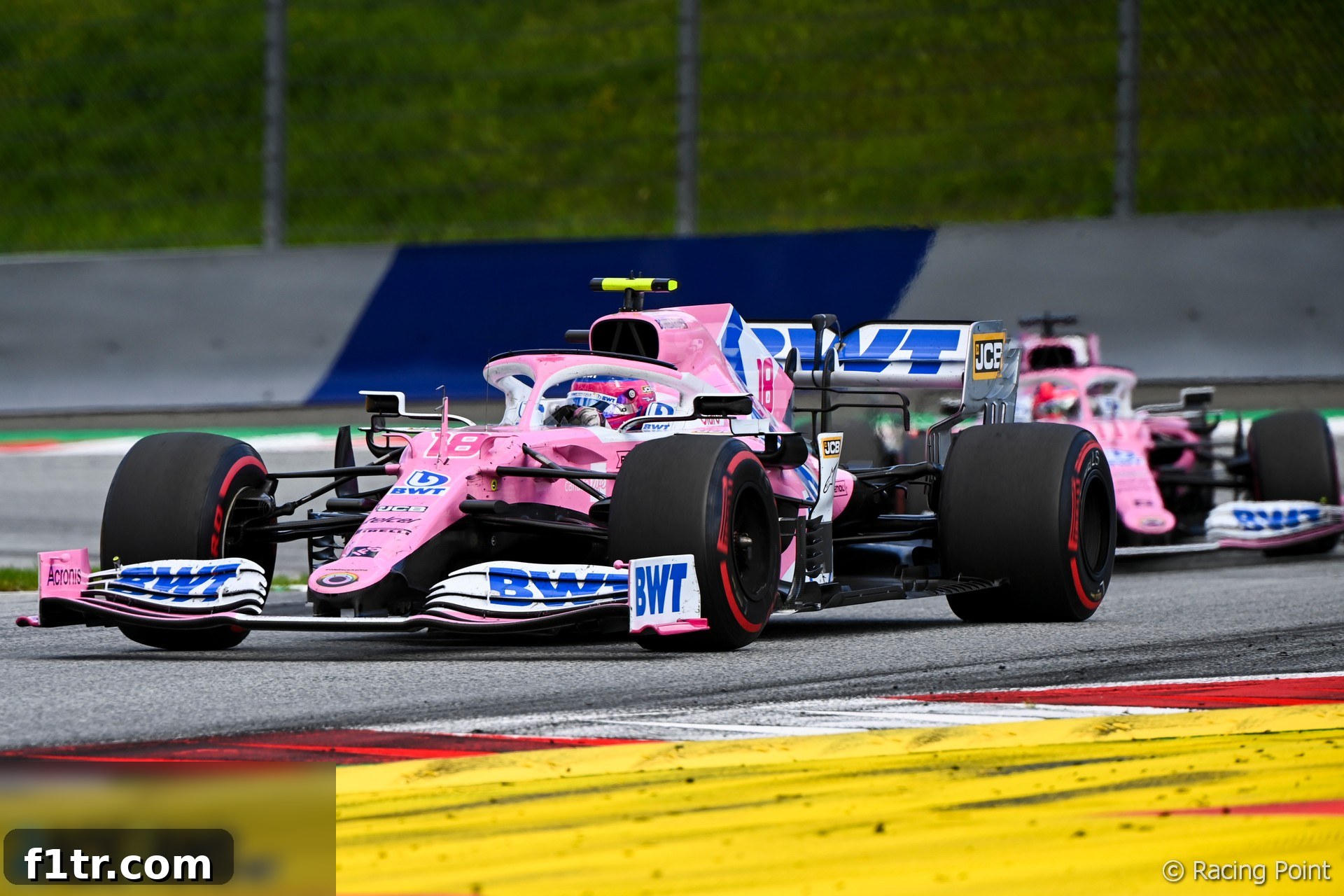
The thrilling and often contentious world of Formula 1 found itself embroiled in a significant technical dispute surrounding Racing Point’s RP20 car, affectionately dubbed the “Pink Mercedes.” This high-stakes saga reached a pivotal moment as FIA stewards prepared to deliver their verdict on Renault’s official protest against the Silverstone-based team, with a decision eagerly anticipated before the start of the Silverstone Grand Prix weekend. At the very core of this passionate debate lay the critical question of whether Racing Point had overstepped regulatory boundaries in replicating key elements of Mercedes’ championship-winning W10 design from the previous season.
The essence of the dispute, which carried substantial implications for Racing Point, directly impacted 32 of the 40 championship points they had accumulated up to that point in the 2020 season, as well as raising fundamental questions about the legality of their car’s brake ducts. The primary accusation from Renault revolved around whether Racing Point had exceeded the permissible limits in their ambitious approach to vehicle development, particularly concerning the contentious “listed parts” regulations. Formula 1’s intricate technical rulebook designates certain components as “listed parts,” meaning teams are explicitly required to design and manufacture these specific parts themselves, or to sub-contract their design and manufacture to a third party. Crucially, brake ducts had transitioned from non-listed to listed parts for the 2020 season, thereby becoming the focal point of the protest and instigating serious scrutiny into the origin and legality of Racing Point’s design process.
Racing Point has openly and consistently acknowledged that the overall design philosophy and many aesthetic elements of its 2020 challenger, the RP20, drew significant inspiration from the dominant and highly successful Mercedes W10 of 2019. However, the team’s CEO, Otmar Szafnauer, steadfastly maintained that their intricate development process and the ultimate execution of the car were entirely compliant with the stringent regulations set forth by the FIA. Szafnauer articulated his team’s defensive position during the preceding Hungarian Grand Prix, explaining that a crucial and timely investment from Canadian billionaire Lawrence Stroll’s consortium had empowered Racing Point to fully leverage its long-standing reputation as astute “fast followers” within the competitive landscape of Formula 1. This newfound and robust financial backing, he argued, allowed them to adopt and seamlessly integrate rival innovations with an unprecedented speed, precision, and efficacy that was previously unattainable for the historically budget-constrained team.
Advert | Become a Supporter & go ad-free
“What genuinely distinguishes our team is the exceptional talent and ingenuity of our individual engineers and designers, who, for many years, were unfortunately constrained by a palpable lack of financial resources,” Szafnauer elaborated during his defense. “For a considerable period, we harbored the profound ambition to pursue precisely this kind of advanced design philosophy, but the necessary funding to meticulously follow, analyze, and effectively emulate the best team in Formula 1 simply wasn’t within our reach. Now, with the proper, sustained investment, we are finally in a position to unleash that inherent talent and demonstrate our capabilities fully.” His insightful remarks underscored a profound and pivotal turning point for the team, signifying a definitive shift from an era defined by financial austerity and compromise to one where strategic, ambitious development decisions could be adequately supported by substantial capital.
Szafnauer provided several compelling historical examples to firmly underscore Racing Point’s established pedigree in rapidly understanding, adapting, and successfully implementing innovative designs first pioneered by their competitors. “If you recall the 2009 season, we were notably among the very first teams to successfully integrate a double diffuser onto our car, a groundbreaking concept that initially emerged from just three pioneering teams. I firmly believe we were indeed pioneers in this regard, even preceding Red Bull’s subsequent adoption of the design. This compellingly demonstrates that we have always possessed highly skilled and perceptive engineers who hold a deep, intuitive understanding of racing dynamics and the intricate processes of car development and optimization.” He continued, referencing another significant aerodynamic innovation: “We genuinely pride ourselves on being agile fast followers, constantly observing what advanced concepts are being developed by others and adeptly adapting them for our own applications. Take the F-duct, for instance, which McLaren famously introduced; we were one of the very first teams, post-McLaren’s unveiling, to successfully implement a functional F-duct design on our car. Our extensive history unequivocally demonstrates our innate capability to execute such complex developments, a direct testament to the extraordinary talent within our ranks.”
The team’s journey, however, wasn’t without its formidable historical hurdles and periods of significant adversity. Szafnauer vividly recalled epochs where chronic financial constraints severely hampered their inherent potential and developmental progress. “Later in our history, particularly during the Force India era, we simply lacked the necessary, consistent funding. There were specific instances, and perhaps you may recall, where we introduced a meticulously developed ‘B-spec’ car at Silverstone that subsequently delivered a monumental and immediate performance leap. That truly significant step forward was only made possible because we had diligently developed those innovations over the preceding winter period, but we simply did not possess the financial means to physically manufacture and integrate them onto the car at the very outset of the season. Consequently, we were often forced to run a hybrid vehicle, incorporating a blend of elements from both the previous year’s and the current year’s designs, leading to inherent performance compromises.” This stark and illustrative contrast powerfully highlights the transformative impact of Lawrence Stroll’s timely and substantial investment. “Those challenging and financially restrictive days are now, thankfully, firmly behind us, as we are now robustly funded, enabling us to fully showcase the immense talent we possess and achieve the remarkable results we have accomplished this season.”
While the undeniable and visually striking similarities between the RP20 and last year’s dominant, championship-winning Mercedes W10 have undoubtedly garnered significant media attention, widespread fan discussion, and considerable controversy, Szafnauer clarified that these resemblances are a direct and logical consequence of a deliberate strategic shift in the team’s fundamental aerodynamic philosophy. For many preceding years, the team, then known as Force India, had largely adopted the influential “high rake” concept, a design philosophy famously championed by Red Bull Racing and its legendary design guru, Adrian Newey. This philosophy involves running the car with a significant upward tilt from front to rear, strategically maximizing underfloor downforce. However, Racing Point made a conscious and calculated decision to transition to the “low centre of gravity” aerodynamic approach, a distinctive hallmark of Mercedes’ highly successful design strategy.
“The universal practice of meticulously studying, observing, and, yes, ‘taking pictures’ of other teams’ cars is an ubiquitous and accepted activity across the entire Formula 1 paddock, encompassing every team from the most resource-rich outfits to the smallest privateer teams,” Szafnauer emphatically asserted. “The crucial difference lies not in whether teams observe, but rather in who ultimately executes a superior job of interpreting, intelligently copying, or effectively integrating the profound insights gained from those observations into their own distinct design and development process.” He further elaborated on the subtle nuances of design evolution versus radical change: “If a design represents an iteration or a subtle, gradual evolution of an existing concept, its origins are often less conspicuous and draw less attention. However, when you undertake a fundamental, radical shift in design philosophy – such as transitioning abruptly from a high-rake aerodynamic philosophy to one intrinsically focused on a low center of gravity – then, by utilizing visual imagery and applying the fundamental aerodynamic principles learned, you inevitably arrive at a very similar optimal technical solution, especially if that original solution is already highly refined, exceptionally effective, and indeed, a championship winner.”
Szafnauer further emphasized that adopting and adapting successful concepts from rivals is an ingrained and long-standing part of F1’s intensely competitive developmental landscape. “We must never forget that Adrian Newey famously pioneered the ‘blown floor’ and the distinctive high-rake design that has been synonymous with Red Bull Racing for many years, and which a significant portion of the current Formula 1 grid, including our own team, subsequently adopted and adapted. We too, in our relentless pursuit of maximizing underfloor aerodynamic performance, took detailed and numerous photographs of Red Bull’s floor when we were experimenting with the blown floor concept and, frankly, initially struggled to make it function optimally on our own car. From those meticulous observations, we discerned crucial and specific details, such as the necessary gap dimensions and airflow management techniques. I can confidently assure you that countless other teams have engaged in identical practices of observation and learning.”
“Therefore, everyone in Formula 1 engages in this type of learning; it is an accepted and integral part of the sport’s developmental cycle,” he continued, underscoring the widespread nature of the practice. “I’ve already provided you with two clear and prominent historical examples – the F-ducts and the innovative double diffusers. But there are numerous other significant instances: ‘cake tins’ (complex and intricate brake duct designs to manage heat and airflow), and ‘blown axles’ (axles with internal ducts specifically designed to manage airflow for aerodynamic benefit). It’s notable that not every team had blown axles just a few short years ago; it was a distinctive feature adopted by only a select few pioneering teams. It struck many observers as remarkably curious that Haas, a relatively nascent team in its second year of competition, managed to implement blown axles so effectively and rapidly. The reality, however, was not that they ‘figured it out’ independently through their own R&D, but rather they were supplied with this technology and expertise directly by Ferrari, their established technical partner. This is simply how collaboration, technical transfer, and knowledge-sharing often manifest in our complex sport, especially among customer teams that share a close technical alliance with their engine supplier.”
Advert | Become a RaceFans supporter andgo ad-free
Szafnauer candidly detailed the formidable challenges, inherent difficulties, and significant risks the team inevitably encountered during their initial foray into fundamentally replicating Mercedes’ distinct aerodynamic philosophy. “Embarking on such a profound and foundational design change is unequivocally never without substantial risk,” he confessed, acknowledging the gravity of their strategic decision. “We possessed no absolute certainty or guarantee that our completely new design approach would perform to the exceptional level it ultimately achieved. Indeed, there was a considerable and unsettling risk that, instead of making progress, we might actually take a significant, detrimental step backward in overall performance.”
He further elaborated on the early and demanding struggles faced during this critical transition: “In fact, when we first commenced the rigorous development of this novel concept in the wind tunnel, basing our initial ideas on diligently collected images and astute observations of the Mercedes, we experienced a monumental regression in performance. I mean truly monumental – at the outset of this intensive development cycle, we were several crucial seconds per lap slower than our previous benchmarks. It was exclusively through our rigorous, iterative, and persistent learning process, involving extensive Computational Fluid Dynamics (CFD) analysis, intensive wind tunnel work, and countless meticulous design iterations and subsequent redesigns, that we eventually arrived at our current highly competitive position. This vividly illustrates a critical underlying principle in F1 design: the more optimized, refined, and effective your existing solution – such as a highly developed high-rake design – the greater the inherent risk and potential performance penalty associated with radically changing to an entirely different and unproven philosophy.”
“For us, ultimately adopting this particular aerodynamic philosophy was a long-held and strategic ambition,” Szafnauer further explained, shedding crucial light on the underlying strategic rationale and technical imperative. “We have consistently purchased our high-performance gearboxes from Mercedes, and it is critically important to understand that the Mercedes gearbox is inherently designed with a lower center of gravity (CoG) car architecture firmly in mind. Consequently, for many years, we often faced unavoidable design compromises at the rear of our car, a section where generating stable and consistent downforce is absolutely critical for overall vehicle stability and performance. We had always earnestly sought to move away from the high-rake solution precisely because of these inherent compromises at the rear, compromises directly dictated by our Mercedes gearbox supply. This specific season, 2020, therefore marked the first opportune and financially viable moment for us to finally make that fundamental architectural change.” This detailed explanation strongly underscores a logical and strategically driven technical progression, rather than a simplistic act of imitation, with the decision being heavily influenced by component integration, synergistic performance optimization, and a long-term vision for the team’s car design.
The astonishing and almost immediate progress made by Racing Point has unquestionably sent ripples of surprise, admiration, and, for some, suspicion, throughout the entire Formula 1 paddock. Their standout performance in Hungary, for instance, saw them emerge as the second-fastest team on the grid during qualifying, consistently outperforming established powerhouses like Red Bull and Ferrari, with only their technical partners, Mercedes, marginally ahead of them. This dramatic and rapid leap in competitiveness cemented the RP20’s status as a genuine midfield frontrunner, demonstrating an undeniable capability to challenge for significant championship points and even aspire to prestigious podium finishes.
Even Szafnauer himself candidly confessed that the immediate and profound success the team experienced caught him entirely by surprise. “I genuinely anticipated that we would initially take a half-step backward in performance before eventually moving forward with this new philosophy,” he admitted, reflecting openly on the challenging and uncertain development phase. “However, that anticipated regression simply did not materialize. The car performed well beyond our most optimistic initial expectations, and the transition proved to be far smoother, more effective, and quicker to yield results than we had dared to hope.” This candid and revealing admission underscores the sheer scale of the team’s engineering achievement, transforming from a perennial midfield contender to a top-tier challenger in a single off-season, despite the swirling controversies and protests.
Advert | Become a RaceFans supporter andgo ad-free
2020 F1 Season Related Articles
- Grosjean to make F1 test return tomorrow for first time since Bahrain horror crash
- Pictures: Wrecked chassis from Grosjean’s Bahrain fireball crash to go on display
- Bottas vs Rosberg: Hamilton’s Mercedes team mates compared after 78 races each
- F1 revenues fell by $877 million in Covid-struck 2020 season
- Hamilton and Mercedes finally announce new deal for 2021 season
Browse all 2020 F1 season articles